Recognition: unknown
HyPulse: A Pulse Synthesis Framework for Hybrid Qubit-Oscillator Gates on Trapped-Ion Platform
Pith reviewed 2026-05-07 11:18 UTC · model grok-4.3
The pith
HyPulse decouples pulse discovery from circuit assembly by caching optimized pulses for any continuous parameter in hybrid qubit-oscillator gates.
A machine-rendered reading of the paper's core claim, the machinery that carries it, and where it could break.
Core claim
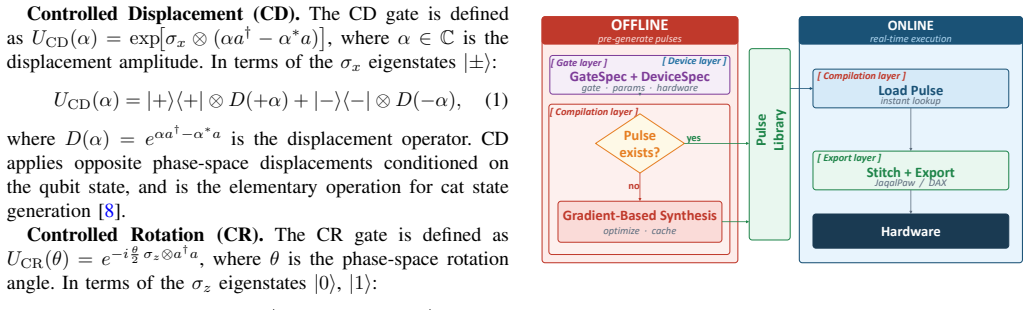
HyPulse contributes a two-phase architecture decoupling pulse discovery from circuit assembly, with an offline optimization engine that populates a content-addressed cache of high-fidelity primitives. If a pulse for a given gate, parameter, and device specification already exists in the library, it is retrieved instantly; otherwise the optimizer synthesizes, hashes, and caches it automatically. An online assembler then constructs circuit-specific pulse programs ready to drive trapped-ion hardware control systems.
What carries the argument
The two-phase architecture that separates an offline optimization engine, which synthesizes and stores pulses in a content-addressed cache, from an online assembler that retrieves or generates the pulses needed for each circuit.
If this is right
- Circuit programs can be assembled instantly when required pulses already exist in the cache.
- The same cached primitives support multiple trapped-ion hardware backends without re-optimization.
- Hybrid gates with any continuous parameter become available at the pulse level once synthesized once.
- Repeated or similar parameter values in an algorithm incur no additional synthesis cost after the first use.
Where Pith is reading between the lines
- The same caching pattern could reduce compilation overhead for other families of parametric quantum gates on different hardware platforms.
- Algorithms that sample many distinct parameter values would benefit most from high cache-hit rates.
- Future compiler layers could automatically decide which parameter ranges to pre-populate in the cache based on expected workload.
Load-bearing premise
The offline optimizer can reliably produce high-fidelity pulses for arbitrary continuous parameter values and device specifications without excessive computation time or failure to converge.
What would settle it
Apply the framework to a new set of hybrid gate parameters never seen before and measure whether the resulting pulses reach target fidelity within practical optimization time or whether cache misses cause unacceptable delays.
Figures




read the original abstract
As hybrid qubit-oscillator algorithm development and trapped-ion hardware demonstrations advance in parallel, there is a lack of a compilation layer connecting the two at the pulse level in the vertical software stack. While qubit gate control and pulse synthesis are well-established, the translation of hybrid qubit-oscillator primitives to the pulse level has not been systematically addressed. This gap is further compounded by the inherently continuous parametric nature of such gates. Each distinct parameter value defines a physically unique operation requiring independent pulse optimization, making static pre-compilation strategies inapplicable. To fill this gap, we present HyPulse, a hardware-aware pulse synthesis and generation framework, which contributes a two-phase architecture decoupling pulse discovery from circuit assembly. An offline optimization engine populates a content-addressed cache of high-fidelity primitives: If a pulse for a given gate, parameter, and device specification already exists in the library, it is retrieved instantly; otherwise the optimizer synthesizes, hashes, and caches it automatically. An online assembler then constructs circuit-specific pulse programs ready to drive trapped-ion hardware control systems via DAX/ARTIQ (Duke) and JaqalPaw/QSCOUT (Sandia), trapped-ion pulse execution backends.
Editorial analysis
A structured set of objections, weighed in public.
Referee Report
Summary. The paper introduces HyPulse, a hardware-aware pulse synthesis framework for hybrid qubit-oscillator gates on trapped-ion platforms. It describes a two-phase architecture that separates offline pulse discovery (optimization and caching of high-fidelity primitives in a content-addressed library) from online circuit assembly (constructing pulse programs for specific backends such as DAX/ARTIQ at Duke and JaqalPaw/QSCOUT at Sandia). The framework targets the challenge that each continuous parameter value requires an independent pulse optimization, rendering static pre-compilation inapplicable.
Significance. If the framework performs as described, it would provide a practical compilation layer connecting hybrid algorithm development to trapped-ion pulse control, enabling efficient reuse via caching while handling parametric gates on demand. The explicit integration with production control systems is a concrete engineering contribution that could accelerate experimental work on hybrid primitives.
major comments (2)
- [Abstract] The central claim that the offline optimization engine produces a cache of 'high-fidelity primitives' is unsupported by any data. The manuscript supplies no fidelity metrics, optimization objectives, success rates, runtimes, or validation against simulation or experiment for any parameter values. (Abstract, description of offline optimization engine)
- [Abstract] The two-phase architecture's utility for continuous parameters rests on the assumption that the optimizer can reliably synthesize pulses for arbitrary new parameter values without excessive cost or non-convergence. No details are provided on the optimization algorithm, convergence criteria, scaling behavior, or handling of difficult parameter regimes. (Abstract, description of the offline optimization engine and content-addressed cache)
Simulated Author's Rebuttal
We thank the referee for their constructive comments and the opportunity to clarify aspects of the HyPulse framework. We address each major comment point by point below, indicating where revisions will be made to the manuscript.
read point-by-point responses
-
Referee: [Abstract] The central claim that the offline optimization engine produces a cache of 'high-fidelity primitives' is unsupported by any data. The manuscript supplies no fidelity metrics, optimization objectives, success rates, runtimes, or validation against simulation or experiment for any parameter values. (Abstract, description of offline optimization engine)
Authors: We agree that the manuscript as presented does not include quantitative data or validation metrics to support the description of 'high-fidelity primitives' in the abstract and offline engine description. The current focus is on the two-phase architecture and hardware integration rather than benchmark results. In the revised manuscript we will add a new subsection detailing the optimization objectives, example fidelity values obtained from simulations for representative parameter sets, success rates, and typical runtimes. This will directly substantiate the central claim. revision: yes
-
Referee: [Abstract] The two-phase architecture's utility for continuous parameters rests on the assumption that the optimizer can reliably synthesize pulses for arbitrary new parameter values without excessive cost or non-convergence. No details are provided on the optimization algorithm, convergence criteria, scaling behavior, or handling of difficult parameter regimes. (Abstract, description of the offline optimization engine and content-addressed cache)
Authors: The referee correctly notes the absence of specifics on the optimizer. To address this, the revised manuscript will expand the offline engine description to specify the optimization algorithm, convergence criteria, preliminary scaling observations with respect to parameter range, and techniques for difficult regimes (such as warm-start initialization from cached neighbors or multi-start methods). These additions will clarify the practical assumptions underlying the framework's handling of continuous parameters. revision: yes
Circularity Check
No circularity: software architecture description with no derivations or fitted results
full rationale
The paper describes a two-phase pulse synthesis framework (offline optimizer populating a content-addressed cache, followed by online circuit assembly) for hybrid qubit-oscillator gates. No equations, parameter fits, uniqueness theorems, or derivation chains appear in the provided text. The central claim is an engineering architecture choice that decouples discovery from assembly; it does not reduce to any input by construction, self-citation, or renaming of prior results. External backends (DAX/ARTIQ, JaqalPaw/QSCOUT) are cited as targets rather than load-bearing premises. This matches the reader's assessment of no mathematical derivation and yields a circularity score of 0.
Axiom & Free-Parameter Ledger
axioms (1)
- domain assumption Trapped-ion hardware is controllable via DAX/ARTIQ (Duke) and JaqalPaw/QSCOUT (Sandia) pulse execution backends.
invented entities (1)
-
HyPulse two-phase architecture with content-addressed pulse cache
no independent evidence
Reference graph
Works this paper leans on
-
[1]
Hybrid discrete- and continuous-variable quantum information,
U. L. Andersen, J. S. Neergaard-Nielsen, P. van Loock, and A. Furusawa, “Hybrid discrete- and continuous-variable quantum information,”Nature Physics, vol. 11, pp. 713–719, 2015
2015
-
[2]
Quantum computation over continuous variables,
S. Lloyd and S. L. Braunstein, “Quantum computation over continuous variables,”Phys. Rev. Lett., vol. 82, pp. 1784–1787, 1999
1999
-
[3]
Gaussian quantum information,
C. Weedbrook, S. Pirandola, R. Garc ´ıa-Patr´on, N. J. Cerf, T. C. Ralph, J. H. Shapiro, and S. Lloyd, “Gaussian quantum information,”Rev. Mod. Phys., vol. 84, pp. 621–669, 2012
2012
-
[4]
Encoding a qubit in an oscillator,
D. Gottesman, A. Kitaev, and J. Preskill, “Encoding a qubit in an oscillator,”Phys. Rev. A, vol. 64, p. 012310, 2001
2001
-
[5]
Dynamically protected cat-qubits: a new paradigm for universal quantum computation,
M. Mirrahimi, Z. Leghtas, V . V . Albertet al., “Dynamically protected cat-qubits: a new paradigm for universal quantum computation,”New J. Phys., vol. 16, p. 045014, 2014
2014
-
[6]
Quantum computing with rotation-symmetric bosonic codes,
A. L. Grimsmo, J. Combes, and B. Q. Baragiola, “Quantum computing with rotation-symmetric bosonic codes,”PRX Quantum, vol. 1, p. 010321, 2020
2020
-
[7]
Universal quantum gate set for Gottesman–Kitaev–Preskill logical qubits,
V . G. Matsos, C. H. Valahu, M. J. Millican, T. Navickas, X. C. Kolesnikow, M. J. Biercuk, and T. R. Tan, “Universal quantum gate set for Gottesman–Kitaev–Preskill logical qubits,”Nature Physics, 2025
2025
-
[8]
Fast universal control of an oscillator with weak dispersive coupling to a qubit,
A. Eickbusch, V . Sivak, A. Z. Dinget al., “Fast universal control of an oscillator with weak dispersive coupling to a qubit,”Nature Physics, vol. 18, pp. 1464–1469, 2022
2022
-
[9]
Analog quantum simulation of chemical dynamics,
R. J. MacDonell, T. Navickas, D. Weckeret al., “Analog quantum simulation of chemical dynamics,”Chem. Sci., vol. 12, pp. 9794–9805, 2021
2021
-
[10]
Hybrid oscillator-qubit quantum processors: Simulating fermions, bosons, and gauge fields,
E. Crane, K. C. Smith, T. Tomesh, A. Eickbusch, J. M. Martyn, S. K ¨uhn, L. Funcke, M. A. DeMarco, I. L. Chuang, N. Wiebe, A. Schuckert, and S. M. Girvin, “Hybrid oscillator-qubit quantum processors: Simulating fermions, bosons, and gauge fields,”arXiv preprint arXiv:2409.03747, 2024
-
[11]
Hybrid quantum simulations with qubits and qumodes on trapped-ion platforms,
J. Y . Araz, M. Grau, J. Montgomery, and F. Ringer, “Hybrid quantum simulations with qubits and qumodes on trapped-ion platforms,”Phys. Rev. A, vol. 112, p. 012620, 2025
2025
-
[12]
Quantum dynamics of single trapped ions,
D. Leibfried, R. Blatt, C. Monroe, and D. Wineland, “Quantum dynamics of single trapped ions,”Rev. Mod. Phys., vol. 75, p. 281, 2003
2003
-
[13]
Quantum computations with cold trapped ions,
J. I. Cirac and P. Zoller, “Quantum computations with cold trapped ions,” Phys. Rev. Lett., vol. 74, pp. 4091–4094, 1995
1995
-
[14]
Quantum computing with trapped ions,
H. H ¨affner, C. F. Roos, and R. Blatt, “Quantum computing with trapped ions,”Phys. Rep., vol. 469, pp. 155–203, 2008
2008
-
[15]
Hybridlane: A software development kit for hy- brid continuous-discrete variable quantum computing,
J. Furcheset al., “Hybridlane: A software development kit for hy- brid continuous-discrete variable quantum computing,”arXiv preprint arXiv:2603.10919, 2026
-
[16]
Hybrid oscillator–qubit quantum processors: Instruction set architectures, abstract machine models, and applications,
Y . Liu, S. Singh, K. C. Smithet al., “Hybrid oscillator–qubit quantum processors: Instruction set architectures, abstract machine models, and applications,”PRX Quantum, vol. 7, p. 010201, 2026
2026
-
[17]
ARTIQ: Advanced real-time infrastructure for quantum physics,
M-Labs, “ARTIQ: Advanced real-time infrastructure for quantum physics,” https://m-labs.hk/artiq, 2014
2014
-
[18]
Modular software for real-time quantum control systems,
L. Riesebos, B. Bondurant, J. Whitlow, J. Kim, M. Kuzyk, T. Chen, S. Phiri, Y . Wang, C. Fang, A. Van Horn, J. Kim, and K. R. Brown, “Modular software for real-time quantum control systems,” in2022 IEEE International Conference on Quantum Computing and Engineer- ing (QCE). IEEE, 2022, pp. 545–555
2022
-
[19]
S. M. Clark, D. Lobser, M. C. Revelleet al., “Engineering the Quantum Scientific Computing Open User Testbed (QSCOUT): Design details and user guide,”arXiv preprint arXiv:2104.00759, 2021
-
[20]
The QICK (Quantum Instru- mentation Control Kit): Readout and control for qubits and detectors,
L. Stefanazzi, K. Treptow, N. Wilceret al., “The QICK (Quantum Instru- mentation Control Kit): Readout and control for qubits and detectors,” Rev. Sci. Instrum., vol. 93, p. 044709, 2022
2022
-
[21]
QubiC: An open-source FPGA- based control and measurement system for superconducting quantum information processors,
Y . Xu, G. Huang, J. Balewskiet al., “QubiC: An open-source FPGA- based control and measurement system for superconducting quantum information processors,”IEEE Trans. Quantum Eng., vol. 2, pp. 1–11, 2021
2021
-
[22]
A pulse generation framework with augmented program-aware basis gates and criticality analysis,
Y . Chen, Y . Jin, F. Hua, A. Hayes, A. Li, Y . Shi, and E. Z. Zhang, “A pulse generation framework with augmented program-aware basis gates and criticality analysis,” in2023 IEEE International Symposium on High-Performance Computer Architecture (HPCA). IEEE, 2023, pp. 773–786
2023
-
[23]
EPOC: An efficient pulse generation framework with advanced synthesis for quan- tum circuits,
J. Cheng, Y . Zhu, Y . Zhou, H. Ren, Z. Song, and Z. Liang, “EPOC: An efficient pulse generation framework with advanced synthesis for quan- tum circuits,” in2025 62nd ACM/IEEE Design Automation Conference (DAC). IEEE, 2025, pp. 1–7
2025
-
[24]
Batch optimization of frequency-modulated pulses for robust two-qubit gates in ion chains,
M. Kang, Q. Liang, B. Zhang, S. Huang, Y . Wang, C. Fang, J. Kim, and K. R. Brown, “Batch optimization of frequency-modulated pulses for robust two-qubit gates in ion chains,”Phys. Rev. Applied, vol. 16, no. 2, p. 024039, 2021
2021
-
[25]
Graph-based pulse representation for diverse quantum control hardware,
A. S. Dalvi, L. Riesebos, J. Whitlow, and K. R. Brown, “Graph-based pulse representation for diverse quantum control hardware,” in2024 IEEE International Conference on Quantum Computing and Engineer- ing (QCE). IEEE, 2024, pp. 897–908
2024
-
[26]
Efficient Z gates for quantum computing,
D. C. McKay, C. J. Wood, S. Sheldon, J. M. Chow, and J. M. Gambetta, “Efficient Z gates for quantum computing,”Phys. Rev. A, vol. 96, p. 022330, 2017
2017
-
[27]
Optimal control of coupled spin dynamics: Design of NMR pulse sequences by gradient ascent algorithms,
N. Khaneja, T. Reiss, C. Kehlet, T. Schulte-Herbr ¨uggen, and S. J. Glaser, “Optimal control of coupled spin dynamics: Design of NMR pulse sequences by gradient ascent algorithms,”J. Magn. Reson., vol. 172, pp. 296–305, 2005
2005
-
[28]
Qiskit Pulse: Program- ming quantum computers through the cloud with pulses,
T. Alexander, N. Kanazawa, D. J. Eggeret al., “Qiskit Pulse: Program- ming quantum computers through the cloud with pulses,”Quantum Sci. Technol., vol. 5, p. 044006, 2020
2020
-
[29]
Qiskit backend speci- fications for OpenQASM and OpenPulse experiments,
D. C. McKay, T. Alexander, L. Belloet al., “Qiskit backend speci- fications for OpenQASM and OpenPulse experiments,”arXiv preprint arXiv:1809.03452, 2018
-
[30]
Boulder Opal: Quantum control infrastructure software,
Q-CTRL, “Boulder Opal: Quantum control infrastructure software,” https://q-ctrl.com/boulder-opal, 2021
2021
-
[31]
Hybrid gate-pulse model for variational quantum algorithms,
Z. Liang, Z. Song, J. Cheng, Z. He, J. Liu, H. Wang, R. Qin, Y . Wang, S. Han, X. Qian, and Y . Shi, “Hybrid gate-pulse model for variational quantum algorithms,” in2023 60th ACM/IEEE Design Automation Conference (DAC). IEEE, 2023
2023
-
[32]
Experimental issues in coherent quantum-state manipulation of trapped atomic ions,
D. J. Wineland, C. Monroe, W. M. Itano, D. Leibfried, B. E. King, and D. M. Meekhof, “Experimental issues in coherent quantum-state manipulation of trapped atomic ions,”J. Res. Natl. Inst. Stand. Technol., vol. 103, pp. 259–328, 1998
1998
-
[33]
ProgrammableN-body interac- tions with trapped ions,
O. Katz, M. Cetina, and C. Monroe, “ProgrammableN-body interac- tions with trapped ions,”PRX Quantum, vol. 4, p. 030311, 2023
2023
-
[34]
Quantum simulation of spin-boson models with structured bath,
K. Sun, M. Kang, H. Nuomin, G. Schwartz, D. N. Beratan, K. R. Brown, and J. Kim, “Quantum simulation of spin-boson models with structured bath,”Nat. Commun., vol. 16, p. 4042, 2025
2025
-
[35]
QuTiP: An open-source Python framework for the dynamics of open quantum systems,
J. R. Johansson, P. D. Nation, and F. Nori, “QuTiP: An open-source Python framework for the dynamics of open quantum systems,” pp. 1760–1772, 2012
2012
-
[36]
Quantum harmonic oscillator state synthesis by reservoir engineering,
D. Kienzler, H.-Y . Lo, B. Keitch, L. de Clercq, F. Leupold, F. Lin- denfelser, M. Marinelli, V . Negnevitsky, and J. P. Home, “Quantum harmonic oscillator state synthesis by reservoir engineering,”Science, vol. 347, pp. 53–56, 2015
2015
discussion (0)
Sign in with ORCID, Apple, or X to comment. Anyone can read and Pith papers without signing in.