Convex combinations of bosonic pure-loss channels
Pith reviewed 2026-05-07 11:11 UTC · model grok-4.3
The pith
Any bosonic fading channel that is not completely noisy supports positive-rate entanglement distribution and quantum key distribution.
A machine-rendered reading of the paper's core claim, the machinery that carries it, and where it could break.
Core claim
We prove that entanglement distribution and quantum key distribution can always be achieved at a strictly positive rate over any fading channel, no matter how noisy it is or how strongly the transmissivity fluctuates, provided the channel is not completely noisy. Thermal states fail to achieve the entanglement-assisted classical capacity of fading channels, with non-Gaussian Fock-diagonal states strictly outperforming all Gaussian encodings. In some regimes the coherent information of thermal inputs vanishes while optimized non-Gaussian states achieve strictly positive values, activating the channel for quantum communication. For a binary fading model the exact capacity-achieving state is 1.
What carries the argument
The fading channel, defined as the convex combination of pure-loss bosonic channels weighted by a known probability distribution over transmissivity values.
If this is right
- Non-Gaussian Fock-diagonal states strictly outperform Gaussian encodings for the entanglement-assisted classical capacity.
- Optimized non-Gaussian states achieve positive coherent information in regimes where thermal inputs give zero, activating the channel for quantum communication.
- For binary fading the exact capacity-achieving input state is obtained in closed form.
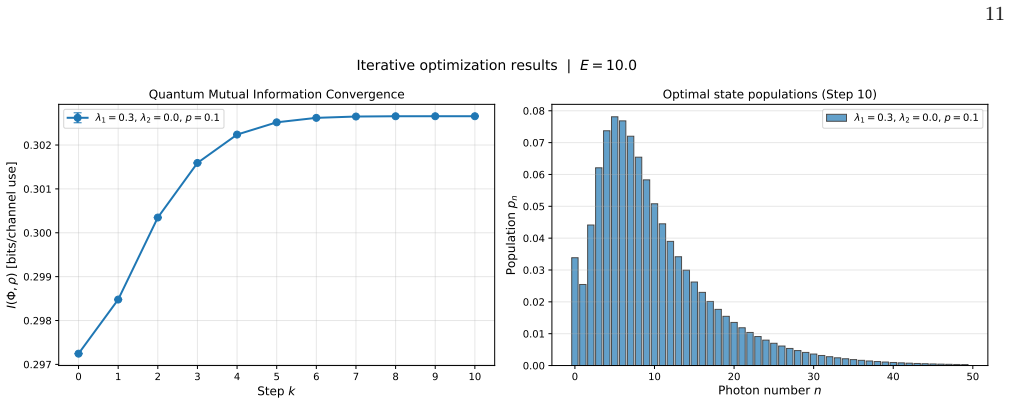
- An iterative variational algorithm computes the coherent and mutual information for arbitrary fading distributions.
Where Pith is reading between the lines
- Quantum-network design can assume positive rates without needing real-time compensation for every transmissivity fluctuation, provided some light transmission remains possible.
- The same convex-combination robustness may apply to other bosonic noise models that admit similar decompositions.
- The variational method could be used to pre-compute optimal input states for experimentally realized fading channels.
Load-bearing premise
The overall channel must be exactly a convex combination of pure-loss channels whose transmissivity distribution has support that includes at least one strictly positive value.
What would settle it
An explicit computation or laboratory simulation of a fading channel with positive transmissivity support in which the coherent information is zero for every possible input state would falsify the positive-rate claim.
Figures






read the original abstract
The pure-loss channel is a fundamental model for describing noise in bosonic quantum platforms. It is characterised by a single parameter, the transmissivity, which quantifies the fraction of the input energy that reaches the output of the channel. In realistic scenarios, however, such as free-space quantum communication, the transmissivity is not fixed but fluctuates from one channel use to another. In this setting, the overall channel is effectively described as a convex combination of pure-loss channels, known as a fading channel. Despite its practical relevance, the quantum Shannon theory of the fading channel has remained largely unexplored. Here, we address this gap, specifically investigating degradability, anti-degradability, entanglement breakingness, and capacities of the fading channel. Of particular relevance to practical quantum-internet applications, we prove that entanglement distribution and quantum key distribution can always be achieved at a strictly positive rate over any fading channel, no matter how noisy it is or how strongly the transmissivity fluctuates, provided the channel is not completely noisy. Moreover, we prove that thermal states, which are optimal for a broad class of static bosonic Gaussian channels, fail to achieve the entanglement-assisted classical capacity of fading channels: non-Gaussian Fock-diagonal states strictly outperform all Gaussian encodings. Most strikingly, we identify regimes where the coherent information of thermal inputs vanishes, while optimized non-Gaussian states achieve strictly positive values, thereby activating the channel for quantum communication. For a paradigmatic binary fading model we establish this result analytically, deriving the exact capacity-achieving state in closed form. For general fading distributions, we design an iterative variational algorithm to optimize the coherent and mutual information.
Editorial analysis
A structured set of objections, weighed in public.
Referee Report
Summary. The manuscript models bosonic fading channels as convex combinations of pure-loss channels with a distribution over transmissivity. It analyzes their degradability, anti-degradability, and entanglement-breaking properties, proves that the single-letter coherent information is strictly positive (hence quantum and private capacities are positive) whenever the distribution has support on at least one η > 0, shows that non-Gaussian Fock-diagonal states strictly outperform thermal states for the entanglement-assisted classical capacity, provides a closed-form optimizer for the binary-fading case, and introduces an iterative variational algorithm for general distributions.
Significance. If the central claims hold, the work is significant for free-space quantum communication: it guarantees strictly positive rates for entanglement distribution and QKD over any non-trivial fading channel and demonstrates that Gaussian encodings are suboptimal, with concrete analytical and algorithmic tools for capacity evaluation.
minor comments (3)
- The abstract and introduction would benefit from an explicit statement of the mean-photon-number constraint used when optimizing the coherent and mutual information, as this is standard for bosonic capacities and affects the comparison with thermal states.
- The description of the iterative variational algorithm (mentioned in the abstract) lacks details on convergence criteria, initialization, or stopping conditions; adding these would improve reproducibility without altering the central claims.
- A brief comparison table or remark contrasting the fading-channel results with the known optimality of thermal states for static pure-loss and thermal-loss channels would clarify the novelty of the non-Gaussian activation result.
Simulated Author's Rebuttal
We thank the referee for their positive summary of our manuscript, recognition of its significance for free-space quantum communication, and recommendation for minor revision. No specific major comments were raised in the report.
Circularity Check
No significant circularity; derivation self-contained
full rationale
The central result—that coherent information (hence quantum and private capacities) remains strictly positive for any fading channel whose transmissivity distribution has support on at least one η > 0—follows directly from the standard fact that the pure-loss channel with η > 0 has positive coherent information for a suitable input, combined with the convexity of coherent information under convex combinations of channels. The paper supplies an explicit optimizer for the binary-fading case and a variational procedure for the general case, but these are computational tools to exhibit the positive value, not definitions that presuppose the result. No self-definitional steps, fitted-input predictions, or load-bearing self-citations appear in the derivation chain; the argument relies on external, independently established properties of bosonic Gaussian channels and coherent information.
Axiom & Free-Parameter Ledger
axioms (2)
- domain assumption Bosonic pure-loss channels are completely characterized by their transmissivity parameter and obey standard quantum channel properties.
- domain assumption The fading channel is defined as the convex combination of pure-loss channels according to a probability distribution over transmissivity.
Reference graph
Works this paper leans on
-
[1]
Applications We evaluate the non-antidegradability condition (26) for the two most relevant classes of fading channels: dis- crete binary mixtures and continuous atmospheric distri- butions. a. Two-Component FadingConsider the convex combination of two lossy channels, Φ =pE λ1 +(1−p)E λ2. The condition (26) takes the explicit form: p(p+1)λ 1 +(1−p)(2−p)λ ...
-
[2]
H. J. Kimble. The quantum internet.Nature, 453(7198):1023–1030, 2008
work page 2008
- [3]
-
[4]
M. A. Nielsen and I. L. Chuang.Quantum Computation and Quantum Information: 10th Anniversary Edition. Cambridge University Press, Cambridge, 2010
work page 2010
-
[5]
C. M. Caves and P. D. Drummond. Quantum limits on bosonic communication rates.Reviews of Modern Physics, 66:481–537, 1994
work page 1994
-
[6]
CRC Press, Boca Ra- ton, FL, 2017
Alessio Serafini.Quantum Continuous Variables: A Primer of Theoretical Methods. CRC Press, Boca Ra- ton, FL, 2017
work page 2017
- [7]
-
[8]
A. A. E. Hajomer, I. Derkach, N. Jain, H.-M. Chin, U. L. Andersen, and T. Gehring. Long-distance continuous- variable quantum key distribution over 100-km fiber with local local oscillator.Science Advances, 10(1):eadi9474, 2024
work page 2024
-
[9]
Y. Zhang, Z. Li, Z. Chen, C. Weedbrook, Y. Zhao, X. Wang, Y. Huang, C. Xu, X. Zhang, Z. Wang, M. Li, X. Zhang, Z. Zheng, B. Chu, X. Gao, N. Meng, W. Cai, Z. Wang, G. Wang, S. Yu, and H. Guo. Continuous- variable QKD over 50 km commercial fiber.Quantum 14 Science and Technology, 4(3):035006, 2019
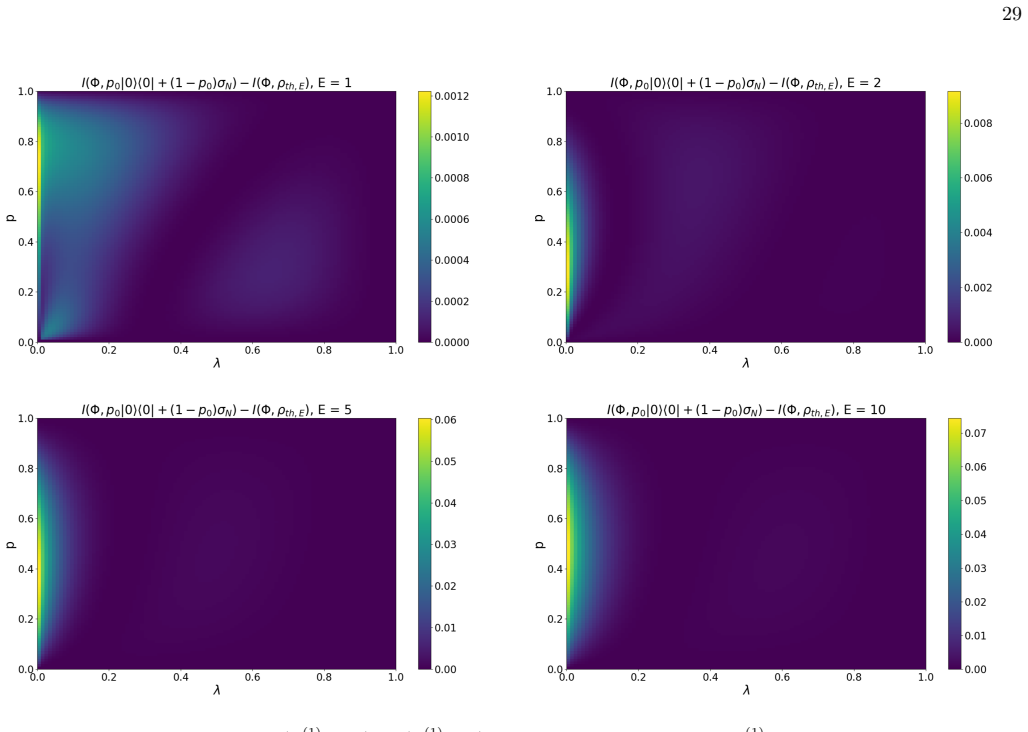
work page 2019
-
[10]
Y. Pi, H. Wang, Y. Pan, Y. Shao, Y. Li, J. Yang, Y. Zhang, W. Huang, and B. Xu. Sub-mbps key-rate continuous-variable quantum key distribution with lo- cal local oscillator over 100-km fiber.Optics Letters, 48(7):1766, 2023
work page 2023
- [11]
-
[12]
S. Pirandola, U. L. Andersen, L. Banchi, M. Berta, D. Bunandar, R. Colbeck, D. Englund, T. Gehring, C. Lupo, C. Ottaviani, J. L. Pereira, M. Razavi, J. Sham- sul Shaari, M. Tomamichel, V. C. Usenko, G. Vallone, P. Villoresi, and P. Wallden. Advances in quantum cryp- tography.Advances in Optics and Photonics, 12(4):1012, December 2020
work page 2020
-
[13]
Usenko, Antonio Ac´ ın, Romain All´ eaume, Ulrik L
Vladyslav C. Usenko, Antonio Ac´ ın, Romain All´ eaume, Ulrik L. Andersen, Eleni Diamanti, Tobias Gehring, Adnan A. E. Hajomer, Florian Kanitschar, Christoph Pacher, Stefano Pirandola, and Valerio Pruneri. Continuous-variable quantum communication.arXiv preprint arXiv:2501.12801, 2025
-
[14]
Fundamental limits of repeater- less quantum communications.Nature Communications, 8(1), April 2017
Stefano Pirandola, Riccardo Laurenza, Carlo Ottaviani, and Leonardo Banchi. Fundamental limits of repeater- less quantum communications.Nature Communications, 8(1), April 2017
work page 2017
-
[15]
Francesco Anna Mele, Ludovico Lami, and Vittorio Gio- vannetti. Maximum tolerable excess noise in continuous- variable quantum key distribution and improved lower bound on two-way capacities.Nature Photonics, 19:329, 334, 2025
work page 2025
-
[16]
Laurent de Forges de Parny, Olivier Alibart, Julien De- baud, Sacha Gressani, Alek Lagarrigue, Anthony Mar- tin, Alexandre Metrat, Matteo Schiavon, Tess Troisi, Eleni Diamanti, Patrick G´ elard, Erik Kerstel, S´ ebastien Tanzilli, and Mathias Van Den Bossche. Satellite-based quantum information networks: use cases, architecture, and roadmap.Communications...
work page 2023
-
[17]
Micius quantum experiments in space.Rev
Chao-Yang Lu, Yuan Cao, Cheng-Zhi Peng, and Jian- Wei Pan. Micius quantum experiments in space.Rev. Mod. Phys., 94:035001, Jul 2022
work page 2022
-
[18]
A. Krˇ ziˇ c, S. Sharma, C. Spiess, et al. Towards metropoli- tan free-space quantum networks.npj Quantum Informa- tion, 9(1):95, 2023
work page 2023
-
[19]
Jasminder S. Sidhu, Siddarth K. Joshi, Mustafa G¨ undo˘ gan, Thomas Brougham, David Lowndes, Luca Mazzarella, Markus Krutzik, Sonali Mohapatra, Daniele Dequal, Giuseppe Vallone, Paolo Villoresi, Alexander Ling, Thomas Jennewein, Makan Mohageg, John G. Rar- ity, Ivette Fuentes, Stefano Pirandola, and Daniel K. L. Oi. Advances in space quantum communication...
work page 2021
-
[20]
Limits and security of free-space quantum communications.Phys
Stefano Pirandola. Limits and security of free-space quantum communications.Phys. Rev. Res., 3:013279, Mar 2021
work page 2021
-
[21]
Vladyslav C. Usenko, Christian Peuntinger, Bettina Heim, Kevin G¨ unthner, Ivan Derkach, Dominique Elser, Christoph Marquardt, Radim Filip, and Gerd Leuchs. Stabilization of transmittance fluctuations caused by beam wandering in continuous-variable quantum com- munication over free-space atmospheric channels.Opt. Express, 26(24):31106–31115, 2018
work page 2018
-
[22]
Larry C. Andrews and Ronald L. Phillips.Laser Beam Propagation through Random Media. SPIE Press, Bellingham, WA, 2nd edition, 2005
work page 2005
-
[23]
D. Vasylyev, A. A. Semenov, and W. Vogel. Atmo- spheric quantum channels with weak and strong turbu- lence.Phys. Rev. Lett., 117:090501, 2016
work page 2016
-
[24]
D. Yu. Vasylyev, A. A. Semenov, and W. Vogel. To- ward global quantum communication: Beam wandering preserves nonclassicality.Phys. Rev. Lett., 108:220501, 2012
work page 2012
-
[25]
Claude E. Shannon. A mathematical theory of commu- nication.The Bell System Technical Journal, 27(3):379– 423, 1948
work page 1948
-
[26]
Charles H. Bennett, Peter W. Shor, John A. Smolin, and Ashish V. Thapliyal. Entanglement-assisted classi- cal capacity of noisy quantum channels.Phys. Rev. Lett., 83:3081–3084, 1999
work page 1999
-
[27]
Charles H. Bennett, Peter W. Shor, John A. Smolin, and Ashish V. Thapliyal. Entanglement-assisted capacity of a quantum channel and the reverse Shannon theorem. IEEE Transactions on Information Theory, 48(10):2637– 2655, 2002
work page 2002
-
[28]
Igor Devetak and Peter W. Shor. The capacity of a quan- tum channel to transmit private classical information. Communications in Mathematical Physics, 256(2):287– 303, 2005
work page 2005
-
[29]
Wilde.Quantum Information Theory
Mark M. Wilde.Quantum Information Theory. Cam- bridge University Press, 2013
work page 2013
-
[30]
A S Holevo and V Giovannetti. Quantum channels and their entropic characteristics.Reports on Progress in Physics, 75(4):046001, March 2012
work page 2012
-
[31]
Christian Weedbrook, Stefano Pirandola, Ra´ ul Garc´ ıa- Patr´ on, Nicolas J. Cerf, Timothy C. Ralph, Jeffrey H. Shapiro, and Seth Lloyd. Gaussian quantum information. Rev. Mod. Phys., 84:621–669, 2012
work page 2012
-
[32]
Michael M. Wolf, Geza Giedke, and J. Ignacio Cirac. Ex- tremality of gaussian quantum states.Phys. Rev. Lett., 96:080502, Mar 2006
work page 2006
-
[33]
Gaussian states minimize the output entropy of one-mode quantum gaussian channels.Phys
Giacomo De Palma, Dario Trevisan, and Vittorio Gio- vannetti. Gaussian states minimize the output entropy of one-mode quantum gaussian channels.Phys. Rev. Lett., 118:160503, Apr 2017
work page 2017
-
[34]
Alexander S. Holevo and Reinhard F. Werner. Evaluating capacities of bosonic Gaussian channels.Phys. Rev. A, 63:032312, 2001
work page 2001
-
[35]
V. Giovannetti, A. S. Holevo, and R. Garc´ ıa-Patr´ on. A Solution of Gaussian Optimizer Conjecture for Quantum Channels.Communications in Mathematical Physics, 334(3):1553–1571, March 2015
work page 2015
-
[36]
M. M. Wolf, D. P´ erez-Garc´ ıa, and G. Giedke. Quantum capacities of bosonic channels.Physical Review Letters, 98:130501, 2007
work page 2007
-
[37]
S. Pirandola, R. Laurenza, C. Ottaviani, and L. Banchi. Fundamental limits of repeaterless quantum communica- tions.Nature Communications, 8(1):15043, 2017
work page 2017
-
[38]
M. M. Wilde, M. Tomamichel, and M. Berta. Con- verse bounds for private communication over quantum channels.IEEE Transactions on Information Theory, 63(3):1792–1817, 2017
work page 2017
-
[39]
M. Takeoka, S. Guha, and M. M. Wilde. Fundamental rate-loss tradeoff for optical quantum key distribution. Nature Communications, 5(1):5235, 2014
work page 2014
-
[40]
M. M. Wilde, P. Hayden, and S. Guha. Quantum trade- off coding for bosonic communication.Physical Review A, 86:062306, 2012. 15
work page 2012
-
[41]
S. Pirandola, R. Garc´ ıa-Patr´ on, S. L. Braunstein, and S. Lloyd. Direct and reverse secret-key capacities of a quantum channel.Physical Review Letters, 102:050503, 2009
work page 2009
-
[42]
V. Giovannetti, S. Lloyd, L. Maccone, and P. W. Shor. Entanglement assisted capacity of the broadband lossy channel.Physical Review Letters, 91:047901, 2003
work page 2003
-
[43]
V. Giovannetti, S. Lloyd, L. Maccone, and P. W. Shor. Broadband channel capacities.Physical Review A, 68:062323, 2003
work page 2003
-
[44]
F. Caruso and V. Giovannetti. Degradability of bosonic gaussian channels.Physical Review A, 74:062307, 2006
work page 2006
-
[45]
V. Giovannetti, R. Garc´ ıa-Patr´ on, N. J. Cerf, and A. S. Holevo. Ultimate classical communication rates of quan- tum optical channels.Nat. Photonics, 8(10):796–800, 2014
work page 2014
-
[46]
Francesco Anna Mele, Giovanni Barbarino, Vittorio Gio- vannetti, and Marco Fanizza. Achievable rates in non- asymptotic bosonic quantum communication.arXiv preprint arXiv:2502.05524, 2025
- [47]
-
[48]
S. Khatri and M. M. Wilde.Principles of Quantum Com- munication Theory: A Modern Approach. 2020
work page 2020
-
[49]
Quantum communication on the bosonic loss-dephasing channel.Phys
Francesco Anna Mele, Farzin Salek, Vittorio Giovan- netti, and Ludovico Lami. Quantum communication on the bosonic loss-dephasing channel.Phys. Rev. A, 110:012460, Jul 2024
work page 2024
-
[50]
Cubitt, Mary Beth Ruskai, and Graeme Smith
Toby S. Cubitt, Mary Beth Ruskai, and Graeme Smith. The structure of degradable quantum channels.Journal of Mathematical Physics, 49(10):102104, 10 2008
work page 2008
-
[51]
M. Horodecki, P. Horodecki, and R. Horodecki. Insep- arable two spin- 1 2 density matrices can be distilled to a singlet form.Phys. Rev. Lett., 78:574–577, 1997
work page 1997
-
[52]
Separability criterion for density matrices
Asher Peres. Separability criterion for density matrices. Phys. Rev. Lett., 77:1413–1415, 1996
work page 1996
-
[53]
Separability of mixed states: necessary and sufficient conditions.Phys
Micha l Horodecki, Pawe l Horodecki, and Ryszard Horodecki. Separability of mixed states: necessary and sufficient conditions.Phys. Lett. A, 223:1–8, 1996
work page 1996
-
[54]
Charles H. Bennett, David P. DiVincenzo, and John A. Smolin. Capacities of quantum erasure channels.Phys. Rev. Lett., 78:3217–3220, 1997
work page 1997
-
[55]
Fac- torizations of quantum channels.Linear Algebra and its Applications, 553:145–168, 2018
Jeremy Levick, David W Kribs, and Rajesh Pereira. Fac- torizations of quantum channels.Linear Algebra and its Applications, 553:145–168, 2018. 16 Appendix A: Proof of Non-Antidegradability Condition In this appendix, we provide the detailed derivation of the fidelity expressions used for the non-antidegradability criterion discussed in Sec. III B. Our goa...
work page 2018
-
[56]
The only non-zero overlap occurs in the vacuum component: F(Φ(ρ 1),Φ(ρ 2)) = 1− ⟨λ⟩.(A3)
Main Output Fidelity The action of the fading channel Φ on the probe states yields: Φ(ρ1) = X n pnEλn(|0⟩ ⟨0|) = X n pn |0⟩ ⟨0|=|0⟩ ⟨0|,(A1) Φ(ρ2) = X n pnEλn(|1⟩ ⟨1|) = X n pn [(1−λ n)|0⟩ ⟨0|+λ n |1⟩ ⟨1|] = (1− ⟨λ⟩)|0⟩ ⟨0|+⟨λ⟩ |1⟩ ⟨1|.(A2) Since both output states are diagonal in the Fock basis, their fidelityF(ρ, σ) = (Tr p√ρσ√ρ)2 = P k √ρkkσkk 2 simpli...
-
[57]
Complementary Output Fidelity To compute the fidelity of the complementary channel, we use the Stinespring dilation derived in Sec. II C. The complementary map is given by: ˜Φ(ρS) = TrS V(ρ S ⊗ |0⟩E ⟨0| ⊗ |ψp⟩A ⟨ψp|)V † ,(A4) where the isometryVacting onS⊗E⊗Ais defined asV= P n U(SE) λn ⊗ |n⟩A ⟨n|and the ancilla state is|ψ p⟩A =P n √pn |n⟩A. Let us explic...
-
[58]
Detailed Analysis of Binary F ading Mixtures In the following, we analyze the non-antidegradability condition for the fundamental class of binary fading channels. We consider a general convex combination of two pure-loss channels with transmissivitiesλ 1 andλ 2 mixed with probabilityp: Φp,λ1,λ2 =pE λ1 + (1−p)E λ2 .(A12) Applying the general sufficient con...
-
[59]
Protocol Description Alice and Bob useMuses of the channel Φ to share a target entangled state|Ψ⟩ AB. •Encoding:Alice prepares a maximally entangled state|Ψ⟩ AB = 1√ D PD k=1 |k⟩A |k⟩B, where the systemB(to be sent through the channel) is encoded in the subspaceH K,M ofKphotons distributed acrossMbosonic modes. The dimension of this subspace isD=D K,M = M...
-
[60]
Success Probability and Rate From [48] we know that the achievable rateRis given by R= Psucc M log2 DK,M .(B1) We computeP succ. For a single use of a pure-loss channelE λ acting on a Fock state|n⟩, the probability of transmitting allnphotons isλ n. For the fading channel Φ, which is a convex combination of lossy channelsE λ, the probability of transmitti...
-
[61]
Universal Lower Bound To obtain a universal bound that depends only on the mean transmissivity⟨λ⟩, we apply Jensen’s inequality for the convex functionf(x) =x n (forx≥0, n≥1). We have⟨λ n⟩ ≥ ⟨λ⟩ n. Substituting this into the expression forP succ: Psucc ≥ 1 DK,M X ⃗ n∈HK,M MY i=1 ⟨λ⟩ni (B5) = 1 DK,M X ⃗ n∈HK,M ⟨λ⟩ P ni (B6) = 1 DK,M X ⃗ n∈HK,M ⟨λ⟩K (B7) = ...
-
[62]
Input Entropy For a Fock-diagonal stateρ= P n ρnn |n⟩ ⟨n|, the von Neumann entropy is the Shannon entropy of its diagonal elements. Substituting the decomposition forρ, we obtain: S(ρ) =H 2(p0) + (1−p 0)S(σ),(C3) whereH 2(x) =−xlog 2 x−(1−x) log 2(1−x) is the binary entropy function
-
[63]
Output Entropy The channel maps the inputρto the output state Φ p(ρ) =pρ+ (1−p)|0⟩ ⟨0|. The vacuum component is shifted due to the erasure term, while the excited components are simply scaled byp. The spectrum of the output state is: spec(Φp(ρ)) ={pρ 00 + (1−p), pρ 11, pρ22, . . .}.(C4) Using the decompositionρ 00 =p 0 and the expression forS(ρ), the outp...
-
[64]
Exchange Entropy To compute the exchange entropyS( ˜Φp(ρ)), we construct the Stinespring dilation and, from that, we can compute the Kraus operators of Φ. The channel admits a Kraus representation with operators{N k}∞ k=0 defined as: N0 = √p1, N k = p 1−p|0⟩ ⟨k−1|fork≥1.(C6) Using the general formula for the complementary channel ˜Φ(ρ) = P i,j |i⟩E ⟨j|Tr[...
-
[65]
Closed-F orm Mutual Information and Optimization Combining the entropy terms derived above, the mutual informationI(Φ p, ρ) simplifies to: I(Φ p, p0, σ) = 2p(1−p 0)S(σ) + 2pH2(p0)−plog 2 p+ (1−p) log 2(1−p) +pp 0 log2(pp0)−(pp 0 + 1−p) log 2(pp0 + 1−p) −(1−p)p 0 log2((1−p)p 0) + X α∈{+,−} λα(p0) log2 λα(p0).(C10) Notice that for a fixedp 0, the mutual inf...
-
[66]
Notation and preliminary: thermal state and binomial kernel We begin by recalling the definition of a thermal state with mean photon numberE≥0: ρth,E = 1 E+ 1 ∞X n=0 E E+ 1 n |n⟩ ⟨n|.(D2) and its von Neumann entropy is the well-known function g(E) :=S(ρ th,E) = (E+ 1) log 2(E+ 1)−Elog 2 E, with the conventiong(0) = 0. For reference we also define the bino...
-
[67]
Input State and Input Entropy At thek-th step of the optimization algorithm, the ansatz stateρ (k) E is constructed as a mixture of the firstkFock states and a “shifted” thermal tail. Explicitly: ρ(k) E = k−1X n=0 wn |n⟩ ⟨n|+w ≥k σ(k) N ,(D5) where we defined the weightsw n =p n Qn−1 i=0 (1−p i) for the discrete part, and the total weight of the tailw ≥k ...
-
[68]
We compute the diagonal elements [Eλ(ρ(k) E )]mm for a generic transmissivityλ
Output State and Output Entropy The action of the fading channel on the input state yields the output state: Φ{pn,λn}(ρ(k) E ) = dX j=1 pjEλj(ρ(k) E ).(D11) Since the input is Fock-diagonal and the channel is phase-insensitive, the output is also Fock-diagonal. We compute the diagonal elements [Eλ(ρ(k) E )]mm for a generic transmissivityλ. Due to the stru...
-
[69]
Exchange Entropy The exchange entropy is defined asS( ˜Φ(ρ(k) E )), where ˜Φ is the complementary channel of Φ. For a fading channel defined by the ensemble{p n, λn}, the output of the complementary channel can be written in a block-diagonal form 24 with respect to the environment basis{|i⟩ E}: ˜Φ{pn,λn}(ρ) = ∞X i=0 |i⟩E ⟨i| ⊗ ˜Φi(ρ),(D15) where each ˜Φi(...
-
[70]
T runcation Error Bound Since the Fock space is infinite-dimensional, any numerical evaluation of entropic functionals requires truncating the Hilbert space at a finite photon number ¯n. We now derive a rigorous upper bound on the error introduced by this truncation, ensuring the reliability of our numerical results. Letρ= P∞ n=0 γn |ψn⟩ ⟨ψn|be the exact ...
-
[71]
Summary: mutual information and numerical recipe Putting the pieces together, for the chosen inputρ=ρ (k) E and channel Φ = Φ {pn,λn} =Pd−1 n=0 pnEλn we compute: 1.S(ρ (k) E ) from (D8)
-
[72]
For each channel componentλ n compute the output populations (D12),(D13), then form the mixture populations Λm = Pd j=1 pj[Eλj(ρ(k) E )]mm by averaging on the distribution and evaluateS(Φ(ρ (k) E )) =− P m Λm log2 Λm by (D14), summing up to the truncation cutoff
-
[73]
For the complementary channel compute each block ˜Φi(ρ(k) E ) by (D18), diagonalize thed×dmatrix to obtain S( ˜Φi(ρ(k) E )) and sum overiup to the truncation cutoff to obtainS( ˜Φ(ρ(k) E )) up to a desired precision
-
[74]
The mutual information follows as I(Φ, ρ(k) E )≃S(ρ (k) E )− imaxX m=0 Λm log2 Λm − ˜imaxX i=0 S( ˜Φi(ρ(k) E )) (D29) wherei max,˜imax are chosen so that the truncation error bound (D25) is negligible for the desired precision. 26 Appendix E: Optimality of F ock-diagonal inputs Lemma 2.LetΦbe a phase-insensitive quantum channel. That is, for any input sta...
-
[75]
Erasure-like channel We begin by analyzing the identity-erasure channel, defined by the map: Φp =pI+ (1−p)E 0.(F1) This channel represents a fundamental communication link suffering from complete signal dropouts with probability 1−p. The numerical evaluation of this channel allows us to observe the core mechanism of non-Gaussian advantage. As shown in Fig...
-
[76]
Erasure-lossy channel We now generalize the previous model to the erasure-lossy channel, where successful transmission events occur with a finite transmissivityλ: Φ(0) p,λ =pE λ + (1−p)E 0.(F2) This model captures the essence of imperfect transmission interspersed with total signal loss. In Fig. 8, we report the absolute capacity gain provided by our Fock...
-
[77]
Identity-lossy channel As a complementary scenario to the erasure models, we consider the identity-lossy channel: Φ(1) p,λ =pI+ (1−p)E λ.(F3) This family describes intermittent “clear-air” turbulence, where the signal is occasionally attenuated but never com- pletely erased. Figure 10 illustrates the capacity gain for this channel. The results demonstrate...
-
[78]
Coherent information and channel activation To further investigate the ultimate quantum limits of the channel, we focus on the single-shot coherent information Ic, which provides a rigorous lower bound for the quantum capacity. Figure 11 displays the optimized coherent information alongside the absolute gain over the thermal benchmark. Crucially, the righ...
-
[79]
General fading (Log-Negative W eibull distribution) Finally, we apply our numerical framework to a physically realistic continuous fading model. In free-space quantum communications affected by beam wandering, the transmissivity statistics are accurately described by the Log-Negative Weibull (LNW) distribution. We map the non-Gaussian advantage for the si...
discussion (0)
Sign in with ORCID, Apple, or X to comment. Anyone can read and Pith papers without signing in.