Semiclassical Ehrenfest paths in open quantum systems
Pith reviewed 2026-05-07 08:31 UTC · model grok-4.3
The pith
Gaussian mixtures evolve under a Fokker-Planck equation that separates coherent and irreversible parts of open quantum dynamics.
A machine-rendered reading of the paper's core claim, the machinery that carries it, and where it could break.
Core claim
We derive the Fokker-Planck equation that governs the time evolution of the mixing measure for a Gaussian mixture representation of the quantum state in an open system. Embedding the generalized Ehrenfest theorem into this phase-space picture then yields the evolution of expectation values, with the coherent and irreversible contributions separated microscopically. The construction supplies a transparent phase-space interpretation of the emergence of classical trajectories in open quantum dynamics.
What carries the argument
The Fokker-Planck equation for the mixing measure of a Gaussian mixture, derived directly from the open-system master equation and used to embed the generalized Ehrenfest theorem.
If this is right
- Coherent and irreversible contributions to the dynamics of expectation values are separated at the level of the phase-space probability currents.
- Classical trajectories appear as the semiclassical limit of the Ehrenfest paths traced by the centers of the Gaussian components.
- The same Fokker-Planck structure applies to any open system whose master equation yields a closed equation for the mixing measure.
- The phase-space picture makes the microscopic origin of decoherence-induced classicality explicit without leaving the quantum formalism.
Where Pith is reading between the lines
- The construction could be tested experimentally in quantum optics by preparing approximate Gaussian states and monitoring the drift and diffusion of their parameter distributions.
- Extensions to non-Markovian or nonlinear master equations would require deriving the corresponding non-local or nonlinear Fokker-Planck equations for the mixing measure.
- The separation of reversible and irreversible flows may offer a route to designing open-system control protocols that steer the classical-like paths.
- The approach invites comparison with other trajectory-based pictures, such as quantum state diffusion, in the same open-system setting.
Load-bearing premise
Any quantum state of the open system admits a Gaussian mixture representation whose mixing measure obeys a Fokker-Planck equation obtained from the master equation.
What would settle it
Prepare a known Gaussian mixture state in a damped harmonic oscillator, evolve it under the master equation, and check whether the observed time-dependent distribution of mixture parameters follows the predicted Fokker-Planck equation to within experimental precision.
Figures
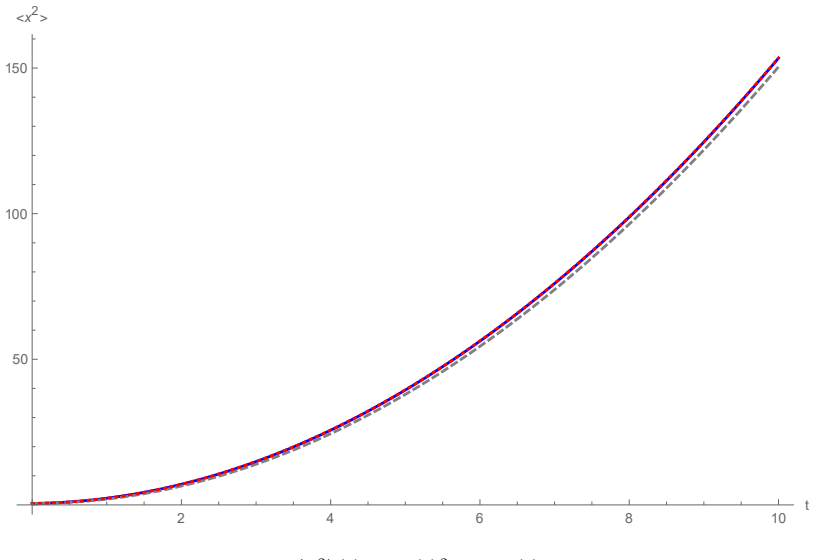
read the original abstract
We study the semiclassical Ehrenfest trajectories in open quantum systems. We first derive in explicit form the Fokker-Planck equation that governs the time evolution of the mixing measure for a Gaussian mixture. Then, we embed the generalized Ehrenfest theorem recently obtained for open quantum systems into this phase-space picture to study the time evolution of the expectations of observable with respect to the Gaussian mixture. We show how the coherent and irreversible contributions are microscopically separated. Our work provides a transparent phase-space interpretation of the emergence of classical trajectories in open quantum dynamics.
Editorial analysis
A structured set of objections, weighed in public.
Referee Report
Summary. The paper claims to provide a phase-space interpretation of semiclassical Ehrenfest trajectories in open quantum systems. It derives an explicit Fokker-Planck equation for the mixing measure of a Gaussian mixture representation of the quantum state, derived from the open-system master equation. It then embeds a generalized Ehrenfest theorem into this picture to analyze the time evolution of observable expectations, separating coherent and irreversible contributions, thereby offering a transparent view of how classical trajectories emerge in open quantum dynamics.
Significance. If the derivation is rigorous, the work could provide a useful intuitive tool for visualizing decoherence and the quantum-to-classical transition via phase-space separation of coherent and dissipative effects. The explicit FP derivation for the mixing measure is a conceptual strength. However, the Gaussian mixture ansatz and closed FP evolution are typically exact only for quadratic Hamiltonians and linear Lindblad operators; for general nonlinear open systems the state leaves the Gaussian manifold, limiting the claimed generality of the interpretation for arbitrary open quantum dynamics. No mention of machine-checked proofs or reproducible code is evident.
major comments (3)
- [Section 2] Derivation of the Fokker-Planck equation for the mixing measure (Section 2, around the explicit FP form): The closure of the FP equation for μ assumes the quantum state remains exactly representable as a Gaussian mixture at all times. This holds only for linear/quadratic open-system dynamics; for nonlinear H or non-linear jump operators the evolution produces non-Gaussianity, so the FP equation does not capture the full dynamics. This assumption is load-bearing for the central claim of a general phase-space picture.
- [Section 3] Embedding of the generalized Ehrenfest theorem (Section 3): The separation of coherent and irreversible contributions to observable expectations is performed with respect to the Gaussian mixture. Without explicit equations demonstrating that the embedding remains exact when the mixture evolves under the derived FP (rather than requiring further approximations), the microscopic separation is not guaranteed to be rigorous beyond the quadratic case.
- [Introduction] Scope of the claims (Introduction and Conclusion): The abstract and introduction present the method for 'open quantum systems' without qualification, yet the Gaussian mixture representation with closed FP evolution fails to be preserved under general Lindblad dynamics. This overstatement of applicability is central to the claimed 'transparent interpretation' and requires either explicit restriction to quadratic systems or additional justification.
minor comments (2)
- [Abstract] The abstract outlines the logical steps clearly but contains no equations; adding the key form of the derived FP equation or the separated Ehrenfest contributions would improve immediate accessibility.
- [References] Ensure the reference to the 'recently obtained generalized Ehrenfest theorem' is cited with the precise paper or equation number for traceability.
Simulated Author's Rebuttal
We thank the referee for their careful reading and constructive comments, which have helped us identify areas where the manuscript's scope and assumptions require clearer qualification. We address each major comment point by point below, indicating the revisions we will make.
read point-by-point responses
-
Referee: [Section 2] Derivation of the Fokker-Planck equation for the mixing measure (Section 2, around the explicit FP form): The closure of the FP equation for μ assumes the quantum state remains exactly representable as a Gaussian mixture at all times. This holds only for linear/quadratic open-system dynamics; for nonlinear H or non-linear jump operators the evolution produces non-Gaussianity, so the FP equation does not capture the full dynamics. This assumption is load-bearing for the central claim of a general phase-space picture.
Authors: The referee is correct that the Fokker-Planck equation for the mixing measure μ closes in explicit form precisely when the open-system dynamics preserve the Gaussian manifold, which occurs for quadratic Hamiltonians and linear Lindblad operators. Our derivation begins from the master equation under the Gaussian mixture ansatz and yields the closed FP equation for μ in that setting. For general nonlinear systems the representation becomes approximate, and the FP equation then supplies an effective semiclassical description rather than an exact evolution. In the revised manuscript we will add an explicit statement of these conditions in Section 2, together with a brief discussion of the approximate validity outside the quadratic regime. This qualification directly addresses the load-bearing assumption without altering the derivation itself. revision: yes
-
Referee: [Section 3] Embedding of the generalized Ehrenfest theorem (Section 3): The separation of coherent and irreversible contributions to observable expectations is performed with respect to the Gaussian mixture. Without explicit equations demonstrating that the embedding remains exact when the mixture evolves under the derived FP (rather than requiring further approximations), the microscopic separation is not guaranteed to be rigorous beyond the quadratic case.
Authors: The generalized Ehrenfest theorem (as cited) holds exactly for any open quantum system and already separates the coherent and irreversible contributions to d⟨A⟩/dt. We apply this theorem to expectation values taken with respect to the Gaussian mixture whose mixing measure evolves according to the derived FP equation. To make the embedding fully transparent, the revised Section 3 will contain the explicit substitution of the FP drift and diffusion terms into the Ehrenfest relation, confirming that the separation follows directly from the theorem and the FP evolution without further approximations inside the mixture representation. When the state remains Gaussian the separation is exact; otherwise it is consistent with the semiclassical approximation employed throughout the work. We therefore view the embedding as rigorous within the stated framework. revision: partial
-
Referee: [Introduction] Scope of the claims (Introduction and Conclusion): The abstract and introduction present the method for 'open quantum systems' without qualification, yet the Gaussian mixture representation with closed FP evolution fails to be preserved under general Lindblad dynamics. This overstatement of applicability is central to the claimed 'transparent interpretation' and requires either explicit restriction to quadratic systems or additional justification.
Authors: We acknowledge that the abstract, introduction, and conclusion employ the phrase 'open quantum systems' without sufficient qualification regarding the exactness of the Gaussian-mixture closure. The manuscript's central contribution is a phase-space interpretation that is exact for quadratic open systems and serves as a transparent semiclassical tool more generally. In the revision we will modify the abstract, introduction, and conclusion to state the precise conditions for exact closure (quadratic Hamiltonians and linear dissipators) while noting the utility of the approach as an interpretive framework for broader classes of open dynamics. These changes will align the claims with the mathematical scope and preserve the claimed transparent view within the appropriate regime. revision: yes
Circularity Check
No significant circularity; derivation embeds prior theorem into derived phase-space representation
full rationale
The paper derives the Fokker-Planck equation for the mixing measure of a Gaussian mixture directly from the open-system master equation, then embeds the generalized Ehrenfest theorem into this picture to separate coherent and irreversible parts. No step reduces a claimed prediction or first-principles result to its own inputs by construction, self-definition, or fitted-parameter renaming. The Gaussian mixture is an explicit modeling framework whose evolution is derived rather than presupposed tautologically, and the embedding provides an interpretive separation without forcing the output to equal the input. The result remains self-contained under the stated assumptions, with no load-bearing self-citation chain or ansatz smuggling identified.
Axiom & Free-Parameter Ledger
axioms (2)
- domain assumption Quantum states in the semiclassical regime can be represented as Gaussian mixtures whose mixing measure evolves via a Fokker-Planck equation.
- domain assumption A generalized Ehrenfest theorem holds for open quantum systems.
Reference graph
Works this paper leans on
-
[1]
P. Ehrenfest, Bemerkung ¨ uber die angen¨ aherte G¨ ultigkeit der klassischen Mechanik innerhalb der Quantenmechanik, Z. Phys.45, 455 (1927)
work page 1927
-
[2]
E. J. Heller, Time-dependent approach to semiclassical dynamics, J. Chem. Phys. 62, 1544 (1975)
work page 1975
-
[3]
R. Liberalquino and F. Parisio, Semiclassical Ehrenfest paths, Phys. Lett. A377, 1391 (2013)
work page 2013
-
[4]
A. Vallejo, A. Romanelli, V. Feldman, and R. Donangelo, Evolution of expected values in open quantum systems, Phys. Rev. A111, 032201 (2025)
work page 2025
-
[5]
E. M. Graefe, B. Longstaff, T. Plastow, and R. Schubert, Lindblad dynamics of Gaussian states and their superpositions in the semiclassical limit, J. Phys. A: Math. Theor.51, 365203 (2018)
work page 2018
-
[6]
F. Hernandez, D. Ranard, and C. J. Riedel, Classical correspondence beyond the Ehrenfest time for open quantum systems with general Lindbladians, Commun. Math. Phys.406, 4 (2025)
work page 2025
-
[7]
P.-L. Lions and T. Paul, Sur les mesures de Wigner, Rev. Mat. Iberoam.9, 553 (1993)
work page 1993
-
[8]
G. J. Milburn, Intrinsic decoherence in quantum mechanics, Phys. Rev. A44, 5401 (1991). 11
work page 1991
-
[9]
A. K. Rajagopal, Implications of the intrinsic decoherence in quantum mechanics to nonequilibrium statistical mechanics, Phys. Rev. A54, 1124 (1996)
work page 1996
-
[10]
R. G. Littlejohn, The semiclassical evolution of wave packets, Phys. Rep.138, 193 (1986). 12
work page 1986
discussion (0)
Sign in with ORCID, Apple, or X to comment. Anyone can read and Pith papers without signing in.