Recognition: unknown
Stable but Wrong: An Inference Limit in Galactic Archaeology
Pith reviewed 2026-05-07 09:38 UTC · model grok-4.3
The pith
Stellar ages inferred from spectroscopic surveys can systematically misestimate the Milky Way disk formation timescale by 0.5-1 Gyr in certain observational quality regimes.
A machine-rendered reading of the paper's core claim, the machinery that carries it, and where it could break.
Core claim
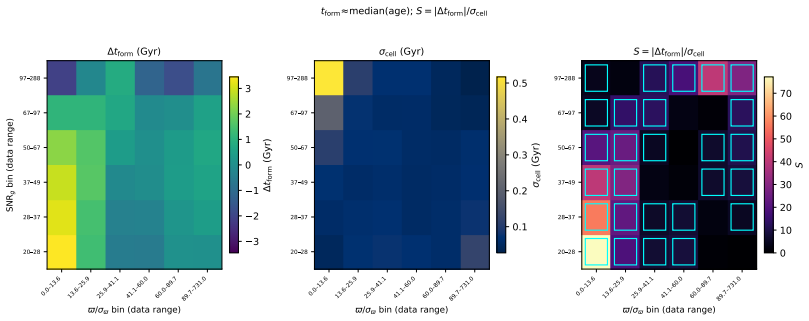
Using a large sample of subgiant stars, the analysis shows that in a specific region of the signal-to-noise ratio and parallax precision parameter space, the formation timescale inferred from the age-metallicity relation is offset by 0.5-1 Gyr compared to an independent asteroseismic reference, while statistical uncertainties remain small.
What carries the argument
The observational quality parameter space of signal-to-noise ratio and parallax precision, which maps to a systematic offset in age-inferred formation timescales.
If this is right
- Inferences of Milky Way disk formation history from spectroscopic ages may contain unrecognized biases in moderate quality regimes.
- Statistical precision does not guarantee accuracy when observational quality affects the age inference model.
- The age-metallicity relation derived formation timescale can be misleading without cross-validation against independent methods like asteroseismology.
- This stable-but-wrong state arises even as sample sizes increase if the quality parameters fall into the biased region.
Where Pith is reading between the lines
- Similar quality-dependent biases could affect other inferences in astronomy that rely on age or parameter estimates from surveys.
- Surveys might benefit from mapping bias regions in their data quality space to flag or correct affected samples.
- Extending this to other galaxies or using additional reference methods like white dwarf cooling could test the generality.
Load-bearing premise
The asteroseismic ages provide the true unbiased formation timescale, and the observed offset stems only from the signal-to-noise ratio and parallax precision rather than other factors like sample selection or model choices.
What would settle it
If an independent age determination method, such as from white dwarf cooling sequences or gyrochronology on the same stars, shows no systematic offset in the identified quality region, or if the offset disappears when using different age inference models, the central claim would be falsified.
Figures


read the original abstract
Statistical inference in observational science typically relies on a fundamental assumption: as sample size increases and uncertainties decrease, the inferred results should converge to the true physical quantities. This assumption underpins the notion that big data lead to more reliable conclusions. In Galactic archaeology, stellar ages inferred from spectroscopic surveys are widely used to reconstruct the formation history of the Milky Way disk. The age metallicity relation (AMR) and its derived formation timescale are often regarded as key physical diagnostics of early disk evolution. This interpretation carries an implicit premise: that observational quality does not introduce systematic bias into age inference. Here we show that this premise may fail. Using a large sample of subgiant stars, we identify a region in the observational quality parameter space (signal-to-noise ratio and parallax precision) where the inferred formation timescale exhibits a systematic offset of 0.5-1 Gyr relative to an independent asteroseismic reference, while the statistical uncertainties remain small, thus producing a stable-but-wrong inference state.
Editorial analysis
A structured set of objections, weighed in public.
Referee Report
Summary. The paper claims that in a large sample of subgiant stars, there exists a region of observational quality parameter space (defined by signal-to-noise ratio and parallax precision) where the formation timescale inferred from the age-metallicity relation exhibits a systematic 0.5-1 Gyr offset relative to an independent asteroseismic reference, even though the statistical uncertainties on the inference remain small, producing a stable-but-wrong result.
Significance. If substantiated with proper controls, the result would be significant for Galactic archaeology because it identifies a concrete inference limit in the use of spectroscopic surveys for reconstructing Milky Way disk formation history. It directly challenges the assumption that increasing data quality and sample size necessarily improves the reliability of derived physical quantities such as formation timescales, with potential implications for interpreting AMR results from surveys like APOGEE, GALAH, and Gaia.
major comments (3)
- [Methods] Methods section: The manuscript provides no details on sample selection, matching between the spectroscopic subgiant sample and the asteroseismic reference, or controls for confounders such as metallicity, mass, or population differences across quality bins. This is load-bearing for the central claim, as the offset must be isolated to SNR and parallax precision rather than sample or model differences.
- [Results] Results section: The procedure for deriving the formation timescale from the AMR (including binning, fitting method, and uncertainty estimation) is not specified, nor is the exact definition of the 'quality region' thresholds. Without these, it cannot be verified that statistical uncertainties remain small while the 0.5-1 Gyr offset is robust.
- [Discussion] Discussion section: No cross-validation of spectroscopic versus asteroseismic ages on overlapping stars is reported, nor tests that rule out systematics in the age-inference pipelines themselves. This leaves open that the observed offset arises from unaccounted factors rather than the claimed inference limit tied to observational quality.
minor comments (2)
- [Abstract] Abstract: The phrase 'a defined quality region' should include the specific SNR and parallax precision thresholds used to define it.
- [Figures] Figure captions: Ensure all panels explicitly mark the identified quality region and include error bars or uncertainty representations for the formation timescale measurements.
Simulated Author's Rebuttal
We thank the referee for their careful reading and constructive feedback, which has identified several areas where additional clarity will strengthen the manuscript. We address each major comment below and commit to revisions that provide the requested details without altering the core findings.
read point-by-point responses
-
Referee: [Methods] Methods section: The manuscript provides no details on sample selection, matching between the spectroscopic subgiant sample and the asteroseismic reference, or controls for confounders such as metallicity, mass, or population differences across quality bins. This is load-bearing for the central claim, as the offset must be isolated to SNR and parallax precision rather than sample or model differences.
Authors: We agree that the Methods section requires expansion to fully document these elements. In the revised manuscript we will add explicit descriptions of the subgiant sample selection criteria, the matching procedure to the asteroseismic reference (including any positional or parameter-based criteria used), and analyses that control for potential confounders. This will include showing that distributions of metallicity, mass, and population indicators remain comparable across the quality bins, thereby isolating the effect to SNR and parallax precision as claimed. revision: yes
-
Referee: [Results] Results section: The procedure for deriving the formation timescale from the AMR (including binning, fitting method, and uncertainty estimation) is not specified, nor is the exact definition of the 'quality region' thresholds. Without these, it cannot be verified that statistical uncertainties remain small while the 0.5-1 Gyr offset is robust.
Authors: We acknowledge that the precise procedures must be stated for reproducibility. The revised Results section will specify the binning strategy applied to the age-metallicity relation, the fitting method used to extract the formation timescale, the uncertainty estimation technique, and the exact numerical thresholds defining the quality region in terms of signal-to-noise ratio and parallax precision. These additions will allow direct verification that the reported offset persists while statistical uncertainties stay small. revision: yes
-
Referee: [Discussion] Discussion section: No cross-validation of spectroscopic versus asteroseismic ages on overlapping stars is reported, nor tests that rule out systematics in the age-inference pipelines themselves. This leaves open that the observed offset arises from unaccounted factors rather than the claimed inference limit tied to observational quality.
Authors: The referee is correct that explicit cross-validation on overlapping stars and dedicated pipeline-sensitivity tests are not presented. While the primary comparison uses an independent asteroseismic reference, we will add these elements in revision. The updated Discussion will include cross-validation results for any stars common to both samples and sensitivity analyses that vary age-inference assumptions to assess whether pipeline systematics could produce the observed offset. This will help confirm the link to observational quality. revision: yes
Circularity Check
No significant circularity; central claim rests on external comparison
full rationale
The paper identifies an empirical offset in formation timescale between spectroscopic inferences and an independent asteroseismic reference as a function of SNR and parallax precision. No load-bearing step reduces by construction to a fitted parameter, self-definition, or self-citation chain; the offset is presented as a direct observational comparison rather than a derived prediction from the paper's own inputs. The derivation chain is therefore self-contained against the external benchmark and exhibits no enumerated circularity patterns.
Axiom & Free-Parameter Ledger
axioms (1)
- domain assumption Asteroseismic ages provide an unbiased reference for stellar ages and formation timescales.
Reference graph
Works this paper leans on
-
[1]
David R. Soderblom. The ages of stars.Annual Review of Astronomy and Astrophysics, 48: 581–629, 2010. doi: 10.1146/annurev-astro-081309-130806
-
[2]
David M. Nataf et al. Accurate, precise, and physically self-consistent ages and metallicities for 400,000 solar neighborhood subgiant branch stars.arXiv preprint, 2024. arXiv:2407.18307
-
[3]
How precisely can we measure the ages of subgiant and giant stars? arXiv preprint, 2025
Cheyanne Shariat et al. How precisely can we measure the ages of subgiant and giant stars? arXiv preprint, 2025. arXiv:2510.08675
-
[4]
Tristan Boin et al. Stellar age determination using deep neural networks: Isochrone ages for 1.3 million stars.arXiv preprint, 2026. arXiv:2603.09540
work page internal anchor Pith review Pith/arXiv arXiv 2026
-
[5]
Marc H. Pinsonneault et al. Apokasc-3: The third joint spectroscopic and asteroseismic catalog for evolved stars in the kepler fields.The Astrophysical Journal Supplement Series, 276(2):69, 2025. doi: 10.3847/1538-4365/ad9b13
-
[6]
2022, Nature, 603, 599, doi: 10.1038/s41586-022-04496-5
Maosheng Xiang and Hans-Walter Rix. A time-resolved picture of our milky way’s early formation history.Nature, 603:599–603, 2022. doi: 10.1038/s41586-022-04496-5. 13 1.0 21.0 21.2 29.9 29.9 39.5 39.5 51.7 51.8 70.8 71.0 132.3 / bin 24 120 120 155 155 197 199 261 262 383 385 1063 SNR bin truth (Gyr), median(ainfer aseismo) 1.0 21.0 21.2 29.9 29.9 39.5 39.5...
-
[7]
2016, ARA&A, 54, 529, doi: 10.1146/annurev-astro-081915-023441 Bogd´ an,´A., Forman, W
Joss Bland-Hawthorn and Ortwin Gerhard. The galaxy in context: Structural, kinematic, and integrated properties.Annual Review of Astronomy and Astrophysics, 54:529–596, 2016. doi: 10.1146/annurev-astro-081915-023441. 14 1.0 21.0 21.2 29.9 29.9 39.5 39.5 51.7 51.8 70.8 71.0 132.3 / bin 24 120 120 155 155 197 199 261 262 383 385 1063 SNR bin Struth = | |/ c...
discussion (0)
Sign in with ORCID, Apple, or X to comment. Anyone can read and Pith papers without signing in.