Recognition: unknown
Fake3DGS: A Benchmark for 3D Manipulation Detection in Neural Rendering
Pith reviewed 2026-05-07 09:07 UTC · model grok-4.3
The pith
3D manipulations in Gaussian splatting scenes defeat standard 2D fake detectors, while a new method using multi-view consistency and scene features performs substantially better.
A machine-rendered reading of the paper's core claim, the machinery that carries it, and where it could break.
Core claim
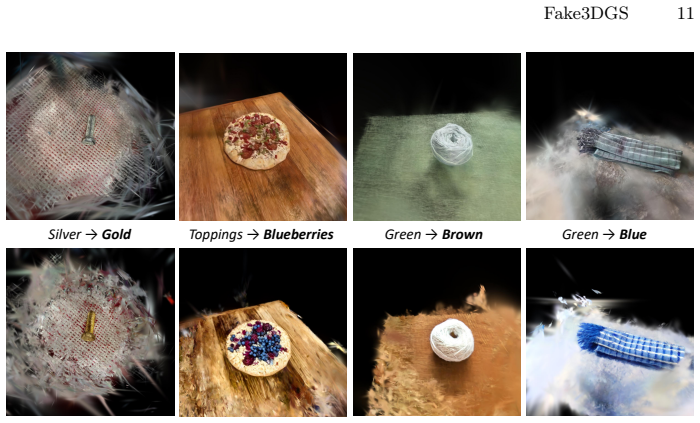
Manipulations performed inside 3D Gaussian splatting models produce photorealistic images that current state-of-the-art 2D detectors cannot reliably separate from authentic renders. The authors supply a public dataset of paired original and manipulated scenes together with a 3D-aware detector that exploits multi-view coherence and features derived from the Gaussian representation, demonstrating that these additional cues raise detection performance markedly.
What carries the argument
The Fake3DGS benchmark dataset of original and manipulated 3D Gaussian splatting scenes, paired with a detector that uses multi-view coherence and Gaussian-derived features to identify edits.
If this is right
- Standard 2D detectors will require supplementation whenever content originates from editable 3D neural representations.
- Future authenticity systems for rendered media will need either multiple views or direct access to the 3D model parameters.
- The three categories of controlled manipulation provide a concrete testbed for developing and comparing other 3D-aware detectors.
- Detection accuracy rises when consistency checks across views are added to single-image analysis.
Where Pith is reading between the lines
- The same multi-view approach could be tested on other neural rendering pipelines such as NeRF variants.
- The benchmark could be extended to include temporal sequences to address detection in 3D video or animated content.
- A practical detector might combine the new 3D cues with existing 2D tools to handle mixed media pipelines.
- Real captured scenes edited in commercial 3D software would serve as a stronger test of whether the coherence features survive domain shift.
Load-bearing premise
The controlled changes to geometry, appearance, and layout in the dataset reflect the properties of real-world 3D forgeries while preserving visual realism, and the multi-view coherence features work on scenes outside this particular collection.
What would settle it
Apply the proposed detector to a fresh set of 3D scenes that were edited independently by other researchers and then rendered with Gaussian splatting; if accuracy drops sharply compared with the benchmark, the method does not generalize.
Figures


read the original abstract
Recent advances in 3D reconstruction and neural rendering,particularly 3D Gaussian Splatting, make it feasible and simple to edit 3D scenes and re-render them as highly realistic images. Therefore, security concerns arise regarding the authenticity of 3D content. Despite this threat, 3D fake detection remains largely unexplored in the literature, and most existing work is limited to 2D space. Therefore, in this paper, we formalize the concept of 3D fake detection and introduce Fake3DGS, a dataset of 3D Gaussian splatting scenes and corresponding rendered views, where fake images are produced by controlled manipulations of geometry, appearance, and spatial layout, while preserving high visual realism. Using this benchmark, we demonstrate that current state-of-the-art 2D detectors struggle to distinguish between original and 3D manipulated images. To bridge this gap, we introduce a 3D-aware detection method that leverages multi-view coherence and features derived from the Gaussian splatting representation. Experimental results demonstrate a substantial improvement in recognizing modified 3D content, underscoring the validity of the new dataset and the necessity for authenticity assessment techniques that extend beyond 2D evidence. Code and data are publicly released for future investigations.
Editorial analysis
A structured set of objections, weighed in public.
Referee Report
Summary. The paper formalizes 3D fake detection for neural rendering and introduces the Fake3DGS benchmark: a collection of 3D Gaussian Splatting scenes together with rendered views in which fake images are generated by controlled manipulations of geometry, appearance, and spatial layout while preserving high visual realism. Using this benchmark the authors report that state-of-the-art 2D detectors fail to distinguish original from manipulated images and propose a 3D-aware detector that exploits multi-view coherence together with features derived from the underlying Gaussian splatting representation, claiming a substantial improvement in detection performance. Code and data are released publicly.
Significance. If the quantitative claims hold, the work is significant because it identifies an emerging authenticity threat created by editable 3D neural scenes, supplies the first public benchmark and code release for 3D manipulation detection, and demonstrates the limitations of purely 2D forensic methods. The public release of code and data is a clear strength that supports reproducibility and future research in multimedia forensics.
major comments (2)
- [Abstract] Abstract: the central claim that 'current state-of-the-art 2D detectors struggle to distinguish between original and 3D manipulated images' and that the proposed method yields 'a substantial improvement' is unsupported by any numerical results, dataset sizes, error bars, ablation studies, or performance tables. Without these load-bearing details the magnitude and reliability of the reported improvement cannot be assessed.
- [Abstract] Abstract: the assumption that the controlled geometry/appearance/spatial manipulations produce realistic 3D fakes that generalize beyond the synthetic benchmark is not validated by cross-benchmark testing, real-world captured data, or explicit ranges of manipulation severity. Consequently it remains possible that the multi-view coherence and GS-derived features succeed only because of artifacts specific to how Fake3DGS was constructed rather than because they capture general 3D manipulation cues.
Simulated Author's Rebuttal
We thank the referee for the constructive feedback and for recognizing the significance of introducing the first benchmark and detection approach for 3D manipulations in neural rendering. We address each major comment point by point below, indicating planned revisions to strengthen the manuscript.
read point-by-point responses
-
Referee: [Abstract] Abstract: the central claim that 'current state-of-the-art 2D detectors struggle to distinguish between original and 3D manipulated images' and that the proposed method yields 'a substantial improvement' is unsupported by any numerical results, dataset sizes, error bars, ablation studies, or performance tables. Without these load-bearing details the magnitude and reliability of the reported improvement cannot be assessed.
Authors: We agree that the abstract would benefit from explicit quantitative support for the claims. The full manuscript (Section 4) presents detailed results on the Fake3DGS benchmark, including performance tables for multiple state-of-the-art 2D detectors versus our multi-view coherence method, dataset statistics (number of scenes, rendered views, and manipulation types), and ablation studies. We will revise the abstract to include key numerical highlights, such as the average detection performance drop for 2D methods and the improvement margin of the proposed 3D-aware detector, while keeping the abstract concise. revision: yes
-
Referee: [Abstract] Abstract: the assumption that the controlled geometry/appearance/spatial manipulations produce realistic 3D fakes that generalize beyond the synthetic benchmark is not validated by cross-benchmark testing, real-world captured data, or explicit ranges of manipulation severity. Consequently it remains possible that the multi-view coherence and GS-derived features succeed only because of artifacts specific to how Fake3DGS was constructed rather than because they capture general 3D manipulation cues.
Authors: The benchmark employs controlled manipulations of geometry, appearance, and layout within 3D Gaussian Splatting scenes, with visual realism preserved and verified through qualitative renderings and perceptual metrics reported in the paper. We acknowledge that explicit cross-benchmark testing on real-world captured data or broader severity ranges is not included in the current experiments. We will add a dedicated limitations paragraph in the discussion section clarifying the synthetic yet realistic scope of Fake3DGS, the rationale for the controlled design to isolate 3D cues, and the public code/data release to enable community-driven extensions to real data. This addresses the concern without requiring new experiments at this stage. revision: partial
Circularity Check
No circularity: empirical benchmark and detector evaluation are independent of inputs
full rationale
The paper introduces a new dataset (Fake3DGS) via controlled manipulations of 3DGS scenes and reports experimental results showing 2D detectors fail while a multi-view + GS-feature detector improves performance. These are direct empirical measurements on held-out rendered views, not reductions by construction, fitted parameters renamed as predictions, or self-citation chains. No equations, uniqueness theorems, or ansatzes are invoked in a load-bearing way; the central claims rest on new data and standard detection metrics rather than re-deriving inputs.
Axiom & Free-Parameter Ledger
axioms (1)
- domain assumption Manipulations of geometry, appearance, and spatial layout preserve high visual realism in rendered views
Reference graph
Works this paper leans on
-
[1]
AI@Meta: Llama 3 model card (2024), https://github.com/meta-llama/llama3/ blob/main/MODEL_CARD.md
2024
-
[2]
In: Proceedings of the European Conference on Computer Vision (2024)
Baraldi, L., Cocchi, F., Cornia, M., Baraldi, L., Nicolosi, A., Cucchiara, R.: Con- trasting Deepfakes Diffusion via Contrastive Learning and Global-Local Similari- ties. In: Proceedings of the European Conference on Computer Vision (2024)
2024
-
[3]
IEEE Access9, 136561–136579 (2021)
Borghi, G., Franco, A., Graffieti, G., Maltoni, D.: Automated artifact retouching in morphed images with attention maps. IEEE Access9, 136561–136579 (2021)
2021
-
[4]
Sensors21(10), 3466 (2021)
Borghi, G., Pancisi, E., Ferrara, M., Maltoni, D.: A double siamese framework for differential morphing attack detection. Sensors21(10), 3466 (2021)
2021
-
[5]
In: Proceedings of the IEEE/CVF conference on computer vision and pattern recognition
Brooks, T., Holynski, A., Efros, A.A.: Instructpix2pix: Learning to follow image editing instructions. In: Proceedings of the IEEE/CVF conference on computer vision and pattern recognition. pp. 18392–18402 (2023)
2023
-
[6]
In: International Con- ference on Social Robotics
Catalini, R., Biagi, F., Salici, G., Borghi, G., Vezzani, R., Biagiotti, L.: Llms and humanoid robot diversity: The pose generation challenge. In: International Con- ference on Social Robotics. pp. 531–538. Springer (2025)
2025
-
[7]
In: NeurIPS (2023)
Cen, J., Zhou, Z., Fang, J., Shen, W., Xie, L., Jiang, D., Zhang, X., Tian, Q., et al.: Segment anything in 3d with nerfs. In: NeurIPS (2023)
2023
-
[8]
In: CVPR (2024)
Chen, Y., Chen, Z., Zhang, C., Wang, F., Yang, X., Wang, Y., Cai, Z., Yang, L., Liu, H., Lin, G.: Gaussianeditor: Swift and controllable 3d editing with gaussian splatting. In: CVPR (2024)
2024
-
[9]
In: CVPR (2024)
Chen, Z., Wang, F., Wang, Y., Liu, H.: Text-to-3d using gaussian splatting. In: CVPR (2024)
2024
-
[10]
In: CVPR (2025)
Chen, Z., Wang, G., Zhu, J., Lai, J., Xie, X.: Guardsplat: Efficient and robust watermarking for 3d gaussian splatting. In: CVPR (2025)
2025
-
[11]
In: CVPR (2023)
Corvi, R., Cozzolino, D., Poggi, G., Nagano, K., Verdoliva, L.: Intriguing properties of synthetic images: from generative adversarial networks to diffusion models. In: CVPR (2023)
2023
-
[12]
In: ICASSP (2023)
Corvi, R., Cozzolino, D., Zingarini, G., Poggi, G., Nagano, K., Verdoliva, L.: On the detection of synthetic images generated by diffusion models. In: ICASSP (2023)
2023
-
[13]
arXiv preprint arXiv:1812.02510 (2018)
Cozzolino, D., Thies, J., Rössler, A., Riess, C., Nießner, M., Verdoliva, L.: Foren- sictransfer: Weakly-supervised domain adaptation for forgery detection. arXiv preprint arXiv:1812.02510 (2018)
-
[14]
In: Proceedings of the IEEE/CVF Conference on Computer Vision and Pattern recognition
Dang, H., Liu, F., Stehouwer, J., Liu, X., Jain, A.K.: On the detection of digital face manipulation. In: Proceedings of the IEEE/CVF Conference on Computer Vision and Pattern recognition. pp. 5781–5790 (2020)
2020
-
[15]
In: 2025 IEEE Intelligent Vehicles Symposium (IV)
Di Nucci, D., Tomei, M., Borghi, G., Ciuffreda, L., Vezzani, R., Cucchiara, R.: Brum: Robust 3d vehicle reconstruction from 360 sparse images. In: 2025 IEEE Intelligent Vehicles Symposium (IV). pp. 1353–1360. IEEE (2025)
2025
-
[16]
arXiv preprint arXiv:2207.13744 (2022)
Farid, H.: Lighting (in) consistency of paint by text. arXiv preprint arXiv:2207.13744 (2022)
-
[17]
arXiv preprint arXiv:2206.14617 (2022)
Farid, H.: Perspective (in) consistency of paint by text. arXiv preprint arXiv:2206.14617 (2022)
-
[18]
In: ICML (2020)
Frank, J., Eisenhofer, T., Schönherr, L., Fischer, A., Kolossa, D., Holz, T.: Lever- aging frequency analysis for deep fake image recognition. In: ICML (2020)
2020
-
[19]
In: CVPR (2022)
Fridovich-Keil, S., Yu, A., Tancik, M., Chen, Q., Recht, B., Kanazawa, A.: Plenox- els: Radiance fields without neural networks. In: CVPR (2022)
2022
-
[20]
Advances in neural in- formation processing systems27(2014) Fake3DGS 13
Goodfellow, I.J., Pouget-Abadie, J., Mirza, M., Xu, B., Warde-Farley, D., Ozair, S., Courville, A., Bengio, Y.: Generative adversarial nets. Advances in neural in- formation processing systems27(2014) Fake3DGS 13
2014
-
[21]
ICME (2021)
Gragnaniello, D., Cozzolino, D., Marra, F., Poggi, G., Verdoliva, L.: Are gan gener- ated images easy to detect? a critical analysis of the state-of-the-art. ICME (2021)
2021
-
[22]
In: Proceedings of the IEEE/CVF conference on computer vision and pattern recognition
He, R., Huang, S., Nie, X., Hui, T., Liu, L., Dai, J., Han, J., Li, G., Liu, S.: Cus- tomize your nerf: Adaptive source driven 3d scene editing via local-global iterative training. In: Proceedings of the IEEE/CVF conference on computer vision and pattern recognition. pp. 6966–6975 (2024)
2024
-
[23]
Hu, X., Wang, Y., Fan, L., Fan, J., Peng, J., Lei, Z., Li, Q., Zhang, Z.: Semantic anything in 3d gaussians. arXiv:2401.17857 (2024)
-
[24]
Huang, X., Luo, Z., Song, Q., Wang, R., Wan, R.: Marksplatter: Generalizable watermarking for 3d gaussian splatting model via splatter image structure (2025)
2025
-
[25]
Hull, M., Yang, H., Mehta, P., Phute, M., Cho, A., Wang, H., Lau, M., Lee, W., Lunardi, W.T., Andreoni, M., Chau, P.: 3d gaussian splat vulnerabilities (2025)
2025
-
[26]
In, S., Jang, Y., Jeong, U., Jang, M., Park, H., Park, E., Kim, S.: Compmarkgs: Robust watermarking for compressed 3d gaussian splatting (2025)
2025
-
[27]
In: CVPR (2025)
Jang, Y., Park, H., Yang, F., Ko, H., Choo, E., Kim, S.: 3d-gsw: 3d gaussian splatting for robust watermarking. In: CVPR (2025)
2025
-
[28]
In: ACM TOG (2024)
Jiang, Y., Yu, C., Xie, T., Li, X., Feng, Y., Wang, H., Li, M., Lau, H.Y.K., Gao, F., Yang, Y., Jiang, C.: Vr-gs: A physical dynamics-aware interactive gaussian splatting system in virtual reality. In: ACM TOG (2024)
2024
-
[29]
ACM TOG (2023)
Kerbl, B., Kopanas, G., Leimkühler, T., Drettakis, G.: 3d gaussian splatting for real-time radiance field rendering. ACM TOG (2023)
2023
-
[30]
Auto-Encoding Variational Bayes
Kingma, D.P., Welling, M.: Auto-encoding variational bayes. arXiv preprint arXiv:1312.6114 (2013)
work page internal anchor Pith review arXiv 2013
-
[31]
In: Proceedings of the IEEE/CVF International Conference on Computer Vision (ICCV) (2025)
Li, Y., Ma, Q., Yang, R., Li, H., Ma, M., Ren, B., Popovic, N., Sebe, N., Konukoglu, E., Gevers, T., et al.: Scenesplat: Gaussian splatting-based scene understanding with vision-language pretraining. In: Proceedings of the IEEE/CVF International Conference on Computer Vision (ICCV) (2025)
2025
-
[32]
Li, Z., Chen, Y., Zhao, L., Liu, P.: Controllable text-to-3d generation via surface- aligned gaussian splatting (2025)
2025
-
[33]
In: CVPR (2024)
Liang, Y., Yang, X., Lin, J., Li, H., Xu, X., Chen, Y.: Luciddreamer: Towards high-fidelity text-to-3d generation via interval score matching. In: CVPR (2024)
2024
-
[34]
In: Proceedings of the Computer Vision and Pattern Recognition Conference
Liu, X., Tayal, P., Wang, J., Zarzar, J., Monnier, T., Tertikas, K., Duan, J., Toisoul, A., Zhang, J.Y., Neverova, N., et al.: Uncommon objects in 3d. In: Proceedings of the Computer Vision and Pattern Recognition Conference. pp. 14102–14113 (2025)
2025
-
[35]
In: Proceedings of the IEEE/CVF Conference on Computer Vision and Pattern Recognition
Liu, Y.T., Guo, Y.C., Luo, G., Sun, H., Yin, W., Zhang, S.H.: Pi3d: Efficient text- to-3d generation with pseudo-image diffusion. In: Proceedings of the IEEE/CVF Conference on Computer Vision and Pattern Recognition. pp. 19915–19924 (2024)
2024
-
[36]
In: 2019 IEEE Winter Applications of Computer Vision Workshops (WACVW)
Matern, F., Riess, C., Stamminger, M.: Exploiting visual artifacts to expose deep- fakes and face manipulations. In: 2019 IEEE Winter Applications of Computer Vision Workshops (WACVW). IEEE (2019)
2019
-
[37]
Commu- nications of the ACM (2021)
Mildenhall, B., Srinivasan, P.P., Tancik, M., Barron, J.T., Ramamoorthi, R., Ng, R.: Nerf: Representing scenes as neural radiance fields for view synthesis. Commu- nications of the ACM (2021)
2021
-
[38]
In: ECCV (2024)
Morgenstern, W., Barthel, F., Hilsmann, A., Eisert, P.: Compact 3d scene repre- sentation via self-organizing gaussian grids. In: ECCV (2024)
2024
-
[39]
ACM TOG (2022)
Müller, T., Evans, A., Schied, C., Keller, A.: Instant neural graphics primitives with a multiresolution hash encoding. ACM TOG (2022)
2022
-
[40]
In: CVPR (2024)
Niedermayr, S., Stumpfegger, J., Westermann, R.: Compressed 3d gaussian splat- ting for accelerated novel view synthesis. In: CVPR (2024)
2024
-
[41]
In: CVPR (2023) 14 D
Ojha, U., Li, Y., Lee, Y.J.: Towards universal fake image detectors that generalize across generative models. In: CVPR (2023) 14 D. Di Nucci et al
2023
-
[42]
Transactions on Ma- chine Learning Research (TMLR) (2024)
Oquab, M., Darcet, T., Moutakanni, T., Vo, H.V., Szafraniec, M., Khalidov, V., Fernandez, P., Haziza, D., Massa, F., El-Nouby, A., Assran, M., Ballas, N., Galuba, W., Howes, R., Huang, P.Y., Li, S.W., Misra, I., Rabbat, M., Sharma, V., Syn- naeve, G., Xu, H., Jégou, H., Mairal, J., Labatut, P., Joulin, A., Bojanowski, P.: DINOv2: Learning robust visual fe...
2024
-
[43]
In: Proceed- ings of the 38th International Conference on Machine Learning (ICML)
Radford, A., Kim, J.W., Hallacy, C., Ramesh, A., Goh, G., Agarwal, S., Sas- try, G., Askell, A., Mishkin, P., Clark, J., Krueger, G., Sutskever, I.: Learn- ing transferable visual models from natural language supervision. In: Proceed- ings of the 38th International Conference on Machine Learning (ICML). Pro- ceedings of Machine Learning Research, vol. 139...
2021
-
[44]
In: Proceedings of the IEEE/CVF conference on computer vision and pattern recognition
Rombach, R., Blattmann, A., Lorenz, D., Esser, P., Ommer, B.: High-resolution image synthesis with latent diffusion models. In: Proceedings of the IEEE/CVF conference on computer vision and pattern recognition. pp. 10684–10695 (2022)
2022
-
[45]
In: CVPR (2019)
Rossler, A., Cozzolino, D., Verdoliva, L., Riess, C., Thies, J., Nießner, M.: Face- forensics++: Learning to detect manipulated facial images. In: CVPR (2019)
2019
-
[46]
In: ACM (2023)
Sha, Z., Li, Z., Yu, N., Zhang, Y.: De-fake: Detection and attribution of fake images generated by text-to-image generation models. In: ACM (2023)
2023
-
[47]
In: NeurIPS (2024)
Shi, Z., zheng, h., Xu, C., Dong, C., Pan, B., xueshuo, X., He, A., Li, T., Fu, H.: Resfusion: Denoising diffusion probabilistic models for image restoration based on prior residual noise. In: NeurIPS (2024)
2024
-
[48]
Vachha, C., Haque, A.: Instruct-gs2gs: Editing 3d gaussian splats with instructions (2024), https://instruct-gs2gs.github.io/
2024
-
[49]
Fakespotter: A simple baseline for spotting ai-synthesized fake faces,
Wang, R.,Juefei-Xu, F., Ma, L., Xie, X., Huang, Y., Wang, J., Liu,Y.: Fakespotter: A simple yet robust baseline for spotting ai-synthesized fake faces. arXiv preprint arXiv:1909.06122 (2019)
-
[50]
Wang, S.Y., Wang, O., Zhang, R., Owens, A., Efros, A.A.: Cnn-generated images are surprisingly easy to spot... for now. In: CVPR (2020)
2020
-
[51]
In: ICCV (2023)
Wang, Z., Bao, J., Zhou, W., Wang, W., Hu, H., Chen, H., Li, H.: Dire for diffusion- generated image detection. In: ICCV (2023)
2023
-
[52]
In: European Conference on Computer Vision
Wu, J., Bian, J.W., Li, X., Wang, G., Reid, I., Torr, P., Prisacariu, V.A.: Gauss- ctrl: Multi-view consistent text-driven 3d gaussian splatting editing. In: European Conference on Computer Vision. pp. 55–71. Springer (2024)
2024
-
[53]
In: CVPR (2024)
Wu, X., Jiang, L., Wang, P.S., Liu, Z., Liu, X., Qiao, Y., Ouyang, W., He, T., Zhao, H.: Point transformer v3: Simpler, faster, stronger. In: CVPR (2024)
2024
-
[54]
In: Proceedings of the IEEE/CVF Conference on Computer Vision and Pattern Recognition
Xu, J., Wang, X., Cheng, W., Cao, Y.P., Shan, Y., Qie, X., Gao, S.: Dream3d: Zero-shot text-to-3d synthesis using 3d shape prior and text-to-image diffusion models. In: Proceedings of the IEEE/CVF Conference on Computer Vision and Pattern Recognition. pp. 20908–20918 (2023)
2023
-
[55]
Journal of Machine Learning Research (2025)
Ye, V., Li, R., Kerr, J., Turkulainen, M., Yi, B., Pan, Z., Seiskari, O., Ye, J., Hu, J., Tancik, M., Kanazawa, A.: gsplat: An open-source library for gaussian splatting. Journal of Machine Learning Research (2025)
2025
-
[56]
In: IEEE Conference on Computer Vision and Patten Recognition (CVPR) (2020)
Yuezun, L., Xin, Y., Pu, S., Honggang, Q., Siwei, L.: Celeb-df: A large-scale chal- lenging dataset for deepfake forensics. In: IEEE Conference on Computer Vision and Patten Recognition (CVPR) (2020)
2020
-
[57]
Zhang, L., Rao, A., Agrawala, M.: Adding conditional control to text-to-image diffusion models (2023)
2023
-
[58]
In: ECCV (2024) Fake3DGS 15
Zhang, X., Ge, X., Xu, T., He, D., Wang, Y., Qin, H., Lu, G., Geng, J., Zhang, J.: Gaussianimage: 1000 fps image representation and compression by 2d gaussian splatting. In: ECCV (2024) Fake3DGS 15
2024
-
[59]
In: ECCV (2024)
Zhou, S., Fan, Z., Xu, D., Chang, H., Chari, P., Bharadwaj, T., You, S., Wang, Z., Kadambi, A.: Dreamscene360: Unconstrained text-to-3d scene generation with panoramic gaussian splatting. In: ECCV (2024)
2024
-
[60]
In: Proceedings of the IEEE/CVF Conference on Computer Vision and Pattern Recognition
Zhou, X., Lin, Z., Shan, X., Wang, Y., Sun, D., Yang, M.H.: Drivinggaussian: Composite gaussian splatting for surrounding dynamic autonomous driving scenes. In: Proceedings of the IEEE/CVF Conference on Computer Vision and Pattern Recognition. pp. 21634–21643 (2024)
2024
-
[61]
arXiv preprint arXiv:2406.09386 (2024)
Zhou, Y., Simon, M., Peng, Z., Mo, S., Zhu, H., Guo, M., Zhou, B.: Simgen: Simulator-conditioned driving scene generation. arXiv preprint arXiv:2406.09386 (2024)
discussion (0)
Sign in with ORCID, Apple, or X to comment. Anyone can read and Pith papers without signing in.