Compressed Sensing for Efficient Fidelity Estimation of GHZ States
Pith reviewed 2026-05-07 07:38 UTC · model grok-4.3
The pith
Compressed sensing estimates GHZ state fidelity using far fewer measurements by exploiting the states' sparsity.
A machine-rendered reading of the paper's core claim, the machinery that carries it, and where it could break.
Core claim
The compressed sensing protocol applied to GHZ states recovers fidelity estimates by sampling only a sparse subset of the possible measurements, which drastically lowers the required overhead compared with conventional verification while still achieving high accuracy, as confirmed in both simulator runs and hardware experiments that incorporate error detection.
What carries the argument
A compressed sensing recovery procedure that uses the sparsity of GHZ states in the measurement basis to reconstruct fidelity from an under-sampled set of expectation values.
If this is right
- Fidelity verification of GHZ states becomes practical with measurement counts that scale much more slowly than the full 4^n possibilities.
- The same protocol remains accurate when combined with error detection on real trapped-ion devices that suffer from decoherence.
- Fewer measurements translate directly into shorter experiment run times and lower resource consumption for state certification.
- The approach is demonstrated to work for both ideal simulator data and data collected from actual quantum hardware.
Where Pith is reading between the lines
- If the sparsity pattern holds for other families of entangled states, the same compressed-sensing template could be reused without redesigning the recovery algorithm.
- In a quantum network setting, the reduced measurement load might allow real-time fidelity checks during entanglement distribution rather than offline post-processing.
- Choosing the measurement basis adaptively based on noise statistics could further tighten the number of required samples.
Load-bearing premise
The GHZ states remain sufficiently sparse in the selected measurement basis that the compressed sensing algorithm can reconstruct the fidelity without large errors introduced by noise or an ill-chosen basis.
What would settle it
Running the same set of compressed-sensing measurements and a full set of tomographic measurements on identical GHZ states and finding that the two fidelity estimates differ by more than the reported error bars would falsify the claim.
Figures




read the original abstract
Accurately characterizing multipartite entangled states is a critical challenge in quantum information processing. In this work, we focus on applying compressed sensing techniques to efficiently estimate the fidelity of Greenberger-Horne-Zeilinger (GHZ) states. By exploiting the inherent sparsity of these states, our compressed sensing protocol drastically reduces the measurement overhead traditionally required for state verification while maintaining high accuracy. To evaluate the practical performance of this approach, we test the protocol on GHZ states using both quantum simulators and Quantinuum's trapped-ion hardware. Furthermore, we implement error detection techniques during our hardware evaluations, demonstrating the robustness and viability of compressed sensing for fidelity estimation in noisy experimental environments.
Editorial analysis
A structured set of objections, weighed in public.
Referee Report
Summary. The paper proposes a compressed sensing protocol to estimate the fidelity of GHZ states by exploiting their sparsity in a chosen measurement basis, claiming this drastically reduces the number of measurements needed relative to full tomography while preserving high accuracy. The method is tested via quantum simulators and on Quantinuum trapped-ion hardware, with error detection and post-selection applied in the latter to mitigate noise.
Significance. If the quantitative claims hold after detailed validation, the work would offer a resource-efficient alternative for verifying multipartite entanglement in noisy intermediate-scale quantum devices, addressing a key experimental bottleneck. The integration of compressed sensing with hardware error detection is a practical strength, though the manuscript must demonstrate that accuracy is not compromised by noise-induced deviations from sparsity.
major comments (3)
- [Hardware experiments] Hardware experiments section: the abstract and results claim robustness via error detection, but no quantitative data are provided on how post-selection alters the support of the measured state (i.e., whether sparsity is restored sufficiently for unbiased ℓ1 recovery) or on the resulting fidelity values with statistical uncertainties. Direct comparison to full tomography on the same data set is also absent, leaving the 'high accuracy' assertion unverified.
- [Compressed sensing protocol] Compressed sensing protocol and results: the central claim that the protocol maintains high accuracy under hardware noise rests on the assumption that GHZ states remain sufficiently sparse in the chosen basis. No analysis or supplementary data are given showing the population of off-support basis states due to noise, nor any bound on the bias this introduces in the fidelity estimate relative to the ideal case.
- [Results] Results and methods: no error bars, number of experimental shots, or baseline comparisons (e.g., to standard fidelity estimation or random Pauli measurements) are reported to support the reduction in measurement overhead. Without these, it is impossible to assess whether the observed fidelity matches the true value within acceptable tolerance.
minor comments (2)
- [Abstract] The abstract would be strengthened by including at least one concrete figure of merit (e.g., 'X-fold reduction in measurements with fidelity agreement to within Y%').
- [Methods] Notation for the measurement basis and the precise definition of the fidelity estimator recovered by compressed sensing should be made explicit in the methods to allow reproducibility.
Simulated Author's Rebuttal
We thank the referee for their thorough review and valuable suggestions. We have carefully considered each comment and revised the manuscript accordingly to strengthen the presentation of our results and address the concerns about quantitative validation.
read point-by-point responses
-
Referee: [Hardware experiments] Hardware experiments section: the abstract and results claim robustness via error detection, but no quantitative data are provided on how post-selection alters the support of the measured state (i.e., whether sparsity is restored sufficiently for unbiased ℓ1 recovery) or on the resulting fidelity values with statistical uncertainties. Direct comparison to full tomography on the same data set is also absent, leaving the 'high accuracy' assertion unverified.
Authors: We agree that more detailed quantitative information on the hardware experiments would improve the manuscript. In the revised version, we have added quantitative data on the effect of post-selection on the support of the measured state, including the populations of off-support basis states before and after post-selection. This shows that sparsity is restored to a level sufficient for the ℓ1 recovery to be unbiased within statistical errors. We also report the fidelity values with statistical uncertainties derived from the experimental data. A direct comparison to full tomography on the exact same dataset was not performed due to the prohibitive measurement overhead of full tomography; however, we have included a comparison based on simulated data with comparable noise levels to support the accuracy claim. revision: yes
-
Referee: [Compressed sensing protocol] Compressed sensing protocol and results: the central claim that the protocol maintains high accuracy under hardware noise rests on the assumption that GHZ states remain sufficiently sparse in the chosen basis. No analysis or supplementary data are given showing the population of off-support basis states due to noise, nor any bound on the bias this introduces in the fidelity estimate relative to the ideal case.
Authors: We acknowledge the need for explicit analysis of noise effects on sparsity. We have added to the supplementary information plots and tables detailing the population of off-support basis states observed in the hardware experiments under noise, both with and without error detection. Furthermore, we derive and include a bound on the bias in the fidelity estimate, using the properties of the compressed sensing recovery guarantee, showing that the bias is small compared to the variance for our chosen number of measurements. revision: yes
-
Referee: [Results] Results and methods: no error bars, number of experimental shots, or baseline comparisons (e.g., to standard fidelity estimation or random Pauli measurements) are reported to support the reduction in measurement overhead. Without these, it is impossible to assess whether the observed fidelity matches the true value within acceptable tolerance.
Authors: We apologize for these omissions in the original submission. The revised manuscript now includes error bars on all reported fidelity values, calculated using bootstrap resampling of the shot data. We specify the number of experimental shots used for each measurement setting. Additionally, we have added baseline comparisons in the results section, including a comparison to standard fidelity estimation protocols and to random Pauli measurements, using the same total measurement budget. These show that our compressed sensing approach achieves similar accuracy with reduced overhead. revision: yes
Circularity Check
No circularity: standard compressed sensing applied to inherently sparse GHZ states with independent validation
full rationale
The paper applies established compressed sensing recovery (l1 minimization) to fidelity estimation of GHZ states, which have only two non-zero amplitudes in the computational basis by definition. No equation reduces a claimed prediction to a fitted parameter defined from the same data, no uniqueness theorem is imported from the authors' prior work, and no ansatz is smuggled via self-citation. Hardware results use post-selection for error detection but do not redefine the sparsity or recovery guarantee from the experimental outputs themselves. The derivation chain is self-contained against external benchmarks (simulators, full tomography comparisons) and does not collapse to tautology.
Axiom & Free-Parameter Ledger
Reference graph
Works this paper leans on
-
[1]
Fast Emulator
Methodology We implemented a verification pipeline comparing the Compressed Sensing (CS)-estimated coherence (C est) against an exact theoretical benchmark (Cexact) for GHZ states of sizeN∈[5,40]. To handle the simulation com- plexity, we used a hybrid strategy: •Small scale (N≤10): We performed full density- matrix simulations using Qiskit’sAerSimulator ...
-
[2]
2, demonstrate that the CS estimator maintains high accuracy across the en- tire range ofN
Results and measurement bias The results, summarized in Fig. 2, demonstrate that the CS estimator maintains high accuracy across the en- tire range ofN. The median and 95-percentile error re- main bounded, confirming that the logarithmic sampling scaling is sufficient for reliable coherence estimation. The depolarizing error rates that we used here arep 1...
-
[3]
success probability
Frequency identification probability The fidelity of the coherence estimation relies on cor- rectly identifying the oscillation frequencyn. If the com- pressed sensing algorithm retrieves the wrong frequency (nrec ̸=N), the subsequent amplitude fit will character- ize noise rather than the signal. Also, we wouldn’t be certain that the quantum computer pre...
-
[4]
In particular, readout errors systemati- cally bias the observed bit-string distributions, and low- frequency dephasing during idle circuit periods degrades coherence
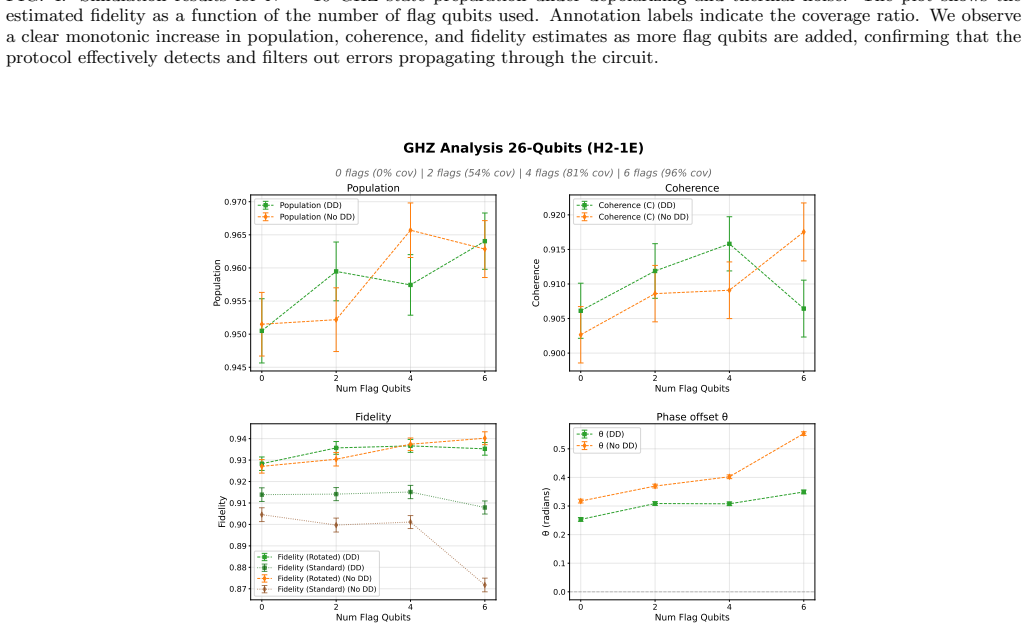
Quantum error mitigation While flag qubits detect errors during state prepara- tion, they do not correct for all noise sources present on the hardware. In particular, readout errors systemati- cally bias the observed bit-string distributions, and low- frequency dephasing during idle circuit periods degrades coherence. To address these residual error chann...
-
[5]
Creating and controlling global Greenberger-Horne-Zeilinger entanglement on quantum processors.Nature Communications, 15(1):8823, 2024
Zehang Bao, Shibo Xu, Zixuan Song, Ke Wang, Liang Xiang, Zitian Zhu, Jiachen Chen, Feitong Jin, Xuhao Zhu, Yu Gao, et al. Creating and controlling global Greenberger-Horne-Zeilinger entanglement on quantum processors.Nature Communications, 15(1):8823, 2024
2024
-
[6]
Compressed sensing shadow tomography.arXiv preprint arXiv:2602.12518, 2026
Joseph Barreto and Daniel Lidar. Compressed sensing shadow tomography.arXiv preprint arXiv:2602.12518, 2026
-
[7]
Mitigating mea- surement errors in multiqubit experiments.Physical Re- view A, 103(4):042605, 2021
Sergey Bravyi, Sarah Sheldon, Abhinav Kandala, David C Mckay, and Jay M Gambetta. Mitigating mea- surement errors in multiqubit experiments.Physical Re- view A, 103(4):042605, 2021
2021
-
[8]
Near-optimal sig- nal recovery from random projections: Universal encod- ing strategies?IEEE Transactions on Information The- ory, 52(12):5406–5425, 2006
Emmanuel J Candes and Terence Tao. Near-optimal sig- nal recovery from random projections: Universal encod- ing strategies?IEEE Transactions on Information The- ory, 52(12):5406–5425, 2006
2006
-
[9]
Practical characterization of quantum de- vices without tomography.Physical Review Letters, 107(21):210404, 2011
Marcus P da Silva, Olivier Landon-Cardinal, and David Poulin. Practical characterization of quantum de- vices without tomography.Physical Review Letters, 107(21):210404, 2011
2011
-
[10]
World Scientific, Singapore, 2nd edition, 2000
Ding-Zhu Du and Frank K Hwang.Combinatorial Group Testing and Its Applications. World Scientific, Singapore, 2nd edition, 2000
2000
-
[11]
A threshold of lnnfor approximating set cover.Journal of the ACM, 45(4):634–652, 1998
Uriel Feige. A threshold of lnnfor approximating set cover.Journal of the ACM, 45(4):634–652, 1998
1998
-
[12]
Direct fidelity esti- mation from few Pauli measurements.Physical Review Letters, 106(23):230501, 2011
Steven T Flammia and Yi-Kai Liu. Direct fidelity esti- mation from few Pauli measurements.Physical Review Letters, 106(23):230501, 2011
2011
-
[13]
Applied and Numer- ical Harmonic Analysis
Simon Foucart and Holger Rauhut.A Mathematical In- troduction to Compressive Sensing. Applied and Numer- ical Harmonic Analysis. Springer New York, New York, NY, 2013
2013
-
[14]
Quantum-enhanced measurements: Beating the stan- dard quantum limit.Science, 306(5700):1330–1336, 2004
Vittorio Giovannetti, Seth Lloyd, and Lorenzo Maccone. Quantum-enhanced measurements: Beating the stan- dard quantum limit.Science, 306(5700):1330–1336, 2004
2004
-
[15]
Going beyond Bell’s theorem
Daniel M Greenberger, Michael A Horne, and Anton Zeilinger. Going beyond Bell’s theorem. InBell’s Theo- rem, Quantum Theory and Conceptions of the Universe, pages 69–72. Springer, 1989
1989
-
[16]
Quantum state tomogra- phy via compressed sensing.Physical Review Letters, 105(15):150401, 2010
David Gross, Yi-Kai Liu, Steven T Flammia, Stephen Becker, and Jens Eisert. Quantum state tomogra- phy via compressed sensing.Physical Review Letters, 105(15):150401, 2010
2010
-
[17]
Toolbox for entanglement detection and fidelity estimation.Physical Review A, 76(3):030305, 2007
Otfried G¨ uhne, Chao-Yang Lu, Wei-Bo Gao, and Jian- Wei Pan. Toolbox for entanglement detection and fidelity estimation.Physical Review A, 76(3):030305, 2007
2007
-
[18]
Nearly optimal sparse Fourier transform
Haitham Hassanieh, Piotr Indyk, Dina Katabi, and Eric Price. Nearly optimal sparse Fourier transform. InPro- ceedings of the Forty-Fourth Annual ACM Symposium on Theory of Computing, pages 563–578. ACM, 2012
2012
-
[19]
Quantum secret sharing.Physical Review A, 59(3):1829, 1999
Mark Hillery, Vladim´ ır Buˇ zek, and Andr´ e Berthiaume. Quantum secret sharing.Physical Review A, 59(3):1829, 1999
1999
-
[20]
Big cats: Entanglement in 120 qubits and beyond.arXiv preprint arXiv:2510.09520, 2025
Ali Javadi-Abhari, Simon Martiel, Alireza Seif, Maika Takita, and Ken X Wei. Big cats: Entanglement in 120 qubits and beyond.arXiv preprint arXiv:2510.09520, 2025
-
[21]
Mitiq: A software package for error mitigation on noisy quantum computers.Quantum, 6:774, 2022
Ryan LaRose, Andrea Mari, Sarah Kaiser, Peter J Kar- alekas, Andre A Alves, Piotr Czarnik, Mohamed El Man- douh, Max H Gordon, Yousef Hindy, Aaron Robertson, et al. Mitiq: A software package for error mitigation on noisy quantum computers.Quantum, 6:774, 2022
2022
-
[22]
Creation of a six-atom ‘Schr¨ odinger cat’ state.Na- ture, 438(7068):639–642, 2005
Dietrich Leibfried, Emanuel Knill, Signe Seidelin, Joe Britton, R Brad Blakestad, John Chiaverini, David B Hume, Wayne M Itano, John D Jost, Christopher Langer, et al. Creation of a six-atom ‘Schr¨ odinger cat’ state.Na- ture, 438(7068):639–642, 2005
2005
-
[23]
Achieving computational gains with quantum error-correction primitives: Generation of long-range entanglement enhanced by error detection
Haoran Liao, Gavin S Hartnett, Ashish Kakkar, Adrian 10 Tan, Michael Hush, Pranav S Mundada, Michael J Bier- cuk, and Yuval Baum. Achieving computational gains with quantum error-correction primitives: Generation of long-range entanglement enhanced by error detection. PRX Quantum, 6(2):020331, 2025
2025
-
[24]
Learning𝑘-body hamiltonians via compressed sensing.arXiv:2410.18928, 2024
Muzhou Ma, Steven T Flammia, John Preskill, and Yu Tong. Learningk-body Hamiltonians via compressed sensing.arXiv preprint arXiv:2410.18928, 2024
-
[25]
Mitigation of readout noise in near-term quan- tum devices by classical post-processing based on detec- tor tomography.Quantum, 4:257, 2020
Filip B Maciejewski, Zolt´ an Zimbor´ as, and Micha l Osz- maniec. Mitigation of readout noise in near-term quan- tum devices by classical post-processing based on detec- tor tomography.Quantum, 4:257, 2020
2020
-
[26]
Low-overhead error detection with spacetime codes.arXiv preprint arXiv:2504.15725, 2025
Simon Martiel and Ali Javadi-Abhari. Low-overhead error detection with spacetime codes.arXiv preprint arXiv:2504.15725, 2025
-
[27]
14-qubit entanglement: Creation and co- herence.Physical Review Letters, 106(13):130506, 2011
Thomas Monz, Philipp Schindler, Julio T Barreiro, Michael Chwalla, Daniel Nigg, William A Coish, Maxim- ilian Harlander, Wolfgang H¨ ansel, Markus Hennrich, and Rainer Blatt. 14-qubit entanglement: Creation and co- herence.Physical Review Letters, 106(13):130506, 2011
2011
-
[28]
Generation and verification of 27- qubit Greenberger-Horne-Zeilinger states in a supercon- ducting quantum computer.Journal of Physics Commu- nications, 5(9):095004, 2021
Gary J Mooney, Gregory AL White, Charles D Hill, and Lloyd CL Hollenberg. Generation and verification of 27- qubit Greenberger-Horne-Zeilinger states in a supercon- ducting quantum computer.Journal of Physics Commu- nications, 5(9):095004, 2021
2021
-
[29]
Scalable mitigation of measure- ment errors on quantum computers.PRX Quantum, 2(4):040326, 2021
Paul D Nation, Hwajung Kang, Neereja Sundaresan, and Jay M Gambetta. Scalable mitigation of measure- ment errors on quantum computers.PRX Quantum, 2(4):040326, 2021
2021
-
[30]
An analysis of approximations for maxi- mizing submodular set functions—I.Mathematical Pro- gramming, 14(1):265–294, 1978
George L Nemhauser, Laurence A Wolsey, and Mar- shall L Fisher. An analysis of approximations for maxi- mizing submodular set functions—I.Mathematical Pro- gramming, 14(1):265–294, 1978
1978
-
[31]
Generation and manipulation of Schr¨ odinger cat states in Rydberg atom arrays.Science, 365(6453):570–574, 2019
Ahmed Omran, Harry Levine, Alexander Keesling, Giu- lia Semeghini, Tout T Wang, Sepehr Ebadi, Hannes Bernien, Alexander S Zibrov, Hannes Pichler, Soon- won Choi, et al. Generation and manipulation of Schr¨ odinger cat states in Rydberg atom arrays.Science, 365(6453):570–574, 2019
2019
-
[32]
Experimental entanglement of four par- ticles.Nature, 404(6775):256–259, 2000
Cass A Sackett, David Kielpinski, Brian E King, Christo- pher Langer, Volker Meyer, Christopher J Myatt, Mary Rowe, Quentin A Turchette, Wayne M Itano, David J Wineland, et al. Experimental entanglement of four par- ticles.Nature, 404(6775):256–259, 2000
2000
-
[33]
Estimation of many-body quantum Hamiltonians via compressive sensing.Physical Review A, 84(1):012107, 2011
Alireza Shabani, Masoud Mohseni, Seth Lloyd, Robert L Kosut, and Herschel Rabitz. Estimation of many-body quantum Hamiltonians via compressive sensing.Physical Review A, 84(1):012107, 2011
2011
-
[34]
Scheme for reducing decoherence in quan- tum computer memory.Physical Review A, 52(4):R2493, 1995
Peter W Shor. Scheme for reducing decoherence in quan- tum computer memory.Physical Review A, 52(4):R2493, 1995
1995
-
[35]
Generation of multicomponent atomic Schr¨ odinger cat states of up to 20 qubits.Science, 365(6453):574–577, 2019
Chao Song, Kai Xu, Hekang Li, Yu-Ran Zhang, Xu Zhang, Wuxin Liu, Qiujiang Guo, Zhen Wang, Wen- hui Ren, Jie Hao, et al. Generation of multicomponent atomic Schr¨ odinger cat states of up to 20 qubits.Science, 365(6453):574–577, 2019
2019
-
[36]
10-qubit entanglement and parallel logic operations with a superconducting circuit
Chao Song, Kai Xu, Wuxin Liu, Chui-ping Yang, Shi- Biao Zheng, Hui Deng, Qiwei Xie, Keqiang Huang, Qiu- jiang Guo, Libo Zhang, et al. 10-qubit entanglement and parallel logic operations with a superconducting circuit. Physical Review Letters, 119(18):180511, 2017
2017
-
[37]
Pearson Prentice Hall, Upper Saddle River, NJ, 2005
Petre Stoica and Randolph L Moses.Spectral Analysis of Signals. Pearson Prentice Hall, Upper Saddle River, NJ, 2005
2005
-
[38]
Dynami- cal decoupling of open quantum systems.Physical Review Letters, 82(12):2417, 1999
Lorenza Viola, Emanuel Knill, and Seth Lloyd. Dynami- cal decoupling of open quantum systems.Physical Review Letters, 82(12):2417, 1999
1999
-
[39]
Dynamical suppression of decoherence in two-state quantum systems.Physical Review A, 58(4):2733, 1998
Lorenza Viola and Seth Lloyd. Dynamical suppression of decoherence in two-state quantum systems.Physical Review A, 58(4):2733, 1998
1998
-
[40]
18-qubit entangle- ment with six photons’ three degrees of freedom.Physical Review Letters, 120(26):260502, 2018
Xi-Lin Wang, Yi-Han Luo, He-Liang Huang, Ming- Cheng Chen, Zu-En Su, Chang Liu, Chao Chen, Wei Li, Yu-Qiang Fang, Xiao Jiang, et al. 18-qubit entangle- ment with six photons’ three degrees of freedom.Physical Review Letters, 120(26):260502, 2018
2018
-
[41]
Verify- ing multipartite entangled Greenberger-Horne-Zeilinger states via multiple quantum coherences.Physical Review A, 101(3):032343, 2020
Ken X Wei, Isaac Lauer, Srikanth Srinivasan, Neereja Sundaresan, Douglas T McClure, David Toyli, David C McKay, Jay M Gambetta, and Sarah Sheldon. Verify- ing multipartite entangled Greenberger-Horne-Zeilinger states via multiple quantum coherences.Physical Review A, 101(3):032343, 2020
2020
-
[42]
Protected quantum computing: Interleaving gate operations with dynamical decoupling sequences.Physical Review Letters, 112(5):050502, 2014
Jingfu Zhang, Alexandre M Souza, Frederico Dias Bran- dao, and Dieter Suter. Protected quantum computing: Interleaving gate operations with dynamical decoupling sequences.Physical Review Letters, 112(5):050502, 2014
2014
discussion (0)
Sign in with ORCID, Apple, or X to comment. Anyone can read and Pith papers without signing in.