Entanglement of multi-qubit quantum graph states and studies structural properties of tripartite graphs with quantum programming
Pith reviewed 2026-05-07 07:01 UTC · model grok-4.3
The pith
Multi-qubit states from weighted tripartite graphs connect entanglement distances to neighbor overlaps and 4-cycles.
A machine-rendered reading of the paper's core claim, the machinery that carries it, and where it could break.
Core claim
Multi-qubit entangled states are constructed to represent weighted tripartite graphs. An explicit expression for the entanglement distance of these states is obtained that holds for arbitrary tripartite structures. The entanglement of a qubit with the remainder of the system is fixed by the weights of edges in its closed neighborhood together with its degree toward the other two partitions. Quantum correlators are calculated in full generality. These quantum quantities are shown to correspond to the graph-theoretic counts of non-overlapping neighbors, common neighbors, and 4-cycles.
What carries the argument
The explicit mapping from a weighted tripartite graph to a multi-qubit quantum graph state, together with the closed-form entanglement-distance formula that translates edge weights and vertex degrees into an observable whose value equals a linear combination of neighbor-overlap and cycle counts.
If this is right
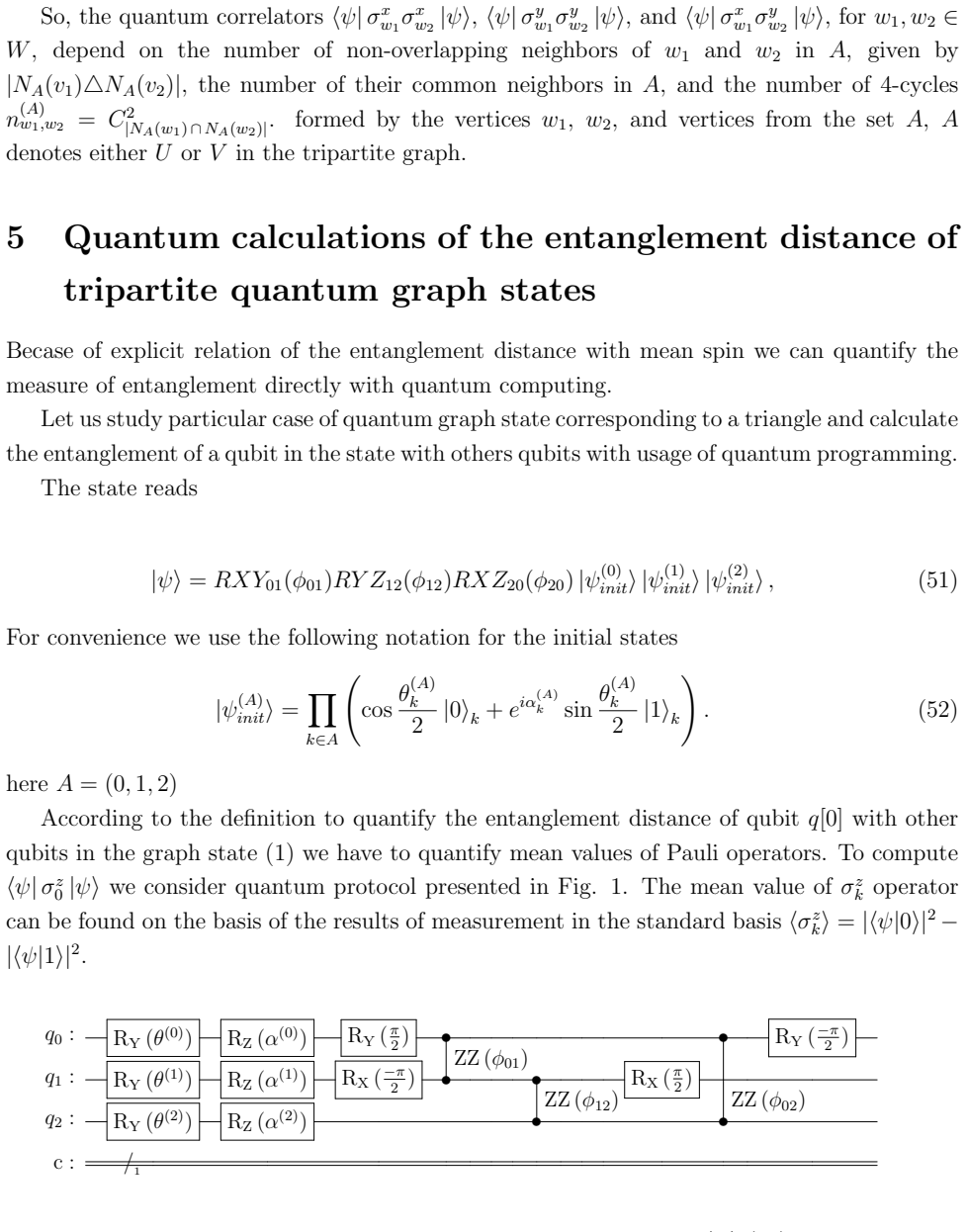
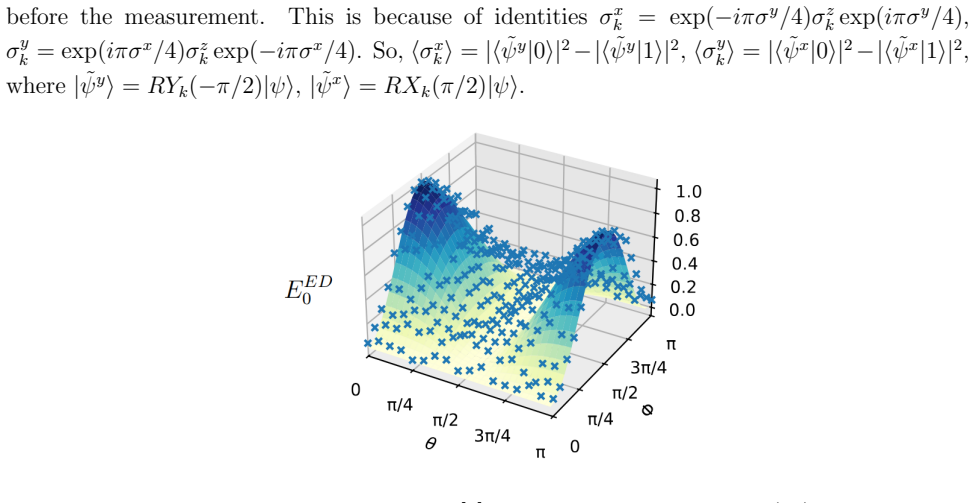
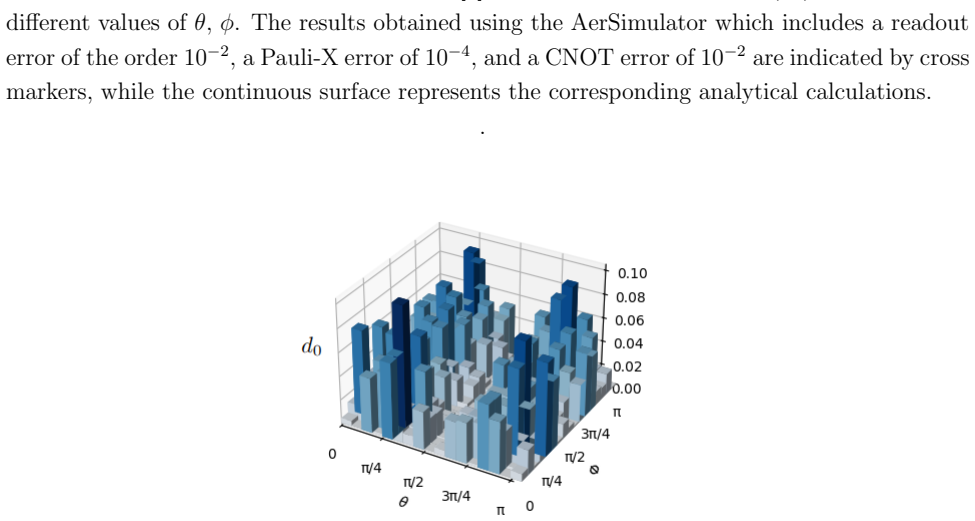
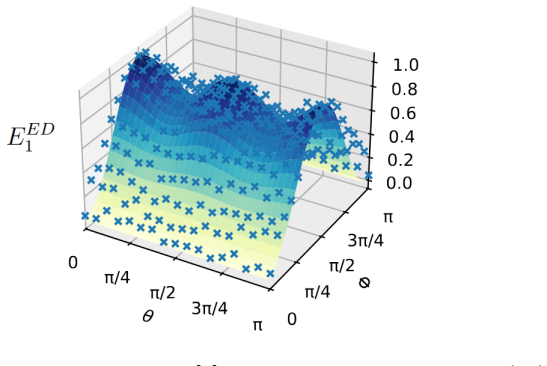
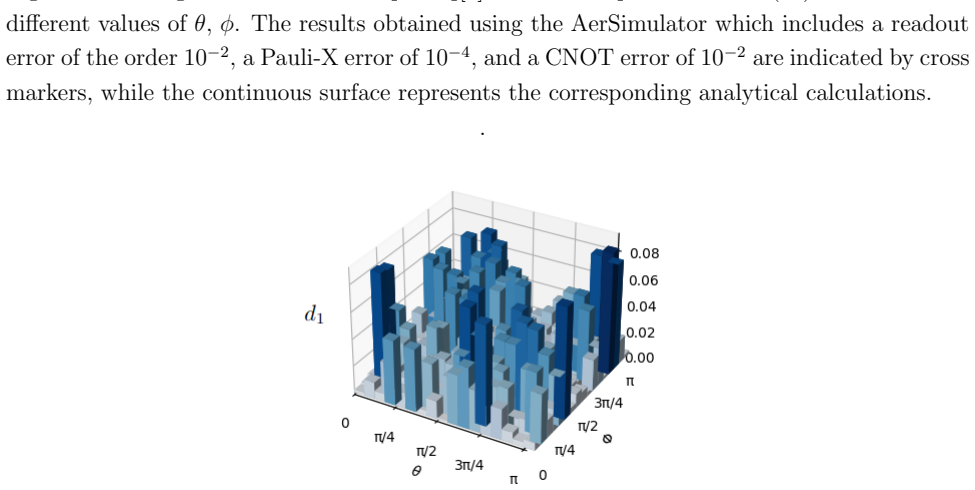
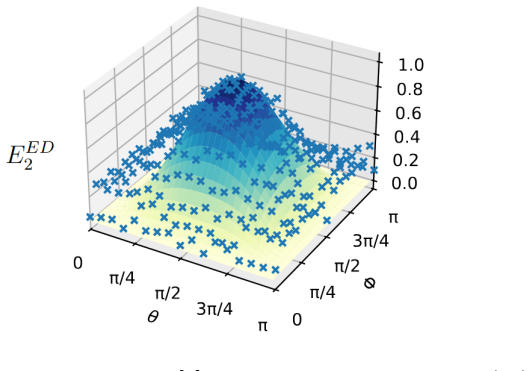
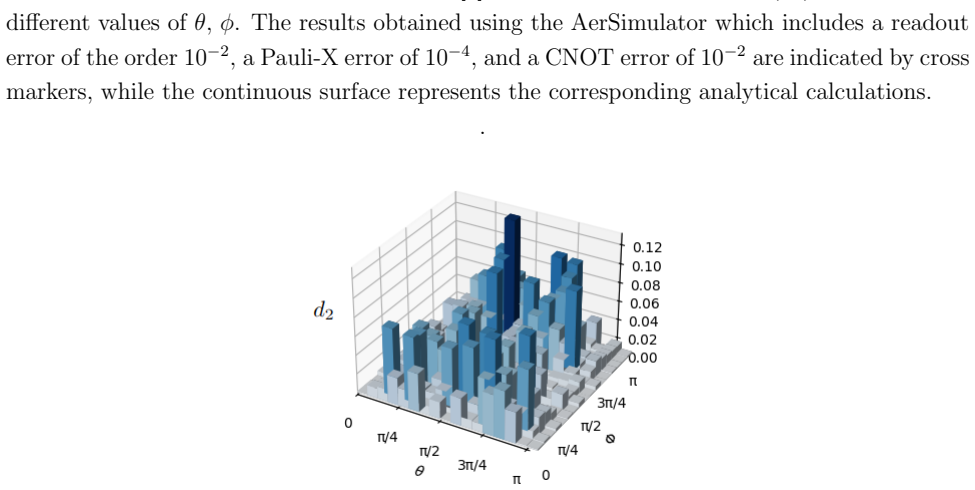
- The entanglement distance for any weighted tripartite graph can be written down in closed form and then verified on a quantum simulator with noise models, as illustrated for the triangle graph.
- Quantum correlators in the constructed states directly encode the number of common neighbors and 4-cycles without enumerating them classically.
- Structural properties of tripartite graphs become accessible to quantum programming, opening a route to study their use in resource allocation and scheduling via quantum hardware.
- The same states furnish a general tool for extracting graph invariants from quantum observables in the tripartite case.
Where Pith is reading between the lines
- If the correspondence survives on larger hardware, quantum measurements could replace classical algorithms for counting certain local substructures in tripartite graphs.
- The construction supplies a concrete bridge between graph theory and quantum information that might be tested by preparing the states on superconducting or trapped-ion processors and reading out the predicted distances.
- Because the states are defined for arbitrary weights, the same framework could be used to explore how continuous parameters in the graph affect discrete combinatorial counts through the lens of entanglement.
Load-bearing premise
The mapping from an arbitrary weighted tripartite graph to a multi-qubit state encodes the intended entanglement structure without hidden constraints from the global topology or from the choice of weights.
What would settle it
For any concrete weighted tripartite graph whose number of 4-cycles and non-overlapping neighbor pairs can be counted by hand, compute the entanglement distance both from the analytic formula and from direct simulation on a noisy quantum simulator; systematic disagreement between the two numbers falsifies the claimed correspondence.
Figures
read the original abstract
We propose a method for constructing multi-qubit entangled quantum states representing weighted tripartite graphs. An expression for the entanglement distance for multi-qubit states corresponding to arbitrary tripartite graph structures is obtained. The entanglement of a qubit with the rest of the system in a quantum graph state is determined by the weights of the edges in the closed neighborhood of the corresponding vertex and by its degree with respect to other sets. We also calculate quantum correlators in the general case of tripartite quantum graph states. We establish a relationship between these quantum properties and the structural properties of the corresponding tripartite graphs, including the number of non-overlapping neighbors, the number of common neighbors of the corresponding vertices, and the number of 4-cycles. As an illustrative example, we consider a tripartite graph forming a triangle and compute the entanglement distance using quantum simulations on the AerSimulator with noise models. The numerical results are consistent with the theoretical predictions. The obtained results demonstrate that quantum graph states provide an effective framework for studying structural properties of tripartite graphs. They open up the possibility of investigating such properties using quantum programming. It is worth highlighting that tripartite graphs have applications in solving practical problems such as resource allocation, scheduling, and database and hypergraph modeling.
Editorial analysis
A structured set of objections, weighed in public.
Referee Report
Summary. The paper claims to introduce a construction of multi-qubit quantum graph states from weighted tripartite graphs, derive a general expression for the entanglement distance, compute quantum correlators in the general case, and establish relationships between these quantum properties and tripartite graph structural invariants including the number of non-overlapping neighbors, common neighbors, and 4-cycles. It supports the claims with an illustrative noisy simulation of a triangle graph on the AerSimulator that matches theoretical predictions and discusses applications to problems such as resource allocation via quantum programming.
Significance. If the general expressions for entanglement distance and correlators are rigorously derived and the claimed relationships to graph invariants hold for arbitrary weights, the work would provide a bridge between quantum information measures and combinatorial graph properties, potentially enabling quantum programming techniques for analyzing tripartite graphs in optimization contexts. The simulation verification is a positive element, but the limited scope of the numerical test and absence of detailed derivations reduce the current significance.
major comments (2)
- [§3] §3, entanglement distance expression: the manuscript states that an expression is obtained for arbitrary weighted tripartite graphs and that the entanglement of a qubit is determined by edge weights in its closed neighborhood and degree to other partitions, yet asserts a direct relationship to the number of non-overlapping neighbors, common neighbors, and 4-cycles. For arbitrary real weights the underlying state (constructed via weighted controlled-phase operations) produces correlator expansions containing cross terms whose coefficients depend on specific weight products; the derivation must explicitly demonstrate cancellation or factorization of these terms to support the weight-independent combinatorial claim.
- [§5] §5, numerical example: the simulation is performed only on the triangle graph K_{1,1,1} with unspecified weights. This graph contains no 4-cycles and does not probe unequal weights or larger structures, so the results do not substantiate the general relationship to the number of 4-cycles or the behavior of the entanglement distance expression under the full range of arbitrary weights.
minor comments (3)
- [§2] §2: the precise construction of the multi-qubit state vector from the weighted tripartite graph is described at a high level; the explicit formula for the state (including normalization and the action of the weighted gates) should be provided.
- The noise model parameters used in the AerSimulator runs are not specified, preventing exact reproduction of the numerical results.
- [References] The bibliography is sparse; key references on graph states (e.g., Hein et al.) and entanglement measures for graph states should be added.
Simulated Author's Rebuttal
We thank the referee for the constructive and detailed comments, which have helped us improve the clarity and rigor of the manuscript. We address each major comment point by point below.
read point-by-point responses
-
Referee: [§3] §3, entanglement distance expression: the manuscript states that an expression is obtained for arbitrary weighted tripartite graphs and that the entanglement of a qubit is determined by edge weights in its closed neighborhood and degree to other partitions, yet asserts a direct relationship to the number of non-overlapping neighbors, common neighbors, and 4-cycles. For arbitrary real weights the underlying state (constructed via weighted controlled-phase operations) produces correlator expansions containing cross terms whose coefficients depend on specific weight products; the derivation must explicitly demonstrate cancellation or factorization of these terms to support the weight-independent combinatorial claim.
Authors: We thank the referee for this observation on the derivation. In Section 3 the entanglement distance is obtained from the reduced density matrix of a single qubit after the sequence of weighted controlled-phase gates between the three partitions. When expanding the relevant multi-qubit correlators that enter the purity, products of distinct edge weights appear. Because the phase gates act exclusively between different partitions, any path that traverses an odd number of edges between the same pair of partitions acquires a phase that cancels upon tracing, while even-length closed walks (precisely the 4-cycles and common-neighbor overlaps) survive and factor according to the combinatorial multiplicity. Non-overlapping neighbors contribute only through their individual degrees. Consequently the final expression for the entanglement distance depends on the three listed graph invariants multiplied by functions of the local weights; the cross terms therefore do not remain as arbitrary weight products but are absorbed into the combinatorial counts. To make this factorization fully transparent we have inserted an expanded step-by-step calculation in the revised Section 3 that isolates each class of terms and shows the cancellation explicitly for arbitrary real weights. revision: yes
-
Referee: [§5] §5, numerical example: the simulation is performed only on the triangle graph K_{1,1,1} with unspecified weights. This graph contains no 4-cycles and does not probe unequal weights or larger structures, so the results do not substantiate the general relationship to the number of 4-cycles or the behavior of the entanglement distance expression under the full range of arbitrary weights.
Authors: The simulation in Section 5 is presented strictly as an illustrative consistency check for the simplest non-trivial tripartite graph under realistic noise on the AerSimulator; the weights are in fact set to unity (as stated in the caption) and the graph indeed contains no 4-cycles. The general analytic relationships to neighbor counts and 4-cycles are derived in Sections 3 and 4 and do not rely on the numerical example. Nevertheless, the referee is correct that a single small instance cannot probe the full range of the claimed expressions. We have therefore added a new subsection to the revised Section 5 containing simulations on a larger tripartite graph that includes multiple 4-cycles and employs both equal and unequal real weights; the numerical entanglement distances and correlators are shown to match the general formulas within statistical error, thereby providing direct numerical support for the combinatorial claims under arbitrary weights. revision: yes
Circularity Check
No significant circularity detected in derivation of entanglement expressions from graph states
full rationale
The paper proposes a direct construction of multi-qubit states from arbitrary weighted tripartite graphs, followed by explicit calculation of an entanglement distance expression and general quantum correlators based on edge weights in closed neighborhoods and vertex degrees across partitions. Relationships to combinatorial graph invariants (non-overlapping neighbors, common neighbors, 4-cycles) are presented as emerging from these calculations. No self-definitional loops, fitted parameters renamed as predictions, or load-bearing self-citations are indicated. The single numerical verification on a triangle graph serves as consistency check rather than input to the derivation. The mapping is self-contained within standard quantum state definitions and graph combinatorics, without reduction of outputs to inputs by construction.
Axiom & Free-Parameter Ledger
free parameters (1)
- edge weights
axioms (2)
- standard math Standard definitions of multi-qubit entanglement and correlators from quantum information theory
- domain assumption Tripartite graphs are undirected with three partitions and weighted edges between partitions
Reference graph
Works this paper leans on
-
[1]
R. Horodecki, P. Horodecki, M. Horodecki, K. Horodecki, Rev. Mod. Phys. 81, 865 (2009)
work page 2009
-
[2]
R. P. Feynman, Int. J. Theor. Phys. 21, 467 (1982)
work page 1982
-
[3]
A. K. Ekert, Phys. Rev. Lett., 67, 661 (1991)
work page 1991
-
[4]
C. H. Bennett, G. Brassard, C. Crepeau, R. Jozsa, A. Peres, W. K. Wootters, Phys. Rev. Lett. 70, 1895 (1993)
work page 1993
- [5]
-
[6]
D. Bouwmeester, J.-W. Pan, K. Mattle, M. Eibl, H. Weinfurter, A. Zeilinger, Nature 390, 575 (1997)
work page 1997
- [7]
- [8]
- [9]
- [10]
-
[11]
A. D’Arrigo, R. Lo Franco, G. Benenti, E. Paladino, G. Falci, Ann. Phys., 350, 211-224 (2014)
work page 2014
-
[12]
Shaoping Shi, Long Tian, Yajun Wang et al, Phys. Rev. Lett. 125, 070502 (2020)
work page 2020
-
[13]
D. Llewellyn, Yu. Ding, I. I. Faruque et al, Nature Physics 16, 148 (2020). 16
work page 2020
-
[14]
T. Jennewein, Ch. Simon, G. Weihs et al, Phys. Rev. Lett. 84, 4729 (2000)
work page 2000
- [15]
-
[16]
B. K. Behera, S. Seth, A. Das, P. K. Panigrahi, Quantum Information Processing 18, 108 (2019)
work page 2019
-
[17]
A. J. Scott, Phys. Rev. A 69, 052330 (2004)
work page 2004
-
[18]
Ni-Ni Huang, Wei-Hao Huang, Che-Ming Li, Scientific Reports 10, 3093 (2020)
work page 2020
-
[19]
Juan Yin, Yu-Huai Li, Sheng-Kai Liao et al, Nature 582, 501 (2020)
work page 2020
-
[20]
J. Torrico, M. Rojas, S. M. de Souza, et al, EPL (Europhysics Letters), 108, 50007 (2014)
work page 2014
-
[21]
Yu-Bo Sheng, Lan Zhou, EPL (Europhysics Letters) 109, 40009 (2015)
work page 2015
-
[22]
A. Vesperini, G. Bel-Hadj-Aissa, L. Capra, R. Franzosi,Front. Phys. 19, 51204, (2024)
work page 2024
-
[23]
D. Cocchiarella, S. Scali, B. N. Ribisi, G. Bel-Hadj-Aissa, R. Franzosi, Phys. Rev. A, 101, 042129, (2020)
work page 2020
-
[24]
Alba Cervera-Lierta J. I. Latorre, D. Goyeneche, Phys. Rev. A 100, 022342, (2019)
work page 2019
-
[25]
B. A. Bell, D. A. Herrera-Martini, M. S. Tame, Nature Communications 5, 3658 (2014)
work page 2014
- [26]
- [27]
- [28]
-
[29]
Yuanhao Wang, Ying Li, Zhang-qi Yin, Bei Zeng, npj Quant. Inf. 4, 46 (2018)
work page 2018
-
[30]
G. J. Mooney, Ch. D. Hill, L. C. L. Hollenberg, Sci. Rep. 9, 13465 (2019)
work page 2019
- [31]
- [32]
- [33]
-
[34]
Kh. P. Gnatenko, Phys. Lett. A 566, 131191 (2026)
work page 2026
-
[35]
Kh. P. Gnatenko, 2025 IEEE International Conference on Quantum Computing and En- gineering (QCE), Albuquerque, NM, USA, 2025, 470–471 (2025)
work page 2025
-
[36]
Kh. P. Gnatenko, Phys. Lett. A 521, 129815 (2024). 17
work page 2024
-
[37]
N. A. Susulovska, Kh. P. Gnatenko Proceedings - 2021 IEEE International Conference on Quantum Computing and Engineering, QCE 2021, Virtual, Online, 17 October 2021 through 22 October 2021 465-466 (2021)
work page 2021
-
[38]
M. Hein, J. Eisert, H. J. Briegel, Phys. Rev. A 69, 062311 (2004)
work page 2004
-
[39]
O. G¨ uhne, G. T´ oth, Ph. Hyllus, H. J. Briegel, Phys. Rev. Lett. 95, 120405, (2005)
work page 2005
-
[40]
Y. Qian, Z. Shen, G. He, and G. Zeng, Phys. Rev. A 86, 052333 (2012)
work page 2012
- [41]
-
[42]
A. Akhound, S. Haddadi, Mohammad Ali Chaman Motlagh, Mod. Phys. Lett. B 33, 1950118 (2019)
work page 2019
-
[43]
S. Haddadi, A. Akhound, Mohammad Ali Chaman Motlagh, Int. J. Theor. Phys. 58, 3406 (2019)
work page 2019
-
[44]
A. Cabello, A. J. Lopez-Tarrida, P. Moreno, J. R. Portillo, Phys. Lett. A 373 2219 (2009). 4, 46 (2018)
work page 2009
- [45]
- [46]
-
[47]
https://docs.quantum.ibm.com/api/qiskit/0.37/qiskit.providers.aer.AerSimulator 18
IBM Quantum Documentation. https://docs.quantum.ibm.com/api/qiskit/0.37/qiskit.providers.aer.AerSimulator 18
discussion (0)
Sign in with ORCID, Apple, or X to comment. Anyone can read and Pith papers without signing in.