Nodal algebraic curves and entropy diagnostics in degenerate two-dimensional harmonic-oscillator shells
Pith reviewed 2026-05-11 00:43 UTC · model grok-4.3
The pith
Algebraic curves organize nodal geometry in degenerate 2D harmonic oscillator eigenspaces
A machine-rendered reading of the paper's core claim, the machinery that carries it, and where it could break.
Core claim
Degenerate quantum eigenspaces can support substantial changes in nodal geometry at fixed energy. We show that, for the two-dimensional isotropic harmonic oscillator, this restructuring is organized by the Hermite-constrained algebraic curve P_N(x,y)=0 associated with each real shell state, ψ_N(x,y)=e^{-α r^2/2}P_N(x,y). Finite singularities, P_N=∇P_N=0, together with projective degeneracies of the leading homogeneous part, identify the strata where topology-changing events can occur. We combine these algebraic criteria with three information diagnostics: the nodal-domain entropy S_dom, the Cartesian mutual information I(x;y), and the entropic uncertainty sum S_r+S_p. Algebraic stratifcation
What carries the argument
The Hermite-constrained algebraic curve P_N(x,y)=0, whose finite singularities and projective degeneracies locate the strata of possible topology changes in the nodal structure of real shell states
If this is right
- The N=1 shell only rotates a nodal line.
- The N=2 shell exhibits a conic transition at b^2=2ac, sharply detected by S_dom but not by global entropies.
- The N=3 shell supports cubic close-branch regimes organized by the projective discriminant, with enhanced responses in S_dom and I(x;y).
- The algebraic stratification defines experimentally testable signatures in real-phase Hermite-Gaussian structured light and approximately isotropic trapped motional systems.
- It suggests a geometry-sensitive verification primitive for fixed-shell bosonic-qudit gates.
Where Pith is reading between the lines
- Extensions to other degenerate quantum systems could use similar algebraic curves to predict nodal transitions.
- The entropy diagnostics may serve as sensitive probes for nodal topology changes in experimental quantum optics setups.
- Application to bosonic-qudit gates could enable geometry-based error detection or state verification protocols.
Load-bearing premise
That the finite singularities and projective degeneracies of the Hermite-constrained algebraic curve P_N(x,y)=0 accurately locate all topology-changing events in the nodal structure of the real shell states for the given wavefunction form.
What would settle it
Observation in the N=2 shell of whether the nodal-domain entropy S_dom shows a sharp transition exactly at the conic condition b^2 = 2ac, while global entropies do not, would confirm or refute the algebraic stratification claim.
Figures


read the original abstract
Degenerate quantum eigenspaces can support substantial changes in nodal geometry at fixed energy. We show that, for the two-dimensional isotropic harmonic oscillator, this restructuring is organized by the Hermite-constrained algebraic curve \(P_N(x,y)=0\) associated with each real shell state, $\psi_N(x,y)=e^{-\alpha r^2/2}P_N(x,y)$. Finite singularities, \(P_N=\nabla P_N=0\), together with projective degeneracies of the leading homogeneous part, identify the strata where topology-changing events can occur. We combine these algebraic criteria with three information diagnostics: the nodal-domain entropy \(S_{\rm dom}\), the Cartesian mutual information \(I(x;y)\), and the entropic uncertainty sum \(S_r+S_p\). The first three shells reveal a clear hierarchy. The \(N=1\) shell only rotates a nodal line; the \(N=2\) shell exhibits a conic transition at \(b^2=2ac\), sharply detected by \(S_{\rm dom}\) but not by global entropies; and the \(N=3\) shell supports cubic close-branch regimes organized by the projective discriminant, with enhanced responses in \(S_{\rm dom}\) and \(I(x;y)\). Thus algebraic stratification, rather than spectral ordering, organizes nodal geometry inside a degenerate eigenspace, while entropy diagnostics quantify the associated probability redistribution and coordinate correlations. The same stratification defines experimentally testable signatures in real-phase Hermite--Gaussian structured light and approximately isotropic trapped motional systems, and suggests a geometry-sensitive verification primitive for fixed-shell bosonic-qudit gates.
Editorial analysis
A structured set of objections, weighed in public.
Referee Report
Summary. The manuscript claims that, for the two-dimensional isotropic harmonic oscillator, nodal geometry restructuring inside degenerate eigenspaces is organized by the Hermite-constrained algebraic curve P_N(x,y)=0 of the real shell state ψ_N = e^{-α r²/2} P_N(x,y). Finite singularities (P_N = ∇P_N = 0) together with projective degeneracies of the leading homogeneous part delineate the strata at which nodal-domain topology changes occur. Explicit verification is given for the N=1 shell (nodal-line rotation), the N=2 shell (conic transition at b²=2ac), and the N=3 shell (cubic close-branch regimes organized by the projective discriminant); these transitions are quantified by the nodal-domain entropy S_dom, Cartesian mutual information I(x;y), and entropic uncertainty sum S_r + S_p, with the first two diagnostics showing enhanced sensitivity. The same stratification is proposed to yield experimentally testable signatures in real-phase Hermite-Gaussian beams and trapped motional systems.
Significance. If the algebraic loci indeed exhaust the topology-changing events, the work supplies a geometry-first classification of nodal patterns that is independent of spectral ordering and directly links algebraic singularities to measurable information-theoretic quantities. The concrete, parameter-free criteria for N=1–3, the differential response of S_dom versus global entropies, and the suggested mapping to structured light and approximately isotropic traps constitute falsifiable predictions. These elements, together with the explicit low-N checks, give the manuscript a clear route to experimental verification.
major comments (2)
- [Abstract] Abstract and the N=1–3 demonstrations: the assertion that finite singularities P_N=∇P_N=0 together with projective degeneracies of the leading homogeneous part “identify the strata where topology-changing events can occur” is verified only by explicit calculation for N=1,2,3; no general argument is supplied showing that other real-plane bifurcations are impossible inside the degenerate eigenspace for arbitrary N. This exhaustiveness claim is load-bearing for the central statement that algebraic stratification organizes nodal geometry.
- [Abstract] Abstract and implied N=2 section: the claim that S_dom “sharply detects” the conic transition at b²=2ac while global entropies do not is stated without the explicit wavefunction expansions, the precise definition of the nodal-domain entropy functional, or the numerical protocol used to evaluate it across the (a,b,c) parameter space. These omissions prevent independent assessment of the reported sensitivity.
minor comments (2)
- [Abstract] The abstract refers to “the first three shells reveal a clear hierarchy” but does not indicate the section or figure in which this hierarchy is quantified or tabulated.
- Notation: the construction of the polynomial P_N(x,y) from the underlying Hermite polynomials is not restated in the abstract; a one-sentence reminder of the precise linear combination would improve readability.
Simulated Author's Rebuttal
We thank the referee for the careful reading, positive significance assessment, and constructive major comments. We address each point below with a general mathematical justification where appropriate and concrete additions to the manuscript. The revisions will strengthen clarity without altering the core claims.
read point-by-point responses
-
Referee: [Abstract] Abstract and the N=1–3 demonstrations: the assertion that finite singularities P_N=∇P_N=0 together with projective degeneracies of the leading homogeneous part “identify the strata where topology-changing events can occur” is verified only by explicit calculation for N=1,2,3; no general argument is supplied showing that other real-plane bifurcations are impossible inside the degenerate eigenspace for arbitrary N. This exhaustiveness claim is load-bearing for the central statement that algebraic stratification organizes nodal geometry.
Authors: The general argument follows from standard results in differential topology and real algebraic geometry. The nodal set of any real shell state is the zero locus of a degree-N plane curve P_N(x,y). By the implicit function theorem, in any open set where the curve is smooth (P_N ≠ 0 or ∇P_N ≠ 0), sufficiently small perturbations of the coefficients induce only C^∞ deformations of the zero set; the number and connectivity of its connected components are therefore locally constant. Global topology changes can occur only when the curve acquires singularities or when its projective closure becomes singular at infinity. The latter are precisely the loci where the leading homogeneous part degenerates. These conditions therefore define the discriminant hypersurface in the projective space of coefficients that partitions the degenerate eigenspace into chambers of constant nodal topology. The explicit N=1–3 calculations confirm that crossings of these loci produce the observed changes; the same algebraic criteria apply verbatim for arbitrary N. We will insert a short paragraph spelling out this reasoning immediately after the statement of the algebraic criteria. revision: yes
-
Referee: [Abstract] Abstract and implied N=2 section: the claim that S_dom “sharply detects” the conic transition at b²=2ac while global entropies do not is stated without the explicit wavefunction expansions, the precise definition of the nodal-domain entropy functional, or the numerical protocol used to evaluate it across the (a,b,c) parameter space. These omissions prevent independent assessment of the reported sensitivity.
Authors: We agree that reproducibility requires these details. In the revised manuscript we will add: (i) the explicit real linear combinations of the N=2 Hermite-Gaussian basis functions that realize the general conic P_2 = a x² + b x y + c y²; (ii) the definition S_dom = −∑_i p_i log p_i, where the sum runs over the connected components of ℝ² minus the nodal set and each p_i is the L¹ mass ∫_{D_i} |ψ_N|² dx dy normalized to unity; (iii) the numerical protocol, which discretizes a large square on a uniform grid, applies a flood-fill algorithm to label domains, and evaluates the integrals by trapezoidal quadrature, with convergence verified by successive grid refinement. These additions will allow direct reproduction of the reported contrast between S_dom and the global entropies at the b² = 2ac locus. revision: yes
Circularity Check
No circularity: algebraic loci and entropy functionals are independently applied to the same states
full rationale
The manuscript defines P_N(x,y) directly as the polynomial factor in the real shell wavefunction ψ_N = e^{-α r²/2} P_N and locates its finite singularities P_N = ∇P_N = 0 together with projective degeneracies of the leading homogeneous component by standard algebraic geometry. These loci are then used to partition coefficient space, after which the independent functionals S_dom, I(x;y) and S_r + S_p are evaluated on the probability densities |ψ_N|². For the N=1,2,3 shells the correspondence is confirmed by explicit computation of nodal domains and entropy values at the algebraic strata (e.g., the conic transition b²=2ac for N=2). No step equates a derived quantity to its input by construction, no parameter is fitted and then relabeled a prediction, and no load-bearing claim rests on a self-citation whose content is itself unverified. The entropy diagnostics remain external information-theoretic measures applied after the algebraic stratification is fixed.
Axiom & Free-Parameter Ledger
axioms (2)
- domain assumption The real eigenfunctions of the 2D isotropic harmonic oscillator in a degenerate shell N take the form ψ_N(x,y) = e^{-α r²/2} P_N(x,y) with P_N a real polynomial.
- standard math Finite singularities (P_N = ∇P_N = 0) and projective degeneracies of the leading homogeneous part locate the strata where nodal topology can change.
Lean theorems connected to this paper
-
IndisputableMonolith/Foundation/AlexanderDuality.leanalexander_duality_circle_linking unclear?
unclearRelation between the paper passage and the cited Recognition theorem.
Finite singularities, P_N=∇P_N=0, together with projective degeneracies of the leading homogeneous part, identify the strata where topology-changing events can occur.
-
IndisputableMonolith/Cost/FunctionalEquation.leanwashburn_uniqueness_aczel unclear?
unclearRelation between the paper passage and the cited Recognition theorem.
The nodal-domain entropy S_dom = −∑ p_k ln p_k ... quantifies how probability is distributed across the nodal partition itself.
What do these tags mean?
- matches
- The paper's claim is directly supported by a theorem in the formal canon.
- supports
- The theorem supports part of the paper's argument, but the paper may add assumptions or extra steps.
- extends
- The paper goes beyond the formal theorem; the theorem is a base layer rather than the whole result.
- uses
- The paper appears to rely on the theorem as machinery.
- contradicts
- The paper's claim conflicts with a theorem or certificate in the canon.
- unclear
- Pith found a possible connection, but the passage is too broad, indirect, or ambiguous to say the theorem truly supports the claim.
Reference graph
Works this paper leans on
-
[1]
Configuration-space Shannon entropyS r Sr =− ZZ R2 ρ(x, y) lnρ(x, y)dx dy.(17)
-
[2]
The Cartesian mutual information given by I(x;y) =S x +S y −S r ≥0,(18) is defined in terms ofS x andS y, Sx =− Z ρx lnρ x dx, Sy =− Z ρy lnρ y dy, (19) where the marginal distributions are ρx(x) = Z ∞ −∞ ρ(x, y)dy,(20) ρy(y) = Z ∞ −∞ ρ(x, y)dx, respectively. For a single particle in two dimen- sions,I(x;y) is not an entanglement measure be- tween two par...
-
[3]
Nodal-domain entropyS dom. Let{Ω k}be the con- nected components of R2 \ {(x, y) :ψ N(x, y) = 0},(21) that is, the maximal connected open sets on which ψN has definite sign. Their probability weights are pk = Z Ωk ρ(x, y)dx dy, X k pk = 1,(22) 4 and the associated entropy is Sdom =− X k pk lnp k.(23) UnlikeS r, this quantity is tied directly to the nodal ...
-
[4]
Entropic uncertainty sumS r +S p. Given the momentum-space wavefunction ˜ψN(px, py), the normalized momentum density ˜ρ(px, py) is ˜ρ(px, py) = | ˜ψN(px, py)|2 RR R2 | ˜ψN(px, py)|2 dpx dpy ,(24) and the corresponding momentum-space Shannon entropy takes the form Sp =− ZZ R2 ˜ρ(px, py) ln ˜ρ(px, py)dp x dpy.(25) The entropic uncertainty sum Sr +S p,(26) m...
-
[5]
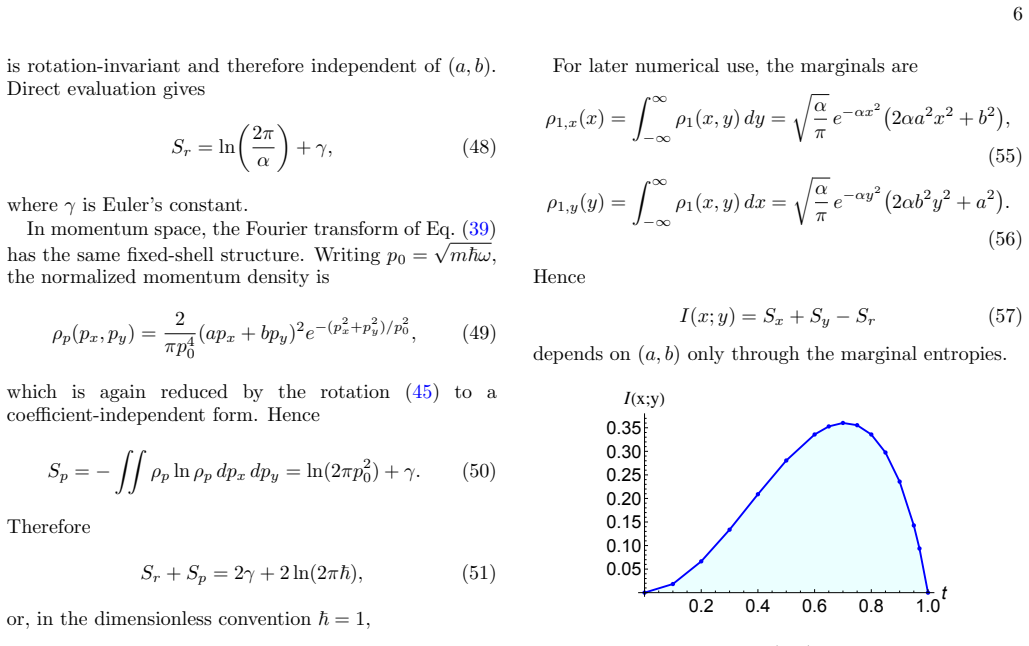
+γ.(50) Therefore Sr +S p = 2γ+ 2 ln(2πℏ),(51) or, in the dimensionless conventionℏ= 1, Sr +S p = 2γ+ 2 ln(2π).(52) Along the patha= √ 1−t 2,b=t, this sum is constant: varying the coefficients only rotates the state. E. Nodal-domain entropy The lineax+by= 0 divides the plane into two nodal domains. In the coordinates (45), these areu >0 and u <0. Becauseρ...
-
[6]
These amplitudes are comparable near t= 1/ √ 2, where the cubic approaches a close-branch regime
Along (95), the Φ 30 and Φ12 contributions scale as √ 1−t 2, whereas the Φ21 contribu- tion scales ast. These amplitudes are comparable near t= 1/ √ 2, where the cubic approaches a close-branch regime. The lower-order Hermite terms shift the most pronounced deformation slightly away from this naive balance point. A useful analytic checkpoint is the degene...
-
[7]
= 0. The first factor gives finite affine singularities; the second gives the rank-degenerate quadratic part controlling the ellipse-to-hyperbola transition. N= 3: constrained cubic curves ForN= 3, after division by an irrelevant nonzero factor, Q3(ξ, η) = 2c3ξ3 + 2 √ 3c 2ξ2η+ 2 √ 3c 1ξη2 + 2c0η3 −(3c 3 + √ 3c 1)ξ−( √ 3c 2 + 3c0)η. Thus theN= 3 shell prod...
-
[8]
Cubic-shell discriminants forN= 3 TheN= 3 shell does not generate arbitrary real cu- bics. Its polynomial has the Hermite-constrained odd form P3(x, y) =Ax 3 +Bx 2y+Cxy 2 +Dy 3 +Ex+F y,(C1) with the linear coefficients fixed by the cubic part: E=− 3A+C 2α , F=− B+ 3D 2α .(C2) Equivalently, if H3(x, y) =Ax 3 +Bx 2y+Cxy 2 +Dy 3,(C3) then P3 =H 3 − 1 4α ∇2H3...
-
[9]
Critical-value diagnostic To distinguish an exact finite singularity from a close approach of smooth nodal branches, we also computed a critical-value diagnostic for theN= 3 path. For each sampled value oft, the real critical points of the cubic were obtained by solving ∂xP3(x, y;t) = 0, ∂ yP3(x, y;t) = 0. At such a point, an actual finite singularity of ...
-
[10]
R. Courant and D. Hilbert,Methods of Mathematical Physics, Vol. 1, 1st ed., Springer Series in Synergetics (Interscience Publishers, Inc. New York, Berlin, 1966)
work page 1966
-
[11]
P. Charron and C. L´ ena, Pleijel’s Theorem for Schr¨ odinger Operators, Ann. Henri Poincar´ e26, 759–786 (2025)
work page 2025
-
[12]
V. N. Karpushkin, Topology of the zeros of eigenfunc- tions, Funct. Anal. Its Appl.23, 218–220 (1989)
work page 1989
-
[13]
V. I. Arnol’d, M. I. Vishik, Y. S. Il’yashenko, A. S. Kalashnikov, V. A. Kondrat’ev, S. N. Kruzhkov, E. M. Landis, V. M. Millionshchikov, O. A. Oleinik, A. F. Fil- ippov, and M. A. Shubin, Some unsolved problems in the theory of differential equations and mathematical physics, Russian Mathematical Surveys44, 157 (1989)
work page 1989
-
[14]
V. I. Arnold, Topological properties of eigenoscillations in mathematical physics, Proc. Steklov Inst. Math.273, 25–34 (2011)
work page 2011
-
[15]
Fulton,Algebraic Curves: An Introduction to Alge- braic Geometry(W
W. Fulton,Algebraic Curves: An Introduction to Alge- braic Geometry(W. A. Benjamin, New York, 1969)
work page 1969
-
[16]
Fischer,Plane Algebraic Curves, Student Mathemat- ical Library, Vol
G. Fischer,Plane Algebraic Curves, Student Mathemat- ical Library, Vol. 15 (American Mathematical Society, Providence, RI, 2001)
work page 2001
-
[17]
Milnor,Singular Points of Complex Hypersurfaces, An- nals of Mathematics Studies, Vol
J. Milnor,Singular Points of Complex Hypersurfaces, An- nals of Mathematics Studies, Vol. 61 (Princeton Univer- sity Press, Princeton, NJ, 1968)
work page 1968
-
[18]
P. Sch¨ urger and V. Engel, On the relation between nodal structures in quantum wave functions and particle corre- lation, AIP Advances13, 125307 (2023)
work page 2023
-
[19]
P. Sch¨ urger and V. Engel, Differential Shannon entropies characterizing electron–nuclear dynamics and correla- tion: Momentum-space versus coordinate-space wave packet motion, Entropy25, 970 (2023)
work page 2023
-
[20]
P. B´ erard and B. Helffer, On the nodal patterns of the 2d isotropic quantum harmonic oscillator, https://arxiv.org/abs/1506.02374 (2015)
-
[21]
T. Beck and B. Hanin, Level spacings and nodal sets at infinity for radial perturbations of the harmonic oscilla- tor, International Mathematics Research Notices2021, 5007 (2021), https://academic.oup.com/imrn/article- pdf/2021/7/5007/36871947/rny290.pdf
work page 2021
-
[22]
R. J. Y´ a˜ nez, W. Van Assche, and J. S. Dehesa, Po- sition and momentum information entropies of the D- dimensional harmonic oscillator and hydrogen atom, Phys. Rev. A50, 3065 (1994)
work page 1994
-
[23]
J. S. Dehesa and I. V. Toranzo, Dispersion and entropy- like measures of multidimensional harmonic systems: ap- plication to Rydberg states and high-dimensional oscil- lators, Eur. Phys. J. Plus135(2020)
work page 2020
-
[24]
S. Wehner and A. Winter, Entropic uncertainty rela- tions—a survey, New Journal of Physics12, 025009 (2010)
work page 2010
-
[25]
V. Majern´ ık and T. Opatrn´ y, Entropic uncertainty re- 21 lations for a quantum oscillator, Journal of Physics A: Mathematical and General29, 2187 (1996)
work page 1996
- [26]
-
[27]
J. B¨ utow, J. S. Eismann, V. Sharma, D. Brandm¨ uller, and P. Banzer, Generating free-space structured light with programmable integrated photonics, Nature Pho- tonics18, 243 (2024)
work page 2024
-
[28]
H. Jeon, J. Kang, J. Kim, W. Choi, K. Kim, and T. Kim, Experimental realization of entangled coherent states in two-dimensional harmonic oscillators of a trapped ion, Scientific Reports14, 6847 (2024)
work page 2024
discussion (0)
Sign in with ORCID, Apple, or X to comment. Anyone can read and Pith papers without signing in.