Broadband Wide Field of View Imaging with Computational Mirrors
Pith reviewed 2026-05-09 22:29 UTC · model grok-4.3
The pith
A concave mirror plus 2-4 images and a new PSF model produces sharp all-in-focus VIS-SWIR images with one sensor.
A machine-rendered reading of the paper's core claim, the machinery that carries it, and where it could break.
Core claim
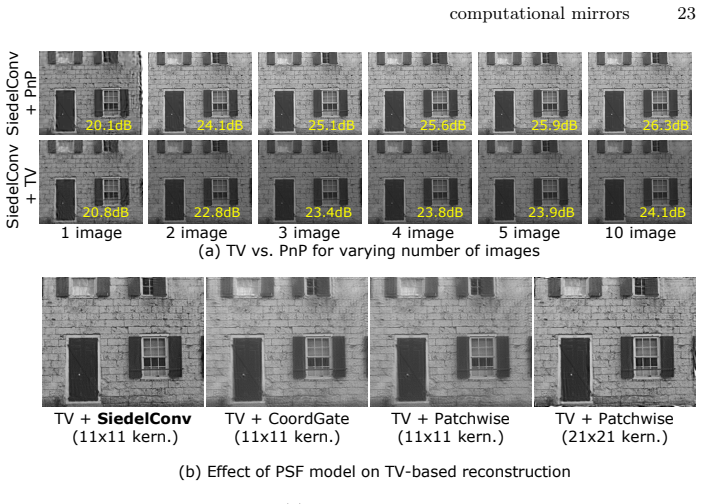
By capturing a minimal focal stack of 2-4 images and applying SeidelConv, a physics-inspired spatially-varying PSF model, the framework recovers a sharp, all-in-focus image across the complete VIS-SWIR spectrum using a single sensor and simple concave mirror.
What carries the argument
SeidelConv, a spatially-varying point-spread-function model that predicts and corrects off-axis aberrations of concave mirrors by incorporating Seidel aberration terms.
Load-bearing premise
That the SeidelConv model accurately captures the off-axis aberrations of the specific concave mirrors used and that a focal stack of only 2-4 images is always sufficient to recover high-resolution detail without artifacts across the full field of view and spectrum.
What would settle it
Acquire a focal stack with a different mirror curvature or a larger number of planes and check whether the SeidelConv reconstruction matches the sharpness and detail of a ground-truth all-in-focus image captured with a reference refractive system.
Figures




read the original abstract
Traditional glass-based optics are typically optimized for narrow spectral bands, such as the visible (400-700nm) or shortwave infrared (1000-1800nm). While the emergence of VIS-SWIR sensors (400-1700nm) offers transformative potential, refractive optics struggle to focus this entire range simultaneously. Mirrors represent a promising achromatic alternative; however, they are often sidelined by field curvature, and off-axis aberrations. This paper introduces Computational Mirrors, a framework that enables high-resolution, wide-field-of-view imaging across the complete VIS-SWIR spectrum using a single sensor. Our method is built on the observation that distinct regions of the field of view reach focus at varying distances from the mirror. By capturing a minimal focal stack (2-4 images), we utilize a computational backend to recover a sharp, all-in-focus image. A key contribution of this work is SeidelConv, a novel, physics-inspired, spatially-varying point spread function (PSF) model designed to accurately characterize and correct the off-axis aberrations inherent in simple concave mirrors. We demonstrate the efficacy of our approach using a first-of-its-kind 50mm F/1 optical system equipped with a VIS-SWIR sensor. Our system produces sharp images across RGB, NIR, and SWIR wavelengths without requiring refocusing, revealing material details invisible within individual spectral bands. We further validate the scalability of our approach with a 100mm F/2 system optimized for long-range imaging.
Editorial analysis
A structured set of objections, weighed in public.
Referee Report
Summary. The manuscript introduces Computational Mirrors, a framework for high-resolution broadband imaging across the full VIS-SWIR spectrum (400-1700 nm) using a single sensor and simple concave mirrors. The approach captures a minimal focal stack of 2-4 images exploiting the observation that different field regions focus at varying distances, then applies SeidelConv—a novel physics-inspired spatially-varying PSF model derived from Seidel aberrations—to computationally recover a sharp, all-in-focus image. Efficacy is demonstrated on a 50 mm F/1 system and a 100 mm F/2 long-range system, claiming sharp results in RGB, NIR, and SWIR without refocusing.
Significance. If the central claims hold after quantitative validation, the work offers a practical route to achromatic wide-FOV imaging by combining the inherent achromaticity of mirrors with targeted computational correction of field curvature and off-axis aberrations. This could reduce reliance on complex multi-element refractive optics for VIS-SWIR sensors, lowering cost and complexity for applications in remote sensing, material inspection, and surveillance. The physical demonstrations on two distinct mirror systems provide a concrete existence proof for the minimal-stack strategy.
major comments (2)
- [SeidelConv model description] The SeidelConv model is described as a third-order Seidel approximation for the spatially-varying PSF of concave mirrors; however, for the 50 mm F/1 system, higher-order terms (oblique spherical aberration, higher-order coma) grow rapidly off-axis, and the manuscript provides no measured-vs-predicted PSF residual quantification or validation that the model residuals permit artifact-free inversion from only 2-4 images.
- [Experimental results / demonstrations] The experimental section reports successful demonstrations on two physical systems but supplies no quantitative metrics (PSNR, MTF, edge sharpness, or spectral-band comparisons), no error analysis accounting for sensor noise or model mismatch, and no baseline comparisons (e.g., single-image deconvolution or traditional focal-stack fusion). This absence prevents verification that the 2-4-image recovery meets the claimed high-resolution performance across the full FOV and spectrum.
minor comments (1)
- [Abstract] The abstract states that the method 'reveals material details invisible within individual spectral bands' without specifying the materials, wavelengths, or quantitative contrast improvement; a brief example or figure reference would strengthen the claim.
Simulated Author's Rebuttal
We thank the referee for their constructive and detailed review of our manuscript on Computational Mirrors. The comments highlight important areas for strengthening the presentation of the SeidelConv model and the experimental validation. We address each major comment below and will incorporate the suggested improvements in the revised manuscript.
read point-by-point responses
-
Referee: [SeidelConv model description] The SeidelConv model is described as a third-order Seidel approximation for the spatially-varying PSF of concave mirrors; however, for the 50 mm F/1 system, higher-order terms (oblique spherical aberration, higher-order coma) grow rapidly off-axis, and the manuscript provides no measured-vs-predicted PSF residual quantification or validation that the model residuals permit artifact-free inversion from only 2-4 images.
Authors: We appreciate the referee's emphasis on rigorous model validation. The SeidelConv formulation deliberately employs the third-order Seidel aberrations to provide a computationally tractable, physics-based spatially-varying PSF that matches the minimal focal-stack acquisition strategy. Although higher-order aberrations are indeed more pronounced in the fast 50 mm F/1 system, our physical experiments indicate that the approximation remains sufficiently accurate for stable inversion. To directly address the concern, the revised manuscript will include measured PSF data acquired at multiple field angles, side-by-side comparisons with SeidelConv predictions, residual error maps, and an analysis demonstrating that the observed residuals support artifact-free recovery from 2-4 images. This addition will quantify the model's practical limits. revision: yes
-
Referee: [Experimental results / demonstrations] The experimental section reports successful demonstrations on two physical systems but supplies no quantitative metrics (PSNR, MTF, edge sharpness, or spectral-band comparisons), no error analysis accounting for sensor noise or model mismatch, and no baseline comparisons (e.g., single-image deconvolution or traditional focal-stack fusion). This absence prevents verification that the 2-4-image recovery meets the claimed high-resolution performance across the full FOV and spectrum.
Authors: We agree that quantitative metrics and baseline comparisons are necessary to substantiate the performance claims. The original manuscript relied primarily on visual results, which we recognize is insufficient for objective evaluation. In the revision we will add PSNR, SSIM, and MTF measurements across the field of view and spectral bands (RGB, NIR, SWIR), edge-sharpness quantification, and an error analysis that incorporates sensor noise and model mismatch effects. We will also include direct comparisons against single-image deconvolution and conventional focal-stack fusion methods for both the 50 mm F/1 and 100 mm F/2 systems. These quantitative results will be presented to verify the high-resolution, broadband imaging performance. revision: yes
Circularity Check
No significant circularity; derivation relies on external Seidel theory and new modeling
full rationale
The paper's core chain—capturing a 2-4 image focal stack from a concave mirror, modeling off-axis aberrations via the new SeidelConv PSF (derived from classical third-order Seidel terms), and recovering an all-in-focus image—does not reduce any output to a fitted parameter or self-defined quantity by construction. No equations equate the final sharp image to inputs via tautology, no uniqueness theorem is imported from self-citations, and no ansatz is smuggled through prior author work. The approach is self-contained against external physical benchmarks (Seidel aberrations) and experimental validation on 50mm F/1 and 100mm F/2 systems.
Axiom & Free-Parameter Ledger
axioms (1)
- domain assumption Distinct regions of the field of view reach focus at varying distances from a concave mirror
invented entities (1)
-
SeidelConv
no independent evidence
Reference graph
Works this paper leans on
-
[1]
José M Bioucas-Dias, Antonio Plaza, Gustavo Camps-Valls, Paul Scheunders, Nasser Nasrabadi, and Jocelyn Chanussot. Hyperspectral remote sensing data analysis and future challenges.IEEE Geoscience and Remote Sensing Magazine, 1(2):6–36, 2013. 1
work page 2013
-
[2]
Deep learning classifiers for hyperspectral imaging: A review.J
Mercedes Eugenia Paoletti, Juan Mario Haut, Javier Plaza, and Antonio Plaza. Deep learning classifiers for hyperspectral imaging: A review.J. Photogrammetry and Remote Sensing, 158:279–317, 2019. 1
work page 2019
-
[3]
Hyperspectral imaging and its applications: A review.Heliyon, 10(12), 2024
Anuja Bhargava, Ashish Sachdeva, Kulbhushan Sharma, Mohammed H Alsharif, Peerapong Uthansakul, and Monthippa Uthansakul. Hyperspectral imaging and its applications: A review.Heliyon, 10(12), 2024. 1 computational mirrors 25
work page 2024
-
[4]
Lang Junwei, Wang Yueming, Xiao Xizhong, Zhuang Xiaoqiong, Wang Sheng- wei, Liu Jun, and Wang Jianyu. Study on shortwave infrared long-distance imag- ing performance based on multiband imaging experiments.Optical Engineering, 52(4):045008–045008, 2013. 1
work page 2013
-
[5]
Comparative long-time visible and shortwave infrared night illumination measurements.Appl
Jürgen Krieg and Uwe Adomeit. Comparative long-time visible and shortwave infrared night illumination measurements.Appl. optics, 58(36):9876–9882, 2019. 1
work page 2019
- [6]
-
[7]
Reflecting microscopes with spherical mirrors.J
KP Norris, WE Seeds, and MHF Wilkins. Reflecting microscopes with spherical mirrors.J. Optical Society of America, 41(2):111–119, 1951. 2, 5
work page 1951
-
[8]
The james webb space telescope mission.Astronomical Society of the Pacific, 135(1048):068001, 2023
Jonathan P Gardner, John C Mather, Randy Abbott, James S Abell, Mark Aber- nathy, Faith E Abney, John G Abraham, Roberto Abraham, Yasin M Abul-Huda, Scott Acton, et al. The james webb space telescope mission.Astronomical Society of the Pacific, 135(1048):068001, 2023. 2
work page 2023
-
[9]
Rudolf Kingslake and R Barry Johnson.Lens design fundamentals. academic press,
-
[10]
Spatial transformer networks.Adv
Max Jaderberg, Karen Simonyan, Andrew Zisserman, et al. Spatial transformer networks.Adv. Neural Info. Processing Systems, 28, 2015. 3
work page 2015
-
[11]
Learning lens blur fields.IEEE Trans
Esther YH Lin, Zhecheng Wang, Rebecca Lin, Daniel Miau, Florian Kainz, Jiawen Chen, Xuaner Zhang, David B Lindell, and Kiriakos N Kutulakos. Learning lens blur fields.IEEE Trans. Pattern Analysis and Machine Intelligence, 47(9):7383– 7395, 2025. 3, 9
work page 2025
-
[12]
Plug-and-playimagerestorationwithdeepdenoiserprior.IEEE Trans
Kai Zhang, Yawei Li, Wangmeng Zuo, Lei Zhang, Luc Van Gool, and Radu Timo- fte. Plug-and-playimagerestorationwithdeepdenoiserprior.IEEE Trans. Pattern Analysis and Machine Intelligence, 44(10):6360–6376, 2021. 3, 8, 10, 21, 22
work page 2021
-
[13]
Cambridge University Press, 7th edition, 1999
Max Born and Emil Wolf.Principles of Optics: Electromagnetic Theory of Prop- agation, Interference and Diffraction of Light. Cambridge University Press, 7th edition, 1999. 4, 7
work page 1999
-
[14]
Anastigmatic three-mirror telescope.Appl
Dietrich Korsch. Anastigmatic three-mirror telescope.Appl. optics, 16(8):2074– 2077, 1977. 4
work page 2074
-
[15]
All-spherical catadioptric telescope design for wide-field imaging.Appl
Mehdi Bahrami and Alexander V Goncharov. All-spherical catadioptric telescope design for wide-field imaging.Appl. optics, 49(30):5705–5712, 2010. 5
work page 2010
-
[16]
Adaptation of the schupmann medial telescope to a large scale astronomical optical system.Appl
John J Villa. Adaptation of the schupmann medial telescope to a large scale astronomical optical system.Appl. Optics, 11(8):1814–1821, 1972. 5
work page 1972
-
[17]
Extended depth of field catadioptric imag- ing using focal sweep
Ryunosuke Yokoya and Shree K Nayar. Extended depth of field catadioptric imag- ing using focal sweep. InIEEE Comp. Vision and Pattern Recognition (CVPR),
-
[18]
Field curvature correction using focal sweep.IEEE Trans
Shigehiko Matsunaga and Shree K Nayar. Field curvature correction using focal sweep.IEEE Trans. Computational Imaging, 1(4):259–269, 2015. 5, 6, 11, 15
work page 2015
-
[19]
Sara Abrahamsson, Jiji Chen, Bassam Hajj, Sjoerd Stallinga, Alexander Y Katsov, Jan Wisniewski, Gaku Mizuguchi, Pierre Soule, Florian Mueller, Claire Dugast Darzacq, et al. Fast multicolor 3d imaging using aberration-corrected multifocus microscopy.Nature methods, 10(1):60–63, 2013. 5
work page 2013
-
[20]
Modeling and removing spatially-varying optical blur
Eric Kee, Sylvain Paris, Simon Chen, and Jue Wang. Modeling and removing spatially-varying optical blur. InIEEE Intl. Conf. Computational Photography (ICCP). IEEE, 2011. 7
work page 2011
-
[21]
Joel Yeo, N Duane Loh, Ramon Paniagua-Dominguez, and Arseniy I Kuznetsov. EigenCWD: A spatially varying deconvolution algorithm for single metalens imag- ing.Optics Express, 33(13):28481–28492, 2025. 7, 8
work page 2025
-
[22]
Sarah Frisken Gibson and Frederick Lanni. Experimental test of an analytical model of aberration in an oil-immersion objective lens used in three-dimensional light microscopy.J. Optical Society of America A, 8(10):1601–1613, 1991. 7 26 V. Saragadam et al
work page 1991
-
[23]
Nicholas Chimitt and Stanley H Chan. Simulating anisoplanatic turbulence by sampling intermodal and spatially correlated zernike coefficients.Optical Engi- neering, 59(8):083101–083101, 2020. 7
work page 2020
-
[24]
Sunny Howard, Peter Norreys, and Andreas Döpp. CoordGate: Efficiently comput- ing spatially-varying convolutions in convolutional neural networks.arXiv preprint arXiv:2401.04680, 2024. 8, 11
-
[25]
Hullin, Bjorn Labitzke, Wolfgang Hei- drich, and Andreas Kolb
Felix Heide, Mushfiqur Rouf, Matthias B. Hullin, Bjorn Labitzke, Wolfgang Hei- drich, and Andreas Kolb. High-quality computational imaging through simple lenses.ACM Trans. Graphics, 32(5), 2013. 11
work page 2013
-
[26]
Kodak lossless true color image suite.http://r0k.us/graphics/kodak/, 1999. Accessed: 2022-11-09. 11, 16
work page 1999
-
[27]
Amit Kohli, Anastasios N Angelopoulos, David McAllister, Esther Whang, Sixian You, Kyrollos Yanny, Federico M Gasparoli, Bo-Jui Chang, Reto Fiolka, and Laura Waller. Ring deconvolution microscopy: exploiting symmetry for efficient spatially varying aberration correction.Nature methods, 22(6):1311–1320, 2025. 16
work page 2025
-
[28]
Ntire 2017 challenge on single image super- resolution: Dataset and study
Eirikur Agustsson and Radu Timofte. Ntire 2017 challenge on single image super- resolution: Dataset and study. InConf. Computer Vision and Pattern Recognition (CVPR) Workshops, 2017. 19
work page 2017
-
[29]
Ntire 2017 challenge on single image super-resolution: Methods and results
Radu Timofte, Eirikur Agustsson, Luc Van Gool, Ming-Hsuan Yang, Lei Zhang, Bee Lim, et al. Ntire 2017 challenge on single image super-resolution: Methods and results. InConf. Computer Vision and Pattern Recognition (CVPR) Workshops,
work page 2017
-
[30]
Dmitry Ulyanov, Andrea Vedaldi, and Victor Lempitsky. Deep image prior. In IEEE Comp. Vision and Pattern Recognition (CVPR), 2018. 21, 22
work page 2018
-
[31]
Wire: Wavelet implicit neural repre- sentations
Vishwanath Saragadam, Daniel LeJeune, Jasper Tan, Guha Balakrishnan, Ashok Veeraraghavan, and Richard G Baraniuk. Wire: Wavelet implicit neural repre- sentations. InIEEE Comp. Vision and Pattern Recognition (CVPR), 2023. 21, 22
work page 2023
discussion (0)
Sign in with ORCID, Apple, or X to comment. Anyone can read and Pith papers without signing in.