Left handness in a four-level atomic system
Pith reviewed 2026-05-09 20:56 UTC · model grok-4.3
The pith
Quantum coherence in a four-level atomic system produces simultaneous negative permittivity and permeability over a wider frequency band.
A machine-rendered reading of the paper's core claim, the machinery that carries it, and where it could break.
Core claim
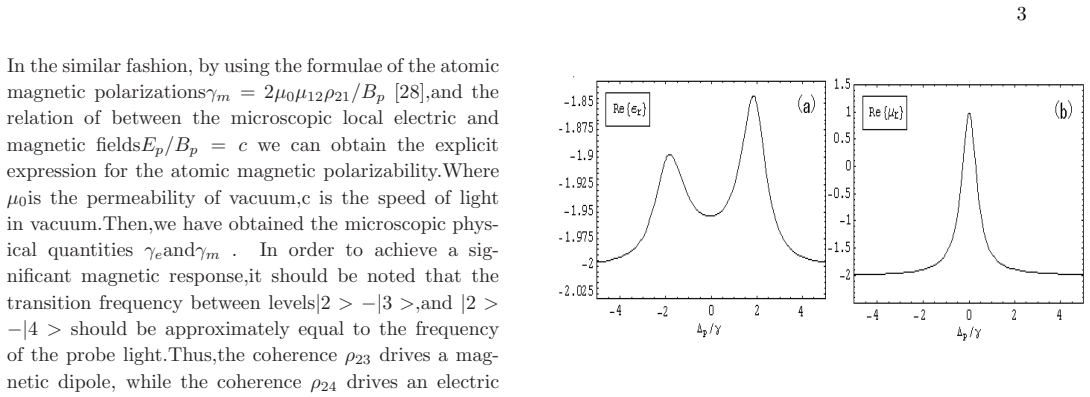
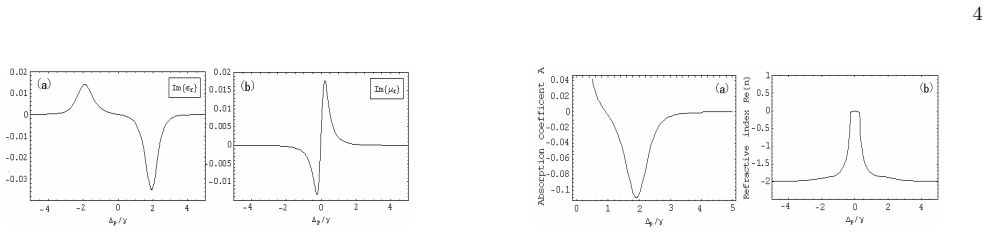
In a four-level dense atomic system, quantum coherence enables the realization of simultaneous negative permittivity and negative permeability, which is left-handedness, in a wider frequency band. The system shows novel properties of gain and dispersion near the resonance frequency that may have potential applications.
What carries the argument
Quantum coherence in the four-level atomic system that modifies the electric and magnetic susceptibilities to produce negative responses over an extended band.
If this is right
- Left-handed behavior becomes possible in a gaseous atomic medium without requiring engineered structures.
- The usable frequency bandwidth for simultaneous negative responses increases through the coherence mechanism.
- Gain near resonance allows the material to amplify as well as refract light negatively.
- Potential device applications arise from the combination of negative index and active dispersion control.
Where Pith is reading between the lines
- Varying external laser parameters could dynamically shift or broaden the negative-index window in real time.
- The same coherence approach might be adapted to other quantum platforms such as trapped ions or Rydberg atoms for different frequency ranges.
- Laboratory tests could confirm the effect by sending a probe beam through the atomic cell and recording both amplitude and phase shifts.
Load-bearing premise
The assumption that certain unspecified parametric conditions will produce the claimed negative permittivity and permeability responses and wider band solely due to quantum coherence effects without any derivation or model details.
What would settle it
Direct measurement of the permittivity and permeability in the proposed four-level atomic vapor showing either positive values or only a narrow frequency interval of negativity would falsify the central claim.
Figures
read the original abstract
A scheme is proposed for realizing simultaneous negative permittivity and negative permeability based on quantum coherence in a four-level dense atomic system here.Under some parametric conditions the system shows that simultaneous negative permittivity and negative permeability(i.e.Left handness) can be achieved in a wider frequency band because of quantum coherence.And the novelty properties of gain and dispersion near the resonance frequency may have some potential applications.
Editorial analysis
A structured set of objections, weighed in public.
Referee Report
Summary. The manuscript proposes a scheme for realizing simultaneous negative permittivity and negative permeability (left-handedness) in a four-level dense atomic system via quantum coherence. It asserts that under unspecified parametric conditions, this left-handed response occurs over a wider frequency band than would otherwise be possible, owing to coherence effects, and notes that gain and dispersion properties near resonance may enable applications.
Significance. If the central claim were substantiated with explicit derivations and results, the work would be significant for the field of quantum optics and coherent metamaterials: it would demonstrate a route to broadband negative refraction and negative permeability using atomic coherence rather than classical structuring, potentially enabling active, tunable left-handed media with gain.
major comments (2)
- The central claim that quantum coherence produces simultaneous Re(ε)<0 and Re(μ)<0 over a wider band rests entirely on 'parametric conditions' (abstract), yet the manuscript supplies no Hamiltonian for the four-level system, no density-matrix equations, no expressions linking coherence to the electric and magnetic susceptibilities, and no analytic or numerical results showing the negative responses or any bandwidth comparison. This absence renders the claim unverifiable and load-bearing for the entire contribution.
- No parameter values, no plots or tables of ε(ω) and μ(ω), and no explicit contrast between the coherent and incoherent cases are provided, so the assertion of a 'wider frequency band because of quantum coherence' cannot be evaluated.
minor comments (1)
- The abstract contains typographical errors (missing space after 'here.', 'i.e.Left' without space, 'handness' instead of 'handedness').
Simulated Author's Rebuttal
We thank the referee for the careful reading and constructive comments. We agree that the current manuscript is too brief and lacks the necessary technical details to support the central claims. We will revise the manuscript to include the missing derivations, equations, parameter values, and numerical results.
read point-by-point responses
-
Referee: The central claim that quantum coherence produces simultaneous Re(ε)<0 and Re(μ)<0 over a wider band rests entirely on 'parametric conditions' (abstract), yet the manuscript supplies no Hamiltonian for the four-level system, no density-matrix equations, no expressions linking coherence to the electric and magnetic susceptibilities, and no analytic or numerical results showing the negative responses or any bandwidth comparison. This absence renders the claim unverifiable and load-bearing for the entire contribution.
Authors: We acknowledge that the submitted manuscript does not contain the four-level Hamiltonian, the density-matrix equations, or the explicit derivations connecting the atomic coherences to the electric and magnetic susceptibilities. This omission makes the claims difficult to verify. In the revised version we will present the full Hamiltonian for the four-level system, the optical Bloch equations including the coherence terms, the steady-state solutions for the relevant off-diagonal density-matrix elements, and the resulting expressions for the electric permittivity and magnetic permeability. We will also add analytic and numerical results that demonstrate the simultaneous negative real parts over a frequency interval and quantify the bandwidth increase relative to the incoherent case. revision: yes
-
Referee: No parameter values, no plots or tables of ε(ω) and μ(ω), and no explicit contrast between the coherent and incoherent cases are provided, so the assertion of a 'wider frequency band because of quantum coherence' cannot be evaluated.
Authors: We agree that the absence of specific parameters and comparative plots prevents evaluation of the bandwidth claim. The revised manuscript will specify all numerical values (decay rates, Rabi frequencies, detunings, atomic density, and transition frequencies) used in the calculations. We will include plots of Re[ε(ω)] and Re[μ(ω)] versus frequency for both the coherent and incoherent regimes, together with a direct comparison that illustrates the extension of the left-handed frequency band due to quantum coherence. revision: yes
Circularity Check
No derivation chain presented; claim is a bare statement without equations or reductions
full rationale
The provided abstract and text contain only a high-level proposal that simultaneous negative permittivity and permeability occur 'under some parametric conditions' due to quantum coherence in a four-level system. No Hamiltonian, density-matrix equations, susceptibility expressions, parameter values, or derivation steps are quoted or shown. Without any load-bearing derivation chain or self-citation, no step reduces to its inputs by construction, and the patterns for circularity cannot be exhibited. The result is therefore not circular; it is simply an unsubstantiated claim.
Axiom & Free-Parameter Ledger
free parameters (1)
- parametric conditions
Reference graph
Works this paper leans on
- [1]
-
[2]
0001γ,γ42 = γ32 = γ21 = γ13 = γ41 = 0. 00018γ,γ = 10 10 . III. RESULTS AND DISCUSSION We consider the coupling laser beam is assumed to be on resonance, i.e.,the frequency detunings ∆ c = 0,and the atomic vapor medium with N = 5 × 1024m− 3to examine the case of dense media where the Lorentz-Lorenz local field corrections play a significant role.As pointed o...
- [3]
-
[4]
Zharov Alexander A, Shadrivov Ilya V et al, Appl.Phys. 97,(2005)113906
work page 2005
- [5]
-
[6]
R.A.Shelby, D.R.Smith, and S.Schultz, Science 77,(2001) 292
work page 2001
-
[7]
A.Lakhtakia, Int. J. Electron. Commun. (AE ¨AU) 58,(2004) 229
work page 2004
-
[8]
Z.M.Zhang and C.J.Fu, Appl. Phys. Lett. 80,(2002) 1097
work page 2002
-
[9]
J.B.Pendry, Phys. Rev. Lett. 85,(2001) 3966
work page 2001
-
[10]
Smith D.R.,Padilla W J,Vier D.C,Nemat-Nasser S.C.and Shultz S, Phys. Rev. Lett. 84,(2000)4184
work page 2000
-
[11]
R.A.Shelby, D.R.Smith, S.C.Nemat-Nasser, and S.Schultz, Appl. Phys. Lett. 78,(2001)489
work page 2001
-
[12]
Yen T.Y, Padilla W.J.,Fang N, Vier D.C., Smith D.R.,Pendry J.B.,Basov D N and Zhang X, Science 5663,(2004)1494
work page 2004
-
[13]
S.He, Z.C.Ruan, L.Chen, and J.Q.Shen, Phys. Rev.B 70,(2004)115113
work page 2004
-
[14]
A.Lakhtakia, Opt. Express. 11,(2003)716
work page 2003
-
[15]
L.Chen, S.He, L.Shen, Phys. Rev. Lett. 92,(2004)107404
work page 2004
-
[16]
J.B.Pendry, A.J.Holden, D.J.Robbins, and W.J.Stewart, Phys. Condens. Matter 10,(1998)4785
work page 1998
-
[17]
J.B.Pendry, A.J.Holden, W.J.Stewart, and I.Youngs, Phys. Rev. Lett. 76,(1996)4773
work page 1996
- [18]
- [19]
-
[20]
G.V.Eleftheriades,A.K. Iyer,P.C.Kremer, IEEE Trans. Microwave TheoryTech. 50,(2004)2702
work page 2004
-
[21]
A.Berrier,M.Mulot,M.Swillo,M.Qiu,L.Thylen,A.Talneau,S.Anand, Phys. Rev. Lett. 93,(2004)073902
work page 2004
-
[22]
Q.Thommen, P.Mandel, Opt. Lett. 31,(2006)1803
work page 2006
- [23]
-
[24]
Phys.: Condens.Matter 18,(2006)6883
V.Yannopapas, J. Phys.: Condens.Matter 18,(2006)6883
work page 2006
- [25]
- [26]
-
[27]
¨O.Oktel, ¨O.E.Mvstecapliouglu, Phys
M. ¨O.Oktel, ¨O.E.Mvstecapliouglu, Phys. Rev.A 70,(2004)053806
work page 2004
- [28]
-
[29]
Q.Thommen, P.Mandel, Phys. Rev. Lett. 96,(2006)053601
work page 2006
-
[30]
J.D.Jackson, Classical Electrodynamics,3rd (NewYork: John Wiley & Sons, 2001), Chap.4, pp.159-162
work page 2001
-
[31]
D.M.Cook, The Theory of the Electromagnetic Field (New Jersey: Prentice-Hall, Inc.,1975), Chap.11
work page 1975
-
[32]
Ramakrishna S.A., Rep. Prog. Phys. 68,(2005)449
work page 2005
- [33]
- [34]
-
[35]
Y.P.Yang, J.P.Xu, H.Chen,et al, Phys. Rev. Lett. 15,(2008)043601
work page 2008
- [36]
- [37]
discussion (0)
Sign in with ORCID, Apple, or X to comment. Anyone can read and Pith papers without signing in.