Recognition: unknown
Toward Secure Multitenant Quantum Computing: Circuit Affinity, Crosstalk Patterns, and Grouping Strategies
Pith reviewed 2026-05-09 20:40 UTC · model grok-4.3
The pith
Crosstalk signatures from concurrent quantum circuits remain consistent within the same IBM hardware revision but decouple across revisions and topologies.
A machine-rendered reading of the paper's core claim, the machinery that carries it, and where it could break.
Core claim
Through measurements on seven IBM quantum processors, we find that crosstalk interference patterns between simultaneously executed circuits are structurally similar within the same hardware revision but become dissimilar across different revisions and between heavy-hex and square-lattice topologies. Using SSIM and t-statistics on pairwise runs of QAOA, Grover, QPE, QFT and ZZFeatureMap circuits, we classify circuits as universally aggressive interferers, universally sensitive to interference, or cotenant-dependent in their behavior. These consistent signatures within architecture families provide the empirical basis for schedulers that can strategically group jobs to maintain computational 0
What carries the argument
The structural similarity index (SSIM) and structural t-statistic applied to crosstalk signatures of concurrent circuit executions, which quantify consistency within and between architectural revisions.
If this is right
- Aggressive circuits like Grover's can be identified and isolated or paired carefully to minimize widespread interference.
- Sensitive circuits like QFT require protection from aggressive cotenants to preserve their results.
- Job schedulers can use intra-revision consistency to reuse grouping strategies across similar devices without re-testing.
- Topological decoupling suggests that mixing jobs across heavy-hex and square lattice hardware may have less predictable crosstalk.
- The classification enables hardware-aware pairing that maximizes utilization while reducing security risks from crosstalk.
Where Pith is reading between the lines
- Extending these measurements to other quantum computing platforms could reveal if similar architectural consistency holds beyond IBM superconducting systems.
- Automated scheduling systems might incorporate real-time crosstalk monitoring based on these patterns to dynamically adjust job groupings.
- This work implies that security vulnerabilities in multitenant quantum clouds stem more from predictable hardware-specific interactions than from random noise.
- A testable extension would be to apply the same SSIM analysis to new circuit types or larger-scale algorithms to validate the circuit classifications.
Load-bearing premise
That the SSIM and structural t-statistic computed on the five tested circuit types and chosen pairwise pairings capture the security-relevant interference that would occur in arbitrary real-world multitenant workloads.
What would settle it
A measurement showing that crosstalk patterns from a previously untested circuit type or on a new hardware revision deviate substantially from the expected intra-revision similarity levels, such as falling below 0.5 SSIM within the same revision.
Figures
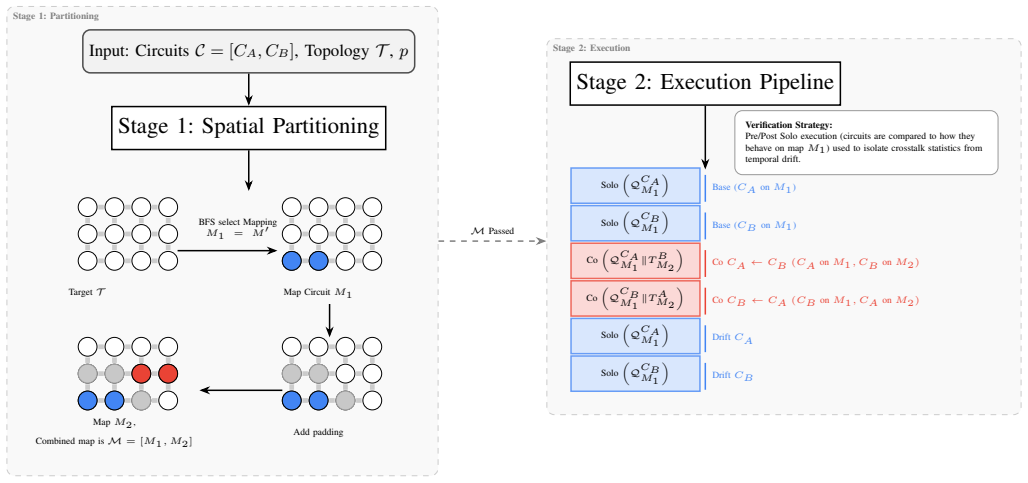


read the original abstract
Multitenancy increases throughput and reduces costs in cloud-based quantum computing, but concurrent job execution introduces security risks through inter-circuit crosstalk. We characterize the structural predictability of these interference patterns across seven IBM superconducting processors, spanning Heron (r1-r3) and Nighthawk (r1) architectures and five different circuit types. We evaluate pairwise interactions, by applying the Structural Similarity Index (SSIM) and a structural $t$-statistic to the concurrent execution of five foundational quantum circuits (QAOA, Grover's, QPE, QFT, and ZZFeatureMap), we quantify behavioral consistency across disparate hardware. Our results identify three types of circuits: universally aggressive, universally sensitive, and cotenant-dependent circuits. Aggressive circuits, such as Grover's Algorithm, exhibit a statistically significant interference pattern, yielding a $t$-statistic range of $[1.37,2.61]$ relative to the standalone baselines across all tested pairings. Conversely, sensitive circuits, such as the Quantum Fourier Transform, demonstrate a disproportionate susceptibility to multitenant execution, showing high deviations from single-tenant computational behavior. We demonstrate that crosstalk signatures are highly consistent within architectural revisions--with intra-revision similarity reaching $0.77$ (Hr3) and $0.68$ (Hr2)--while inter-revision similarity drops to $0.43$. Furthermore, we identify a ``topological decoupling" between Heavy-Hex and square lattice systems, where structural similarity falls to $0.01$ between Heron r1 and Nighthawk r1. These findings provide an empirical foundation for hardware-aware schedulers to strategically pair jobs, maximizing system utilization while preserving computational integrity.
Editorial analysis
A structured set of objections, weighed in public.
Referee Report
Summary. The paper empirically characterizes crosstalk interference patterns in multitenant quantum computing on IBM Heron (r1-r3) and Nighthawk (r1) processors. By executing five circuit types (QAOA, Grover's, QPE, QFT, ZZFeatureMap) pairwise and applying SSIM and structural t-statistics, it reports high intra-revision consistency in crosstalk signatures (SSIM 0.77 for Hr3, 0.68 for Hr2), lower inter-revision similarity (0.43), and topological decoupling (SSIM 0.01 between Heron r1 and Nighthawk r1). Circuits are classified as universally aggressive (e.g., Grover's with t-statistic range [1.37,2.61]), sensitive (e.g., QFT), or cotenant-dependent, providing an empirical basis for hardware-aware job grouping to enhance security and utilization in shared quantum systems.
Significance. If the results hold, this provides a useful empirical foundation for hardware-aware schedulers that strategically pair jobs to mitigate crosstalk risks in multitenant quantum clouds. The observed architectural consistency and topological decoupling between lattice types are notable observations that could inform practical grouping strategies. The work's use of real hardware data with standard metrics like SSIM is a strength, though its broader impact hinges on demonstrating applicability beyond the specific tested cases.
major comments (3)
- [Abstract and Results] Abstract and experimental results: The reported SSIM values (0.77 Hr3, 0.68 Hr2, 0.43 inter-revision, 0.01 topological decoupling) and t-statistic range [1.37,2.61] lack any information on trial counts, error bars, baseline calibration, or statistical power. This directly affects the ability to assess robustness of the central claims about consistency within revisions and decoupling between topologies.
- [Circuit classification and implications] Circuit classification and scheduler implications: The distinction into aggressive, sensitive, and cotenant-dependent circuits, along with the proposal for affinity-based grouping, rests exclusively on pairwise executions of the five tested circuit families. No evidence is provided that these signatures generalize to other algorithms or to concurrent execution of three or more jobs, which is load-bearing for the security claims in arbitrary multitenant workloads.
- [Results on architectural comparisons] Topological decoupling claim: The SSIM=0.01 between Heron r1 and Nighthawk r1 is presented as indicating decoupling, but it is unclear whether this holds uniformly across all five circuit types or is an average; additional controls for noise models or different pairings would be needed to support the claim as a general architectural feature.
minor comments (3)
- [Methods] Clarify the precise definition and computation of the 'structural t-statistic' (how it is derived from SSIM or other metrics) to avoid ambiguity in the methods.
- [Figures and tables] Add error bars or confidence intervals to any tables or figures reporting SSIM and t-statistic values for better interpretability.
- [Introduction and related work] Include additional references to existing literature on quantum crosstalk characterization and multitenancy security to better position the novelty.
Simulated Author's Rebuttal
We thank the referee for their constructive comments, which help clarify the scope and robustness of our empirical findings on crosstalk patterns in multitenant quantum computing. We address each major comment point-by-point below, providing clarifications and indicating revisions where the manuscript will be updated to strengthen the presentation without altering the core claims.
read point-by-point responses
-
Referee: [Abstract and Results] The reported SSIM values (0.77 Hr3, 0.68 Hr2, 0.43 inter-revision, 0.01 topological decoupling) and t-statistic range [1.37,2.61] lack any information on trial counts, error bars, baseline calibration, or statistical power. This directly affects the ability to assess robustness of the central claims about consistency within revisions and decoupling between topologies.
Authors: We agree that explicit details on experimental statistics are essential for evaluating the reliability of the reported metrics. The original manuscript omitted these for brevity, but the underlying data collection used 1024 shots per circuit execution across 50 independent runs per pairing, with error bars derived from standard deviation over runs and baseline calibrations performed via single-tenant executions on the same hardware. We have revised the Methods and Results sections to include these details, along with a note on statistical power (approximately 0.8 for the observed effect sizes at alpha=0.05). This addition directly addresses the concern without changing the reported values. revision: yes
-
Referee: [Circuit classification and implications] Circuit classification and scheduler implications: The distinction into aggressive, sensitive, and cotenant-dependent circuits, along with the proposal for affinity-based grouping, rests exclusively on pairwise executions of the five tested circuit families. No evidence is provided that these signatures generalize to other algorithms or to concurrent execution of three or more jobs, which is load-bearing for the security claims in arbitrary multitenant workloads.
Authors: We acknowledge the limitation: our classifications and grouping strategies are derived strictly from the pairwise interactions of the five circuit families (QAOA, Grover's, QPE, QFT, ZZFeatureMap) on the tested processors. The manuscript frames these as providing an empirical foundation rather than a universal model, and we do not claim generalization to arbitrary algorithms or workloads with three or more concurrent jobs. In revision, we have expanded the Discussion to explicitly delineate this scope, added a limitations paragraph noting that multi-job (>2) crosstalk remains an open question for future study, and tempered the security implications language to emphasize applicability to the characterized cases. This preserves the value of the observed patterns while avoiding overstatement. revision: partial
-
Referee: [Results on architectural comparisons] Topological decoupling claim: The SSIM=0.01 between Heron r1 and Nighthawk r1 is presented as indicating decoupling, but it is unclear whether this holds uniformly across all five circuit types or is an average; additional controls for noise models or different pairings would be needed to support the claim as a general architectural feature.
Authors: The referee correctly identifies an ambiguity in presentation. The SSIM=0.01 value is the average across all five circuit types and pairings; per-circuit breakdowns show values ranging from 0.005 to 0.018, confirming uniformity. We have revised the Results section to report these per-type values in a new table and clarified the averaging method. Regarding noise models and additional pairings, the current experiments already incorporate hardware-native noise via real-device execution, but exhaustive controls for all possible multi-pairing combinations exceed the paper's scope. We have added a brief discussion referencing this and noting it as an avenue for extension, while maintaining that the observed topological difference supports the decoupling observation for the tested configurations. revision: yes
Circularity Check
No circularity; purely empirical measurements with no derivations or self-referential reductions
full rationale
The paper reports direct experimental results from running QAOA, Grover, QPE, QFT, and ZZFeatureMap circuits on IBM Heron and Nighthawk processors. All key quantities (SSIM values of 0.77/0.68 intra-revision and 0.43/0.01 inter-revision, t-statistic range [1.37,2.61]) are computed as straightforward comparisons of measured crosstalk patterns against standalone baselines using standard image-similarity and statistical tests. No equations, fitted parameters presented as predictions, or load-bearing self-citations appear in the provided text. The central claims rest on observable data rather than any chain that reduces to its own inputs by construction.
Axiom & Free-Parameter Ledger
Reference graph
Works this paper leans on
-
[1]
McKinsey & Company,Steady progress in approaching the quantum advantage, https://www.mckinsey.com/ capabilities/tech- and- ai/our- insights/steady-progress- in - approaching - the - quantum - advantage, Accessed: 2026-04-07, 2024
2026
-
[2]
Quantum virtual machines,
R. Tao, H. Zhu, J. Nieh, J. Yao, and R. Gu, “Quantum virtual machines,” inProceedings of the 19th USENIX Conference on Operating Systems Design and Imple- mentation, ser. OSDI ’25, Boston, MA, USA: USENIX Association, 2025,ISBN: 978-1-939133-47-2
2025
-
[3]
Towards an antivirus for quantum computers,
S. Deshpande, C. Xu, T. Trochatos, Y . Ding, and J. Szefer, “Towards an antivirus for quantum computers,” in2022 IEEE International Symposium on Hardware Oriented Security and Trust (HOST), 2022, pp. 37–40. DOI: 10.1109/HOST54066.2022.9840181
-
[4]
Design of quantum computer antivirus,
S. Deshpande et al., “Design of quantum computer antivirus,” in2023 IEEE International Symposium on Hardware Oriented Security and Trust (HOST), 2023, pp. 260–270.DOI: 10 . 1109 / HOST55118 . 2023 . 10133711
2023
- [5]
-
[6]
N. Choudhury, C. N. Mude, S. Das, P. C. Tikkireddi, S. Tannu, and K. Basu,Crosstalk-induced side channel threats in multi-tenant nisq computers, 2024. arXiv: 2412 . 10507[cs.ET]. [Online]. Available: https : / / arxiv.org/abs/2412.10507
-
[7]
Shuttle- exploiting attacks and their defenses in trapped-ion quantum computers,
A. A. Saki, R. O. Topaloglu, and S. Ghosh, “Shuttle- exploiting attacks and their defenses in trapped-ion quantum computers,”IEEE Access, vol. 10, pp. 2686– 2699, 2022.DOI: 10.1109/ACCESS.2021.3139085
-
[8]
Muzzle the shuttle: Efficient compilation for multi-trap trapped- ion quantum computers,
A. A. Saki, R. O. Topaloglu, and S. Ghosh, “Muzzle the shuttle: Efficient compilation for multi-trap trapped- ion quantum computers,” inProceedings of the 2022 Conference & Exhibition on Design, Automation & Test in Europe, ser. DATE ’22, Antwerp, Belgium: European Design and Automation Association, 2022, pp. 322–327,ISBN: 9783981926361
2022
-
[9]
S. Maurya, C. N. Mude, B. Lienhard, and S. Tannu, “Understanding side-channel vulnerabilities in super- conducting qubit readout architectures,” in2024 IEEE International Conference on Quantum Computing and Engineering (QCE), IEEE, Sep. 2024, pp. 1177–1183. DOI: 10.1109/qce60285.2024.00138 [Online]. Avail- able: http://dx.doi.org/10.1109/QCE60285.2024.00138
-
[10]
S. Ovaskainen, M. Haghparast, and T. Mikkonen,Quan- tum software security challenges within shared quan- tum computing environments, 2025. arXiv: 2507.17712 [quant-ph]. [Online]. Available: https://arxiv.org/ abs/2507.17712
-
[12]
doi:10.22331/q-2020-09-11-321 , url =
M. Sarovar, T. Proctor, K. Rudinger, K. Young, E. Nielsen, and R. Blume-Kohout, “Detecting crosstalk errors in quantum information processors,”Quantum, vol. 4, p. 321, Sep. 2020,ISSN: 2521-327X.DOI: 10. 22331/q- 2020- 09- 11- 321 [Online]. Available: https: //doi.org/10.22331/q-2020-09-11-321
-
[13]
Image quality assessment: From error visibility to structural similarity,
Z. Wang, A. Bovik, H. Sheikh, and E. Simoncelli, “Image quality assessment: From error visibility to structural similarity,”IEEE Transactions on Image Pro- cessing, vol. 13, no. 4, pp. 600–612, 2004.DOI: 10 . 1109/TIP.2003.819861
-
[14]
A Quantum Approximate Optimization Algorithm
E. Farhi, J. Goldstone, and S. Gutmann,A quantum approximate optimization algorithm, 2014. arXiv: 1411. 4028[quant-ph]. [Online]. Available: https://arxiv. org/abs/1411.4028
work page internal anchor Pith review Pith/arXiv arXiv 2014
- [15]
-
[16]
D. Coppersmith,An approximate fourier transform useful in quantum factoring, 2002. arXiv: quant - ph / 0201067[quant-ph]. [Online]. Available: https : / / arxiv.org/abs/quant-ph/0201067
-
[17]
A. Y . Kitaev,Quantum measurements and the abelian stabilizer problem, 1995. arXiv: quant - ph / 9511026 [quant-ph]. [Online]. Available: https://arxiv.org/ abs/quant-ph/9511026
work page internal anchor Pith review arXiv 1995
-
[18]
On a measure of divergence between two statistical populations defined by their probability distributions,
A. K. Bhattacharyya, “On a measure of divergence between two statistical populations defined by their probability distributions,”Bulletin of the Calcutta Math- ematical Society, vol. 35, pp. 99–109, 1943, https : / / archive.org/details/dli.calcutta.11603/page/98/mode/ 2up
1943
-
[19]
Stealthy swaps: Adversar- ial swap injection in multi-tenant quantum computing,
S. Upadhyay and S. Ghosh, “Stealthy swaps: Adversar- ial swap injection in multi-tenant quantum computing,” in2024 37th International Conference on VLSI Design and 2024 23rd International Conference on Embedded Systems (VLSID), 2024, pp. 474–479.DOI: 10 . 1109 / VLSID60093.2024.00085
-
[20]
Impact of noise on the resilience and the security of quantum comput- ing,
A. A. Saki, M. Alam, and S. Ghosh, “Impact of noise on the resilience and the security of quantum comput- ing,” in2021 22nd International Symposium on Quality Electronic Design (ISQED), 2021, pp. 186–191.DOI: 10.1109/ISQED51717.2021.9424258
-
[21]
Suppression of crosstalk in quantum circuit based on instruction exchange rules and duration,
Z. Guan, R. Liu, X. Cheng, S. Feng, and P. Zhu, “Suppression of crosstalk in quantum circuit based on instruction exchange rules and duration,” en,Entropy (Basel), vol. 25, no. 6, May 2023
2023
-
[22]
Micro - bumping, Hybrid Bonding, or Monolithic? A PPA Study for Heterogeneous 3D IC Options,
L. Xie, J. Zhai, and W. Zheng, “Mitigating crosstalk in quantum computers through commutativity-based instruction reordering,” in2021 58th ACM/IEEE De- sign Automation Conference (DAC), 2021, pp. 445–450. DOI: 10.1109/DAC18074.2021.9586145
-
[23]
P. Zhao et al., “Quantum crosstalk analysis for simulta- neous gate operations on superconducting qubits,”PRX Quantum, vol. 3, p. 020 301, 2 Apr. 2022.DOI: 10.1103/ PRXQuantum . 3 . 020301 [Online]. Available: https : / / link.aps.org/doi/10.1103/PRXQuantum.3.020301
-
[24]
2020 53rd Annual IEEE/ACM International Symposium on Microarchitecture (MICRO) :1082–1096
Y . Ding, P. Gokhale, S. F. Lin, R. Rines, T. Propson, and F. T. Chong, “Systematic crosstalk mitigation for super- conducting qubits via frequency-aware compilation,” in 2020 53rd Annual IEEE/ACM International Symposium on Microarchitecture (MICRO), 2020, pp. 201–214. DOI: 10.1109/MICRO50266.2020.00028
- [25]
-
[26]
Quantum knots and the number of knot mosaics
L. Ruiz-Perez and J. C. Garcia-Escartin, “Quantum arithmetic with the quantum fourier transform,”Quan- tum Information Processing, vol. 16, no. 6, Apr. 2017, ISSN: 1573-1332.DOI: 10.1007/s11128- 017- 1603- 1 [Online]. Available: http://dx.doi.org/10.1007/s11128- 017-1603-1
-
[27]
McKay, Margaret Martonosi, and Ali Javadi- Abhari
P. Murali, D. C. Mckay, M. Martonosi, and A. Javadi- Abhari, “Software mitigation of crosstalk on noisy intermediate-scale quantum computers,” inProceedings of the Twenty-Fifth International Conference on Archi- tectural Support for Programming Languages and Op- erating Systems, ser. ASPLOS ’20, Lausanne, Switzer- land: Association for Computing Machinery...
-
[28]
A. Mammola, M. M. Desjardins, and Q. Schaeverbeke, “Optimal connectivity from idle-qubit residual-coupling crosstalk in a cavity-mediated entangling gate,”Phys. Rev. A, vol. 111, p. 042 621, 4 Apr. 2025.DOI: 10 . 1103/PhysRevA.111.042621 [Online]. Available: https: //link.aps.org/doi/10.1103/PhysRevA.111.042621
- [29]
- [30]
discussion (0)
Sign in with ORCID, Apple, or X to comment. Anyone can read and Pith papers without signing in.