Recognition: unknown
Learning Fingerprints for Medical Time Series with Redundancy-Constrained Information Maximization
Pith reviewed 2026-05-09 20:06 UTC · model grok-4.3
The pith
A total coding rate penalty on cross-attention tokens produces statistically disentangled fingerprints for medical time series.
A machine-rendered reading of the paper's core claim, the machinery that carries it, and where it could break.
Core claim
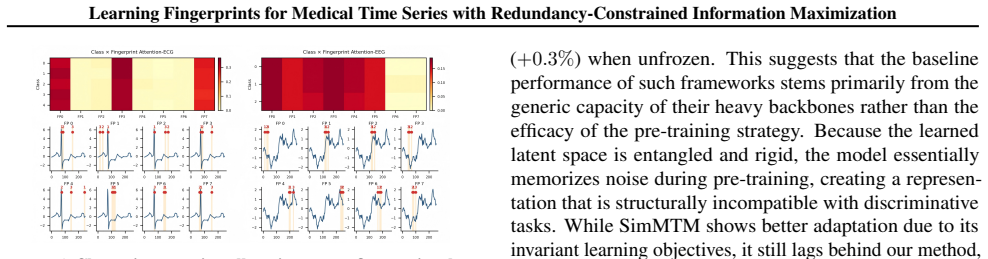
Our architecture compresses medical time series into k fingerprint tokens via a cross-attention bottleneck. The tokens are optimized under a dual objective: a reconstruction loss that makes them sufficient statistics for the input and a total coding rate penalty that minimizes redundancy, thereby producing statistically disentangled representations. We justify the approach theoretically as the solution to a Disentangled Rate-Distortion problem.
What carries the argument
The cross-attention bottleneck that outputs k fingerprint tokens, regularized by the total coding rate penalty that reduces mutual information among the tokens to promote statistical disentanglement.
If this is right
- Each token captures an independent factor of variation in the time series.
- The representation becomes low-dimensional, interpretable, and sample-efficient.
- Heuristic aggregation steps such as global average pooling or a single CLS token are no longer required.
- The tokens support more robust digital biomarkers derived from signals like ECG and EEG.
Where Pith is reading between the lines
- The same bottleneck-plus-penalty structure could be tested on non-medical sequential data such as audio or sensor streams.
- Disentangled tokens may improve robustness when the input contains the typical noise and artifacts found in clinical recordings.
- One could check whether individual tokens align with known physiological components such as heart rate variability or specific EEG bands.
Load-bearing premise
The total coding rate penalty will produce tokens that stay sufficient for reconstruction while becoming statistically disentangled and semantically useful for medical tasks.
What would settle it
Downstream medical classification or biomarker tasks show no accuracy gain or interpretability improvement when using the learned tokens versus tokens from a standard masked autoencoder with global average pooling.
Figures



read the original abstract
Learning meaningful representations from medical time series (MedTS) such as ECG or EEG signals is a critical challenge. These signals are often high-dimensional, variable-length and rife with noise. Existing self-supervised approaches, such as Masked Autoencoders (MAEs) are highly effective for pre-training general-purpose encoders. However, they do not explicitly learn compact and semantically interpretable latent representations, typically relying on heuristic aggregation strategies such as global average pooling or a designated [CLS] token. We propose a novel framework that compresses a variable-length MedTS into a fixed-size set of $k$ latent Fingerprint Tokens. Our architecture employs a cross-attention bottleneck to generate these tokens and is trained with a dual-objective function. The first objective is a reconstruction loss, which ensures the tokens are \textit{sufficient statistics} for the original data. The second, a diversity penalty based on the Total Coding Rate (TCR), explicitly minimizes the redundancy between tokens, encouraging them to become statistically \textit{disentangled} representations. We present the theoretical justification for our method, framing it as a novel \textbf{Disentangled Rate-Distortion} problem. This approach produces a low-dimensional, interpretable, and sample-efficient representation, where each token is encouraged to capture an independent factor of variation, paving the way for more robust digital biomarkers.
Editorial analysis
A structured set of objections, weighed in public.
Referee Report
Summary. The paper proposes a self-supervised framework to compress variable-length medical time series (e.g., ECG, EEG) into a fixed set of k Fingerprint Tokens via a cross-attention bottleneck. The model is trained with a dual objective: a reconstruction loss intended to make the tokens sufficient statistics of the input, and a Total Coding Rate (TCR) penalty to minimize redundancy and produce statistically disentangled representations. The approach is framed as a novel Disentangled Rate-Distortion problem, with the goal of yielding low-dimensional, interpretable, and sample-efficient latents for downstream medical tasks such as digital biomarkers.
Significance. If the dual-objective claims are substantiated, the work could advance representation learning for noisy, variable-length MedTS by replacing heuristic aggregation (global pooling or [CLS] tokens) with an explicit redundancy-constrained bottleneck. The TCR penalty and rate-distortion framing offer a principled alternative to standard MAE pretraining and could support more robust biomarkers. However, the significance is currently limited by the absence of any empirical validation or formal bounds.
major comments (3)
- [Abstract] Abstract: the reconstruction loss is asserted to guarantee that the Fingerprint Tokens are sufficient statistics, yet the cross-attention bottleneck is known to risk information loss on variable-length inputs. No mutual-information bounds, information-preservation analysis, or proof that the joint optimum retains all task-relevant information is supplied.
- [Abstract] Abstract: the TCR penalty is claimed to produce statistically disentangled tokens by minimizing redundancy. However, the TCR term penalizes the log-determinant of the token covariance and therefore enforces only second-order decorrelation; for non-Gaussian medical signals this does not imply zero mutual information or independent factors of variation. No derivation, counter-example discussion, or empirical check (e.g., MI estimation) is provided.
- The manuscript contains no experimental results, ablation studies, baseline comparisons (e.g., against standard MAEs or other disentanglement methods), or downstream-task evaluations. Without such evidence it is impossible to verify the asserted gains in interpretability, sample efficiency, or robustness for medical applications.
minor comments (1)
- [Abstract] The phrase 'Disentangled Rate-Distortion problem' is introduced without a formal mathematical definition or explicit contrast to prior rate-distortion or information-bottleneck formulations.
Simulated Author's Rebuttal
We thank the referee for the detailed and constructive feedback. We address each major comment below, clarifying the theoretical contributions of the work while committing to revisions that strengthen the claims with additional analysis and empirical support.
read point-by-point responses
-
Referee: [Abstract] Abstract: the reconstruction loss is asserted to guarantee that the Fingerprint Tokens are sufficient statistics, yet the cross-attention bottleneck is known to risk information loss on variable-length inputs. No mutual-information bounds, information-preservation analysis, or proof that the joint optimum retains all task-relevant information is supplied.
Authors: We agree that the manuscript would benefit from a more explicit information-theoretic treatment. The reconstruction objective is motivated as encouraging sufficiency in the rate-distortion sense, but we will add a dedicated subsection deriving the conditions under which the cross-attention bottleneck preserves task-relevant information, including a discussion of mutual-information bounds under standard assumptions on the encoder and decoder. revision: partial
-
Referee: [Abstract] Abstract: the TCR penalty is claimed to produce statistically disentangled tokens by minimizing redundancy. However, the TCR term penalizes the log-determinant of the token covariance and therefore enforces only second-order decorrelation; for non-Gaussian medical signals this does not imply zero mutual information or independent factors of variation. No derivation, counter-example discussion, or empirical check (e.g., MI estimation) is provided.
Authors: The referee is correct that the TCR penalty primarily achieves second-order decorrelation. In the revision we will expand the theoretical justification to include (i) a derivation relating TCR to mutual information under Gaussianity, (ii) an explicit discussion of its limitations for non-Gaussian medical signals, and (iii) a short section outlining how mutual-information estimation could be used for empirical verification in follow-up work. revision: yes
-
Referee: [—] The manuscript contains no experimental results, ablation studies, baseline comparisons (e.g., against standard MAEs or other disentanglement methods), or downstream-task evaluations. Without such evidence it is impossible to verify the asserted gains in interpretability, sample efficiency, or robustness for medical applications.
Authors: We acknowledge that the current submission is primarily theoretical and therefore lacks the empirical validation needed to substantiate the practical claims. In the revised manuscript we will add an experimental section containing (a) ablation studies isolating the TCR term, (b) comparisons against standard MAE pre-training and other disentanglement baselines, and (c) downstream evaluations on public ECG and EEG datasets measuring interpretability, sample efficiency, and biomarker performance. revision: yes
Circularity Check
No circularity; derivation is a standard proposal of dual-objective optimization
full rationale
The paper defines an architecture (cross-attention bottleneck producing k fingerprint tokens) and a composite loss (reconstruction + TCR penalty), then conceptually frames the combination as a Disentangled Rate-Distortion problem. Reconstruction is invoked to guarantee sufficiency and TCR to reduce redundancy; these are conventional information-theoretic motivations rather than a closed loop in which any claimed output is definitionally identical to an input parameter or fitted quantity. No equations reduce a prediction to its own fit, no uniqueness theorem is imported from self-citation, and no ansatz is smuggled via prior work. The central claims remain open empirical assertions about the resulting representations, not tautological restatements of the training procedure.
Axiom & Free-Parameter Ledger
free parameters (1)
- k
axioms (2)
- domain assumption Reconstruction loss ensures the tokens are sufficient statistics for the original data
- ad hoc to paper TCR penalty produces statistically disentangled representations
invented entities (2)
-
Fingerprint Tokens
no independent evidence
-
Disentangled Rate-Distortion problem
no independent evidence
Reference graph
Works this paper leans on
-
[1]
Advances in Neural Information Processing Systems , volume=
Simmtm: A simple pre-training framework for masked time-series modeling , author=. Advances in Neural Information Processing Systems , volume=
-
[2]
Ti-mae: Self-supervised masked time series autoencoders, 2023
Ti-mae: Self-supervised masked time series autoencoders , author=. arXiv preprint arXiv:2301.08871 , year=
-
[3]
Advances in neural information processing systems , volume=
The im algorithm: a variational approach to information maximization , author=. Advances in neural information processing systems , volume=
-
[4]
The twelfth international conference on learning representations , pages=
Moderntcn: A modern pure convolution structure for general time series analysis , author=. The twelfth international conference on learning representations , pages=
-
[5]
Proceedings of the AAAI conference on artificial intelligence , volume=
Ts2vec: Towards universal representation of time series , author=. Proceedings of the AAAI conference on artificial intelligence , volume=
-
[6]
arXiv preprint arXiv:2106.14112 , year=
Time-series representation learning via temporal and contextual contrasting , author=. arXiv preprint arXiv:2106.14112 , year=
-
[7]
Advances in neural information processing systems , volume=
Attention is all you need , author=. Advances in neural information processing systems , volume=
-
[8]
Proceedings of the IEEE/CVF conference on computer vision and pattern recognition , pages=
Masked autoencoders are scalable vision learners , author=. Proceedings of the IEEE/CVF conference on computer vision and pattern recognition , pages=
-
[9]
International conference on machine learning , pages=
Perceiver: General perception with iterative attention , author=. International conference on machine learning , pages=. 2021 , organization=
2021
-
[10]
Advances in neural information processing systems , volume=
Learning diverse and discriminative representations via the principle of maximal coding rate reduction , author=. Advances in neural information processing systems , volume=
-
[11]
Learning Phrase Representations using RNN Encoder-Decoder for Statistical Machine Translation
Learning phrase representations using RNN encoder-decoder for statistical machine translation , author=. arXiv preprint arXiv:1406.1078 , year=
work page internal anchor Pith review arXiv
-
[12]
International conference on machine learning , pages=
A simple framework for contrastive learning of visual representations , author=. International conference on machine learning , pages=. 2020 , organization=
2020
-
[13]
The information bottleneck method
The information bottleneck method , author=. arXiv preprint physics/0004057 , year=
work page internal anchor Pith review arXiv
-
[14]
Auto-Encoding Variational Bayes
Auto-encoding variational bayes , author=. arXiv preprint arXiv:1312.6114 , year=
work page internal anchor Pith review Pith/arXiv arXiv
-
[15]
International conference on learning representations , year=
beta-vae: Learning basic visual concepts with a constrained variational framework , author=. International conference on learning representations , year=
-
[16]
IBM Journal of research and development , volume=
Information theoretical analysis of multivariate correlation , author=. IBM Journal of research and development , volume=. 1960 , publisher=
1960
-
[17]
Data , volume=
A dataset of scalp EEG recordings of Alzheimer’s disease, frontotemporal dementia and healthy subjects from routine EEG , author=. Data , volume=. 2023 , publisher=
2023
-
[18]
IEEe Access , volume=
DICE-net: a novel convolution-transformer architecture for Alzheimer detection in EEG signals , author=. IEEe Access , volume=. 2023 , publisher=
2023
-
[19]
Circulation , volume=
Physionet: components of a new research resource for complex physiologic signals , author=. Circulation , volume=
-
[20]
Scientific data , volume=
PTB-XL, a large publicly available electrocardiography dataset , author=. Scientific data , volume=. 2020 , publisher=
2020
-
[21]
Advances in neural information processing systems , volume=
Autoformer: Decomposition transformers with auto-correlation for long-term series forecasting , author=. Advances in neural information processing systems , volume=
-
[22]
The eleventh international conference on learning representations , year=
Crossformer: Transformer utilizing cross-dimension dependency for multivariate time series forecasting , author=. The eleventh international conference on learning representations , year=
-
[23]
International conference on machine learning , pages=
Fedformer: Frequency enhanced decomposed transformer for long-term series forecasting , author=. International conference on machine learning , pages=. 2022 , organization=
2022
-
[24]
Proceedings of the AAAI conference on artificial intelligence , volume=
Informer: Beyond efficient transformer for long sequence time-series forecasting , author=. Proceedings of the AAAI conference on artificial intelligence , volume=
-
[25]
iTransformer: Inverted Transformers Are Effective for Time Series Forecasting
itransformer: Inverted transformers are effective for time series forecasting , author=. arXiv preprint arXiv:2310.06625 , year=
work page internal anchor Pith review arXiv
-
[26]
International conference on artificial intelligence and statistics , pages=
Multi-resolution time-series transformer for long-term forecasting , author=. International conference on artificial intelligence and statistics , pages=. 2024 , organization=
2024
-
[27]
Advances in neural information processing systems , volume=
Non-stationary transformers: Exploring the stationarity in time series forecasting , author=. Advances in neural information processing systems , volume=
-
[28]
A Time Series is Worth 64 Words: Long-term Forecasting with Transformers
A Time Series is Worth 64Words: Long-term Forecasting with Transformers , author=. arXiv preprint arXiv:2211.14730 , year=
work page internal anchor Pith review arXiv
-
[29]
Reformer: The Efficient Transformer
Reformer: The efficient transformer , author=. arXiv preprint arXiv:2001.04451 , year=
work page internal anchor Pith review arXiv 2001
-
[30]
Advances in Neural Information Processing Systems , volume=
Medformer: A multi-granularity patching transformer for medical time-series classification , author=. Advances in Neural Information Processing Systems , volume=
-
[31]
Advances in neural information processing systems , volume=
Self-supervised contrastive pre-training for time series via time-frequency consistency , author=. Advances in neural information processing systems , volume=
-
[32]
Procedia Computer Science , volume=
Flaap: An open human activity recognition (har) dataset for learning and finding the associated activity patterns , author=. Procedia Computer Science , volume=. 2022 , publisher=
2022
-
[33]
Data Mining and Knowledge Discovery , volume=
Inceptiontime: Finding alexnet for time series classification , author=. Data Mining and Knowledge Discovery , volume=. 2020 , publisher=
2020
-
[34]
Right and Left Bundle Branch Blocks: Complete vs Incomplete , author =
-
[35]
Proceedings of the ACM on Web Conference 2025 , pages=
Towards multi-resolution spatiotemporal graph learning for medical time series classification , author=. Proceedings of the ACM on Web Conference 2025 , pages=
2025
-
[36]
arXiv preprint arXiv:2409.00032 , year=
ADformer: A multi-granularity transformer for EEG-based Alzheimer's disease assessment , author=. arXiv preprint arXiv:2409.00032 , year=
-
[37]
Advances in Neural Information Processing Systems , volume=
Timexer: Empowering transformers for time series forecasting with exogenous variables , author=. Advances in Neural Information Processing Systems , volume=
-
[38]
2024 , organization=
GAFormer: Enhancing time-series transformers through group-aware embeddings,(ICLR), 2024 , author=. 2024 , organization=
2024
-
[39]
Neural Networks , pages=
CSFformer: Redefining multi-channel time series analysis with cross-scale fusion Transformer , author=. Neural Networks , pages=. 2025 , publisher=
2025
-
[40]
Physiological measurement , volume=
Analysis of electroencephalograms in Alzheimer's disease patients with multiscale entropy , author=. Physiological measurement , volume=. 2006 , publisher=
2006
-
[41]
International workshop on ambient assisted living , pages=
Human activity recognition on smartphones using a multiclass hardware-friendly support vector machine , author=. International workshop on ambient assisted living , pages=. 2012 , organization=
2012
-
[42]
URL http://www
The sleep-EDF database online , author=. URL http://www. physionet. org/physiobank/database/sleep-edf , year=
discussion (0)
Sign in with ORCID, Apple, or X to comment. Anyone can read and Pith papers without signing in.