Recognition: unknown
Real-Time Frame- and Event-based Object Detection with Spiking Neural Networks on Edge Neuromorphic Hardware: Design, Deployment and Benchmark
Pith reviewed 2026-05-09 20:13 UTC · model grok-4.3
The pith
Spiking neural networks on Loihi 2 perform real-time object detection with the lowest energy per inference among tested platforms.
A machine-rendered reading of the paper's core claim, the machinery that carries it, and where it could break.
Core claim
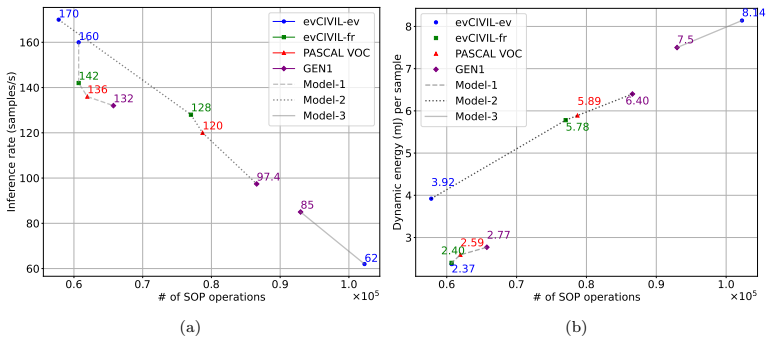
The central discovery is that spiking neural networks deployed on the Loihi 2 neuromorphic processor can achieve real-time object detection on both frame-based and event-based datasets. With ANN-to-SNN distillation-aware training, these networks recover 87-100% of the detection accuracy of their artificial neural network counterparts. They also exhibit the lowest per-inference dynamic energy consumption and lower overall power draw compared to ANNs running on NVIDIA Jetson and Apple M2 platforms, although the latter can achieve higher inference rates.
What carries the argument
ANN-to-SNN distillation-aware training combined with deployment adaptations for the Loihi 2 processor, which converts standard detection models into energy-efficient spiking versions while preserving accuracy.
If this is right
- Real-time detection becomes viable on severely power-limited edge devices like UAVs and mobile robots.
- Event-based inputs pair efficiently with SNNs, potentially reducing data processing overhead.
- Distillation training closes much of the accuracy gap between spiking and non-spiking networks for detection tasks.
- Neuromorphic platforms like Loihi 2 offer superior power efficiency for vision at the edge despite lower peak speeds.
Where Pith is reading between the lines
- Similar approaches might apply to other real-time tasks such as tracking or segmentation on neuromorphic hardware.
- The energy savings could enable longer operation times in autonomous systems without increasing hardware size.
- Further optimizations in model size or hardware mapping might push inference rates closer to those of GPUs while retaining energy benefits.
Load-bearing premise
That energy consumption and latency figures measured across Loihi 2, Jetson, and Apple platforms can be compared directly without hidden variations in measurement methods, clock speeds, or how the detection workload is represented.
What would settle it
Conducting identical object detection experiments on the same input data using both the Loihi 2 SNN implementation and an ANN on the Jetson Orin Nano, with standardized power and timing measurements.
Figures


read the original abstract
Real-time object detection on energy-constrained platforms is critical for applications such as UAV-based inspection, autonomous navigation, and mobile robotics. Spiking neural networks (SNNs) on neuromorphic hardware are believed to be significantly more energy-efficient than conventional artificial neural networks (ANNs). In this work, we present a comprehensive methodology for designing general SNN detection architectures targeting neuromorphic platforms, along with the engineering adaptations required to deploy them on the state-of-the-art Neuromorphic processor, Intel Loihi 2. We benchmark SNN-based object detection on Loihi 2 using both frame-based and event-based datasets, comparing performance with ANN-based detection on the NVIDIA Jetson Orin Nano, NVIDIA Jetson Nano B01, and the Apple M2 CPU. Our results show that SNNs on Loihi 2 can perform real-time detection while achieving the lowest per-inference dynamic energy among all platforms. Also, Loihi 2 outperforms the other platforms in terms of power consumption, though ANNs on Jetson Orin Nano achieve higher inference rates. Furthermore, our ANN-to-SNN distillation-aware training enables SNNs to recover 87-100% of the detection accuracy of their ANN counterparts while maintaining lower inference latency; without distillation, SNNs exhibit an 11-27% accuracy drop. These results highlight the potential of neuromorphic systems for energy-efficient, real-time object detection at the edge.
Editorial analysis
A structured set of objections, weighed in public.
Referee Report
Summary. The manuscript presents a methodology for designing and deploying spiking neural networks (SNNs) for real-time object detection on Intel Loihi 2 neuromorphic hardware, including adaptations for frame-based and event-based inputs and ANN-to-SNN distillation-aware training. It benchmarks SNN performance on Loihi 2 against ANN-based detectors on NVIDIA Jetson Orin Nano, Jetson Nano B01, and Apple M2, claiming that SNNs achieve the lowest per-inference dynamic energy and power consumption while maintaining real-time operation and recovering 87-100% of ANN accuracy (versus 11-27% drop without distillation).
Significance. If the cross-platform energy and latency comparisons are shown to be methodologically equivalent, the work provides a valuable practical demonstration of SNN deployment for energy-efficient edge object detection in applications such as UAV inspection and robotics. The engineering details on Loihi 2 deployment, use of both input modalities, and distillation results constitute useful implementation contributions for the neuromorphic vision community.
major comments (2)
- [Experimental Setup / Benchmarking section] The section on experimental setup and hardware measurement protocols does not specify the exact definition of 'per-inference dynamic energy' (e.g., inference start/end boundaries, subtraction of static/leakage power, inclusion of spike encoding or DMA overhead) nor provide a common normalization (such as energy per output bounding box or per effective MAC) that would allow direct comparison between Loihi 2 on-chip counters, Jetson nvpmodel/external meters, and M2 powermetrics. This directly undermines the central claim that Loihi 2 achieves the lowest dynamic energy while remaining real-time.
- [Results section] The results reporting the 87-100% accuracy recovery with distillation and 11-27% drop without it lacks accompanying details on the precise model architectures (e.g., backbone, detection head), exact datasets used for frame-based and event-based cases, training hyperparameters, and any statistical tests or variance across runs. Without these, the quantitative claims cannot be independently assessed or generalized.
minor comments (2)
- [Figures and Tables] Figure captions and tables should explicitly state the input modality (frame vs. event) and the exact hardware configuration for each reported metric to improve readability.
- [Abstract] The abstract would benefit from naming the specific datasets and model sizes used to support the quantitative claims.
Simulated Author's Rebuttal
We thank the referee for the constructive comments that help strengthen the clarity and reproducibility of our work. We address each major point below and will revise the manuscript accordingly.
read point-by-point responses
-
Referee: [Experimental Setup / Benchmarking section] The section on experimental setup and hardware measurement protocols does not specify the exact definition of 'per-inference dynamic energy' (e.g., inference start/end boundaries, subtraction of static/leakage power, inclusion of spike encoding or DMA overhead) nor provide a common normalization (such as energy per output bounding box or per effective MAC) that would allow direct comparison between Loihi 2 on-chip counters, Jetson nvpmodel/external meters, and M2 powermetrics. This directly undermines the central claim that Loihi 2 achieves the lowest dynamic energy while remaining real-time.
Authors: We agree that precise definitions are required to support the energy-efficiency claims. In the revised manuscript we will explicitly state the start and end boundaries used for each per-inference measurement, describe how static/leakage power is subtracted on every platform, and clarify the treatment of spike encoding and DMA overheads. We will also add a normalized metric (energy per output bounding box) alongside the raw per-inference figures to enable direct cross-platform comparison. These additions will be placed in the Experimental Setup section and referenced in the Results. revision: yes
-
Referee: [Results section] The results reporting the 87-100% accuracy recovery with distillation and 11-27% drop without it lacks accompanying details on the precise model architectures (e.g., backbone, detection head), exact datasets used for frame-based and event-based cases, training hyperparameters, and any statistical tests or variance across runs. Without these, the quantitative claims cannot be independently assessed or generalized.
Authors: We acknowledge the need for fuller documentation. The revised Results section will include: (i) exact backbone and detection-head architectures for both frame-based and event-based models, (ii) the precise datasets and splits used in each case, (iii) all training hyperparameters (learning rates, epochs, distillation temperature, etc.), and (iv) accuracy statistics (mean and standard deviation) across at least three independent runs together with the statistical test employed. These details will be presented in a new table or expanded text to allow independent assessment and generalization of the distillation results. revision: yes
Circularity Check
No circularity: empirical implementation and hardware benchmarking paper with no derivations or self-referential predictions.
full rationale
The paper presents a design methodology for SNN object detection architectures, engineering adaptations for Loihi 2 deployment, and direct benchmark comparisons of energy, latency, power, and accuracy against ANN baselines on Jetson and Apple platforms. All reported results (real-time detection, lowest dynamic energy on Loihi 2, 87-100% accuracy recovery via distillation) derive from implementation, training runs, and platform-specific measurements rather than any equations, fitted parameters renamed as predictions, or self-citation chains. No load-bearing steps reduce by construction to inputs within the paper; the work is self-contained against external hardware benchmarks.
Axiom & Free-Parameter Ledger
Reference graph
Works this paper leans on
-
[2]
N. M. Alahdal, F. Abukhodair, L. H. Meftah, A. Cherif, Real-time object detection in autonomous vehicles with yolo, Procedia Computer Science 246 (2024) 2792–2801, 28th International Conference on Knowledge Based and Intelligent information and Engineering Systems (KES 2024).doi:https://doi.org/10.1016/j.procs.2024.09.392. URLhttps://www.sciencedirect.com...
-
[3]
K. Luo, X. Kong, J. Zhang, J. Hu, J. Li, H. Tang, Computer vision-based bridge inspection and monitoring: A review, Sensors 23 (18) (2023). doi:10.3390/s23187863
-
[4]
M. T. Rasheed, D. Shi, H. Khan, A comprehensive experiment-based review of low-light image enhancement methods and benchmarking low- light image quality assessment, Signal Processing 204 (2023) 108821. doi:https://doi.org/10.1016/j.sigpro.2022.108821
-
[5]
G. Gallego, T. Delbr¨ uck, G. Orchard, C. Bartolozzi, B. Taba, A. Censi, S. Leutenegger, A. J. Davison, J. Conradt, K. Daniilidis, D. Scaramuzza, Event-based vision: A survey, IEEE Transactions on Pattern Analysis and Machine Intelligence 44 (1) (2022) 154–180.doi:10.1109/TPAMI. 2020.3008413
-
[6]
YOLOv3: An Incremental Improvement
J. Redmon, A. Farhadi, Yolov3: An incremental improvement, arXiv preprint arXiv:1804.02767 (2018)
work page internal anchor Pith review arXiv 2018
-
[7]
W. Liu, D. Anguelov, D. Erhan, C. Szegedy, S. Reed, C.-Y. Fu, A. C. Berg, Ssd: Single shot multibox detector, in: B. Leibe, J. Matas, N. Sebe, M. Welling (Eds.), Computer Vision – ECCV 2016, Springer International Publishing, Cham, 2016, pp. 21–37
2016
-
[8]
Ngo, H.-C
D. Ngo, H.-C. Park, B. Kang, Edge intelligence: A review of deep neural network inference in resource-limited environments, Electronics 14 (12) (2025)
2025
-
[9]
P. Mittal, A comprehensive survey of deep learning-based lightweight object detection models for edge devices, Artificial Intelligence Review 57 (9) (2024) 242.doi:10.1007/s10462-024-10877-1
-
[10]
J. Chen, X. Ran, Deep learning with edge computing: A review, Pro- 42 ceedings of the IEEE 107 (8) (2019) 1655–1674.doi:10.1109/JPROC. 2019.2921977
-
[11]
S. Liu, J. Zha, J. Sun, Z. Li, G. Wang, Edgeyolo: An edge-real- time object detector, in: Proceedings of the 2023 42nd Chinese Con- trol Conference (CCC), Tianjin, China, 2023, pp. 7507–7512.doi: 10.23919/CCC58697.2023.10239786
-
[12]
Sandler, A
M. Sandler, A. Howard, M. Zhu, A. Zhmoginov, L.-C. Chen, Mo- bilenetv2: Inverted residuals and linear bottlenecks, in: Proceedings of the IEEE/CVF Conference on Computer Vision and Pattern Recog- nition (CVPR), 2018, pp. 4510–4520
2018
-
[13]
F. Paredes-Vall´ es, J. J. Hagenaars, J. Dupeyroux, S. Stroobants, Y. Xu, G. C. H. E. de Croon, Fully neuromorphic vision and control for au- tonomous drone flight, Science Robotics 9 (90) (2024) eadi0591, erra- tum:Science Robotics, vol. 9, no. 91, p. eadr0223, Jun 2024.doi: 10.1126/scirobotics.adi0591
- [14]
-
[16]
Hinet: Half instance normalization network for image restoration
Y. Hu, S.-C. Liu, T. Delbruck, v2e: From video frames to realistic dvs events, in: Proceedings of the 2021 IEEE/CVF Conference on Computer Vision and Pattern Recognition Workshops (CVPRW), Virtual, 2021, pp. 1312–1321.doi:10.1109/CVPRW53098.2021.00144
-
[17]
A. Sironi, M. Brambilla, N. Bourdis, X. Lagorce, R. Benosman, HATS: Histograms of averaged time surfaces for robust event-based object clas- sification, in: Proceedings of the IEEE Conference on Computer Vision and Pattern Recognition (CVPR), Salt Lake City, UT, USA, 2018, pp. 1731–1740.doi:10.1109/CVPR.2018.00186
-
[18]
D. Gehrig, A. Loquercio, K. G. Derpanis, D. Scaramuzza, End-to-end learning of representations for asynchronous event-based data, in: Pro- ceedings of the IEEE/CVF International Conference on Computer Vi- sion (ICCV), Seoul, South Korea, 2019, pp. 5633–5643.doi:10.1109/ ICCV.2019.00573
-
[19]
Speech recognition through physical reservoir computing with neuromorphic nanowire networks,
L. Cordone, B. Miramond, P. Thierion, Object detection with spiking neural networks on automotive event data, in: 2022 International Joint 43 Conference on Neural Networks (IJCNN), Padua, Italy, 2022, pp. 1–8. doi:10.1109/IJCNN55064.2022.9892618
- [20]
-
[21]
W. Fang, Z. Yu, Y. Chen, T. Masquelier, T. Huang, Y. Tian, In- corporating learnable membrane time constant to enhance learning of spiking neural networks, in: Proceedings of the IEEE/CVF Interna- tional Conference on Computer Vision (ICCV), 2021, pp. 2641–2651. doi:10.1109/ICCV48922.2021.00265
-
[22]
K. Roy, A. R. Jaiswal, P. Panda, Towards spike-based machine intelli- gence with neuromorphic computing, Nature 575 (7784) (2019) 607–617. doi:10.1038/s41586-019-1677-2
-
[23]
M. Dampfhoffer, T. Mesquida, A. Valentian, L. Anghel, Backpropagation-based learning techniques for deep spiking neural networks: A survey, IEEE Transactions on Neural Networks and Learning Systems 35 (9) (2024) 11906–11921. doi:10.1109/TNNLS.2023.3263008
-
[24]
S. B. Shrestha, G. Orchard, SLAYER: Spike layer error reassign- ment in time, in: Advances in Neural Information Processing Systems (NeurIPS), Vol. 31, 2018
2018
-
[25]
Panda, Spiking neural networks, ESWEEK 2021 Tutorial, Yale Uni- versity, accessed: 2025-04-28 (2021)
P. Panda, Spiking neural networks, ESWEEK 2021 Tutorial, Yale Uni- versity, accessed: 2025-04-28 (2021). URLhttps://www.youtube.com/watch?v=7TybETlCslM
2021
-
[26]
URLhttps://www.ibm.com/think/topics/neuromorphic- computing
IBM, What is neuromorphic computing?, accessed: 2025-05-01 (2025). URLhttps://www.ibm.com/think/topics/neuromorphic- computing
2025
-
[27]
7, 2025 (2025)
BrainChip Inc., Akida — BrainChip neuromorphic chip overview, accessed: Dec. 7, 2025 (2025). URLhttps://brainchip.com/neuromorphic-chip-maker-takes- aim-at-the-edge
2025
-
[28]
7, 2025 (2025)
SynSense, DYNAP-CNN — event-driven neuromorphic AI processor for vision processing, accessed: Dec. 7, 2025 (2025). URLhttps://open-neuromorphic.org/neuromorphic-computing/ hardware
2025
-
[29]
Furber, F
S. Furber, F. Galluppi, S. Temple, L. A. Plana, SpiNNaker: A spiking neural network architecture, Journal of Neural Engineering 11 (5) (2014) 056021. 44
2014
-
[30]
7, 2025 (2018)
Intel Corporation, Loihi neuromorphic research chip, accessed: Dec. 7, 2025 (2018). URLhttps://open-neuromorphic.org/neuromorphic-computing/ hardware
2025
-
[31]
rep., Intel Corporation, accessed: 2025-05-01 (2025)
Intel Corporation, Neuromorphic computing: Loihi 2 technology brief, Tech. rep., Intel Corporation, accessed: 2025-05-01 (2025). URLhttps://www.intel.com/content/www/us/en/research/ neuromorphic-computing-loihi-2-technology-brief.html
2025
-
[32]
A. Wild, M. Richter, Lava: Open-source framework for neuro-inspired applications, Online Video, accessed: 2025-05-01 (2023). URLhttps://www.youtube.com/watch?v=vXZukQ6A79k
2025
-
[33]
URLhttps://github.com/lava-nc/lava-dl
Lava Neuromorphic Computing Community, lava-dl: Deep learning li- brary for lava, GitHub Repository, accessed: 2025-05-01 (2025). URLhttps://github.com/lava-nc/lava-dl
2025
-
[34]
URLhttps://www.intel.com/content/www/us/en/newsroom/news/ intel-advances-neuromorphic-loihi-2-lava.html
Intel Corporation, Intel advances neuromorphic with Loihi 2, new Lava software framework and new partners, Intel Newsroom Press Release, accessed: 2025-12-08 (2021). URLhttps://www.intel.com/content/www/us/en/newsroom/news/ intel-advances-neuromorphic-loihi-2-lava.html
2025
-
[35]
URLhttps://www.youtube.com/watch?v=AlASZb93rrc
MIT 6.S965, Lecture 05 - quantization (Part I), accessed: May 1, 2025 (2020). URLhttps://www.youtube.com/watch?v=AlASZb93rrc
2025
-
[36]
URLhttps://www.youtube.com/watch?v=tT9Lnt6stwA
MIT HAN Lab, Lecture 10 - knowledge distillation — MIT 6.S965, accessed: May 1, 2025 (2020). URLhttps://www.youtube.com/watch?v=tT9Lnt6stwA
2025
-
[37]
A. Vicente-Sola, D. L. Manna, P. Kirkland, G. Di Caterina, T. J. Bihl, Spiking neural networks for event-based action recognition: A new task to understand their advantage, Neurocomputing 611 (2025) 128657. doi:10.1016/j.neucom.2024.128657
-
[38]
S. Barchid, J. Mennesson, J. Eshraghian, C. Dj´ eraba, M. Bennamoun, Spiking neural networks for frame-based and event-based single ob- ject localization, Neurocomputing 559 (2023) 126805.doi:10.1016/ j.neucom.2023.126805
-
[39]
U. K. N. G. W. Gamage, L. Zanatta, M. Fumagalli, C. Cadena, S. Tolu, Event-based classification of defects in civil infrastructures with artificial and spiking neural networks, in: I. Rojas, G. Joya, A. Catala (Eds.), Advances in Computational Intelligence, Springer Nature Switzerland, Cham, 2023, pp. 629–640. 45
2023
-
[40]
S. Kim, S. Park, B. Na, S. Yoon, Spiking-yolo: Spiking neural net- work for energy-efficient object detection, in: Proceedings of the AAAI Conference on Artificial Intelligence, Vol. 34, 2020, pp. 11270–11277. doi:10.1609/aaai.v34i07.6787
-
[41]
X. Luo, M. Yao, Y. Chou, B. Xu, G. Li, Integer-valued training and spike-driven inference spiking neural network for high-performance and energy-efficient object detection, in: Proceedings of the European Con- ference on Computer Vision (ECCV), 2024, best Paper Candidate
2024
-
[42]
Kugele, T
A. Kugele, T. Pfeil, M. Pfeiffer, E. Chicca, Hybrid snn-ann: Energy- efficient classification and object detection for event-based vision, in: C. Bauckhage, J. Gall, A. Schwing (Eds.), Pattern Recognition, Springer International Publishing, Cham, 2021, pp. 297–312
2021
-
[43]
Z. Wang, Z. Wang, H. Li, L. Qin, R. Jiang, D. Ma, H. Tang, Eas-snn: End-to-end adaptive sampling and representation for event-based detec- tion with recurrent spiking neural networks, in: A. Leonardis, E. Ricci, S. Roth, O. Russakovsky, T. Sattler, G. Varol (Eds.), Computer Vision – ECCV 2024, Springer Nature Switzerland, Cham, 2025, pp. 310–328
2024
-
[44]
Systematic Gener- alization in Neural Networks-based Multivariate Time Series Forecasting Models
A. Viale, A. Marchisio, M. Martina, G. Masera, M. Shafique, CarSNN: An efficient spiking neural network for event-based autonomous cars on the loihi neuromorphic research processor, in: 2021 International Joint Conference on Neural Networks (IJCNN), Virtual (Shenzhen, China), 2021, pp. 1–10.doi:10.1109/IJCNN52387.2021.9533738
-
[45]
Trajectory Optimization and Following for a Three Degrees of Freedom Overactuated Floating Platform
A. Viale, A. Marchisio, M. Martina, G. Masera, M. Shafique, LaneSNNs: Spiking neural networks for lane detection on the Loihi neuromorphic processor, in: Proceedings of the 2022 IEEE/RSJ International Confer- ence on Intelligent Robots and Systems (IROS), Kyoto, Japan, 2022, pp. 79–86.doi:10.1109/IROS47612.2022.9981034
-
[46]
M. Brehove, S. A. Tumpa, E. Kyubwa, N. Menon, N. Vijaykrish- nan, Sigma-delta neural network conversion on loihi 2, arXiv preprint arXiv:2505.06417 (2025)
-
[47]
and Carlsson, Marcel , month = apr, year =
J. Moosmann, P. Bonazzi, Y. Li, S. Bian, P. Mayer, L. Benini, M. Magno, Ultra-Efficient On-Device Object Detection on AI-Integrated Smart Glasses with TinyissimoYOLO, in: Proceedings of the IEEE International Conference on Acoustics, Speech and Signal Processing (ICASSP), 2024.doi:10.1109/ICASSP48485.2024.10446059
-
[48]
Rueckauer, Y
B. Rueckauer, Y. Wen, K. Liu, Y. Shi, G. Cauwenberghs, Going deeper in spiking neural networks: VGG and residual architectures, Frontiers in Neuroscience 13 (2019) 95. 46
2019
-
[49]
A. Balaji, A. Das, Compiling spiking neural networks to mitigate neu- romorphic hardware constraints, in: Proceedings of the IEEE/ACM International Conference on Computer-Aided Design (ICCAD), 2020. doi:10.1145/3400302.3415694
- [50]
-
[51]
Jocher, A
G. Jocher, A. Chaurasia, J. Qiu, YOLOv8: Ultralytics real-time object detection (2023). URLhttps://github.com/ultralytics/ultralytics
2023
-
[52]
X. Ding, X. Zhang, N. Ma, J. Han, G. Ding, J. Sun, RepVGG: Making VGG-style ConvNets great again, in: Proceedings of the IEEE/CVF Conference on Computer Vision and Pattern Recognition (CVPR), 2021, pp. 13733–13742
2021
-
[53]
T. Kong, F. Sun, H. Liu, Y. Jiang, L. Li, J. Shi, FoveaBox: Beyond anchor-based object detector, IEEE Transactions on Image Processing 29 (2020) 7389–7398.doi:10.1109/TIP.2020.3002345
-
[54]
Rebecq, R
H. Rebecq, R. Ranftl, V. Koltun, D. Scaramuzza, High speed and high HDR video with an event camera, IEEE Transactions on Pattern Anal- ysis and Machine Intelligence (TPAMI) 43 (6) (2021) 1964–1980
2021
-
[55]
Ioffe, C
S. Ioffe, C. Szegedy, Batch normalization: Accelerating deep network training by reducing internal covariate shift, in: Proceedings of the 32nd International Conference on Machine Learning (ICML), 2015, pp. 448– 456
2015
-
[56]
X. Li, W. Wang, L. Wu, S. Chen, X. Hu, J. Li, J. Tang, J. Yang, Gen- eralized focal loss: Learning qualified and distributed bounding boxes for dense object detection, in: Proceedings of the IEEE/CVF Confer- ence on Computer Vision and Pattern Recognition (CVPR), 2020, pp. 12839–12848
2020
-
[57]
T.-Y. Lin, M. Maire, S. Belongie, J. Hays, P. Perona, D. Ramanan, P. Doll´ ar, C. L. Zitnick, Microsoft COCO: Common objects in context, in: Computer Vision – ECCV 2014, Springer International Publish- ing, Cham, Switzerland, 2014, pp. 740–755.doi:10.1007/978-3-319- 10602-1\_48
-
[58]
URLhttps://github.com/lava-nc/lava-dl/blob/main/ 47 tutorials/lava/lib/dl/netx/pilotnet_snn/benchmark.ipynb
lava-nc contributors, lava-dl: Deep Learning Library for Lava — PilotNet SNN Benchmark Notebook, GitHub repository, accessed: 26-Nov-2025 (2025). URLhttps://github.com/lava-nc/lava-dl/blob/main/ 47 tutorials/lava/lib/dl/netx/pilotnet_snn/benchmark.ipynb
2025
-
[59]
U. G. W. K. N. Gamage, X. Huo, L. Zanatta, T. Delbr¨ uck, C. Ca- dena, M. Fumagalli, S. Tolu, Event-based civil infrastructure visual defect detection: ev-CIVIL dataset and benchmark, arXiv preprint arXiv:2504.05679 (2025)
work page internal anchor Pith review Pith/arXiv arXiv 2025
-
[60]
P. de Tournemire, D. Nitti, E. Perot, D. Migliore, A. Sironi, A large scale event-based detection dataset for automotive, in: Proceedings of the IEEE/CVF Conference on Computer Vision and Pattern Recognition (CVPR) Workshops, 2020, pp. 346–347.doi:10.1109/CVPRW50498. 2020.00173
-
[61]
Everingham, L
M. Everingham, L. Van Gool, C. K. I. Williams, J. Winn, A. Zisser- man, The PASCAL visual object classes (VOC) challenge, International Journal of Computer Vision 88 (2) (2010) 303–338
2010
-
[62]
Paszke, S
A. Paszke, S. Gross, F. Massa, A. Lerer, J. Bradbury, G. Chanan, T. Killeen, Z. Lin, N. Gimelshein, L. Antiga, et al., PyTorch: An im- perative style, high-performance deep learning library, in: Advances in Neural Information Processing Systems (NeurIPS), 2019
2019
-
[63]
W. Fang, Y. Chen, J. Ding, D. Chen, Z. Yu, T. Masquelier, Y. Chen, T. Huang, Y. Tian, SpikingJelly,https://github.com/ fangwei123456/spikingjelly, accessed: May 28, 2025 (2020)
2025
-
[64]
Z. Teed, J. Deng, RAFT: Recurrent all-pairs field transforms for optical flow, in: Proceedings of the European Conference on Computer Vision (ECCV), Glasgow, UK (Virtual), 2020, pp. 402–419
2020
- [65]
-
[66]
7, 2025 (2025)
lava-nc contributors, lava-dl: PilotNet SDNN inference tutorial, ac- cessed: Dec. 7, 2025 (2025). URLhttps://github.com/lava-nc/lava-dl/tree/main/ tutorials/lava/lib/dl/netx/pilotnet_sdnn
2025
-
[67]
URLhttps://category.yahboom.net/products/jetson-nano-sub
Yahboom, Jetson nano 4gb b01 sub developer kit, accessed: 2025-12-07 (2025). URLhttps://category.yahboom.net/products/jetson-nano-sub
2025
-
[68]
NVIDIA Corporation, Jetson Orin Nano Super Developer Kit, https://www.nvidia.com/en-us/autonomous-machines/embedded- systems/jetson-orin/nano-super-developer-kit/, accessed: 2026-03-29 (2024)
2026
-
[69]
48 URLhttps://www.macrumors.com/guide/m2/
MacRumors, M2 chip guide, accessed: 2025-06-12 (2022). 48 URLhttps://www.macrumors.com/guide/m2/
2025
-
[70]
D. Cooney, Intel unveils 1.15bn neuron neuromorphic system Hala Point,https://www.datacenterdynamics.com/en/news/intel- unveils-115bn-neuron-neuromorphic-system-hala-point/, ac- cessed: 2026-03-29 (Apr 2024)
2026
-
[71]
MIT HAN Lab, Lecture 07 – Neural Architecture Search (Part I) — MIT 6.S965, YouTube video (2020). URLhttps://www.youtube.com/watch?v=NQj5TkqX48Q 49 (a) (b) (c) (d) Figure A.1: Qualitative visualization of sample detections on (a) evCIVIL-ev, (b) GEN1, (c) evCIVIL-fr, and (d) PASCAL VOC datasets. For each dataset, the first row shows the correct detections...
2020
discussion (0)
Sign in with ORCID, Apple, or X to comment. Anyone can read and Pith papers without signing in.