Extinction law and stellar mass in the Nuclear Bulge from kinematically-selected red clump stars
Pith reviewed 2026-05-09 19:34 UTC · model grok-4.3
The pith
Kinematically selected red clump stars yield an extinction law and stellar mass for the Nuclear Bulge.
A machine-rendered reading of the paper's core claim, the machinery that carries it, and where it could break.
Core claim
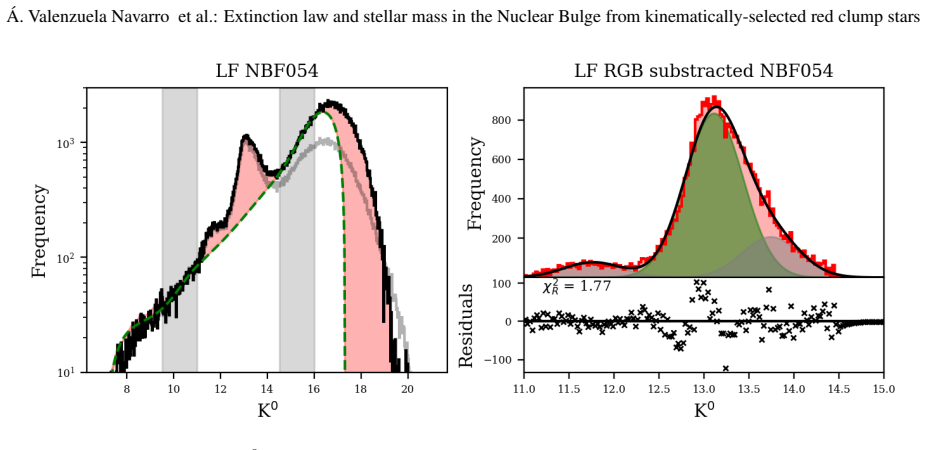
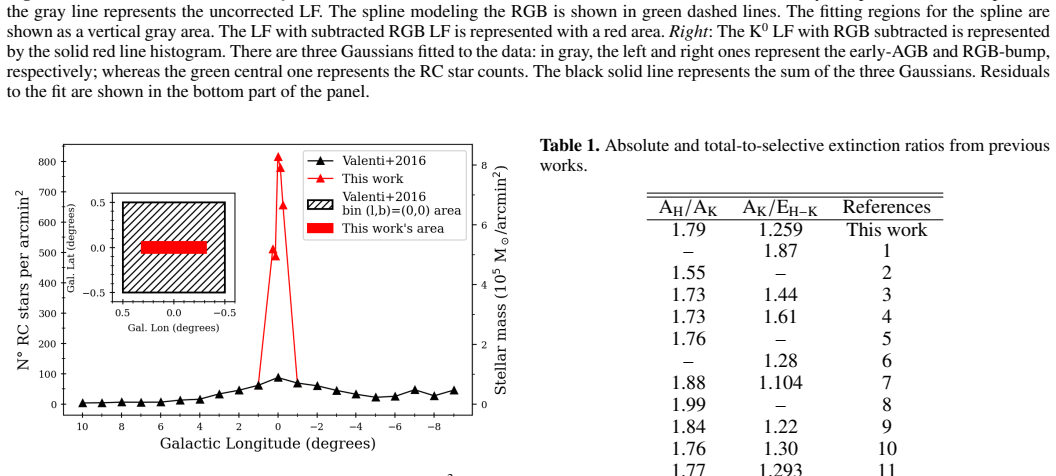
By kinematically selecting red clump stars belonging to the Nuclear Bulge, the extinction law is determined with a total-to-selective ratio A_K/E_{H-K} = 1.259 ± 0.074 and an extinction ratio A_H/A_K = 1.794 ± 0.046. A high-spatial resolution reddening map is created showing clear filamentary structures and a gradient in extinction over the giant molecular cloud G0.253+0.016. The stellar mass of the Nuclear Bulge is computed from completeness-corrected red clump star counts as 12.2 ± 2.6 × 10^8 solar masses, in agreement with other estimates.
What carries the argument
Kinematically-selected red clump stars, which isolate Nuclear Bulge members to measure differential reddening and to count stars for mass estimation.
If this is right
- The measured extinction ratios can be applied to correct photometry of other stars observed in the same lines of sight.
- The high-resolution reddening map enables studies of how dust is distributed relative to molecular clouds such as the Brick.
- The stellar mass estimate can be compared directly with dynamical and star-count models of the galactic center.
- Completeness corrections applied to the star counts improve density estimates in regions of high and variable extinction.
Where Pith is reading between the lines
- The same kinematic selection technique could be tested on other stellar tracers to map extinction laws across additional obscured zones of the Milky Way.
- An accurate Nuclear Bulge mass constrains the contribution of this component to the overall bulge mass budget and its formation timescale.
- Filamentary dust structures visible in the map may trace gas inflows or shear flows driven by the galactic bar.
Load-bearing premise
Kinematically selected red clump stars are assumed to belong to the Nuclear Bulge with negligible contamination and to have sufficiently uniform and known intrinsic colors and luminosities.
What would settle it
Independent spectroscopic or photometric measurements showing that the selected red clump sample contains substantial contamination from disk or bar stars, or that their intrinsic properties vary more than assumed, would invalidate the derived extinction ratios and mass.
Figures


read the original abstract
The Nuclear Bulge of the Milky Way harbors stellar populations that provide crucial insights into galaxy formation processes and serve as a nearby analog for understanding bulge formation in external galaxies. However, detailed studies of this region are severely hampered by extreme and highly variable interstellar extinction, which obscures the intrinsic stellar properties and impedes accurate stellar mass determinations. Our goal is to measure the extinction law towards the Nuclear Bulge and to estimate its stellar density. We developed a method to determine the extinction law towards the Nuclear Bulge by kinematically selecting red clump stars belonging to this region. We created a high-spatial resolution reddening map, and computed stellar mass with completeness-corrected red clump star counts, scaled from empirical measurements. We find a total-to-selective extinction ratio of $\mathrm{A_K/{E_{H-K}} = 1.259 \pm 0.074}$, and an extinction ratio of $\mathrm{A_H/A_K = 1.794 \pm 0.046}$, which are consistent with previous works. The high-spatial resolution reddening map shows clear filamentary structures, and a gradient in the extinction over the giant molecular cloud G0.253+0.016 (i.e., the Brick). From the star counts, we measured a stellar mass of $\mathrm{12.2~\pm2.6\times10^8~M_{\odot}}$ for the Nuclear Bulge, in agreement with other mass estimates.
Editorial analysis
A structured set of objections, weighed in public.
Referee Report
Summary. The paper develops a method to measure the extinction law towards the Nuclear Bulge by kinematically selecting red clump stars. It reports A_K/E_{H-K} = 1.259 ± 0.074 and A_H/A_K = 1.794 ± 0.046 (consistent with prior work), presents a high-resolution reddening map with filamentary structures and a gradient across G0.253+0.016 (the Brick), and derives a Nuclear Bulge stellar mass of 12.2 ± 2.6 × 10^8 M_⊙ from completeness-corrected star counts scaled to empirical measurements.
Significance. If the kinematic selection isolates a clean Nuclear Bulge sample, the work supplies an independent near-IR extinction law measurement in a heavily obscured region and a star-count-based mass estimate that aligns with other determinations. These are useful benchmarks for Milky Way central structure models and for bulge analogs in external galaxies. The direct use of observed star counts with empirical scaling is a methodological strength when contamination and completeness are adequately controlled.
major comments (2)
- [Method (kinematic selection)] The kinematic selection of red clump stars (described in the method) is load-bearing for both the extinction ratios and the mass estimate in the abstract, yet no quantitative contamination fraction from foreground disk stars (via velocity modeling or mock catalogs) is provided. Overlap in velocity distributions could systematically bias the observed (H-K) colors and the completeness-corrected counts used for the 12.2 ± 2.6 × 10^8 M_⊙ result.
- [Results (star counts and mass)] Completeness correction factors are invoked for the star-count mass but are listed among the free parameters without derivation details, uncertainty propagation, or validation against the data selection criteria. This directly affects the quoted mass uncertainty and its agreement with other estimates.
minor comments (2)
- [Abstract] The abstract notation for the extinction ratios is mostly clear but could standardize the subscript formatting (e.g., E_{H-K}) for consistency with the full text.
- [Results (reddening map)] The reddening map description would benefit from explicit reference to a figure panel showing the gradient across the Brick and any comparison to prior maps.
Simulated Author's Rebuttal
We thank the referee for their thorough review and constructive comments. We address the major points below and will revise the manuscript accordingly.
read point-by-point responses
-
Referee: The kinematic selection of red clump stars (described in the method) is load-bearing for both the extinction ratios and the mass estimate in the abstract, yet no quantitative contamination fraction from foreground disk stars (via velocity modeling or mock catalogs) is provided. Overlap in velocity distributions could systematically bias the observed (H-K) colors and the completeness-corrected counts used for the 12.2 ± 2.6 × 10^8 M_⊙ result.
Authors: We agree that a quantitative assessment of foreground contamination would strengthen the robustness of the kinematic selection. In the revised manuscript we will add an analysis of the velocity distributions to estimate the contamination fraction from disk stars, including a discussion of potential biases on the derived extinction ratios and stellar mass. revision: yes
-
Referee: Completeness correction factors are invoked for the star-count mass but are listed among the free parameters without derivation details, uncertainty propagation, or validation against the data selection criteria. This directly affects the quoted mass uncertainty and its agreement with other estimates.
Authors: We acknowledge that additional details on the completeness corrections are required. The revised manuscript will expand the methods section to describe the derivation of the completeness factors, their validation with respect to the selection criteria, and the propagation of their uncertainties into the final mass estimate. revision: yes
Circularity Check
No significant circularity; results are direct measurements from data
full rationale
The paper derives the extinction ratios A_K/E_{H-K} and A_H/A_K from observed colors of kinematically selected red clump stars after subtracting assumed intrinsic colors, and the mass from completeness-corrected star counts scaled by empirical luminosity. These steps are observational computations, not reductions by construction to fitted parameters renamed as predictions or to self-citations. No load-bearing uniqueness theorem, ansatz smuggling, or self-definitional loop is present in the described chain. The consistency with prior work is reported but does not substitute for the measurement itself.
Axiom & Free-Parameter Ledger
free parameters (1)
- completeness correction factors
axioms (2)
- domain assumption Red clump stars possess well-defined, environment-independent intrinsic colors and luminosities suitable for extinction measurements
- domain assumption Kinematic criteria can isolate Nuclear Bulge members with low contamination from disk or foreground stars
Reference graph
Works this paper leans on
-
[1]
2001, A&A, 379, L44 Albarracín, R., Zoccali, M., Olivares Carvajal, J., et al
Alard, C. 2001, A&A, 379, L44 Albarracín, R., Zoccali, M., Olivares Carvajal, J., et al. 2025, A&A, 693, A28 Alonso-García, J., Dékány, I., Catelan, M., et al. 2015, AJ, 149, 99 Alonso-García, J., Minniti, D., Catelan, M., et al. 2017, ApJ, 849, L13
work page 2001
- [2]
-
[3]
Arsenault, R., Madec, P. Y ., Hubin, N., et al. 2008, in Society of Photo-Optical Instrumentation Engineers (SPIE) Conference Series, V ol. 7015, Adaptive Optics Systems, ed. N. Hubin, C. E. Max, & P. L. Wizinowich, 701524 Astropy Collaboration, Price-Whelan, A. M., Lim, P. L., et al. 2022, ApJ, 935, 167 Astropy Collaboration, Price-Whelan, A. M., Sip˝ocz...
work page 2008
- [4]
-
[5]
Benjamin, R. A., Churchwell, E., Babler, B. L., et al. 2003, Publications of the Astronomical Society of the Pacific, 115, 953
work page 2003
- [6]
-
[7]
Bonnarel, F., Fernique, P., Bienaymé, O., et al. 2000, A&AS, 143, 33
work page 2000
-
[8]
Calamida, A., Sahu, K. C., Casertano, S., et al. 2015, ApJ, 810, 8
work page 2015
- [9]
-
[10]
2006, in Society of Photo- Optical Instrumentation Engineers (SPIE) Conference Series, V ol
Casali, M., Pirard, J.-F., Kissler-Patig, M., et al. 2006, in Society of Photo- Optical Instrumentation Engineers (SPIE) Conference Series, V ol. 6269, Ground-based and Airborne Instrumentation for Astronomy, ed. I. S. McLean & M. Iye, 62690W
work page 2006
-
[11]
Churchwell, E., Babler, B. L., Meade, M. R., et al. 2009, Publications of the Astronomical Society of the Pacific, 121, 213 6 http://www.astropy.org Article number, page 13 A&A proofs:manuscript no. aa58263-25 Table 2.Mass estimates in the Nuclear Bulge region compared with literature. RegionMσ M Method [108 M⊙] [10 8 M⊙] References NBF region (same obser...
work page 2009
-
[12]
2021, The Messenger, 182, 17 De Marchi, G., Panagia, N., Sabbi, E., et al
Davies, R., Hörmann, V ., Rabien, S., et al. 2021, The Messenger, 182, 17 De Marchi, G., Panagia, N., Sabbi, E., et al. 2016, MNRAS, 455, 4373 de Sá-Freitas, C., Fragkoudi, F., Gadotti, D. A., et al. 2023, A&A, 671, A8 de Sá-Freitas, C., Gadotti, D. A., Fragkoudi, F., et al. 2025, A&A, 698, A5
work page 2021
-
[13]
Fragkoudi, F., Athanassoula, E., & Bosma, A. 2016, MNRAS, 462, L41
work page 2016
-
[14]
Fritz, T. K., Patrick, L. R., Feldmeier-Krause, A., et al. 2021, A&A, 649, A83
work page 2021
-
[15]
A., Sánchez-Blázquez, P., Falcón-Barroso, J., et al
Gadotti, D. A., Sánchez-Blázquez, P., Falcón-Barroso, J., et al. 2019, MNRAS, 482, 506
work page 2019
-
[16]
Gallart, C., Aparicio, A., & Vilchez, J. M. 1996, AJ, 112, 1928
work page 1996
- [17]
-
[18]
A., Minniti, D., Valenti, E., et al
Gonzalez, O. A., Minniti, D., Valenti, E., et al. 2018, MNRAS, 481, L130 GRA VITY Collaboration. 2019, A&A, 625, L10 GRA VITY Collaboration. 2022, A&A, 657, L12
work page 2018
-
[19]
Groenewegen, M. A. T. 2008, A&A, 488, 935
work page 2008
-
[20]
Hammer, F., Morris, S., Cuby, J.-G., et al. 2021, The Messenger, 182, 33
work page 2021
-
[21]
Harris, C. R., Millman, K. J., van der Walt, S. J., et al. 2020, Nature, 585, 357
work page 2020
-
[22]
Harris, W. E. 1990, PASP, 102, 949
work page 1990
-
[23]
Harris, W. E. & Speagle, J. S. 2024, AJ, 168, 38
work page 2024
-
[24]
Henshaw, J. D., Barnes, A. T., Battersby, C., et al. 2023, in Astronomical Society of the Pacific Conference Series, V ol. 534, Protostars and Planets VII, ed. S. Inutsuka, Y . Aikawa, T. Muto, K. Tomida, & M. Tamura, 83
work page 2023
-
[25]
Henshaw, J. D., Ginsburg, A., Haworth, T. J., et al. 2019, MNRAS, 485, 2457
work page 2019
-
[26]
Anderson, Alberto Cellino, Claus Fabricius, Michael Davidson, and Lennart Lindegren
Hobbs, D., Høg, E., Mora, A., et al. 2016, arXiv e-prints, arXiv:1609.07325
- [27]
- [28]
-
[29]
Hunter, G. H., Sormani, M. C., Beckmann, J. P., et al. 2024, A&A, 692, A216
work page 2024
-
[30]
Indebetouw, R., Mathis, J. S., Babler, B. L., et al. 2005, ApJ, 619, 931
work page 2005
- [31]
-
[32]
Kennicutt, Jr., R. C. 1998, ApJ, 498, 541
work page 1998
-
[33]
Kissler-Patig, M., Pirard, J. F., Casali, M., et al. 2008, A&A, 491, 941
work page 2008
-
[34]
Kruijssen, J. M. D. & Longmore, S. N. 2013, MNRAS, 435, 2598
work page 2013
-
[35]
Launhardt, R., Zylka, R., & Mezger, P. G. 2002, A&A, 384, 112
work page 2002
-
[36]
Li, Z., Shen, J., Gerhard, O., & Clarke, J. P. 2022, ApJ, 925, 71
work page 2022
- [37]
-
[38]
N., Bally, J., Testi, L., et al
Longmore, S. N., Bally, J., Testi, L., et al. 2013, MNRAS, 429, 987
work page 2013
-
[39]
Marsh, K. A., Whitworth, A. P., Lomax, O., et al. 2017, MNRAS, 471, 2730
work page 2017
- [40]
-
[41]
Minniti, D., Lucas, P. W., Emerson, J. P., et al. 2010, New Astron., 15, 433
work page 2010
-
[42]
H., Sbordone, L., Rojas-Arriagada, A., et al
Minniti, J. H., Sbordone, L., Rojas-Arriagada, A., et al. 2020, A&A, 640, A92
work page 2020
-
[43]
Molinari, S., Schisano, E., Elia, D., et al. 2016, A&A, 591, A149
work page 2016
-
[44]
Molinari, S., Swinyard, B., Bally, J., et al. 2010, A&A, 518, L100
work page 2010
-
[45]
Nishiyama, S., Nagata, T., Kusakabe, N., et al. 2006, ApJ, 638, 839
work page 2006
-
[46]
2009, ApJ, 696, 1407 Nogueras-Lara , F., Schödel, R., Gallego-Calvente, A
Nishiyama, S., Tamura, M., Hatano, H., et al. 2009, ApJ, 696, 1407 Nogueras-Lara , F., Schödel, R., Gallego-Calvente, A. T., et al. 2020, Nature Astronomy, 4, 377
work page 2009
- [47]
-
[48]
Nogueras-Lara, F., Schödel, R., Neumayer, N., et al. 2020, A&A, 641, A141
work page 2020
-
[49]
2023, A&A, 671, L10 pandas development team, T
Nogueras-Lara, F., Schultheis, M., Najarro, F., et al. 2023, A&A, 671, L10 pandas development team, T. 2020, pandas-dev/pandas: Pandas
work page 2023
-
[50]
2010, in Society of Photo-Optical Instrumentation Engineers (SPIE) Conference Series, V ol
Paufique, J., Bruton, A., Glindemann, A., et al. 2010, in Society of Photo-Optical Instrumentation Engineers (SPIE) Conference Series, V ol. 7736, Adaptive Optics Systems II, ed. B. L. Ellerbroek, M. Hart, N. Hubin, & P. L. Wiz- inowich, 77361P
work page 2010
-
[51]
2011, Journal of Machine Learning Research, 12, 2825
Pedregosa, F., Varoquaux, G., Gramfort, A., et al. 2011, Journal of Machine Learning Research, 12, 2825
work page 2011
- [52]
-
[53]
2004, in Society of Photo- Optical Instrumentation Engineers (SPIE) Conference Series, V ol
Pirard, J.-F., Kissler-Patig, M., Moorwood, A., et al. 2004, in Society of Photo- Optical Instrumentation Engineers (SPIE) Conference Series, V ol. 5492, Ground-based Instrumentation for Astronomy, ed. A. F. M. Moorwood & M. Iye, 1763–1772
work page 2004
-
[54]
Plevne, O., Önal Ta¸ s, Ö., Bilir, S., & Seabroke, G. M. 2020, ApJ, 893, 108
work page 2020
-
[55]
Portail, M., Wegg, C., Gerhard, O., & Martinez-Valpuesta, I. 2015, MNRAS, 448, 713
work page 2015
-
[56]
Rathborne, J. M., Longmore, S. N., Jackson, J. M., et al. 2014, ApJ, 786, 140
work page 2014
-
[57]
Reid, M. J. & Brunthaler, A. 2020, ApJ, 892, 39
work page 2020
- [58]
-
[59]
Rodriguez-Fernandez, N. J. & Combes, F. 2008, A&A, 489, 115
work page 2008
-
[60]
K., Hempel, M., Alonso-García, J., et al
Saito, R. K., Hempel, M., Alonso-García, J., et al. 2024, A&A, 689, A148
work page 2024
-
[61]
L., Smith, L., González-Fernández, C., Lucas, P., & Minniti, D
Sanders, J. L., Smith, L., González-Fernández, C., Lucas, P., & Minniti, D. 2022, MNRAS, 514, 2407
work page 2022
- [62]
-
[63]
1959, ApJ, 129, 243 Schödel, R., Najarro, F., Muzic, K., & Eckart, A
Schmidt, M. 1959, ApJ, 129, 243 Schödel, R., Najarro, F., Muzic, K., & Eckart, A. 2010, A&A, 511, A18 Schödel, R., Nogueras-Lara, F., Hosek, M., et al. 2023, A&A, 672, L8 Schödel, R., Yelda, S., Ghez, A., et al. 2013, MNRAS, 429, 1367 Schönrich, R., Aumer, M., & Sale, S. E. 2015, ApJ, 812, L21
work page 1959
-
[64]
Schultheis, M., Fritz, T. K., Nandakumar, G., et al. 2021, A&A, 650, A191
work page 2021
-
[65]
Schultheis, M., Sormani, M. C., & Gadotti, D. A. 2025, A&A Rev., 33, 7
work page 2025
-
[66]
Siebenmorgen, R., Carraro, G., Valenti, E., et al. 2011, The Messenger, 144, 9
work page 2011
-
[67]
T., Belokurov, V ., Irwin, M., et al
Simion, I. T., Belokurov, V ., Irwin, M., et al. 2017, MNRAS, 471, 4323
work page 2017
-
[68]
Skrutskie, M. F., Cutri, R. M., Stiening, R., et al. 2006, AJ, 131, 1163
work page 2006
-
[69]
Smith, L. C., Lucas, P. W., Koposov, S. E., et al. 2025, MNRAS, 536, 3707
work page 2025
-
[70]
Sormani, M. C., Sanders, J. L., Fritz, T. K., et al. 2022, MNRAS, 512, 1857
work page 2022
-
[71]
Z., Mateo, M., Udalski, A., et al
Stanek, K. Z., Mateo, M., Udalski, A., et al. 1994, ApJ, 429, L73
work page 1994
-
[72]
Z., Udalski, A., Szyma ´Nski, M., et al
Stanek, K. Z., Udalski, A., Szyma ´Nski, M., et al. 1997, ApJ, 477, 163
work page 1997
-
[73]
Stetson, P. B. 1987, PASP, 99, 191
work page 1987
-
[74]
Stetson, P. B. 1994, PASP, 106, 250
work page 1994
- [75]
- [76]
-
[77]
2017, arXiv e-prints, arXiv:1707.02160
Taylor, M. 2017, arXiv e-prints, arXiv:1707.02160
-
[78]
Thatte, N., Tecza, M., Schnetler, H., et al. 2021, The Messenger, 182, 7
work page 2021
-
[79]
Tress, R. G., Sormani, M. C., Glover, S. C. O., et al. 2020, MNRAS, 499, 4455
work page 2020
- [80]
discussion (0)
Sign in with ORCID, Apple, or X to comment. Anyone can read and Pith papers without signing in.