Sequential Measurements as a Resource for Quantum Metrology
Pith reviewed 2026-05-09 19:34 UTC · model grok-4.3
The pith
Sequential weak measurements on a quantum harmonic oscillator can increase the information gained about displacement parameters by using measurement backaction as a resource.
A machine-rendered reading of the paper's core claim, the machinery that carries it, and where it could break.
Core claim
We present a protocol in which sequential weak measurements of a quantum harmonic oscillator enable simultaneous estimation of both quadratures of a displacement channel. Calculations of the quantum Fisher information show that the measurement backaction can increase the information gained for a range of measurement strengths. The protocol distributes information over an N-bit string after N weak measurements, allowing post-processing to avoid information loss due to phase wrapping and increase the effective dynamic range. The periodic information extraction makes the protocol robust to decoherence, establishing mid-sensing measurement as a resource for single- and multi-parameter quantummet
What carries the argument
Sequential weak measurements on a quantum harmonic oscillator that distribute displacement information into an N-bit string and use backaction to enhance quantum Fisher information.
If this is right
- Simultaneous estimation of both quadratures of a displacement becomes possible with one sequence of measurements.
- Post-processing of the N-bit string extends the dynamic range by correcting phase-wrapping losses.
- Periodic extraction of information improves robustness against decoherence compared to single strong measurements.
- Measurement backaction shifts from a limitation to a controllable contributor to metrological precision.
Where Pith is reading between the lines
- The bit-string encoding may integrate with classical digital filtering techniques to further suppress noise in real devices.
- Similar sequential protocols could be adapted to other continuous-variable systems such as optical modes or mechanical resonators.
- The approach suggests that mid-strength measurements might reduce hardware demands for multi-parameter sensing in noisy environments.
Load-bearing premise
The assumption that sequential weak measurements on the quantum harmonic oscillator produce backaction that increases quantum Fisher information over a useful range of strengths, and that post-processing fully mitigates phase wrapping without introducing new errors.
What would settle it
An experiment or simulation that varies measurement strength, computes the quantum Fisher information from the sequential outcomes, and checks whether it exceeds the value obtained without backaction in the predicted interval.
Figures




read the original abstract
We present a protocol in which sequential weak measurements of a quantum harmonic oscillator enable simultaneous estimation of both quadratures of a displacement channel. Calculations of the quantum Fisher information show that the measurement backaction can increase the information gained for a range of measurement strengths. The protocol distributes information over a $N$-bit string after $N$ weak measurements. Thus we find that post-processing can be used to avoid information loss due to phase wrapping, increasing the effective dynamic range. Finally, the periodic information extraction makes the protocol robust to decoherence. Our results establish mid-sensing measurement as a resource for single- and multi-parameter quantum metrology.
Editorial analysis
A structured set of objections, weighed in public.
Referee Report
Summary. The manuscript proposes a protocol for simultaneous estimation of both quadratures of a displacement channel acting on a quantum harmonic oscillator, using a sequence of N weak measurements. Quantum Fisher information calculations demonstrate that measurement backaction increases extractable information over a finite interval of measurement strengths. The outcomes form an N-bit string whose post-processing rule unwraps phase ambiguities to extend the effective dynamic range without introducing bias in the considered regimes. Master-equation simulations further show that the periodic information extraction confers robustness to decoherence.
Significance. If the central claims hold, the work establishes sequential weak measurements as a concrete resource for both single- and multi-parameter quantum metrology in continuous-variable systems. Explicit QFI derivations, the bias-free post-processing construction, and quantified decoherence simulations provide reproducible, falsifiable support. These elements could inform practical sensor designs that trade measurement strength for backaction-assisted gain and extended range.
minor comments (3)
- [§3.2] §3.2, Eq. (12): the explicit form of the measurement operators and the resulting backaction map on the QHO state should be written out fully so that the subsequent QFI expression in Eq. (15) can be verified by direct substitution.
- [§4.3] §4.3: the master-equation simulations quantify robustness, but the specific ratio of decoherence rate to measurement strength at which the periodic protocol outperforms a single strong measurement is not tabulated; adding this comparison would make the robustness claim easier to assess.
- [Figure 4] Figure 4 caption: the plotted dynamic-range extension is shown only for N=4 and N=8; a brief statement of the scaling with N would clarify whether the post-processing advantage saturates or continues to grow.
Simulated Author's Rebuttal
We thank the referee for their careful reading and positive evaluation of our manuscript. The summary accurately reflects our protocol for simultaneous quadrature estimation via sequential weak measurements on a quantum harmonic oscillator, the backaction-assisted information gain, the bias-free post-processing for extended dynamic range, and the decoherence robustness. We appreciate the recognition that these elements could inform practical sensor designs. The recommendation for minor revision is noted; however, no specific major comments were raised in the report.
Circularity Check
No significant circularity; derivation is self-contained
full rationale
The paper computes quantum Fisher information directly from the standard definition applied to the explicit weak-measurement interaction Hamiltonian and measurement operators on the QHO. The N-outcome post-processing rule for phase unwrapping is algebraically derived from the bit-string outcomes without any fitted parameters or self-referential redefinition of the target quantities. Decoherence robustness is quantified via independent master-equation simulations. No load-bearing step reduces by construction to a prior fit, self-citation, or ansatz imported from the authors' own work; all central claims rest on explicit calculations that remain falsifiable against external benchmarks.
Axiom & Free-Parameter Ledger
axioms (1)
- standard math Standard quantum mechanics governs the harmonic oscillator dynamics and weak measurement backaction effects.
Reference graph
Works this paper leans on
-
[1]
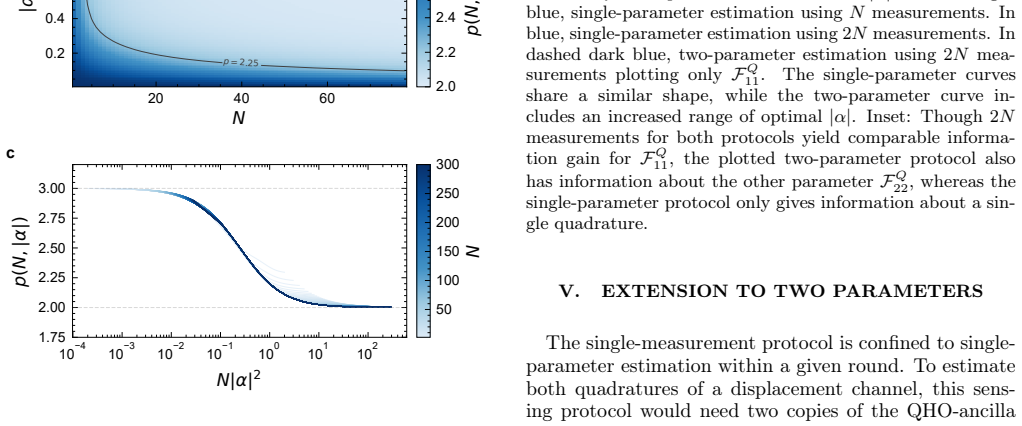
The single-parameter curves share a similar shape, while the two-parameter curve in- cludes an increased range of optimal|α|. Inset: Though2N measurements for both protocols yield comparable informa- tion gain forF Q 11, the plotted two-parameter protocol also has information about the other parameterFQ 22, whereas the single-parameter protocol only gives...
-
[2]
This motivates further study of se- quential measurement protocols across diverse hardware platforms and applications
and QHO-QHO. This motivates further study of se- quential measurement protocols across diverse hardware platforms and applications. Combined with non-classical probe states [9, 13] and adaptive control [17, 51], mid- 9 sensing measurement-based protocols could offer new op- portunities for quantum-enhanced parameter estimation. IX. ACKNOWLEDGMENTS This wo...
-
[3]
C. L. Degen, F. Reinhard, and P. Cappellaro, Quantum sensing, Rev. Mod. Phys.89, 035002 (2017)
2017
-
[4]
L. O. Conlon, T. Vogl, C. D. Marciniak, I. Pogorelov, S. K. Yung, F. Eilenberger, D. W. Berry, F. S. San- tana, R. Blatt, T. Monz, P. K. Lam, and S. M. Assad, Approaching optimal entangling collective measurements on quantum computing platforms, Nat. Phys.19, 351 (2023)
2023
-
[5]
C. D. Marciniak, T. Feldker, I. Pogorelov, R. Kaubrueg- ger, D. V. Vasilyev, R. van Bijnen, P. Schindler, P. Zoller, R. Blatt, and T. Monz, Optimal metrology with pro- grammable quantum sensors, Nature603, 604 (2022)
2022
-
[6]
Zhang, S
Z. Zhang, S. Mouradian, F. N. C. Wong, and J. H. Shapiro, Entanglement-enhanced sensing in a lossy and noisy environment, Phys. Rev. Lett.114, 110506 (2015)
2015
-
[7]
Hempel, B
C. Hempel, B. P. Lanyon, P. Jurcevic, R. Gerritsma, R. Blatt, and C. F. Roos, Entanglement-enhanced detec- tion of single-photon scattering events, Nat. Photonics7, 630 (2013)
2013
-
[8]
W. J. Eckner, N. Darkwah Oppong, A. Cao, A. W. Young, W. R. Milner, J. M. Robinson, J. Ye, and A. M. Kaufman, Realizing spin squeezing with Rydberg inter- actions in an optical clock, Nature621, 734 (2023)
2023
-
[9]
S. C. Burd, R. Srinivas, J. J. Bollinger, A. C. Wilson, D. J. Wineland, D. Leibfried, D. H. Slichter, and D. T. C. Allcock, Quantum amplification of mechanical oscillator motion, Science364, 1163 (2019)
2019
-
[10]
Tseet al.(LIGO Scientific Collaboration), Quantum- enhanced advanced LIGO detectors in the era of gravitational-wave astronomy, Phys
M. Tseet al.(LIGO Scientific Collaboration), Quantum- enhanced advanced LIGO detectors in the era of gravitational-wave astronomy, Phys. Rev. Lett.123, 231107 (2019)
2019
-
[11]
L. J. Bond, C. H. Valahu, A. Shankar, T. R. Tan, and A. Safavi-Naini, Optimal displacement sensing with spin- dependent squeezed states, PRX Quantum , (2026)
2026
-
[12]
P. T. Grochowski and R. Filip, Optimal phase-insensitive force sensing with non-gaussian states, Phys. Rev. Lett. 135, 230802 (2025)
2025
-
[13]
A.Dey, S.Mouradian, C.Lupo,andZ.Huang,Quantum- optimalfrequencyestimationofstochasticacfields,Phys. Rev. Lett.135, 130802 (2025)
2025
-
[14]
C. H. Valahu, M. P. Stafford, Z. Huang, V. G. Matsos, M. J. Millican, T. Chalermpusitarak, N. C. Menicucci, J. Combes, B. Q. Baragiola, and T. R. Tan, Quantum- enhanced multiparameter sensing in a single mode, Sci. Adv.11, eadw9757 (2025)
2025
-
[15]
Labarca, S
L. Labarca, S. Turcotte, A. Blais, and B. Royer, Quan- tum sensing of displacements with stabilized gottesman- kitaev-preskill states, PRX Quantum7, 020301 (2026)
2026
-
[16]
Kaubruegger, D
R. Kaubruegger, D. V. Vasilyev, M. Schulte, K. Ham- merer, and P. Zoller, Quantum variational optimization of ramsey interferometry and atomic clocks, Phys. Rev. X11, 041045 (2021)
2021
-
[17]
Kotler, N
S. Kotler, N. Akerman, Y. Glickman, A. Keselman, and R. Ozeri, Single-ion quantum lock-in amplifier, Nature 473, 61 (2011)
2011
-
[18]
S. L. Mouradian, N. Glikin, E. Megidish, K.-I. Ellers, and H. Haeffner, Quantum sensing of intermittent stochastic signals, Phys. Rev. A103, 032419 (2021)
2021
- [19]
-
[20]
Flühmann, T
C. Flühmann, T. L. Nguyen, M. Marinelli, V. Negnevit- sky, K. Mehta, and J. P. Home, Encoding a qubit in a trapped-ion mechanical oscillator, Nature566, 513 (2019)
2019
-
[21]
N. Ofek, A. Petrenko, R. Heeres, P. Reinhold, Z. Leghtas, B. Vlastakis, Y. Liu, L. Frunzio, S. M. Girvin, L. Jiang, M. Mirrahimi, M. H. Devoret, and R. J. Schoelkopf, Ex- tending the lifetime of a quantum bit with error correc- tion in superconducting circuits, Nature536, 441 (2016)
2016
-
[22]
Montenegro, G
V. Montenegro, G. S. Jones, S. Bose, and A. Bayat, Sequential measurements for quantum-enhanced mag- netometry in spin chain probes, Phys. Rev. Lett.129, 120503 (2022). 15
2022
-
[23]
Ritboon, L
A. Ritboon, L. Slodička, and R. Filip, Sequential phonon measurements of atomic motion, Quantum Sci. Technol. 7, 015023 (2022)
2022
-
[24]
Ilias, D
T. Ilias, D. Yang, S. F. Huelga, and M. B. Plenio, Criticality-enhanced quantum sensing via continuous measurement, PRX Quantum3, 010354 (2022)
2022
-
[25]
O’Connor, S
E. O’Connor, S. Campbell, and G. T. Landi, Fisher infor- mation rates in sequentially measured quantum systems, New J. Phys.26, 033048 (2024)
2024
-
[26]
W. Wang, Y. Wu, Y. Ma, W. Cai, L. Hu, X. Mu, Y. Xu, Z.-J. Chen, H. Wang, Y. P. Song, H. Yuan, C.-L. Zou, L.-M. Duan, and L. Sun, Heisenberg-limited single-mode quantum metrology in a superconducting circuit, Nat. Commun.10, 4382 (2019)
2019
-
[27]
Aasiet al.(LIGO Scientific Collaboration), Enhanced sensitivityoftheLIGOgravitationalwavedetectorbyus- ing squeezed states of light, Nat
J. Aasiet al.(LIGO Scientific Collaboration), Enhanced sensitivityoftheLIGOgravitationalwavedetectorbyus- ing squeezed states of light, Nat. Photonics7, 613 (2013)
2013
-
[28]
E.R.Eisenach, J.F.Barry, M.F.O’Keeffe, J.M.Schloss, M. H. Steinecker, D. R. Englund, and D. A. Braje, Cavity-enhanced microwave readout of a solid-state spin sensor, Nat. Commun.12, 1357 (2021)
2021
-
[29]
K. A. Gilmore, M. Affolter, R. J. Lewis-Swan, D. Barber- ena, E. Jordan, A. M. Rey, and J. J. Bollinger, Quantum- enhanced sensing of displacements and electric fields with two-dimensional trapped-ion crystals, Science373, 673 (2021)
2021
-
[30]
Braggio, L
C. Braggio, L. Balembois, R. Di Vora, Z. Wang, J. Trav- esedo, L. Pallegoix, G. Carugno, A. Ortolan, G. Ruoso, U. Gambardella, D. D’Agostino, P. Bertet, and E. Flurin, Quantum-enhanced sensing of axion dark matter with a transmon-based single microwave photon counter, Phys. Rev. X15, 021031 (2025)
2025
-
[31]
A. Y. Kitaev, A. H. Shen, and M. N. Vyalyi,Classical and Quantum Computation(AmericanMathematicalSo- ciety, Providence, Rhode Island, 2002)
2002
-
[32]
Kimmel, G
S. Kimmel, G. H. Low, and T. J. Yoder, Robust calibra- tion of a universal single-qubit gate set via robust phase estimation, Phys. Rev. A92, 062315 (2015)
2015
-
[33]
B. L. Higgins, D. W. Berry, S. D. Bartlett, H. M. Wise- man, and G. J. Pryde, Entanglement-free Heisenberg- limited phase estimation, Nature450, 393 (2007)
2007
-
[34]
B. M. Terhal and D. Weigand, Encoding a qubit into a cavity mode in circuit qed using phase estimation, Phys. Rev. A93, 012315 (2016)
2016
-
[35]
De Pasquale, K
A. De Pasquale, K. Yuasa, and V. Giovannetti, Estimat- ing temperature via sequential measurements, Phys. Rev. A96, 012316 (2017)
2017
-
[36]
A. L. Shaw, D. K. Mark, J. Choi, R. Finkelstein, P. Scholl, S. Choi, and M. Endres, Experimental signa- tures of hilbert-space ergodicity: Universal bitstring dis- tributions and applications in noise learning, Phys. Rev. X15, 031001 (2025)
2025
-
[37]
Senanian, S
A. Senanian, S. Prabhu, V. Kremenetski, S. Roy, Y. Cao, J. Kline, T. Onodera, L. G. Wright, X. Wu, V. Fatemi, and P. L. McMahon, Microwave signal processing using an analog quantum reservoir computer, Nat. Commun. 15, 7490 (2024)
2024
-
[38]
A. A. Geim, N. U. Köylüoğlu, S. J. Evered, R. Sa- hay, S. H. Li, M. Xu, D. Bluvstein, N. O. Gjonbalaj, N. Maskara, M. Kalinowski, T. Manovitz, R. Verresen, S. F. Yelin, J. Feldmeier, M. Greiner, V. Vuletić, and M. D. Lukin, Engineering quantum criticality and dy- namics on an analog-digital simulator, arXiv:2602.18555 (2026)
- [39]
-
[40]
Leibfried, R
D. Leibfried, R. Blatt, C. Monroe, and D. Wineland, Quantum dynamics of single trapped ions, Rev. Mod. Phys.75, 281 (2003)
2003
-
[41]
Aspelmeyer, T
M. Aspelmeyer, T. J. Kippenberg, and F. Marquardt, Cavity optomechanics, Rev. Mod. Phys.86, 1391 (2014)
2014
-
[42]
Y. Liu, S. Singh, K. C. Smith, E. Crane, J. M. Mar- tyn, A. Eickbusch, A. Schuckert, R. D. Li, J. Sinanan- Singh, M. B. Soley, T. Tsunoda, I. L. Chuang, N. Wiebe, and S. M. Girvin, Hybrid oscillator-qubit quantum pro- cessors: Instruction set architectures, abstract machine models, and applications, PRX Quantum7, 010201 (2026)
2026
- [43]
-
[44]
Aharonov, D
Y. Aharonov, D. Z. Albert, and L. Vaidman, How the result of a measurement of a component of the spin of a spin-1/2 particle can turn out to be 100, Phys. Rev. Lett. 60, 1351 (1988)
1988
-
[45]
Flühmann, V
C. Flühmann, V. Negnevitsky, M. Marinelli, and J. P. Home, Sequential modular position and momentum mea- surements of a trapped ion mechanical oscillator, Phys. Rev. X8, 021001 (2018)
2018
-
[46]
J. S. Sidhu and P. Kok, Geometric perspective on quan- tum parameter estimation, AVS Quantum Sci.2, 014701 (2020)
2020
-
[47]
Luis, Phase-shift amplification for precision measure- ments without nonclassical states, Phys
A. Luis, Phase-shift amplification for precision measure- ments without nonclassical states, Phys. Rev. A65, 025802 (2002)
2002
-
[48]
Y. Yang, V. Montenegro, and A. Bayat, Extractable in- formation capacity in sequential measurements metrol- ogy, Phys. Rev. Res.5, 043273 (2023)
2023
-
[49]
Górecki, S
W. Górecki, S. Zhou, L. Jiang, and R. Demkowicz- Dobrzański, Optimal probes and error-correction schemes in multi-parameter quantum metrology, Quan- tum4, 288 (2020)
2020
-
[50]
J. Liu, H. Yuan, X.-M. Lu, and X. Wang, Quantum Fisher information matrix and multiparameter estima- tion, J. Phys. A: Math. Theor.53, 023001 (2020)
2020
-
[51]
Demkowicz-Dobrzański, W
R. Demkowicz-Dobrzański, W. Górecki, and M. Guţă, Multi-parameter estimation beyond quantum Fisher in- formation, J. Phys. A: Math. Theor.53, 363001 (2020)
2020
-
[52]
Y. Dong, J. A. Gross, and M. Y. Niu, Optimal low-depth quantum signal-processing phase estimation, Nat. Com- mun.16, 1504 (2025)
2025
-
[53]
de Neeve, A
B. de Neeve, A. V. Lebedev, V. Negnevitsky, and J. P. Home, Time-adaptive phase estimation, Phys. Rev. Res. 7, 023070 (2025)
2025
-
[54]
Kashyap, G
V. Kashyap, G. Styliaris, S. Mouradian, J. I. Cirac, and R. Trivedi, Accuracy guarantees and quantum advantage in analog open quantum simulation with and without noise, Phys. Rev. X15, 021017 (2025)
2025
- [55]
-
[56]
V. G. Matsos, C. H. Valahu, T. Navickas, A. D. Rao, M. J. Millican, X. C. Kolesnikow, M. J. Biercuk, and T. R. Tan, Robust and deterministic preparation of bosonic logical states in a trapped ion, Phys. Rev. Lett. 16 133, 050602 (2024)
2024
-
[57]
S. L. Braunstein and C. M. Caves, Statistical distance and the geometry of quantum states, Phys. Rev. Lett. 72, 3439 (1994)
1994
-
[58]
Gottesman, A
D. Gottesman, A. Kitaev, and J. Preskill, Encoding a qubit in an oscillator, Phys. Rev. A64, 012310 (2001)
2001
discussion (0)
Sign in with ORCID, Apple, or X to comment. Anyone can read and Pith papers without signing in.