Tailoring Mechanical Properties of Germanium Anodes via Metal Incorporation for Improved Cycle Stability
Pith reviewed 2026-05-09 19:48 UTC · model grok-4.3
The pith
Doping germanium with large-atom metals like ytterbium softens the anode material and triples its cycle life in lithium-ion batteries.
A machine-rendered reading of the paper's core claim, the machinery that carries it, and where it could break.
Core claim
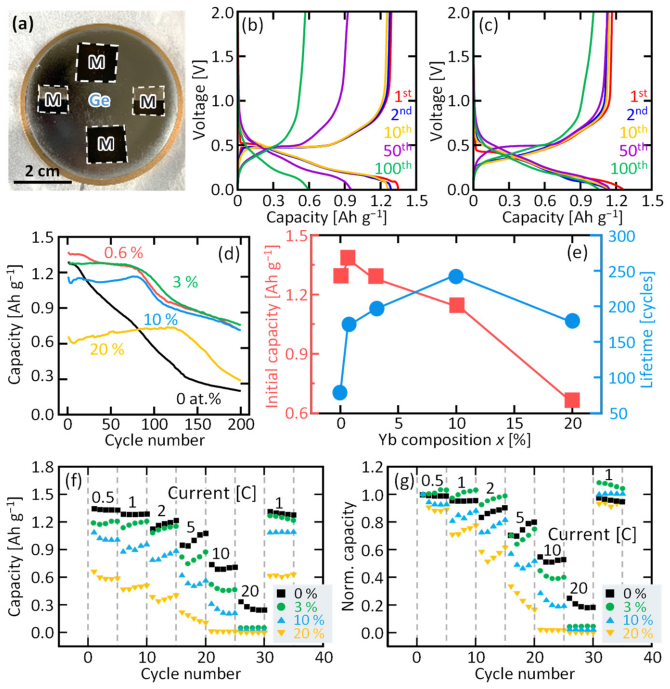
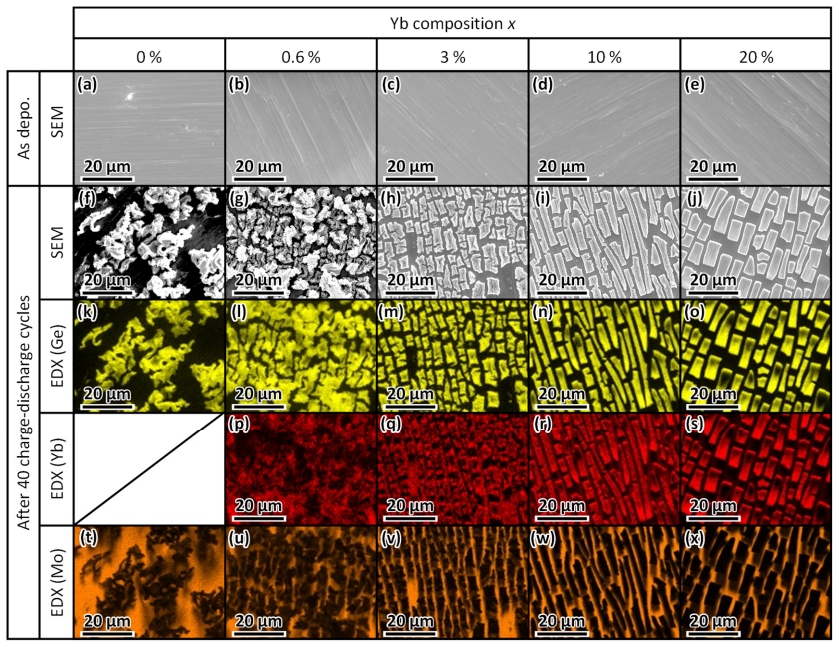
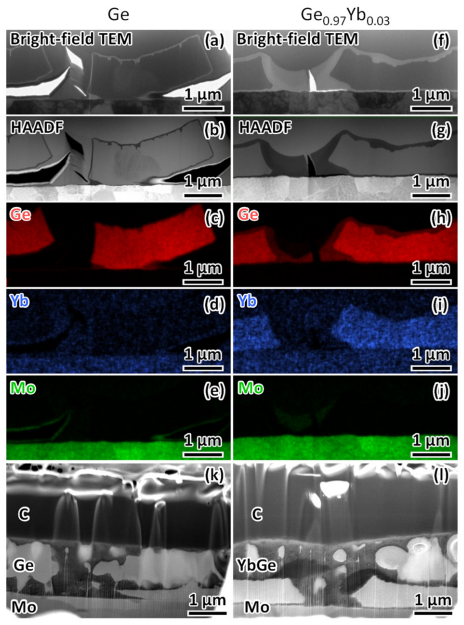
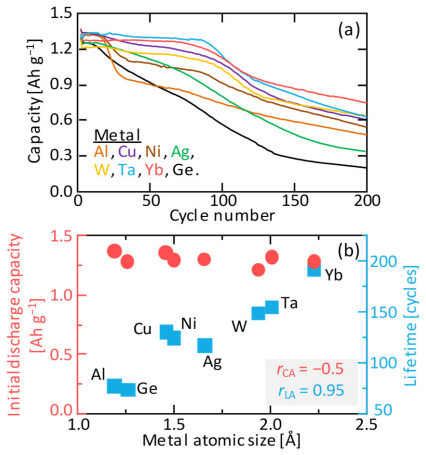
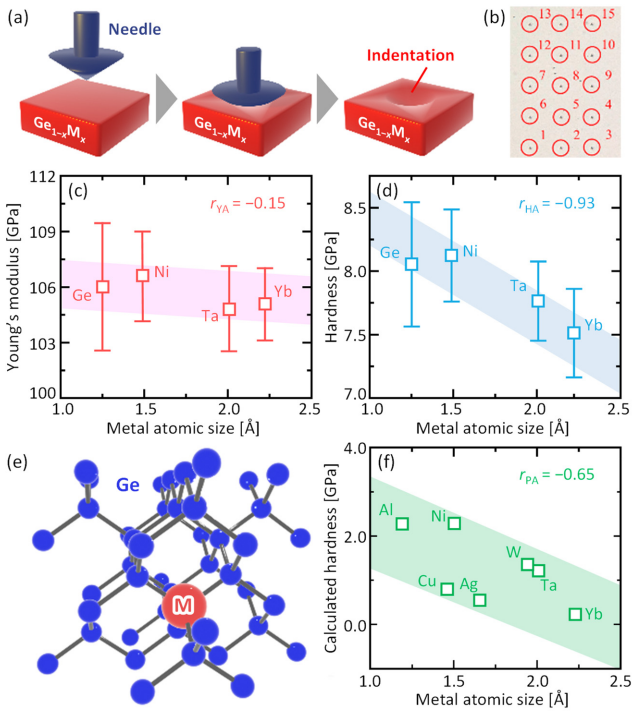
Trace incorporation of large-atomic-size metals, especially Yb, into Ge films softens the anode mechanically, as confirmed by nanoindentation hardness measurements that correlate inversely with dopant size, thereby suppressing lithiation-induced cracking and delamination to raise cycling stability by roughly a factor of three while leaving initial capacity unchanged.
What carries the argument
Metal doping with large atomic size (Yb) to lower film hardness and increase mechanical compliance, shifting the anode from rigid to damage-tolerant behavior.
If this is right
- Appropriate Yb doping raises anode lifetime by approximately a factor of three.
- The approach moves battery anode design from volume-change suppression toward deliberate mechanical compliance.
- A negative correlation between dopant atomic size and hardness supplies a general rule for choosing stabilizers.
- Initial capacity remains intact even as cycle life improves.
- High-C-rate performance declines, indicating a trade-off that must be managed separately.
Where Pith is reading between the lines
- The same size-based softening rule could be tested on silicon or other alloy anodes that also suffer cracking.
- Pairing this doping with thin coatings might offset the observed rate-capability penalty.
- Measuring hardness after many cycles would test whether the softening benefit persists or erodes over time.
- Full-cell data at moderate rates would clarify whether the three-fold gain survives realistic voltage windows and electrolyte interactions.
Load-bearing premise
The observed link between larger dopant atoms, lower hardness, and longer cycle life is causal, and softening will outweigh any side effects on conductivity or surface films under real battery operation.
What would settle it
A full-cell test of Yb-doped Ge anodes at high C-rates that shows no lifetime gain or faster fade would falsify the claim that mechanical softening is the dominant stabilizer.
Figures
read the original abstract
Achieving long-term stability in high-capacity lithium-ion battery anodes remains a critical challenge. In this study, we present a materials-intrinsic strategy for extending the cycle life of Ge, a promising next-generation anode material, through trace doping with metal elements. We systematically investigated the effects of small additions of various metals and found that elements with large atomic size, particularly Yb, markedly improved the cycling stability without sacrificing the initial capacity, while appropriate Yb doping enhanced the anode lifetime by approximately a factor of three. Structural and electrochemical analyses revealed that this improvement originates from mechanical softening of the Ge anode, which suppresses lithiation-induced damage such as cracking and delamination. Nanoindentation measurements further showed a strong negative correlation between dopant atomic size and film hardness, establishing anode softening as a new design principle for damage-tolerant electrodes. Although Yb doping reduced the rate capability at high C-rates, the present results demonstrate a clear shift in design strategy from volume-change suppression to mechanical compliance. These findings provide a useful framework for stabilizing high-capacity alloy anodes through atomic-scale mechanical control.
Editorial analysis
A structured set of objections, weighed in public.
Referee Report
Summary. The manuscript reports an experimental study on thin-film Ge anodes doped with trace metals. It finds that dopants with larger atomic radii (especially Yb) reduce film hardness as measured by nanoindentation, correlate with a roughly threefold extension in cycle life at comparable initial capacity, and suppress cracking/delamination during lithiation. The authors attribute the gain to mechanical softening that increases compliance, propose this as a new design principle for alloy anodes, and note a trade-off in high-rate capability.
Significance. If the causal mechanism is confirmed, the work supplies a concrete, atomically tunable route to damage-tolerant high-capacity anodes that complements existing volume-change-suppression strategies. The observed negative correlation between dopant size, hardness, and cycle life is a useful empirical observation that could guide screening of other alloy systems.
major comments (1)
- [Results and Discussion (mechanism section)] The central claim that mechanical softening is the operative mechanism (suppressing cracking/delamination and thereby extending cycle life) rests on the observed correlation between dopant atomic size, nanoindentation hardness, and cycling data. However, the manuscript does not isolate this effect from confounding changes in Li diffusivity, electronic percolation, or SEI chemistry that could independently improve cycling; the acknowledged reduction in high-C-rate performance is consistent with such alternative contributions. An orthogonal control (e.g., porosity-induced softening or defect engineering without metal doping) would be required to establish specificity.
minor comments (3)
- [Experimental Results] Quantitative hardness values, error bars, number of indents per sample, and film-thickness statistics are not reported for the nanoindentation data; likewise, cycle-life plots lack explicit sample sizes and capacity-retention error bars, making it difficult to assess the statistical robustness of the factor-of-three lifetime claim.
- [Abstract and Results] The abstract and main text state that Yb doping “enhanced the anode lifetime by approximately a factor of three” without specifying the exact cycling protocol (C-rate, voltage window, or number of cycles at which the comparison is made); this should be stated explicitly.
- [Figures] Figure captions and axis labels for the nanoindentation hardness vs. atomic-radius plot and the cycling curves should include the number of replicates and any fitting details.
Simulated Author's Rebuttal
We thank the referee for the positive evaluation of our work's significance and for the detailed major comment. We agree that our mechanistic interpretation relies on correlations and that potential confounding factors have not been fully isolated. We address this point below and will revise the manuscript to strengthen the discussion of limitations.
read point-by-point responses
-
Referee: [Results and Discussion (mechanism section)] The central claim that mechanical softening is the operative mechanism (suppressing cracking/delamination and thereby extending cycle life) rests on the observed correlation between dopant atomic size, nanoindentation hardness, and cycling data. However, the manuscript does not isolate this effect from confounding changes in Li diffusivity, electronic percolation, or SEI chemistry that could independently improve cycling; the acknowledged reduction in high-C-rate performance is consistent with such alternative contributions. An orthogonal control (e.g., porosity-induced softening or defect engineering without metal doping) would be required to establish specificity.
Authors: We agree that the evidence for mechanical softening as the operative mechanism is correlative and that alternative contributions from Li diffusivity, electronic percolation, or SEI chemistry cannot be ruled out with the present data set. Our study used multiple dopants spanning a range of atomic sizes and observed that cycle-life gains and hardness reductions scale consistently with dopant radius rather than with other dopant properties, which would be unexpected if SEI or diffusivity changes were dominant. The high-rate performance trade-off is already noted in the manuscript and could arise from several factors, including those suggested. However, we did not include orthogonal controls such as porosity-induced softening or non-metallic defect engineering. In the revised manuscript we will expand the Results and Discussion section to explicitly acknowledge these potential confounders, clarify that the proposed mechanism is supported by the size-dependent trend but remains correlative, and recommend future orthogonal experiments to establish specificity. revision: partial
Circularity Check
No circularity: purely experimental study with direct measurements
full rationale
The paper reports experimental doping of Ge thin-film anodes with various metals, followed by direct measurements of cycling stability, initial capacity, nanoindentation hardness, and structural properties. No equations, fitted parameters, predictive models, or derivations are present. The observed negative correlation between dopant atomic size and hardness, and the factor-of-three lifetime improvement for Yb, are presented as empirical results rather than outputs of any self-referential chain. No self-citations are invoked as load-bearing uniqueness theorems or ansatzes. The central claim rests on experimental correlations and is not reduced to its inputs by construction.
Axiom & Free-Parameter Ledger
Reference graph
Works this paper leans on
-
[1]
H. Nishide, K. Oyaizu, Toward Flexible Batteries, Science 319 (2008) 737−738
work page 2008
-
[2]
Takada, Progress and Prospective of Solid-State Lithium Batteries, Acta Mater
K. Takada, Progress and Prospective of Solid-State Lithium Batteries, Acta Mater. 61 (2013) 759−770
work page 2013
-
[3]
B. Scrosati, J. Garche, Lithium Batteries: Status, Prospects and Future, J. Power Sour. 195 (2010) 2419−2430
work page 2010
- [4]
- [5]
-
[6]
H. Tian, F. Xin, X. Wang, W. He, W. Han, High Capacity Group-IV Elements (Si, Ge, Sn) Based Anodes for Lithium-Ion Batteries, J. Mater. 1 (2015) 153–169
work page 2015
-
[7]
C.-M. Park, J.-H. Kim, H. Kim, H.-J. Sohn, Li-Alloy Based Anode Materials for Li Secondary Batteries, Chem. Soc. Rev. 39 (2010) 3115
work page 2010
- [8]
- [9]
- [10]
-
[11]
L. Baggetto, P. H. L. Notten, Lithium-Ion (De) In sertion Reaction of Germanium Thin-Film Electrodes: An Electrochemical and In Situ XRD Study, J. Electrochem. Soc. 156 (2009) A169
work page 2009
-
[12]
S. Wu, C. Han, J. Iocozzia, M. Lu, R. Ge, R. Xu, Z. Lin, Germanium-Based Nanomaterials for Rechargeable Batteries, Angew. Chem. Int. Ed. 55 (2016) 7898–7922
work page 2016
- [13]
-
[14]
Y . Yang, S. Liu, X. Bian, J. Feng, Y . An, C. Yuan, Morphology- and Porosity-Tunable Synthesis of 3D Nanoporous SiGe Alloy as a High-Performance Lithium-Ion Battery Anode, ACS Nano 12 (2018) 2900–2908
work page 2018
-
[15]
J. Yu, N. Du, J. Wang, H. Zhang, D. Yang, SiGe Por ous Nanorod Arrays as High-Perfo rmance Anode Materials for Lithium-Ion Batteries, J. Alloys Compd. 577 (2013) 564–568
work page 2013
-
[16]
Z. Hu, S. Zhang, C. Zhang, G. Cui, High Performance Germanium-Based Anode Materials, Coord. Chem. Rev. 326 (2016) 34−85
work page 2016
-
[17]
S. Zhang, Chemomechanical Modeling of Lithiation-induced Failure in High-volume-cha nge Electrode Materials for Lithium-ion Batteries, npj Comput. Mater. 3 (2017) 7
work page 2017
-
[18]
M. A. Rahman, G. Song, A. I. Bhatt, Y . C. Wong, C. Wen, Nanostructured Silicon Anodes for High-Performance Lithium- Ion Batteries, Adv. Funct. Mater. 26 (2016) 647−678
work page 2016
-
[19]
A. M. Chockla, K. C. Klavetter, C. B. Mullins, B. A. Korgel, Solution-Grown Germanium Nanowire Anodes for Lithium- Ion Batteries, ACS Appl. Mater. Interfaces 4 (2012) 4658−4664
work page 2012
-
[20]
T. Kennedy, E. Mullane, H. Geaney, M. Osiak, C. O'Dwyer, K. M. Ryan, High-Performance Germanium Nanowire-Based Lithium-Ion Battery Anodes Extending Over 1000 Cycles Through In Situ Formation of a Continuous Porous Network, 18 Nano Lett. 14 (2014) 716−723
work page 2014
-
[21]
N. Liu, L. Hu, M. T. McDowell, A. Jackson, Y . Cui, Prelithiated Silicon Nanowires as an Anode for Lithium Ion Batteries, ACS Nano 5 (2011) 6487−6493
work page 2011
-
[22]
W. Ai, N. Kirkaldy, Y . Jiang, G. Offer, H. Wang, B. Wu, A Composite Electrode Model for Lithium-Ion Batteries With Silicon/Graphite Negative Electrodes, J. Power Sour. 527 (2022) 231142
work page 2022
-
[23]
G. Derrien, J. Hassoun, S. Panero, B. Scrosati, Nanostructured Sn–C Composite as an Advanced Anode Material in High- Performance Lithium-Ion Batteries, Adv. Mater. 19 (2007) 2336−2340
work page 2007
-
[24]
B. Fuchsbichler, C. Stangl, H. Kren, F. Uhlig, S. Koller, High Capacity Graphite–Silicon Composite Anode Material for Lithium-Ion Batteries, J. Power Sour. 196 (2011) 2889−2892
work page 2011
-
[25]
J. Wang, H. Zhao, J. He, C. Wang, J. Wang, Nano-Sized SiO x/C Composite Anode for Lithium Ion Batteries, J. Power Sour. 10 (2011) 4811−4815
work page 2011
-
[26]
Y . Li, C. Zhu, T. Lu, Z. Guo, D. Zhang, J. Ma, S. Zhu, Simple Fabrication of a Fe 2O3/Carbon Composite for Use in a High-Performance Lithium Ion Battery, Carbon 52 (2013) 556−573
work page 2013
-
[27]
Y . Xu, R. Yi, B. Yuan, X. Wu, M. Dunwell, Q. Lin, L. Fe i, S. Deng, P. Andersen, D. Wang, H. Luo, High Capacity MoO2/Graphite Oxide Composite Anode for Lithium-Ion Batteries, J. Phys. Chem. Lett. 3 (2012) 309−314
work page 2012
-
[28]
Y . Yu, C. Yan, L. Gu, X. Lang, K. Tang, L. Zhang, Y . H ou, Z. W ang, M . W . Chen, O. G. Schmidt, J. Maier , Three- Dimensional (3D) Bicontinuous Au/amorphous-Ge Thin F ilms as Fast and High-capacity Anodes for Lithium-ion Batteries, Adv. Energy Mater. 3(3) (2013) 281–285
work page 2013
- [29]
-
[30]
G. Wang, H. Lei, Z. Liu, Z. Yuan, L. Li, Z. Zhan, X. Wang, An Oxygen-deficient Ge/GeO 2/C Anode for Lithium-ion Batteries with Enhanced Reversible Energy Storage Performance, J. Power Sources 632 (2025) 236319
work page 2025
-
[31]
J. Wang, X. Meng, X. Fan, W. Zhang, H. Zhang, C. Wang, Scalable Synthesis of Defect Abundant Si Nanorods for High- Performance Li-Ion Battery Anodes, ACS Nano 9(6) (2015) 6576–6586
work page 2015
-
[32]
Y . Yu, C. Yang, J. Zhu, B. Xue, J. Zhang, M. Jiang, An Advanced 3D Crosslinked Conductive Binder for Silicon Anodes: Leveraging Glycerol Chemistry for Supe rior Lithium-Ion Battery Performance, Angew. Chem. Int. Ed. 64 (2025) e202418794
work page 2025
-
[33]
E. P. Pandres, J. Z. Olson, C. W. Schlenker, V . C. Holmberg, Germanium Nanowire Battery Electrodes With Engineered Surface-Binder Interactions Exhibit Improved Cycle Life and High Energy Density Without Fluorinated Additives, ACS Appl. Energy Mater. 2 (2019) 6200−6208
work page 2019
-
[34]
J. Entwistle, R. Ge, K. Pardikar, R. Smith, D. Cumming, Carbon Binder Domain Networks and Electrical Conductivity in Lithium-Ion Battery Electrodes: A Critical Review, Renew. Sustain. Energy Rev. 166 (2022) 112624
work page 2022
-
[35]
Y . Yang, S. Wu, Y . Zhang, C. Liu, X. Wei, D. Luo, Z. Lin, Towards Efficient Binders for Silicon Based Lithium-Ion Battery Anodes, Chem. Eng. J. 406 (2021) 126807
work page 2021
-
[36]
Z. Li, Y . Zhang, T. Liu, X. Gao, S. Li, M. Ling, C. Liang, J. Zheng, Z. Lin, Silicon Anode With High Initial Coulombic Efficiency by Modulated Trifunctional Binder for High-Areal-Capacity Lithium-Ion Batteries, Adv. Energy Mater. 10 (2020) 1903110
work page 2020
-
[37]
J. Song, M. Zhou, R. Yi, T. Xu, M. L. Gordin, D. Tang, Z. Yu, M. Regula, D. Wang, Interpenetrated Gel Polymer Binder for High-Performance Silicon Anodes in Lithium-Ion Batteries, Adv. Funct. Mater. 24 (2014) 5904−5910. 19
work page 2014
-
[38]
S. Choi, T.-W. Kwon, A. Coskun, J. W. Choi, Highly Elastic Binders Integrating Polyrotaxanes for Silicon Microparticle Anodes in Lithium-ion Batteries, Science 357(6348) (2017) 279–283
work page 2017
- [39]
-
[40]
D. Wei, S. Zeng, H. Li, X. Li, J. Liang, Y . Qian, Multiphase Ge-Based Ge/FeGe/FeGe ₂/C Composite Anode for High Performance Lithium Ion Batteries, Electrochim. Acta 253 (2017) 522−529
work page 2017
-
[41]
Z. Wang, Z. Du, L. Wang, G. He, I. P. Parkin, Y . Zhang, Y . Yue, Tunable Synthesis of Fe–Ge Alloy Confined in Oxide Matrix and Its Application for Energy Storage, J. Power Sources 360 (2017) 124−128
work page 2017
- [42]
-
[43]
J. Wu, A. Tang, S. Huang, J. Li, L. Zeng, M. Wei, In Situ Confined Co 5Ge3 Alloy Nanoparticles in Nitrogen-Doped Carbon Nanotubes for Boosting Lithium Storage, ACS Appl. Mater. Interfaces 12 (2020) 46247−46253
work page 2020
-
[44]
Z. Zhang, K. Sun, Y . Chen, H. Yang, G. Xie, Z. Yu, M. Zhang, Y . Zhang, W. Li, S. Chou, Y . Jiang, High Conductivity Cu3Ge and High-Capacity GeO 2 Synergistically Enhance a Continuous Ch annel Ge-Based Anode for Lithium-Ion Batteries With Long-Life and Scalable Preparation, Sustain. Energ. Fuels 36 (2022) 13390−13397
work page 2022
-
[45]
K. Wang, M. Liu, D. Huang, L. Li, K. Feng, L. Zhao, J. Li, F. Jiang, Rapi d Thermal Deposited GeSe Nanowires as a Promising Anode Material for Lithium-Ion and Sodium-Ion Batteries, J. Colloid Interface Sci. 571 (2020) 387−397
work page 2020
- [46]
- [47]
-
[48]
A. O. Lyakhov, A. R. Oganov, Evolutionary Search for Superhard Materials: Methodology and Applications to Forms of Carbon and TiO2, Physical Review B 84, 092103 (2011)
work page 2011
-
[49]
S . E n g e l , E . C . J . G i e ß e l m a n n , M . K . R e i m a n n , R . P ö t tgen, O. Janka, On the Ytterbium Valence and the Physical Properties in Selected Intermetallic Phases, ACS Org. Inorg. Au 4 (2024) 188–222
work page 2024
- [50]
-
[51]
J. Nelson Weker, N. Liu, S. Misra, J. C. Andrews, Y . Cui, M. F. Toney, In Situ Nanotomography and Operando Transmission X-Ray Microscopy of Micron-Sized Ge particles, Energy Environ. Sci. 7 (2014) 2771–2777
work page 2014
-
[52]
Pearson, Mathematical Contributions to the Theory of Evolution
K. Pearson, Mathematical Contributions to the Theory of Evolution. III. Regression, Heredity, and Panmixia. Philos. Trans. A Math. Phys. Eng. Sci. 187 (1896) 253–318
-
[53]
E. Clementi, D. L. Raimondi, W. P. Reinhardt, Atomic Screening Constants from SCF Functions, J. Chem. Phys. 38 (1963) 2686–2689
work page 1963
-
[54]
D. A. Lucca, K. Herrmann, M. J. Klopfstein, Nanoindentation: M easuring Methods and Applications, CIRP Ann. 59 (2010) 803−819
work page 2010
-
[55]
T. J. Rupert, Solid Solution Strengthe ning and Softening Due to Collective Nanocrystalline Deformation Physics, Scr. Mater. 81 (2014) 44−47
work page 2014
-
[56]
C. A. Schuh, T. C. Hufnagel, U. Ramamurty, Mechanical Behavior of Amorphous Alloys, Acta Mater. 55 (2007) 4067– 4109. 20
work page 2007
-
[57]
A. Pozzi, A. Incremona, D. Toti, Imitation learning-driv en approximation of stochastic control models. Applied Intelligence, 55 (2025) 838. 21 Figure 1. Effects of Yb addition on Ge anodes. (a) Photograph of the Ge sputtering target with Yb chips affixed to its surface. Elec trochemical characterization of the Ge 1−xYbx anodes in a coin-type cell at a cu...
work page 2025
discussion (0)
Sign in with ORCID, Apple, or X to comment. Anyone can read and Pith papers without signing in.