Recognition: unknown
Superconducting diode effect in correlated electron systems by nonreciprocal magnetism
Pith reviewed 2026-05-09 18:28 UTC · model grok-4.3
The pith
A supercurrent nonreciprocally induces antiferromagnetic order that governs critical current and enables perfect diode efficiency.
A machine-rendered reading of the paper's core claim, the machinery that carries it, and where it could break.
Core claim
In the Rashba-Zeeman-Hubbard model, electron correlations suppress the conventional intrinsic superconducting diode effect arising from depairing currents. A supercurrent nonreciprocally induces antiferromagnetic order, which fundamentally governs the critical current and enables perfect diode efficiency.
What carries the argument
Nonreciprocal induction of antiferromagnetic order by supercurrent, which then determines the direction-dependent critical currents.
If this is right
- Electron correlations suppress the conventional intrinsic SDE arising from depairing currents.
- The induced antiferromagnetic order governs the critical current and produces perfect diode efficiency.
- This correlation-driven process provides a mechanism for the SDE distinct from weak-coupling pictures.
- Strongly correlated superconductors near quantum criticality become a natural platform for realizing the diode effect.
Where Pith is reading between the lines
- The same nonreciprocal magnetism could appear in other pairing symmetries or lattice geometries near quantum critical points.
- Measuring field-induced or current-induced magnetic order in candidate materials would test whether the mechanism operates in real compounds.
- Engineering proximity to antiferromagnetic quantum criticality might offer a route to enhance diode performance beyond what band-structure effects alone can achieve.
Load-bearing premise
The fluctuation exchange approximation accurately captures how supercurrent induces antiferromagnetic order nonreciprocally near quantum criticality in this model.
What would settle it
If supercurrent fails to induce antiferromagnetic order or if diode efficiency remains imperfect even when such order appears, the proposed mechanism would not hold.
Figures

read the original abstract
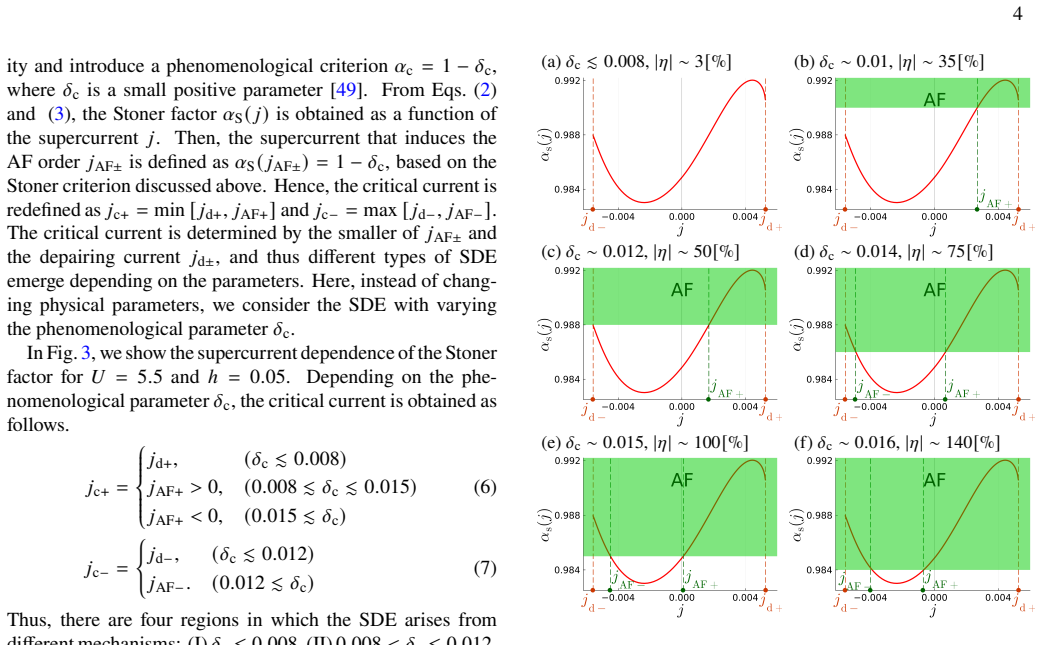
The superconducting diode effect (SDE), characterized by a nonreciprocal critical current in superconductors, has recently been observed in strongly correlated electron systems and near quantum criticality, pointing to unconventional mechanisms beyond weak-coupling theories. Here we investigate the SDE in the Rashba-Zeeman-Hubbard model, which captures $d$-wave superconductivity in an antiferromagnetic quantum critical regime, using the Dyson-Gor'kov equation with the fluctuation exchange approximation. We show that electron correlations suppress the conventional intrinsic SDE arising from depairing currents. More importantly, a supercurrent nonreciprocally induces antiferromagnetic order, which fundamentally governs the critical current and enables perfect diode efficiency. Our results reveal a previously unrecognized correlation-driven mechanism of the SDE and establish strongly correlated superconductors as a platform for superconducting diode physics.
Editorial analysis
A structured set of objections, weighed in public.
Referee Report
Summary. The paper studies the superconducting diode effect (SDE) in the Rashba-Zeeman-Hubbard model describing d-wave superconductivity near an antiferromagnetic quantum critical point. Within the Dyson-Gor'kov framework and the fluctuation-exchange (FLEX) approximation, the authors find that electron correlations suppress the conventional depairing-current contribution to the SDE. They report that a finite supercurrent nonreciprocally stabilizes antiferromagnetic order, which in turn controls the critical current and produces perfect diode efficiency.
Significance. If the central mechanism survives beyond the FLEX approximation, the work identifies a correlation-driven route to perfect SDE that is distinct from weak-coupling intrinsic mechanisms and may explain recent experiments in strongly correlated systems near quantum criticality. The derivation from a microscopic lattice model without additional fitting parameters is a positive feature.
major comments (2)
- [Methods (Dyson-Gor'kov + FLEX section)] The load-bearing claim that supercurrent nonreciprocally induces AF order which then sets the critical current and yields perfect diode efficiency is obtained inside the FLEX approximation to the Dyson-Gor'kov equations. Near an AF quantum critical point the same fluctuations being resummed become non-perturbative; the self-consistent feedback between current-induced order and the gap can therefore produce uncontrolled artifacts. The manuscript should demonstrate that the reported perfect efficiency is robust against this limitation, for example by comparing with a different conserving approximation or by showing the induced moment remains finite when the FLEX cutoff is varied.
- [Results (critical-current and diode-efficiency figures)] The statement that correlations suppress the conventional intrinsic SDE while the induced AF order enables perfect efficiency requires explicit separation of the two contributions. It is not clear from the presented results whether the perfect efficiency survives when the AF order is artificially suppressed (e.g., by detuning the interaction or by adding a small staggered field), which would test whether the nonreciprocal magnetism is truly the governing mechanism.
minor comments (2)
- [Model section] Notation for the Rashba and Zeeman terms, the current-carrying boundary condition, and the definition of diode efficiency should be collected in a single table or appendix for clarity.
- [Abstract] The abstract asserts 'perfect diode efficiency' without quoting the numerical value or the parameter window in which it is obtained; a brief quantitative statement would help readers assess the result.
Simulated Author's Rebuttal
We thank the referee for the thorough review and valuable suggestions. We have carefully considered the major comments and provide detailed responses below. We believe these points can be addressed through clarifications and additional analyses in the revised manuscript.
read point-by-point responses
-
Referee: [Methods (Dyson-Gor'kov + FLEX section)] The load-bearing claim that supercurrent nonreciprocally induces AF order which then sets the critical current and yields perfect diode efficiency is obtained inside the FLEX approximation to the Dyson-Gor'kov equations. Near an AF quantum critical point the same fluctuations being resummed become non-perturbative; the self-consistent feedback between current-induced order and the gap can therefore produce uncontrolled artifacts. The manuscript should demonstrate that the reported perfect efficiency is robust against this limitation, for example by comparing with a different conserving approximation or by showing the induced moment remains finite when the FLEX cutoff is varied.
Authors: We acknowledge the potential limitations of the FLEX approximation near the antiferromagnetic quantum critical point, where fluctuations can become non-perturbative. However, our calculations are performed in a regime where the AF order is induced by the supercurrent and remains moderate. To address the robustness, we will vary the momentum cutoff in the FLEX summation and include a demonstration that the induced AF moment and the perfect diode efficiency persist. While a comparison with an entirely different conserving approximation (such as a parquet approach) would be desirable, it lies beyond the scope of the current work and would require extensive methodological development. We argue that the qualitative mechanism is likely robust, as supported by the self-consistent nature of the solution. revision: partial
-
Referee: [Results (critical-current and diode-efficiency figures)] The statement that correlations suppress the conventional intrinsic SDE while the induced AF order enables perfect efficiency requires explicit separation of the two contributions. It is not clear from the presented results whether the perfect efficiency survives when the AF order is artificially suppressed (e.g., by detuning the interaction or by adding a small staggered field), which would test whether the nonreciprocal magnetism is truly the governing mechanism.
Authors: We agree that an explicit separation of the conventional depairing contribution and the AF-order contribution would strengthen the manuscript. We will perform additional calculations suppressing the AF order by introducing a small staggered magnetic field and by detuning the Hubbard interaction U. These will be added to the revised manuscript to explicitly demonstrate that the nonreciprocal magnetism is the dominant mechanism for the perfect SDE. revision: yes
- Demonstrating robustness of the results by comparing with a different conserving approximation beyond the FLEX method.
Circularity Check
No circularity: results obtained from self-consistent solution of microscopic equations
full rationale
The derivation proceeds by solving the Dyson-Gor'kov equations in the fluctuation-exchange approximation applied to the Rashba-Zeeman-Hubbard model. The reported nonreciprocal induction of antiferromagnetic order by supercurrent, its effect on the critical current, and the resulting diode efficiency are outputs of this calculation rather than inputs or self-definitions. No equations or claims reduce by construction to fitted parameters, renamed empirical patterns, or load-bearing self-citations whose validity depends on the present work. The approach is a standard (if approximate) microscopic computation whose central results are independent of the target observables.
Axiom & Free-Parameter Ledger
axioms (1)
- domain assumption The fluctuation exchange approximation is sufficient to capture the nonreciprocal induction of antiferromagnetic order by supercurrent in the antiferromagnetic quantum critical regime.
Reference graph
Works this paper leans on
-
[1]
F. Ando, Y. Miyasaka, T. Li, J. Ishizuka, T. Arakawa, Y. Shiota, T. Moriyama, Y. Yanase, and T. Ono, Observation of supercon- ducting diode effect, Nature584, 373 (2020)
2020
-
[2]
Nadeem, M
M. Nadeem, M. S. Fuhrer, and X. Wang, The superconducting diode effect, Nat. Rev. Phys.5, 558 (2023)
2023
-
[3]
Nagaosa and Y
N. Nagaosa and Y. Yanase, Nonreciprocal transport and optical phenomena in quantum materials, Annual Review of Condensed Matter Physics15, 63 (2024)
2024
-
[4]
N. F. Q. Yuan and L. Fu, Supercurrent diode effect and finite-momentum superconductors, Proceedings of the National Academy of Sciences119, e2119548119 (2022)
2022
-
[5]
Daido, Y
A. Daido, Y. Ikeda, and Y. Yanase, Intrinsic superconducting diode effect, Phys. Rev. Lett.128, 037001 (2022)
2022
-
[6]
Ili ´c and F
S. Ili ´c and F. S. Bergeret, Theory of the supercurrent diode effect in rashba superconductors with arbitrary disorder, Phys. Rev. Lett.128, 177001 (2022)
2022
-
[7]
J. J. He, Y. Tanaka, and N. Nagaosa, A phenomenological theory of superconductor diodes, New Journal of Physics24, 053014 (2022)
2022
-
[8]
Daido and Y
A. Daido and Y. Yanase, Superconducting diode effect and non- reciprocal transition lines, Phys. Rev. B106, 205206 (2022)
2022
-
[9]
Y. Hou, F. Nichele, H. Chi, A. Lodesani, Y. Wu, M. F. Rit- ter, D. Z. Haxell, M. Davydova, S. Ili ´c, O. Glezakou-Elbert, A. Varambally, F. S. Bergeret, A. Kamra, L. Fu, P. A. Lee, and J. S. Moodera, Ubiquitous superconducting diode effect in superconductor thin films, Phys. Rev. Lett.131, 027001 (2023)
2023
-
[10]
Daido and Y
A. Daido and Y. Yanase, Unidirectional superconductivity and superconducting diode effect induced by dissipation, Phys. Rev. B.111, L020508 (2025)
2025
-
[11]
Shaffer, D
D. Shaffer, D. V. Chichinadze, and A. Levchenko, Supercon- ducting diode effect in multiphase superconductors, Phys. Rev. B.110, 184509 (2024)
2024
-
[12]
Chakraborty and A
D. Chakraborty and A. M. Black-Schaffer, Perfect superconduct- ing diode effect in altermagnets, Phys. Rev. Lett.135, 026001 (2025)
2025
-
[13]
Kawarazaki, H
R. Kawarazaki, H. Narita, Y. Miyasaka, Y. Ikeda, R. Hisatomi, A. Daido, Y. Shiota, T. Moriyama, Y. Yanase, A. V. Ognev, A. S. Samardak, and T. Ono, Magnetic-field-induced polarity oscillation of superconducting diode effect, Appl. Phys. Express 15, 113001 (2022)
2022
-
[14]
Narita, J
H. Narita, J. Ishizuka, R. Kawarazaki, D. Kan, Y. Shiota, T. Moriyama, Y. Shimakawa, A. V. Ognev, A. S. Samardak, Y. Yanase, and T. Ono, Field-free superconducting diode effect in noncentrosymmetric superconductor/ferromagnet multilay- ers, Nature Nanotechnology17, 823 (2022)
2022
-
[15]
Bauriedl, C
L. Bauriedl, C. B ¨auml, L. Fuchs, C. Baumgartner, N. Paulik, J. M. Bauer, K.-Q. Lin, J. M. Lupton, T. Taniguchi, K. Watan- abe, C. Strunk, and N. Paradiso, Supercurrent diode effect and magnetochiral anisotropy in few-layer NbSe2, Nature Commu- nications13, 4266 (2022)
2022
-
[16]
J. He, Y. Ding, X. Zeng, Y. Zhang, Y. Wang, P. Dong, Y. Wu, K. Cao, K. Ran, X. Zhou, J. Wang, Y. Chen, K. Watan- abe, T. Taniguchi, S.-L. Yu, J.-X. Li, J. Wen, and J. Li, Proximity-induced superconducting diode effect in antiferro- magnetic mott insulator𝛼-RuCl 3, Adv. Funct. Mater.35, 10.1002/adfm.202504056 (2025)
-
[17]
J.-X. Lin, P. Siriviboon, H. D. Scammell, S. Liu, D. Rhodes, K. Watanabe, T. Taniguchi, J. Hone, M. S. Scheurer, and J. I. A. Li, Zero-field superconducting diode effect in small-twist-angle trilayer graphene, Nature Physics18, 1221 (2022)
2022
-
[18]
Mizuno, Y
A. Mizuno, Y. Tsuchiya, S. Awaji, and Y. Yoshida, Rectifica- tion at various temperatures in YBa 2Cu3Oy coated conductors with PrBa2Cu3Oy buffer layers, IEEE Transactions on Applied Superconductivity32, 1 (2022)
2022
-
[19]
S. Qi, J. Ge, C. Ji, Y. Ai, G. Ma, Z. Wang, Z. Cui, Y. Liu, Z. Wang, and J. Wang, High-temperature field-free supercon- ducting diode effect in high-T c cuprates, Nature Communica- tions16, 531 (2025)
2025
-
[20]
Nagata, M
U. Nagata, M. Aoki, A. Daido, S. Kasahara, Y. Kasahara, R. Ohshima, Y. Ando, Y. Yanase, Y. Matsuda, and M. Shiraishi, Field-free superconducting diode effect in layered superconduc- tor FeSe, Phys. Rev. Lett.134, 236703 (2025)
2025
-
[21]
P. Dong, J. Wang, Y. Wang, J. Xiao, X. Zhou, H. Xing, Y. Wu, Y. Chen, J. Wen, and J. Li, Field-free superconducting diode effect in FeTe0.55Se0.45, arXiv [cond-mat.supr-con] (2025)
2025
-
[22]
Kobayashi, J
Y. Kobayashi, J. Shiogai, T. Nojima, and J. Matsuno, A scaling relation of vortex-induced rectification effects in a superconduct- ing thin-film heterostructure, Commun. Phys.8, 196 (2025)
2025
-
[23]
T. Le, Z. Pan, Z. Xu, J. Liu, J. Wang, Z. Lou, X. Yang, Z. Wang, Y. Yao, C. Wu, and X. Lin, Superconducting diode effect and in- terference patterns in kagome CsV3Sb5, Nature630, 64 (2024)
2024
-
[24]
J. M. Brooks, R. Mataira, T. Simpson, R. A. Badcock, and C. W. Bumby, A high-T csuperconducting diode with large current carrying capacity, Appl. Phys. Lett.126, 082601 (2025)
2025
-
[25]
H. Wang, Y. Zhu, Z. Bai, Z. Lyu, J. Yang, L. Zhao, X. J. Zhou, Q.- K. Xue, and D. Zhang, Quantum superconducting diode effect with perfect efficiency above liquid-nitrogen temperature, Nat. Phys. , 1 (2025)
2025
-
[26]
Nakamura and Y
K. Nakamura and Y. Yanase, Supercurrent-induced antiferro- magnetic order and spin-triplet pair generation in quantum crit- ical𝑑-wave superconductors, Phys. Rev. B113, 014508 (2026)
2026
-
[27]
Moriya and K
T. Moriya and K. Ueda, Spin fluctuations and high temperature superconductivity, Advances in Physics49, 555 (2000)
2000
-
[28]
Yanase, T
Y. Yanase, T. Jujo, T. Nomura, H. Ikeda, T. Hotta, and K. Ya- mada, Theory of superconductivity in strongly correlated elec- tron systems, Physics Reports387, 1 (2003)
2003
-
[29]
N. E. Bickers, D. J. Scalapino, and S. R. White, Conserving approximations for strongly correlated electron systems: Bethe- salpeter equation and dynamics for the two-dimensional hubbard model, Phys. Rev. Lett.62, 961 (1989)
1989
-
[30]
Bickers and D
N. Bickers and D. Scalapino, Conserving approximations for strongly fluctuating electron systems. i. formalism and calcula- tional approach, Annals of Physics193, 206 (1989)
1989
-
[31]
Kita, Self-consistent approximations for superconductivity beyond the Bardeen–Cooper–Schrieffer theory, J
T. Kita, Self-consistent approximations for superconductivity beyond the Bardeen–Cooper–Schrieffer theory, J. Phys. Soc. Jpn.80, 124704 (2011)
2011
-
[32]
Georges, G
A. Georges, G. Kotliar, W. Krauth, and M. J. Rozenberg, Dy- namical mean-field theory of strongly correlated fermion sys- tems and the limit of infinite dimensions, Rev. Mod. Phys.68, 13 (1996)
1996
-
[33]
Troyer and U.-J
M. Troyer and U.-J. Wiese, Computational complexity and fun- damental limitations to fermionic quantum monte carlo simula- tions, Phys. Rev. Lett.94, 170201 (2005). 6
2005
-
[34]
Yanase and M
Y. Yanase and M. Sigrist, Non-centrosymmetric superconduc- tivity and antiferromagnetic order: Microscopic discussion of CePt3Si, Journal of the Physical Society of Japan76, 043712 (2007)
2007
-
[35]
Yanase and M
Y. Yanase and M. Sigrist, Superconductivity and magnetism in non-centrosymmetric system: Application to CePt 3Si, Journal of the Physical Society of Japan77, 124711 (2008)
2008
-
[36]
See Supplemental Material
-
[37]
Baym and L
G. Baym and L. P. Kadanoff, Conservation laws and correlation functions, Phys. Rev.124, 287 (1961)
1961
-
[38]
Nogaki and Y
K. Nogaki and Y. Yanase, Strongly parity-mixed superconduc- tivity in the rashba-hubbard model, Phys. Rev. B102, 165114 (2020)
2020
-
[39]
O. V. Dimitrova and M. V. Feigel’man, Phase diagram of a surface superconductor in parallel magnetic field, Journal of Experimental and Theoretical Physics Letters78, 637 (2003)
2003
-
[40]
D. F. Agterberg and R. P. Kaur, Magnetic-field-induced helical and stripe phases in rashba superconductors, Phys. Rev. B75, 064511 (2007)
2007
-
[41]
Shishido, S
H. Shishido, S. Yamada, K. Sugii, M. Shimozawa, Y. Yanase, and M. Yamashita, Anomalous change in the de haas–van alphen oscillations of cecoin5 at ultralow temperatures, Phys. Rev. Lett. 120, 177201 (2018)
2018
-
[42]
Bauer and M
E. Bauer and M. Sigrist,Non-centrosymmetric superconduc- tors: introduction and overview, Vol. 847 (Springer Science & Business Media, 2012)
2012
-
[43]
Monthoux and D
P. Monthoux and D. J. Scalapino, Self-consistentd x2 −y2 pairing in a two-dimensional hubbard model, Phys. Rev. Lett.72, 1874 (1994)
1994
-
[44]
Pao and N
C.-H. Pao and N. E. Bickers, Anisotropic superconductivity in the 2d hubbard model: Gap function and interaction weight, Phys. Rev. Lett.72, 1870 (1994)
1994
-
[45]
Dahm and L
T. Dahm and L. Tewordt, Quasiparticle and spin excitation spec- tra in the normal and𝑑-wave superconducting state of the two- dimensional hubbard model, Phys. Rev. Lett.74, 793 (1995)
1995
-
[46]
Ihara, R
Y. Ihara, R. Kumar, K. Miyakoshi, M. Oda, and K. Ishida, Superconductivity emerging from the n´eel state in infinite-stage single-layer cuprate La2CuO4+𝛿 , Sci. Rep.15, 27640 (2025)
2025
-
[47]
T. Moriya, Y. Takahashi, and K. Ueda, Antiferromagnetic spin fluctuations and superconductivity in two-dimensional metals -a possible model for high tc oxides, Journal of the Physical Society of Japan59, 2905 (1990), https://doi.org/10.1143/JPSJ.59.2905
-
[48]
Dahm and L
T. Dahm and L. Tewordt, Physical quantities in nearly antifer- romagnetic and superconducting states of the two-dimensional hubbard model and comparison with cuprate superconductors, Phys. Rev. B52, 1297 (1995)
1995
-
[49]
Kino and H
H. Kino and H. Kontani, Effects of spin fluctuations and su- perconductivity in quasi-one-dimensional organic conductors, J. Low Temp. Phys.117, 317 (1999)
1999
-
[50]
Daido, Y
A. Daido, Y. Yanase, and K. T. Law, Nonreciprocal current- induced zero-resistance state in valley-polarized superconduc- tors, Phys. Rev. Lett.135, 236001 (2025)
2025
-
[51]
Banerjee and M
S. Banerjee and M. S. Scheurer, Enhanced superconducting diode effect due to coexisting phases, Phys. Rev. Lett.132, 046003 (2024)
2024
-
[52]
Goldman, V
A. Goldman, V. Vas’ko, P. Kraus, K. Nikolaev, and V. Larkin, Cuprate/manganite heterostructures, Journal of Magnetism and Magnetic Materials200, 69 (1999)
1999
-
[53]
Chakhalian, J
J. Chakhalian, J. W. Freeland, G. Srajer, J. Strempfer, G. Khal- iullin, J. C. Cezar, T. Charlton, R. Dalgliesh, C. Bernhard, G. Cristiani, H.-U. Habermeier, and B. Keimer, Magnetism at the interface between ferromagnetic and superconducting ox- ides, Nat. Phys.2, 244 (2006)
2006
-
[54]
N. M. Nemes, M. Garcia-Hernandez, Z. Szatmari, T. Feher, F. Simon, C. Visani, V. Pena, C. Miller, J. Garcia-Barriocanal, F. Bruno, Z. Sefrioui, C. Leon, and J. Santamaria, Thickness dependent magnetic anisotropy of ultrathin LCMO epitaxial thin films, IEEE Transactions on Magnetics44, 2926 (2008)
2008
-
[55]
C. M. Varma, Theory of the pseudogap state of the cuprates, Phys. Rev. B73, 155113 (2006)
2006
-
[56]
D. Maruyama and Y. Yanase, Electron correlation effects in non-centrosymmetric metals in the weak coupling regime, Journal of the Physical Society of Japan84, 074702 (2015), https://doi.org/10.7566/JPSJ.84.074702
-
[57]
Watanabe and Y
H. Watanabe and Y. Yanase, Photocurrent response in parity- time symmetric current-ordered states, Phys. Rev. B104, 024416 (2021)
2021
- [58]
-
[59]
R. Tazai, Y. Yamakawa, T. Morimoto, and H. Kon- tani, Quantum metric–induced giant and reversible non- reciprocal transport phenomena in chiral loop-current phases of kagome metals, Proceedings of the Na- tional Academy of Sciences122, e2503645122 (2025), https://www.pnas.org/doi/pdf/10.1073/pnas.2503645122
-
[60]
J. M. Luttinger and J. C. Ward, Ground-state energy of a many- fermion system. ii, Phys. Rev.118, 1417 (1960)
1960
-
[61]
Shinaoka, J
H. Shinaoka, J. Otsuki, M. Ohzeki, and K. Yoshimi, Compress- ing green’s function using intermediate representation between imaginary-time and real-frequency domains, Phys. Rev. B96, 035147 (2017)
2017
-
[62]
J. Li, M. Wallerberger, N. Chikano, C.-N. Yeh, E. Gull, and H. Shinaoka, Sparse sampling approach to efficient ab initio calculations at finite temperature, Phys. Rev. B101, 035144 (2020)
2020
-
[63]
Shinaoka, N
H. Shinaoka, N. Chikano, E. Gull, J. Li, T. Nomoto, J. Otsuki, M. Wallerberger, T. Wang, and K. Yoshimi, Efficient ab initio many-body calculations based on sparse modeling of Matsubara Green’s function, SciPost Phys. Lect. Notes , 63 (2022). 1 Supplemental Material: Superconducting diode effect in correlated electron systems by nonreciprocal magnetism S1...
2022
discussion (0)
Sign in with ORCID, Apple, or X to comment. Anyone can read and Pith papers without signing in.