Monte Carlo study of the superfluid phase of ⁴He
Pith reviewed 2026-05-09 18:45 UTC · model grok-4.3
The pith
Simulations of 2048 helium atoms revise estimates for superfluid properties and condensate fraction.
A machine-rendered reading of the paper's core claim, the machinery that carries it, and where it could break.
Core claim
State-of-the-art Quantum Monte Carlo simulations are performed on a system of 2048 helium atoms in the superfluid phase at saturated vapor pressure. The calculations supply revised estimates for energetic and structural properties together with the ground-state condensate fraction, reflecting two decades of methodological improvements and the reduction of finite-size effects.
What carries the argument
Quantum Monte Carlo sampling of a 2048-atom system of ^4He, which reduces finite-size corrections when computing ground-state energy, pair correlations, and the condensate fraction.
If this is right
- The updated energy and structural values become the new reference benchmarks for testing other many-body theories of quantum liquids.
- The condensate fraction obtained with smaller finite-size corrections gives a clearer number for the superfluid order parameter in the thermodynamic limit.
- Structural quantities such as the pair distribution function are determined with higher statistical precision than in earlier smaller-system runs.
- The results can be used directly to calibrate effective potentials or to check consistency with experimental specific-heat and neutron-scattering data.
Where Pith is reading between the lines
- The same large-system approach could be applied to helium films or to ^3He-^4He mixtures to test whether finite-size corrections behave similarly.
- If the revised condensate fraction aligns better with experiment, it would strengthen the case for using these simulations as calibration standards for other quantum Monte Carlo codes.
- The methodology suggests that further increases in particle number, once feasible, would mainly refine the extrapolation to infinite volume rather than change the central values.
Load-bearing premise
The chosen interatomic potential together with the particular Quantum Monte Carlo algorithm reproduces the real behavior of helium-4 without large unrecognized errors from the potential form or from the finite size of the simulated box.
What would settle it
An independent calculation or a new measurement that differs by more than the stated statistical uncertainty from the reported ground-state energy per atom or from the reported condensate fraction would show the estimates to be inaccurate.
Figures
read the original abstract
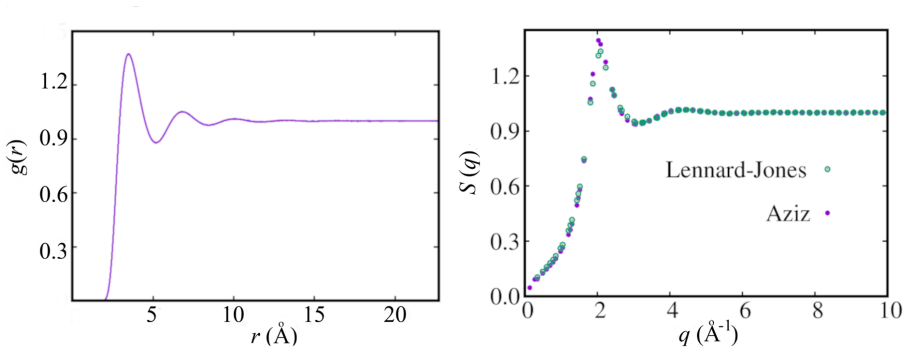
Detailed numerical results obtained with state-of-the-art Quantum Monte Carlo (QMC) simulations are presented for the superfluid phase of $^4$He at saturated vapor pressure. The aim of this contribution is that of providing reliable, up-to-date estimates for this archetypal superfluid, reflecting the methodological progress that has taken place over the past two decades. We simulate a system comprising 2,048 helium atoms, i.e., an order of magnitude greater in size than those for which results currently regarded as standard references were originally obtained. We offer revised estimates for energetic and structural properties, as well as for the ground state condensate fraction.
Editorial analysis
A structured set of objections, weighed in public.
Referee Report
Summary. The paper presents detailed Quantum Monte Carlo simulations of the superfluid phase of ^4He at saturated vapor pressure. It simulates a system of 2,048 helium atoms—an order of magnitude larger than prior standard references—and provides revised estimates for energetic and structural properties as well as the ground-state condensate fraction.
Significance. If finite-size effects are rigorously controlled, the work would supply improved benchmark values for an archetypal superfluid, strengthening comparisons with experiment and theory. The order-of-magnitude increase in system size is a clear methodological advance that addresses a known limitation in earlier studies.
major comments (1)
- [Abstract] Abstract: The central claim of 'reliable, up-to-date estimates' rests on N=2048 being large enough that finite-size corrections (especially 1/L terms in the condensate fraction from long-wavelength phase fluctuations) fall below the targeted precision. No extrapolation procedure, functional form, or direct comparison to runs at N=1024 or N=4096 is described, leaving the revised numbers vulnerable to residual O(1/N) bias.
Simulated Author's Rebuttal
We thank the referee for the constructive assessment of our manuscript and for emphasizing the need to rigorously control finite-size effects. We address the major comment in detail below.
read point-by-point responses
-
Referee: [Abstract] Abstract: The central claim of 'reliable, up-to-date estimates' rests on N=2048 being large enough that finite-size corrections (especially 1/L terms in the condensate fraction from long-wavelength phase fluctuations) fall below the targeted precision. No extrapolation procedure, functional form, or direct comparison to runs at N=1024 or N=4096 is described, leaving the revised numbers vulnerable to residual O(1/N) bias.
Authors: We agree that the abstract does not explicitly describe the finite-size analysis or extrapolation procedure, and that this leaves the central claim open to the concern raised. In the revised manuscript we will add a dedicated subsection on finite-size scaling. We will report the condensate fraction (and other observables) for at least two additional system sizes (N=1024 and, where computationally feasible, N=4096), fit the leading 1/L correction arising from long-wavelength phase fluctuations, and present the extrapolated thermodynamic-limit values together with the functional form used. This will directly quantify the residual bias at N=2048 and strengthen the reliability of the reported estimates. revision: yes
Circularity Check
No circularity: direct numerical estimates from large-scale QMC
full rationale
The paper reports direct output from Quantum Monte Carlo simulations of a 2048-atom system of ^4He. All claimed estimates (energies, structure factors, condensate fraction) are computed quantities from the Monte Carlo sampling under a fixed interatomic potential and algorithm; none are obtained by fitting parameters to the target observables or by renaming prior results. The manuscript compares these numbers to external experimental benchmarks and independent prior calculations rather than deriving them from self-referential equations or self-citations. No load-bearing step reduces to a definition, ansatz, or fitted input supplied by the same work.
Axiom & Free-Parameter Ledger
axioms (1)
- domain assumption The chosen interatomic potential and QMC algorithm faithfully represent the low-temperature physics of real ^4He.
Reference graph
Works this paper leans on
-
[1]
D. M. Ceperley and E. L. Pollock. Path-integral Computation of the Low-Temperature Properties of Liquid 4He.Phys. Rev. Lett., 56(4):351–354, 1986
work page 1986
-
[2]
E. L. Pollock and D. M. Ceperley. Path-integral computation of superfluid densities.Phys. Rev. B, 36:8343–8352, 1987
work page 1987
-
[3]
D. M. Ceperley and E. L. Pollock. Path-integral simulation of the superfluid transition in two-dimensional 4He.Phys. Rev. B, 39(4):2084–2093, 1989
work page 2084
-
[4]
R. P. Feynman and A. R. Hibbs.Quantum Mechanics and Path Integrals, chapter 10. McGraw-Hill, New York, 1965
work page 1965
-
[5]
M. Boninsegni, N. Prokof’ev, and B. Svistunov. Worm Algorithm for Continuous-Space Path Integral Monte Carlo Simulations.Phys. Rev. Lett., 96:070601, 2006
work page 2006
-
[6]
M. Boninsegni, N. V. Prokof’ev, and B. V. Svistunov. Worm algorithm and diagrammatic monte carlo: A new approach to continuous-space path integral Monte Carlo simulations. Phys. Rev. E, 74:036701, 2006
work page 2006
-
[7]
S. Saccani, S. Moroni, and M. Boninsegni. Phase diagram of soft-core bosons in two di- mensions.Phys. Rev. B, 83(9):92506, 2011
work page 2011
-
[8]
M. Boninsegni. Supersolid phases of cold atom assemblies.J. Low Temp. Phys., 168(3- 4):137–149, 2012
work page 2012
-
[9]
Y. Kora and M. Boninsegni. Patterned supersolids in dipolar bose systems.J. Low Temp. Phys., 197(5-6):337–347, 2019
work page 2019
-
[10]
A. V. Filinov, N. V. Prokof’ev, and M. Bonitz. Berezinskii-kosterlitz-thouless transition in two-dimensional dipole systems.Phys. Rev. Lett., 105(7):70401, 2010
work page 2010
- [11]
-
[12]
D. M. Ceperley. Path integrals in the theory of condensed helium.Rev. Mod. Phys., 67(2):279–355, 1995
work page 1995
-
[13]
R. J. Donnelly and C. F. Barenghi. The observed properties of liquid helium at the saturated vapor pressure.J. Phys. Chem. Ref. Data, 27(6):1217–1274, 1998
work page 1998
-
[14]
M. Boninsegni and S. Moroni. Microscopic Calculation of Superfluidity and Kinetic Energies in Isotopic Liquid Helium Mixtures.Phys. Rev. Lett., 78(9):1727–1730, 1997
work page 1997
-
[15]
R. P. Feynman. Atomic theory of liquid helium near absolute zero.Phys. Rev., 91(6):1301–1308, 1953
work page 1953
-
[16]
Wilks.The Properties of Liquid and Solid Helium
J. Wilks.The Properties of Liquid and Solid Helium. Clarendon Press, Oxford, 1967
work page 1967
-
[17]
M. H. Kalos, D. Levesque, and L. Verlet. Helium at zero temperature with hard-sphere and other forces.Phys. Rev. A, 9:2178–2195, 1974
work page 1974
-
[18]
R. A. Aziz, V. P. S. Nain, J. S. Carley, W. L. Taylor, and G. T. McConville. An accurate intermolecular potential for helium.The Journal of Chemical Physics, 70(9):4330–4342, 1979
work page 1979
- [19]
-
[20]
L. M. Ses´ e. Real space triplets in quantum condensed matter: Numerical experiments using path integrals, closures, and hard spheres.Entropy, 22(12), 2020
work page 2020
- [21]
-
[22]
S. Y. Chang and M. Boninsegni. Ab initio potentials and the equation of state of condensed helium at high pressure.J. Chem. Phys., 115(6):2629–2633, 2001
work page 2001
-
[23]
R. A. Aziz, A. R. Janzen, and M. R. Moldover. Ab initio calculations for helium: A standard for transport property measurements.Phys. Rev. Lett., 74:1586–1589, Feb 1995
work page 1995
-
[24]
F. Mezzacapo and M. Boninsegni. Superfluidity and quantum melting ofp-H 2 clusters. Phys. Rev. Lett., 97:045301, 2006
work page 2006
-
[25]
F. Mezzacapo and M. Boninsegni. Structure, superfluidity, and quantum melting of hydro- gen clusters.Phys. Rev. A, 75:033201, Mar 2007
work page 2007
-
[26]
M. Boninsegni, L. Pollet, N. Prokof’ev, and B. Svistunov. Role of bose statistics in crys- tallization and quantum jamming.Phys. Rev. Lett., 109:025302, 2012
work page 2012
-
[27]
M. Boninsegni. Permutation sampling in Path Integral Monte Carlo.J. Low Temp. Phys., 141(1-2):27–46, 2005
work page 2005
-
[28]
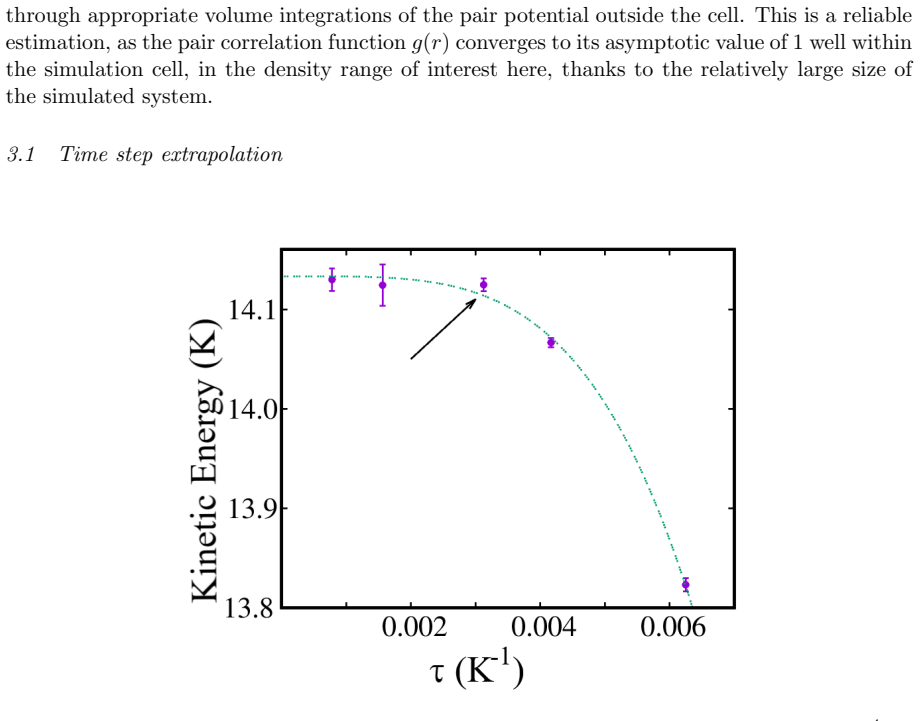
Usually the total, rather than the kinetic energy is extrapolated, but the procedures are equivalent because the kinetic energy is by far the most important source of time step error, as shown in Table 1
-
[29]
T. R. Prisk, M. S. Bryan, P. E. Sokol, G. E. Granroth, S. Moroni, and M. Boninsegni. The momentum distribution of liquid he-4.Journal of Low Temperature Physics, 189(3- 4):158–184, 2017
work page 2017
-
[30]
Extrapolation to theτ= 0 limit can be carried out for the total energy, just as illustrated in Fig. 1 for the kinetic energy. In practice, the results for the total energy obtained with τ≤τ c are indistinguishable within statistical uncertainties
-
[31]
M. H. Kalos, M. A. Lee, and P. A. Whitlock. Modern potentials and the properties of condensed helium-four.Phys. Rev. B, 24(1):115–130, 1981
work page 1981
-
[32]
J. Boronat and J. Casulleras. Monte carlo analysis of an interatomic potential for he.Phys. Rev. B, 49(13):8920–8930, 1994
work page 1994
-
[33]
M. Boninsegni. Ground state phase diagram of parahydrogen in one dimension.Phys. Rev. Lett., 111(23):235303, 2013
work page 2013
-
[34]
S. Moroni and M. Boninsegni. Coexistence, interfacial energy, and the fate of microemul- sions of 2d dipolar bosons.Phys. Rev. Lett., 113(24):240407–240407, 2014
work page 2014
- [35]
-
[36]
M. Boninsegni and S. Moroni. Population size bias in Diffusion Monte Carlo.Phys. Rev. E, 86:056712, 2012
work page 2012
-
[37]
M. Boninsegni. Phase separation in mixtures of hard core bosons.Phys. Rev. Lett., 87:087201, 2001
work page 2001
-
[38]
J. S. Brooks and R. J. Donnelly. The observed properties of liquid helium at the saturated vapor pressure.J. Phys. Chem. Ref. Data, 27(6):1217–1274, 1998
work page 1998
-
[39]
H. A. Mook. Neutron-scattering study of the momentum distribution of 4He.Phys. Rev. Lett., 32:1167–1170, 1974
work page 1974
-
[40]
V. F. Sears, E. C. Svensson, P. Martel, and A. D. B. Woods. Neutron-scattering determi- nation of the momentum distribution and the condensate fraction in liquid 4He.Phys. Rev. Lett., 49:279–282, 1982
work page 1982
-
[41]
R. T. Azuah, W. R. Stirling, H. R. Glyde, M. Boninsegni, P. E. Sokol, and S. M. Bennington. Condensate and final-state effects in superfluid 4He.Phys. Rev. B, 56(22):14620–14630, 1997
work page 1997
-
[42]
H. R. Glyde, R. T. Azuah, and W. G. Stirling. Condensate, momentum distribution and final-state effects in liquid helium-four.Phys. Rev. B, 62(21):14337–14349, 2000
work page 2000
-
[43]
H. R. Glyde, S. O. Diallo, R. T. Azuah, O. Kirichek, and J. W. Taylor. Atomic momentum distribution and Bose-Einstein condensation in liquid 4He under pressure.Phys. Rev. B, 84:184506, 2011
work page 2011
-
[44]
K. Beauvois, J. Dawidowski, B. F˚ ak, H. Godfrin, E. Krotscheck, J. Ollivier, and A. Sul- tan. Microscopic dynamics of superfluid 4He: A comprehensive study by inelastic neutron scattering.Phys. Rev. B, 97:184520, 2018
work page 2018
-
[45]
M. Przybytek, W. Cencek, B. Jeziorski, and K. Szalewicz. Pair potential with submillikelvin uncertainties and nonadiabatic treatment of the halo state of the helium dimer.Phys. Rev. Lett., 119:123401, 2017
work page 2017
-
[46]
M. Boninsegni, C. Pierleoni, and D. M. Ceperley. Isotopic shift of helium melting pressure: Path integral monte carlo study.Phys. Rev. Lett., 72(12):1854–1857, 1994
work page 1994
-
[47]
H. N. Robkoff and R. B. Hallock. Structure-factor measurements in 4He as a function of density.Phys. Rev. B, 25:1572–1588, 1982
work page 1982
-
[48]
E. C. Svensson, V. F. Sears, A. D. B. Woods, and P. Martel. Neutron-diffraction study of the static structure factor and pair correlations in liquid he-4.Phys. Rev. B, 21(8):3638–3651, 1980
work page 1980
-
[49]
B. V. Svistunov, E. S. Babaev, and N. V. Prokof’ev.Superfluid States of Matter. CRC Press, Boca Raton, first edition, 2015
work page 2015
-
[50]
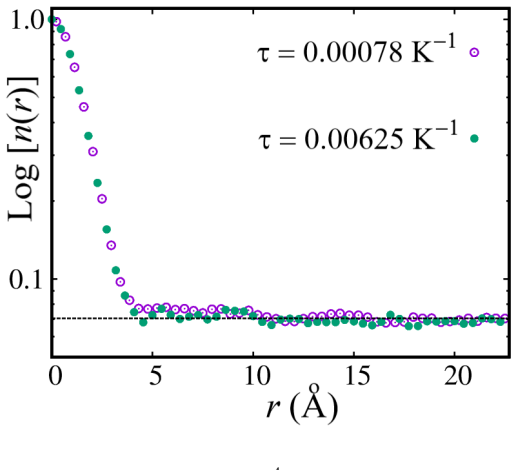
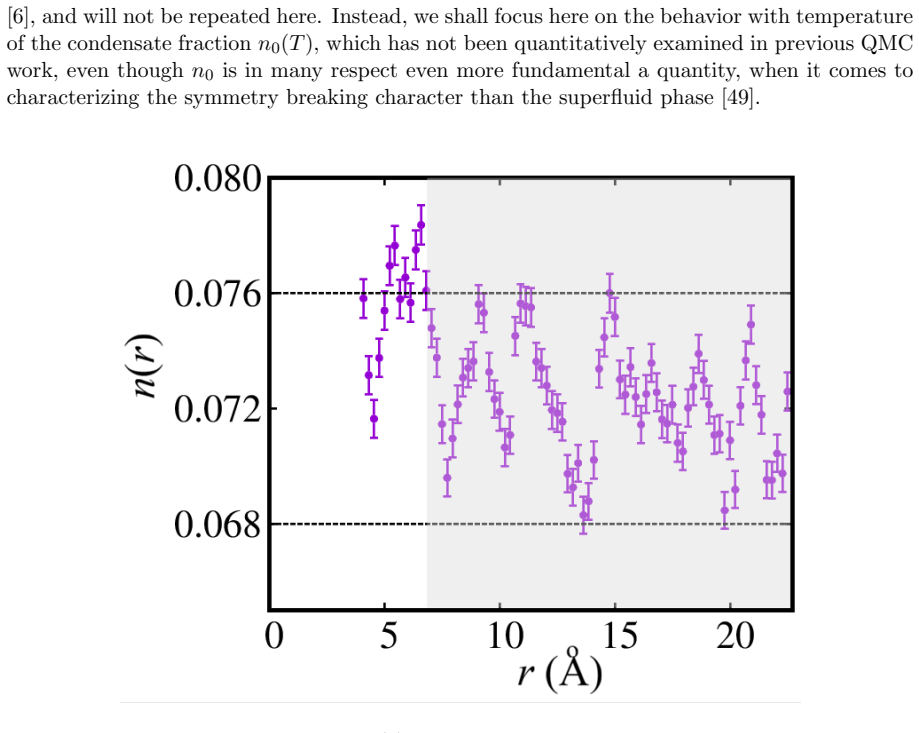
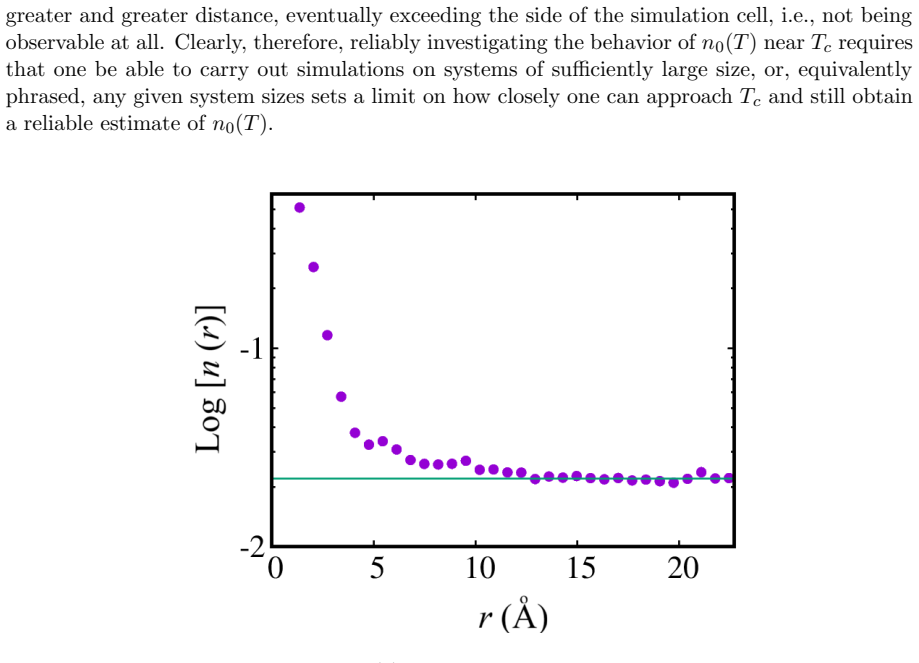
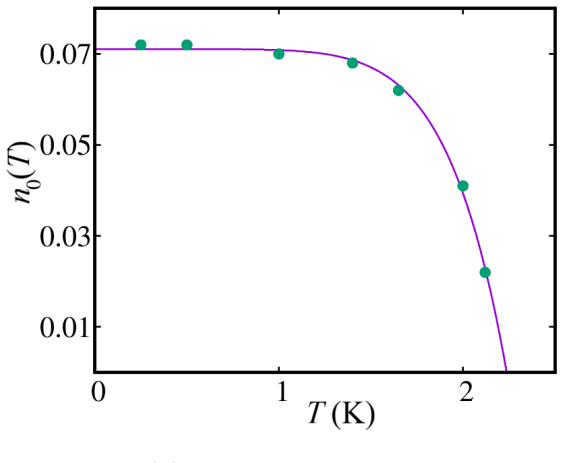
Generally speaking, in theT→0 limit the computedn(r) is independent of system size, within statistical uncertainties. The greater the system size, the higher the temperature for which the computedn(r) can be observed to plateau at large distances, i.e., for which an estimate of the condensate fractionn 0(T) can be obtained
-
[51]
W. M. Snow, Y. Wang, and P. E. Sokol. Density and Temperature Dependence of the Condensate Fraction in Liquid 4He.Europhys. Lett., 19(5):403, 1992
work page 1992
-
[52]
H. R. Glyde. Bose-Einstein Condensation Measurements and Superflow in Condensed He- lium.J. Low Temp. Phys., 172:364, 2013
work page 2013
-
[53]
S. Moroni and M. Boninsegni. Condensate Fraction in Liquid 4He.J. Low Temp. Phys., 136(3/4):129–137, 2004
work page 2004
-
[54]
M. Boninsegni. The Solid Phase of 4He: A Monte Carlo Simulation Study.Entropy, 25(8):1114, 2023
work page 2023
-
[55]
M. Boninsegni and D. M. Ceperley. Density fluctuations in liquid 4He. Path integrals and maximum entropy.J. Low Temp. Phys., 104(5-6):339–357, 1996
work page 1996
- [56]
-
[57]
Y. Kora and M. Boninsegni. Dynamic structure factor of superfluid he-4 from quantum monte carlo: Maximum entropy revisited.Phys. Rev. B, 98(13):134509–134509, 2018
work page 2018
discussion (0)
Sign in with ORCID, Apple, or X to comment. Anyone can read and Pith papers without signing in.