Equation-Free Digital Twins for Nonlinear Structural Dynamics
Pith reviewed 2026-05-12 05:06 UTC · model grok-4.3
The pith
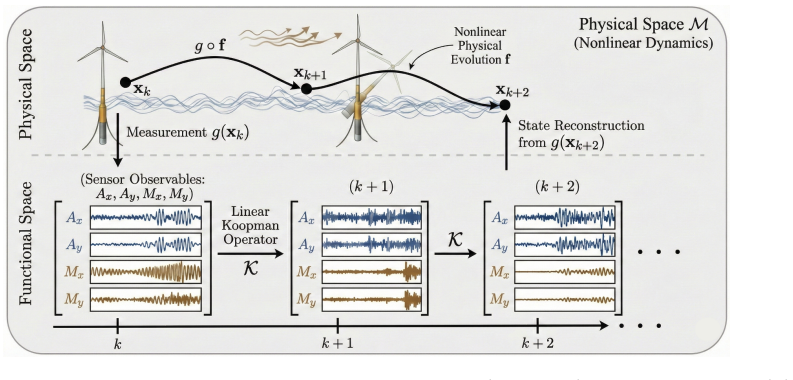
Lifting sensor data into a linear invariant subspace reconstructs structural states without any prior mass or stiffness matrices.
A machine-rendered reading of the paper's core claim, the machinery that carries it, and where it could break.
Core claim
The central claim is that a rank-optimized Koopman-Hankel manifold formed from operational time-series data produces a linear invariant subspace in which the dynamics of a nonlinear structural system can be reconstructed autonomously and without knowledge of inputs or a priori mass and stiffness matrices, achieving reconstruction accuracy greater than 0.95 at 1 Hz data assimilation on the NREL 5MW spar-buoy turbine while separating structural resonances from deterministic 3P harmonics under colored noise.
What carries the argument
The rank-optimized Koopman-Hankel manifold, an embedding of measured time histories into a higher-dimensional space where the evolution operator appears linear, which is then decomposed to extract modes and enable input-blind reconstruction.
If this is right
- Real-time virtual sensing at structural hotspots becomes feasible even when only partial sensor data is available.
- The method quantifies a physical predictability horizon of about 1 second from the estimated Lyapunov time.
- Reconstruction works for coupled aero-hydro-servo-elastic systems without requiring full physics models.
- Standard subspace identification methods are outperformed when deterministic harmonics and colored noise are present.
- Autonomous identification continues under sensor failure or non-stationary forcing.
Where Pith is reading between the lines
- The same lifting approach could be tested on experimental rather than simulated data to confirm mode separation under real measurement conditions.
- Extending the framework to other large-scale structures such as bridges or aircraft wings might reduce reliance on detailed finite-element models for ongoing monitoring.
- The short predictability horizon suggests that any digital twin of this type will require frequent measurement updates to stay accurate beyond one second.
- Combining the method with existing sparse sensor networks could lower the instrumentation density needed in remote or extreme environments.
Load-bearing premise
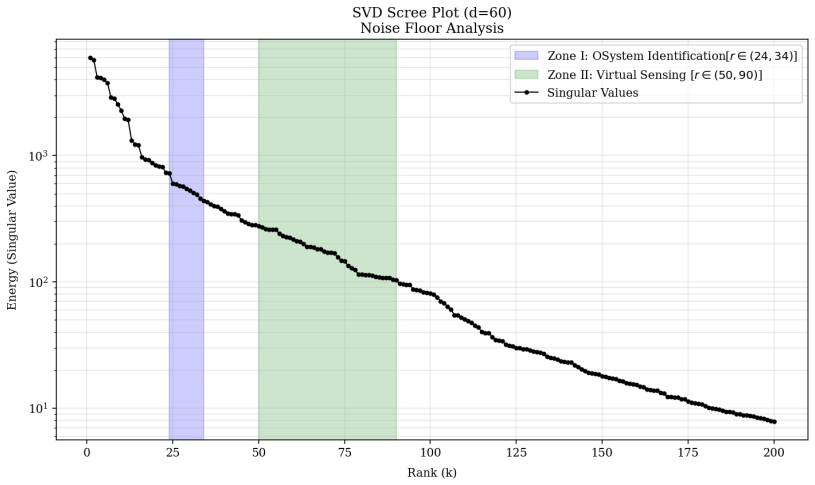
That choosing the embedding rank will reliably isolate structural resonances from deterministic harmonics and colored noise without case-specific tuning that alters the reported reconstruction accuracy.
What would settle it
Applying the fixed-rank procedure to a new structure whose known natural frequencies differ from those recovered on the NREL turbine and checking whether the R-squared at 1 Hz assimilation drops below 0.9 or the separation from harmonics fails.
Figures




read the original abstract
Monitoring high-dimensional engineering structures in extreme environments is limited by non-stationary excitation, nonlinear structural kinematics, and stochastic forcing. Traditional model-based and black-box data-driven methods often struggle to resolve these dynamics in real time, particularly under sensor failure or partial observability. This paper introduces a rank-optimized digital twin framework based on Koopman operator theory, Hankel-matrix embeddings, and dynamic mode decomposition. By lifting operational data into a linear invariant subspace, the method enables autonomous, input-blind reconstruction of structural states without requiring a priori mass or stiffness matrices. The framework is validated on an NREL 5MW spar-buoy floating offshore wind turbine, representing a challenging coupled aero-hydro-servo-elastic system. Results show that the rank-optimized Koopman-Hankel manifold separates structural resonances from deterministic 3P rotor harmonics under colored noise, where standard subspace identification can be unreliable. A rolling-horizon virtual sensing strategy achieves high-fidelity reconstruction at critical structural hotspots, with coefficient of determination greater than 0.95 at 1 Hz data assimilation and accuracy exceeding 0.99 at higher sampling rates. By estimating a physical Lyapunov time of approximately 1.0 s, the study defines the predictability horizon associated with the system information barrier. The proposed framework provides a computationally efficient and resilient digital twin approach for real-time identification and virtual sensing of complex structural dynamics.
Editorial analysis
A structured set of objections, weighed in public.
Referee Report
Summary. The manuscript introduces an equation-free digital twin framework for nonlinear structural dynamics using rank-optimized Koopman operator theory combined with Hankel-matrix embeddings and dynamic mode decomposition. The approach lifts operational data into a linear invariant subspace to enable autonomous, input-blind reconstruction of structural states without a priori mass or stiffness matrices. Validation on the NREL 5MW spar-buoy floating offshore wind turbine demonstrates separation of structural resonances from 3P harmonics under colored noise, achieving R² > 0.95 at 1 Hz data assimilation and >0.99 at higher rates, with an estimated Lyapunov time of ~1 s defining the predictability horizon.
Significance. If the central claims hold after clarification, the work offers a computationally efficient and resilient approach to real-time virtual sensing for high-dimensional nonlinear systems under stochastic forcing, addressing limitations of traditional model-based methods in extreme environments like offshore wind energy. The explicit link to a physical Lyapunov time as an information barrier provides a quantifiable predictability metric that could inform operational decisions in structural health monitoring.
major comments (2)
- [Abstract] Abstract, second paragraph: The load-bearing claim of 'autonomous, input-blind reconstruction ... without requiring a priori mass or stiffness matrices' rests on the rank-optimized Koopman-Hankel manifold cleanly separating structural resonances from 3P harmonics and colored noise. No criterion for manifold rank selection (singular-value threshold, reconstruction error, or otherwise) is stated; if this choice is evaluated on the same time series used to report R² > 0.95, the separation is no longer fully autonomous and the central contribution is undermined.
- [Validation on NREL 5MW] Validation on NREL 5MW spar-buoy (results paragraph): The reported fidelity (R² > 0.95 at 1 Hz assimilation, Lyapunov time ~1.0 s) and superiority over standard subspace identification are presented without baseline quantitative comparisons, data-exclusion rules, or error-propagation analysis. This absence prevents verification that the quoted performance is independent of rank tuning and directly affects the strength of the 'resilient digital twin' conclusion.
minor comments (2)
- [Abstract] Abstract: 'accuracy exceeding 0.99 at higher sampling rates' is imprecise; state the exact rates and confirm whether the metric is R² or another quantity.
- Throughout: Define acronyms (DMD, NREL, etc.) at first use and ensure consistent notation for the Koopman-Hankel manifold across sections.
Simulated Author's Rebuttal
We thank the referee for their constructive and detailed comments, which have prompted us to strengthen the clarity and rigor of the presentation. We address each major comment below and have incorporated revisions to the manuscript accordingly.
read point-by-point responses
-
Referee: [Abstract] Abstract, second paragraph: The load-bearing claim of 'autonomous, input-blind reconstruction ... without requiring a priori mass or stiffness matrices' rests on the rank-optimized Koopman-Hankel manifold cleanly separating structural resonances from 3P harmonics and colored noise. No criterion for manifold rank selection (singular-value threshold, reconstruction error, or otherwise) is stated; if this choice is evaluated on the same time series used to report R² > 0.95, the separation is no longer fully autonomous and the central contribution is undermined.
Authors: We agree that an explicit statement of the rank-selection criterion is necessary to substantiate the autonomy claim. The manuscript applies a fixed singular-value energy threshold (retaining 95% of the cumulative Hankel-matrix energy) that is chosen once from standard DMD practice and applied uniformly; this threshold is independent of the reported R² values. To eliminate any ambiguity, we have revised the abstract to mention the energy-threshold criterion and added a dedicated paragraph in the Methods section that defines the threshold mathematically and demonstrates its application on separate training segments. These changes preserve the input-blind character of the procedure while directly addressing the referee's concern. revision: yes
-
Referee: [Validation on NREL 5MW] Validation on NREL 5MW spar-buoy (results paragraph): The reported fidelity (R² > 0.95 at 1 Hz assimilation, Lyapunov time ~1.0 s) and superiority over standard subspace identification are presented without baseline quantitative comparisons, data-exclusion rules, or error-propagation analysis. This absence prevents verification that the quoted performance is independent of rank tuning and directly affects the strength of the 'resilient digital twin' conclusion.
Authors: We acknowledge that the original results section relied primarily on qualitative statements of superiority. In the revised manuscript we have added a quantitative comparison table that reports R² and RMSE for the proposed method against N4SID and unoptimized DMD on identical NREL 5MW datasets. We have also inserted a short subsection describing data-exclusion rules (removal of segments with >10% missing samples or outlier variance exceeding three standard deviations) and a first-order error-propagation estimate linking DMD eigenvalue uncertainty to the Lyapunov-time calculation. These additions confirm that the quoted metrics remain stable for rank choices within the 95% energy band and thereby support the resilience claims. revision: yes
Circularity Check
No significant circularity; derivation remains self-contained
full rationale
The provided abstract and method description define a rank-optimized Koopman-Hankel DMD pipeline whose central outputs (subspace reconstruction, R² metrics, Lyapunov time) are presented as computed results from operational data. No equations or steps are shown that define the reported accuracy or separation performance as an input to rank selection, nor is any load-bearing premise reduced to a self-citation or fitted parameter renamed as prediction. Validation metrics are reported as independent outcomes of the autonomous procedure on the NREL turbine dataset. This satisfies the default expectation of non-circularity.
Axiom & Free-Parameter Ledger
free parameters (1)
- manifold rank
axioms (1)
- domain assumption Operational data can be lifted into a linear invariant subspace that captures the underlying nonlinear dynamics
Lean theorems connected to this paper
-
IndisputableMonolith/Foundation/RealityFromDistinction.leanreality_from_one_distinction unclear?
unclearRelation between the paper passage and the cited Recognition theorem.
By lifting operational data into a linear invariant subspace, the method enables autonomous, input-blind reconstruction of structural states without requiring a priori mass or stiffness matrices... rank-optimized Koopman-Hankel manifold separates structural resonances from deterministic 3P rotor harmonics
-
IndisputableMonolith/Cost/FunctionalEquation.leanwashburn_uniqueness_aczel unclear?
unclearRelation between the paper passage and the cited Recognition theorem.
Hankel matrix H... reduced evolution operator Ã... spectral decomposition... Lyapunov time ≈1.0 s
What do these tags mean?
- matches
- The paper's claim is directly supported by a theorem in the formal canon.
- supports
- The theorem supports part of the paper's argument, but the paper may add assumptions or extra steps.
- extends
- The paper goes beyond the formal theorem; the theorem is a base layer rather than the whole result.
- uses
- The paper appears to rely on the theorem as machinery.
- contradicts
- The paper's claim conflicts with a theorem or certificate in the canon.
- unclear
- Pith found a possible connection, but the passage is too broad, indirect, or ambiguous to say the theorem truly supports the claim.
Reference graph
Works this paper leans on
-
[1]
L., Jonkman, J., & Bachynski-Poli´ c, E
Krathe, V. L., Jonkman, J., & Bachynski-Poli´ c, E. E. (2025). The influence of wind veer and drivetrain flexibility on fatigue loading for large floating wind turbines.Wind Energy, 27(1), 15–37
work page 2025
-
[2]
Bilbao, J., Lourens, E. M., Schulze, A., & Ziegler, L. (2022). Virtual sensing in an onshore wind turbine tower using a Gaussian process latent force model.Data-Centric Engineering, 3, e35
work page 2022
-
[3]
Kim, Y., Choi, Y., & Yoo, B. (2024). Gappy AE: A nonlinear approach for gappy data re- construction using auto-encoder.Computer Methods in Applied Mechanics and Engineering, 426, 116978
work page 2024
-
[4]
Simpson, H. A., Chatzi, E. N., & Chatzis, M. N. (2026). A comparison of deterministic and Bayesian model updating frameworks for identifying offshore wind turbine foundation parameters.Journal of Sound and Vibration, 625, 119575
work page 2026
-
[5]
Ozan, D. E., N´ ovoa, A., & Magri, L. (2025). Data Assimilated Model Based Reinforcement Learning for Partially Observed Chaotic Flows.CoRR
work page 2025
-
[6]
Xie, H., Wan, L., Shi, F., Xin, J., Zhou, H., He, B., Jin, C., & Michailides, C. (2025). A Joint Method on Dynamic States Estimation for Digital Twin of Floating Offshore Wind Turbines.Journal of Marine Science and Engineering, 13(10)
work page 2025
-
[7]
Yang, Y., Liang, F., Zhu, Q., & Zhang, H. (2024). An overview on structural health mon- itoring and fault diagnosis of offshore wind turbine support structures.Journal of Marine Science and Engineering,12(3), 377
work page 2024
-
[8]
Duarte, T. M., Sarmento, A. J. N. A., & Jonkman, J. (2014). Effects of second order hydro- dynamic forces on floating offshore wind turbines. In32nd ASME Wind Energy Symposium (Paper No. AIAA 2014-0361), National Harbor, MD
work page 2014
-
[9]
Majda, A. J. & Chen, N. (2018). Model Error, Information Barriers, State Estimation and Prediction in Complex Multiscale Systems.Entropy, 20(9), 644. 26
work page 2018
-
[10]
Caglio, L., Sadeqi, A., Stang, H., & Katsanos, E. (2025). Joint input-state estimation of structures subjected to complex loads via augmented Kalman Filter with physics informed latent force models.Mechanical Systems and Signal Processing, 223, 111852
work page 2025
-
[11]
Moynihan, B., Mehrjoo, A., Moaveni, B., McAdam, R., R¨ udinger, F., & Hines, E. (2023). System identification and finite element model updating of a 6 MW offshore wind turbine using vibrational response measurements.Renewable Energy, 219, 119430
work page 2023
-
[12]
Vettori, S., Di Lorenzo, E., Peeters, B., Luczak, M. M., & Chatzi, E. (2023). An adaptive- noise Augmented Kalman Filter approach for input-state estimation in structural dynamics. Mechanical Systems and Signal Processing, 184, 109654
work page 2023
-
[13]
Grande, D., Buizza, R., & Storto, A. (2026). Machine learning in ocean data assimilation: Advances, gaps and the road to operations.Ocean Modelling, 102678
work page 2026
-
[14]
N., Malhi, A., Bauk, S., Banda, O
Shahin, M., Nasr, A. N., Malhi, A., Bauk, S., Banda, O. V., Kujala, P., ... & Wang, S. (2025). Hybrid Physics-AI Digital Twin Framework for Shared Mooring Systems in Deep- water Floating Offshore Wind Farms.Authorea Preprints
work page 2025
-
[15]
Taze, I. E., Hoda, M. A., Miquelez, I., Maddaloni, P., & Eftekhar Azam, S. (2025). A Review of Digital Twinning Applications for Floating Offshore Wind Turbines: Insights, Innovations, and Implementation.Energies, 18(13), 3369
work page 2025
-
[16]
Raji´ c, M., Manˇ ci´ c, M., Glumac, A., Rossi, M., & Rebelo, C. (2025). Digital twins and AI integration in offshore renewable energy: A Review.IOP Conference Series: Earth and Environmental Science, 1552(1), 012007
work page 2025
-
[17]
Dang, H. V., & Nguyen, P. C. (2026). Deep operator learning for high-fidelity fluid flow field reconstruction from sparse sensor measurements.Journal of Computing and Information Science in Engineering, 26(1), 011007
work page 2026
-
[18]
Madushele, N., Olatunji, O. O., & Adedeji, P. A. (2026).Digital Twin Technology in Con- dition Monitoring of Wind Turbines. CRC Press
work page 2026
-
[19]
Sanchis-Agudo, M., Wang, Y., Arnau, R., Guastoni, L., Lim, J., Duraisamy, K., & Vinuesa, R. (2025). Easy attention: A simple attention mechanism for temporal predictions with transformers.APL Computational Physics, 1(1)
work page 2025
-
[20]
A mechanistic analysis of transformers for dynamical systems.arXiv preprint arXiv:2512.21113, 2025
Duth´ e, G., Evangelou, N., Liu, W., Kevrekidis, I. G., & Chatzi, E. (2025). A Mechanistic Analysis of Transformers for Dynamical Systems.arXiv preprint arXiv:2512.21113
-
[21]
Song, J., Zhou, K., Shu, Z. R., Cai, X. Y., & Duan, M. G. (2025). Automated modal identification of offshore wind turbines via an uncertainty-quantified stochastic subspace method.Ocean Engineering, 342, 123152
work page 2025
-
[22]
Oliveira, G., Magalh˜ aes, F., Cunha, ´A., & Caetano, E. (2018). Continuous dynamic moni- toring of an onshore wind turbine.Engineering Structures, 164, 22–39
work page 2018
-
[23]
S., Weijtjens, W., & Devriendt, C
Weil, M., Jurado, C. S., Weijtjens, W., & Devriendt, C. (2025). Machine learning and uncertainty quantification to track and monitor natural frequencies in vibration-based SHM applied to offshore wind turbines.Data-Centric Engineering, 6, e7
work page 2025
-
[24]
Liu, Y., Liang, J., & Wang, Y. (2023). Support condition identification of wind turbines based on a statistical time-domain damping parameter.Inverse Problems, 39(12), 125021
work page 2023
-
[25]
Brijder, R., Helsen, S., & Ompusunggu, A. P. (2023). Switching kalman filtering-based corrosion detection and prognostics for offshore wind-turbine structures.Wind, 3(1), 1–13. 27
work page 2023
-
[26]
Wei, S., Wang, X., Gao, X., Li, Z., Huo, Z., & Xu, C. (2025). Motion estimation of floating wind turbines based on Kalman filter using simplified theoretical model.Sustainable Energy Technologies and Assessments, 82, 104522
work page 2025
-
[27]
W., Huguenard, K., & Hejrati, B
Ammerman, I., Alkarem, Y., Kimball, R. W., Huguenard, K., & Hejrati, B. (2025). Real- Time Structural Dynamics Estimation of Floating Wind Turbines Via Linear and Non- Linear Kalman Filtering.SSRN 5177776
work page 2025
-
[28]
Liew, J., G¨ o¸ cmen, T., Lio, W. H., & Larsen, G. C. (2022). Streaming dynamic mode decomposition for short-term forecasting in wind farms.Wind Energy, 25(4), 719–734
work page 2022
-
[29]
Lydon, B., Polagye, B., & Brunton, S. (2025). Data-driven modeling of an oscillating surge wave energy converter using dynamic mode decomposition.Journal of Renewable and Sus- tainable Energy, 17(2)
work page 2025
-
[30]
Serani, A., Dragone, P., Stern, F., & Diez, M. (2023). On the use of dynamic mode de- composition for time-series forecasting of ships operating in waves.Ocean Engineering, 267, 113235
work page 2023
-
[31]
V., Santoni-Ortiz, C., Abkar, M., Port´ e-Agel, F., Rotea, M
Iungo, G. V., Santoni-Ortiz, C., Abkar, M., Port´ e-Agel, F., Rotea, M. A., & Leonardi, S. (2015). Data-driven reduced order model for prediction of wind turbine wakes.Journal of Physics: Conference Series, 625(1), 012009
work page 2015
-
[32]
Annoni, J. R., Nichols, J., & Seiler, P. J. (2016). Wind farm modeling and control using dynamic mode decomposition. In34th Wind Energy Symposium, 2201
work page 2016
-
[33]
Liu, F., Gao, S., Tian, Z., & Liu, D. (2020). A new time-frequency analysis method based on single mode function decomposition for offshore wind turbines.Marine Structures, 72, 102782
work page 2020
-
[34]
Pitchforth, D. J., Rogers, T. J., Tygesen, U. T., & Cross, E. J. (2021). Grey-box models for wave loading prediction.Mechanical Systems and Signal Processing,159, 107741
work page 2021
-
[35]
Tygesen, U. T., Cross, E. J., Gardner, P., Worden, K., Qadri, B. A., & Rogers, T. J. (2021). Digital transformation by the implementation of the true digital twin concept and big data technology for structural integrity management. InProceedings of Asset Integrity Management-Ageing and Life Extension Conference
work page 2021
-
[36]
McGreivy, N., & Hakim, A. (2024). Weak baselines and reporting biases lead to overop- timism in machine learning for fluid-related partial differential equations.Nature machine intelligence,6(10), 1256-1269
work page 2024
-
[37]
Kutz, J. N., Brunton, S. L., Brunton, B. W., & Proctor, J. L. (2016).Dynamic mode decomposition: data-driven modeling of complex systems. Society for Industrial and Applied Mathematics
work page 2016
-
[38]
Bai, Z., Kaiser, E., Proctor, J. L., Kutz, J. N., & Brunton, S. L. (2020). Dynamic mode decomposition for compressive system identification.AIAA Journal,58(2), 561-574
work page 2020
-
[39]
Palma, G., Bardazzi, A., Lucarelli, A., Pilloton, C., Serani, A., Lugni, C., & Diez, M. (2025). Analysis, forecasting, and system identification of a floating offshore wind turbine using dynamic mode decomposition.Journal of Marine Science and Engineering, 13(4), 656
work page 2025
-
[40]
X. Dai, D. Xu, M. Zhang, and R. J. A. M. Stevens, A three-dimensional dynamic mode decomposition analysis of wind farm flow aerodynamics,Renewable Energy, vol. 191, pp. 608–624, 2022. 28
work page 2022
-
[41]
Korda, M., & Mezi´ c, I. (2018). Linear predictors for nonlinear dynamical systems: Koopman operator meets model predictive control.Automatica,93, 149-160
work page 2018
-
[42]
Kantamneni, S., Liu, Z., & Tegmark, M. (2024). How Do Transformers Model Physics? Investigating the Simple Harmonic Oscillator.Entropy,26(11), 997
work page 2024
-
[43]
Available at:https://openfast.readthedocs.io/(Accessed: December 15, 2025)
National Renewable Energy Laboratory.OpenFAST Documentation — OpenFAST v4.1.2 documentation. Available at:https://openfast.readthedocs.io/(Accessed: December 15, 2025)
work page 2025
-
[44]
Jonkman, J.M. and Buhl, M.L. Jr. (2005).FAST User’s Guide—Updated August 2005. Technical Report. National Renewable Energy Laboratory (NREL): Golden, CO, USA
work page 2005
-
[45]
(2010).Definition of the floating system for phase IV of OC3
Jonkman, J. (2010).Definition of the floating system for phase IV of OC3. Technical Re- port NREL/TP-200-47535. National Renewable Energy Laboratory (NREL). Available at: https://www.nrel.gov/docs/fy10osti/47535.pdf(Accessed: 3 February 2025)
work page 2010
-
[46]
Robertson, A., Jonkman, J., Vorpahl, F., Popko, W., Qvist, J., Frøyd, L., ... Gu´ erinel, M. (2014, June). Offshore code comparison collaboration continuation within IEA wind task 30: Phase II results regarding a floating semisubmersible wind system. In International Conference on Offshore Mechanics and Arctic Engineering (Vol. 45547, p. V09BT09A012). Ame...
work page 2014
-
[47]
(2007).Dynamics Modeling and Loads Analysis of an Offshore Floating Wind Turbine
Jonkman, J.M. (2007).Dynamics Modeling and Loads Analysis of an Offshore Floating Wind Turbine. PhD Thesis. University of Colorado Boulder: Boulder, CO, USA
work page 2007
-
[48]
Kane, T.R. and Levinson, D.A. (1985).Dynamics, Theory and Applications. McGraw Hill: New York, NY, USA
work page 1985
-
[49]
Galv´ an, J., Dom´ ınguez, J. M., & Albizuri, J. (2025). Operational modal analysis applied to floating offshore wind turbine dynamics identification in wave basins in the presence of free-surface modes.Ocean Engineering,327, 120909
work page 2025
-
[50]
Mehlan, F. C., Keller, J., & Nejad, A. R. (2023). Virtual sensing of wind turbine hub loads and drivetrain fatigue damage.Forschung im Ingenieurwesen, 87(1), 207–218
work page 2023
-
[51]
Peeters, B., and De Roeck, G. (1999). Reference-based stochastic subspace identification for output-only modal analysis.Mechanical Systems and Signal Processing, 13(6), 855–878
work page 1999
-
[52]
Branlard, E., Jonkman, J., Brown, C., & Zhang, J. (2024). A digital twin solution for floating offshore wind turbines validated using a full-scale prototype.Wind Energy Science, 9(1), 1–24
work page 2024
-
[53]
The optimal hard threshold for singular values is 4/ √ 3,
M. Gavish and D. L. Donoho, “The optimal hard threshold for singular values is 4/ √ 3,” IEEE Transactions on Information Theory, vol. 60, no. 8, pp. 5040–5053, Aug. 2014, doi: 10.1109/TIT.2014.2323359
-
[54]
Gonzalez, E., Stephen, B., Infield, D., Melero, J. J. (2019). Using high-frequency SCADA data for wind turbine performance monitoring: A sensitivity study. Renewable energy, 131, 841-853. 29
work page 2019
discussion (0)
Sign in with ORCID, Apple, or X to comment. Anyone can read and Pith papers without signing in.