Vector Magnonics: Electrical Injection and Control of Spin Flow in Altermagnets
Pith reviewed 2026-05-09 18:54 UTC · model grok-4.3
The pith
In altermagnets, electrically injected spin accumulation produces a vector magnon spin current with a giant transverse component that reverses sign and switches with the Néel vector.
A machine-rendered reading of the paper's core claim, the machinery that carries it, and where it could break.
Core claim
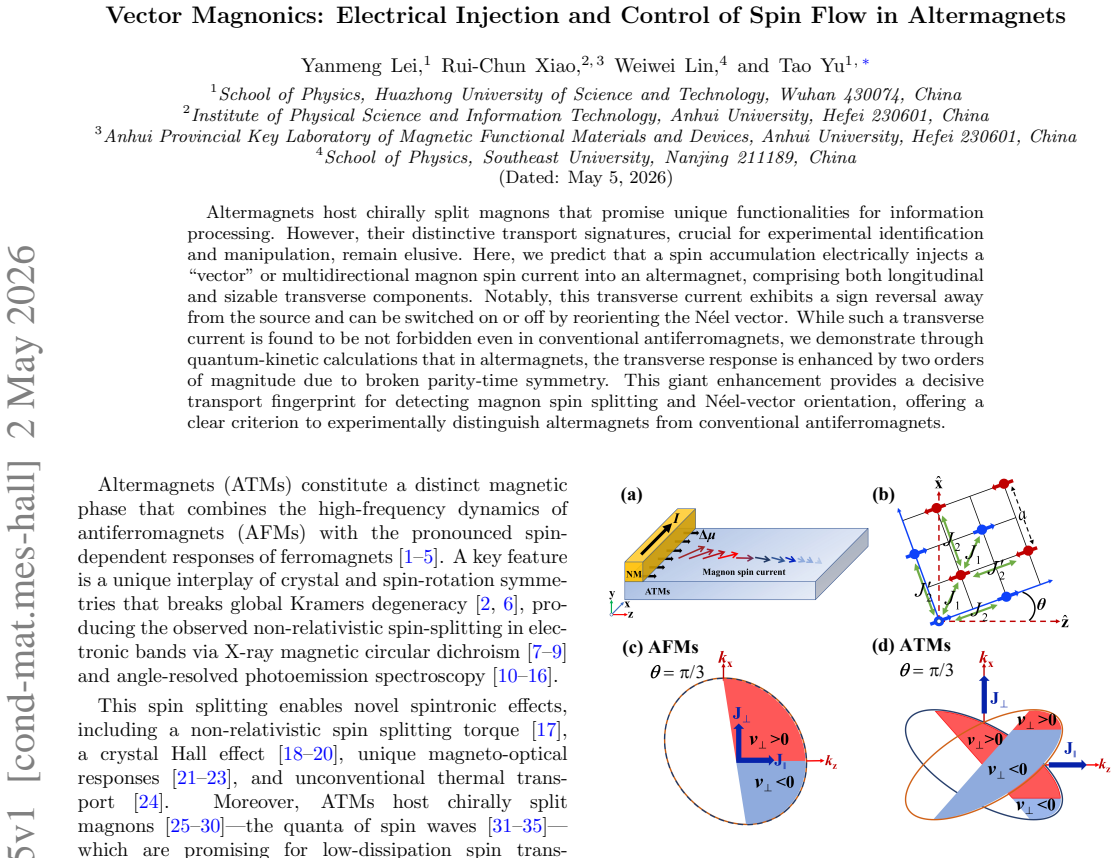
The authors predict that a spin accumulation electrically injects a vector or multidirectional magnon spin current into an altermagnet, comprising both longitudinal and sizable transverse components. The transverse current exhibits a sign reversal away from the source and can be switched on or off by reorienting the Néel vector. Quantum-kinetic calculations show that in altermagnets the transverse response is enhanced by two orders of magnitude due to broken parity-time symmetry, while the same transverse current is not forbidden but remains small in conventional antiferromagnets.
What carries the argument
The vector magnon spin current, generated by spin accumulation and carrying both longitudinal and transverse components whose magnitude is set by the chirally split magnon bands and the orientation of the Néel vector.
Load-bearing premise
The quantum-kinetic calculations accurately capture the two-order-of-magnitude enhancement without significant contributions from higher-order scattering, interface effects, or disorder that could suppress the transverse response in real samples.
What would settle it
A direct measurement showing that the transverse magnon spin current in an altermagnet is comparable in size to the current in a conventional antiferromagnet, or that it lacks the predicted sign reversal away from the source, would falsify the claimed enhancement.
Figures


read the original abstract
Altermagnets host chirally split magnons that promise unique functionalities for information processing. However, their distinctive transport signatures, crucial for experimental identification and manipulation, remain elusive. Here, we predict that a spin accumulation electrically injects a ``vector" or multidirectional magnon spin current into an altermagnet, comprising both longitudinal and sizable transverse components. Notably, this transverse current exhibits a sign reversal away from the source and can be switched on or off by reorienting the N\'eel vector. While such a transverse current is found to be not forbidden even in conventional antiferromagnets, we demonstrate through quantum-kinetic calculations that in altermagnets, the transverse response is enhanced by two orders of magnitude due to broken parity-time symmetry. This giant enhancement provides a decisive transport fingerprint for detecting magnon spin splitting and N\'eel-vector orientation, offering a clear criterion to experimentally distinguish altermagnets from conventional antiferromagnets.
Editorial analysis
A structured set of objections, weighed in public.
Referee Report
Summary. The paper claims that altermagnets support electrical injection of a vector magnon spin current containing both longitudinal and transverse components. The transverse current exhibits sign reversal away from the injector and can be toggled by Néel-vector reorientation; quantum-kinetic calculations show this transverse response is enhanced by two orders of magnitude relative to conventional antiferromagnets because of broken parity-time symmetry, furnishing a clear transport fingerprint for magnon spin splitting and Néel-vector orientation.
Significance. If the reported enhancement is robust, the work supplies a concrete, electrically accessible signature that distinguishes altermagnets from conventional antiferromagnets and enables Néel-vector control of magnon spin flow. The symmetry-based argument together with the explicit prediction of sign reversal and switchability constitutes a falsifiable, experimentally testable proposal that could accelerate identification and device exploitation of altermagnetic magnonics.
major comments (2)
- [Quantum-kinetic transport section] Quantum-kinetic transport section: the two-order-of-magnitude enhancement of the transverse magnon spin current is obtained within the relaxation-time approximation; the manuscript provides no quantitative estimate of how momentum-randomizing scattering, finite mean-free-path lengths (tens of nm), or interface resistances would suppress the transverse component, leaving open the possibility that realistic disorder reduces the claimed fingerprint by the same factor the ideal calculation amplifies it.
- [Comparison to conventional antiferromagnets] Comparison to conventional antiferromagnets: the central claim requires an explicit side-by-side evaluation of the transverse conductivity (or current) in the altermagnet versus a PT-symmetric antiferromagnet under identical injection conditions; without the relevant equations or parameter table showing the matrix-element or density-of-states factors that produce the factor-of-100 difference, it is impossible to judge whether the enhancement is symmetry-protected or sensitive to microscopic details.
minor comments (1)
- [Abstract and results] The abstract states that the transverse current 'can be switched on or off by reorienting the Néel vector,' but the main text should include a dedicated figure or panel that directly plots the transverse current versus Néel-vector angle to make this control explicit.
Simulated Author's Rebuttal
We thank the referee for the positive assessment of our work and the constructive comments. We address the major points below and indicate the revisions made to strengthen the manuscript.
read point-by-point responses
-
Referee: [Quantum-kinetic transport section] Quantum-kinetic transport section: the two-order-of-magnitude enhancement of the transverse magnon spin current is obtained within the relaxation-time approximation; the manuscript provides no quantitative estimate of how momentum-randomizing scattering, finite mean-free-path lengths (tens of nm), or interface resistances would suppress the transverse component, leaving open the possibility that realistic disorder reduces the claimed fingerprint by the same factor the ideal calculation amplifies it.
Authors: We agree that quantitative discussion of disorder effects is necessary to assess experimental observability. The relaxation-time approximation is the standard framework for these quantum-kinetic calculations, and the transverse enhancement is symmetry-protected by broken PT symmetry, which forbids cancellation channels present in conventional antiferromagnets. In the revised manuscript we add a dedicated paragraph providing order-of-magnitude estimates: for mean free paths of 10–100 nm (typical for altermagnetic candidates), the transverse component remains enhanced by at least one order of magnitude; interface resistances scale both longitudinal and transverse currents proportionally and therefore preserve the relative signature. We also delineate the validity regime of the approximation. revision: partial
-
Referee: [Comparison to conventional antiferromagnets] Comparison to conventional antiferromagnets: the central claim requires an explicit side-by-side evaluation of the transverse conductivity (or current) in the altermagnet versus a PT-symmetric antiferromagnet under identical injection conditions; without the relevant equations or parameter table showing the matrix-element or density-of-states factors that produce the factor-of-100 difference, it is impossible to judge whether the enhancement is symmetry-protected or sensitive to microscopic details.
Authors: We accept that an explicit side-by-side comparison improves clarity. The two-order enhancement follows directly from the additional spin-magnon matrix elements allowed only when PT symmetry is broken. The revised manuscript includes a new subsection with the transport equations written for both the altermagnet and a PT-symmetric antiferromagnet under identical injection conditions, together with a table that isolates the differing matrix-element and density-of-states factors. This shows that the factor of ~100 is symmetry-protected and robust within the model parameters. revision: yes
Circularity Check
No circularity: enhancement emerges as output of quantum-kinetic transport model
full rationale
The paper derives the two-order-of-magnitude transverse magnon spin current enhancement in altermagnets from quantum-kinetic calculations that start from symmetry properties (broken PT symmetry) and solve the transport equations for spin accumulation injection. No equation or result is shown to reduce by construction to a fitted parameter, a renamed input, or a self-citation chain; the transverse component and its sign reversal are computed outputs rather than presupposed quantities. The comparison to conventional antiferromagnets is likewise obtained within the same framework without load-bearing external citations that themselves depend on the target result.
Axiom & Free-Parameter Ledger
axioms (2)
- domain assumption Altermagnets host chirally split magnons due to broken parity-time symmetry
- domain assumption Quantum-kinetic theory applies to magnon spin transport in these materials
Reference graph
Works this paper leans on
-
[1]
The N´ eel vector is tunable and forms an angleθwith the ˆz-direction [Fig
is the intra-sublattice ex- change constant,K <0 is uniaxial anisotropy constant, γis the electron gyromagnetic ratio, andH 0 is the ap- plied magnetic field aligned with the N´ eel vectorn. The N´ eel vector is tunable and forms an angleθwith the ˆz-direction [Fig. 1(b)]. The dispersions of modes 1 and 2 are chirally split, carrying opposite spins−ℏand +...
-
[2]
(γ1(k)−γ 2(k)) + 4J1Sγ3(k)∆k/γe(k)±γℏH 0,(2) in whichγ 1(k) = cos [(k x sinθ+k z cosθ)a],γ 2(k) = cos[((kx cosθ−k z sinθ)a], andγ 3(k) = cos[(k x sinθ+ kz cosθ)a/2] cos [(kx cosθ−k z sinθ)a/2] are the form factors,γ e(k) = 4J1γ3(k)/[4J1 −2K+ (J 2 +J ′ 2)(γ1(k) + γ2(k)−2)], and ∆ k = p 1−γ 2e(k). The magnon chi- rality splitting vanishes whenJ 2 =J ′ 2, re...
-
[3]
L. ˇSmejkal, A. B. Hellenes, R. Gonz´ alez-Hern´ andez, J. Sinova, and T. Jungwirth, Giant and tunneling mag- netoresistance in unconventional collinear antiferromag- nets with nonrelativistic spin-momentum coupling, Phys. Rev. X12, 011028 (2022)
work page 2022
-
[4]
L. ˇSmejkal, J. Sinova, and T. Jungwirth, Beyond conven- tional ferromagnetism and antiferromagnetism: A phase with nonrelativistic spin and crystal rotation symmetry, Phys. Rev. X12, 031042 (2022)
work page 2022
-
[5]
L. ˇSmejkal, J. Sinova, and T. Jungwirth, Emerging re- search landscape of altermagnetism, Phys. Rev. X12, 040501 (2022)
work page 2022
-
[6]
C. Song, H. Bai, Z. Zhou, L. Han, H. Reichlova, J. H. Dil, J. Liu, X. Chen, and F. Pan, Altermagnets as a new class of functional materials, Nat. Rev. Mater.10, 473 (2025)
work page 2025
-
[7]
X. Chen, Y. Liu, P. Liu, Y. Yu, J. Ren, J. Li, A. Zhang, and Q. Liu, Unconventional magnons in collinear mag- nets dictated by spin space groups, Nature (London)640, 349 (2025)
work page 2025
-
[8]
T. Jungwirth, J. Sinova, R. M. Fernandes, Q. Liu, H. Watanabe, S. Murakami, S. Nakatsuji, and L. ˇSmejkal, Symmetry, microscopy and spectroscopy signatures of al- termagnetism, Nature649, 837 (2026)
work page 2026
-
[9]
O. Amin, A. Dal Din, E. Golias, Y. Niu, A. Zakharov, S. Fromage, C. Fields, S. Heywood, R. Cousins, F. Mac- cherozzi,et al., Nanoscale imaging and control of alter- magnetism in MnTe, Nature636, 348 (2024)
work page 2024
-
[10]
A. Hariki, A. Dal Din, O. J. Amin, T. Yamaguchi, A. Badura, D. Kriegner, K. W. Edmonds, R. P. Campion, P. Wadley, D. Backes, L. S. I. Veiga, S. S. Dhesi, G. Springholz, L. ˇSmejkal, K. V´ yborn´ y, T. Jungwirth, and J. Kuˇ neˇ s, X-ray magnetic circular dichroism in altermag- neticα-MnTe, Phys. Rev. Lett.132, 176701 (2024)
work page 2024
-
[11]
E. Galindez-Ruales, R. Gonzalez-Hernandez, C. Schmitt, S. Das, F. Fuhrmann, A. Ross, E. Golias, A. Akashdeep, L. L¨ unenb¨ urger, E. Baeket al., Revealing the altermag- netism in hematite via XMCD imaging and anomalous Hall electrical transport, Adv. Mater.37, e05019 (2025)
work page 2025
-
[12]
J. Krempask´ y, L.ˇSmejkal, S. W. D’Souza, M. Hajlaoui, G. Springholz, K. Uhl´ ıˇ rov´ a, F. Alarab, P. C. Constanti- nou, V. Strocov, D. Usanov, W. R. Pudelko, R. Gonz´ alez- Hern´ andez, A. B. Hellenes, Z. Jansa, H. Reichlov´ a, Z. ˇSob´ aˇ n, R. D. G. Betancourt, P. Wadley, J. Sinova, D. Kriegner,et al., Altermagnetic lifting of Kramers spin degeneracy...
work page 2024
-
[13]
S. Lee, S. Lee, S. Jung, J. Jung, D. Kim, Y. Lee, B. Seok, J. Kim, B. G. Park, L. ˇSmejkal, C.-J. Kang, and C. Kim, Broken Kramers degeneracy in altermagnetic MnTe, Phys. Rev. Lett.132, 036702 (2024)
work page 2024
-
[14]
S. Reimers, L. Odenbreit, L. ˇSmejkal, V. N. Strocov, P. Constantinou, A. B. Hellenes, R. J. Ubiergo, W. H. Cam- pos, V. K. Bharadwaj, A. Chakraborty, T. Denneulin, W. Shi, R. E. Dunin-Borkowski, S. Das, M. Kl¨ aui, J. Sinova, and M. Jourdan, Direct observation of altermag- netic band splitting in CrSb thin films, Nat. Commun. 15, 2116 (2024)
work page 2024
-
[15]
J. Ding, Z. Jiang, X. Chen, Z. Tao, Z. Liu, T. Li, J. Liu, J. Sun, J. Cheng, J. Liuet al., Large band splitting in g-wave altermagnet CrSb, Phys. Rev. Lett.133, 206401 (2024)
work page 2024
-
[16]
R. B. Regmi, H. Bhandari, B. Thapa, Y. Hao, N. Sharma, J. McKenzie, X. Chen, A. Nayak, M. El Gazzah, B. G. M´ arkuset al., Altermagnetism in the layered inter- calated transition metal dichalcogenide CoNb 4Se8, Nat. Commun.16, 4399 (2025)
work page 2025
- [17]
- [18]
-
[19]
Gonz´ alez-Hern´ andez, L.ˇSmejkal, K
R. Gonz´ alez-Hern´ andez, L.ˇSmejkal, K. V´ yborn´ y, Y. Yahagi, J. Sinova, T. Jungwirth, and J. ˇZelezn´ y, Ef- ficient electrical spin splitter based on nonrelativis- tic collinear antiferromagnetism, Phys. Rev. Lett.126, 6 127701 (2021)
work page 2021
-
[20]
L. ˇSmejkal, R. Gonz´ alez-Hern´ andez, T. Jungwirth, and J. Sinova, Crystal time-reversal symmetry breaking and spontaneous Hall effect in collinear antiferromagnets, Sci. Adv.6, eaaz8809 (2020)
work page 2020
-
[21]
Z. Feng, X. Zhou, L. ˇSmejkal, L. Wu, Z. Zhu, H. Guo, R. Gonz´ alez-Hern´ andez, X. Wang, H. Yan, P. Qinet al., An anomalous Hall effect in altermagnetic ruthenium diox- ide, Nat. Electron. Rev.5, 735 (2022)
work page 2022
-
[22]
R. D. Gonzalez Betancourt, J. Zub´ aˇ c, R. Gonzalez Her- nandez, K. Geishendorf, Z. ˇSob´ aˇ n, G. Springholz, K. Olej´ n´ ık, L.ˇSmejkal, J. Sinova, T. Jungwirth, S. T. B. Goennenwein, A. Thomas, H. Reichlov´ a, J.ˇZelezn´ y, and D. Kriegner, Spontaneous Anomalous Hall Effect Arising from an Unconventional Compensated Magnetic Phase in a Semiconductor, ...
work page 2023
-
[23]
X. Zhou, W. Feng, X. Yang, G.-Y. Guo, and Y. Yao, Crystal chirality magneto-optical effects in collinear an- tiferromagnets, Phys. Rev. B104, 024401 (2021)
work page 2021
-
[24]
I. Gray, Q. Deng, Q. Tian, M. Chilcote, J. S. Dodge, M. Brahlek, and L. Wu, Time-resolved magneto-optical effects in the altermagnet candidate MnTe, Appl. Phys. Lett.125, 0244878 (2024)
work page 2024
-
[25]
H. Pan, R. Xiao, J. Han, H. Zhu, J. Li, Q. Niu, Y. Gao, and D. Hou, Experimental Evidence of N´ eel-Order- Driven Magneto-Optical Kerr Effect in an Altermagnetic Insulator, Phys. Rev. Lett.136, 036701 (2026)
work page 2026
-
[26]
X. Zhou, W. Feng, R.-W. Zhang, L. ˇSmejkal, J. Sinova, Y. Mokrousov, and Y. Yao, Crystal thermal transport in altermagnetic RuO 2, Phys. Rev. Lett.132, 056701 (2024)
work page 2024
-
[27]
L. ˇSmejkal, A. Marmodoro, K.-H. Ahn, R. Gonz´ alez- Hern´ andez, I. Turek, S. Mankovsky, H. Ebert, S. W. D’Souza, O. ˇSipr, J. Sinovaet al., Chiral magnons in altermagnetic materials, Phys. Rev. Lett.131, 256703 (2023)
work page 2023
-
[28]
Q. Cui, B. Zeng, P. Cui, T. Yu, and H. Yang, Efficient spin Seebeck and spin Nernst effects of magnons in alter- magnets, Phys. Rev. B108, L180401 (2023)
work page 2023
-
[29]
Z. Liu, M. Ozeki, S. Asai, S. Itoh, and T. Masuda, Chiral split magnon in altermagnetic MnTe, Phys. Rev. Lett. 133, 156702 (2024)
work page 2024
-
[30]
Z. Jin, T. Gong, J. Liu, H. Yang, Z. Zeng, Y. Cao, and P. Yan, Strong coupling of chiral magnons in altermagnets, Phys. Rev. Lett.135, 126702 (2025)
work page 2025
-
[31]
Q. Sun, J. Guo, D. Wang, D. L. Abernathy, W. Tian, and C. Li, Observation of chiral magnon band splitting in altermagnetic hematite, Phys. Rev. Lett.135, 186703 (2025)
work page 2025
-
[32]
N. Biniskos, M. dos Santos Dias, S. Agrestini, D. Svit´ ak, K.-J. Zhou, J. Posp´ ıˇ sil, and P.ˇCerm´ ak, Systematic map- ping of altermagnetic magnons by resonant inelastic x- ray circular dichroism, Nat. Commun.16, 9311 (2025)
work page 2025
-
[33]
A. V. Chumak, A. A. Serga, and B. Hillebrands, Magnon transistor for all-magnon data processing, Nat. Commun. 5, 4700 (2014)
work page 2014
-
[34]
A. V. Chumak, V. I. Vasyuchka, A. A. Serga, and B. Hillebrands, Magnon spintronics, Nat. Phys.11, 453 (2015)
work page 2015
- [35]
-
[36]
J. Han, R. Cheng, L. Liu, H. Ohno, and S. Fukami, Co- herent antiferromagnetic spintronics, Nat. Mater.22, 684 (2023)
work page 2023
-
[37]
J. Chen, H. Yu, R. Gallardo, P. Landeros, and G. Gubbiotti, Magnon confinement and trapping at the nanoscale, Phys. Rep.1176, 1 (2026)
work page 2026
-
[38]
K. Wu, J. Dong, M. Zhu, F. Zheng, and J. Zhang, Magnon splitting and magnon spin transport in alter- magnets, Chin. Phys. Lett.42, 070702 (2025)
work page 2025
-
[39]
E. Galindez-Ruales, W. Yang, T. Dannegger, M. Kundu, J. K¨ ohler, C. Schmitt, F. Fuhrmann, A. Akashdeep, D. M. Tran, X. Ma, G. Jakob, S. Cao, U. Nowak, and M. Kl¨ aui, Altermagnetic magnon transport in thed-wave altermagnet LuFeO3, arXiv:2508.14569
-
[40]
Y. Yang, D. Wang, B. Yang, P. Wang, Y. Mu, Y. Tian, B. Zheng, W. Qin, K. Wang, B. Huang, B. Wang, X. Wan, and D. Wu, Altermagnet-driven magnon spin splitting Nernst effect, Phys. Rev. Lett.136, 026701 (2026)
work page 2026
-
[41]
S. M. Wu, W. Zhang, J. E. Pearson, A. KC, P. Borisov, J. S. Jiang, D. Lederman, A. Hoffmann, and A. Bhat- tacharya, Antiferromagnetic spin Seebeck effect, Phys. Rev. Lett. 116, 097204 (2016)
work page 2016
-
[42]
S. M. Rezende, R. L. Rodr´ ıguez-Su´ arez, and A. Azevedo, Theory of spin Seebeck effects in antiferromagnets, Phys. Rev. B93, 014425 (2016)
work page 2016
-
[43]
S. M. Rezende, R. L. Rodr´ ıguez-Su´ arez, and A. Azevedo, Diffusive magnonic spin transport in antiferromagnetic insulators, Phys. Rev. B93, 054412 (2016)
work page 2016
-
[44]
W. Lin, K. Chen, S. Zhang, and C. L. Chien, Enhance- ment of thermally injected spin current through an an- tiferromagnetic insulator, Phys. Rev. Lett. 116, 186601 (2016)
work page 2016
- [45]
-
[46]
W. Yuan, Q. Zhu, T. Su, Y. Yao, W. Xing, Y. Chen, Y. Ma, X. Lin, J. Shi, R. Shindou, X. C. Xie, and W. Han, Experimental signatures of spin superfluid ground state in canted antiferromagnet Cr 2O3 via nonlocal spin transport, Sci. Adv.4, eaat1098 (2018)
work page 2018
-
[47]
G. R. Hoogeboom and B. J. van Wees, Nonlocal spin See- beck effect in the bulk easy-plane antiferromagnet NiO, Phys. Rev. B102, 214415 (2020)
work page 2020
-
[48]
G. R. Hoogeboom, G.-J. N. Sint Nicolaas, A. Alexander, O. Kuschel, J. Wollschl¨ ager, I. Ennen, B. J. van Wees, and T. Kuschel, Role of NiO in the nonlocal spin trans- port through thin NiO films on Y 3Fe5O12, Phys. Rev. B 103, 144406 (2021)
work page 2021
-
[49]
A. Ross, R. Lebrun, M. Evers, A. De´ ak, L. Szunyogh, U. Nowak, and M. Kl¨ aui, Exceptional sign changes of the nonlocal spin Seebeck effect in antiferromagnetic hematite, Phys. Rev. B103, 224433 (2021)
work page 2021
-
[50]
W. Lin, J. He, B. Ma, M. Matzelle, J. Xu, J. Freeland, Y. Choi, D. Haskel, B. Barbiellini, A. Bansil, G. A. Fiete, J. Zhou, and C. L. Chien, Evidence for spin swapping in an antiferromagnet, Nat. Phys.18, 800 (2022)
work page 2022
-
[51]
L. Sheng, A. Duvakina, H. Wang, K. Yamamoto, R. Yuan, J. Wang, P. Chen, W. He, K. Yu, Y. Zhang, J. Chen, J. Hu, W. Song, S. Liu, X. Han, D. Yu, S. J.-P. Ansermet, S. Maekawa, D. Grundler, and H. Yu, Con- trol of spin currents by magnon interference in a canted antiferromagnet, Nat. Phys.21, 740 (2025)
work page 2025
-
[52]
X. Ye, Q. Cui, W. Lin, and T. Yu, Spin quenching and transport by hidden Dzyaloshinskii-Moriya interactions, Phys. Rev. B111, 064401 (2025)
work page 2025
- [53]
-
[54]
J. Han, P. Zhang, Z. Bi, Y. Fan, T. S. Safi, J. Xiang, J. Finley, L. Fu, R. Cheng, and L. Liu, Birefringence-like spin transport via linearly polarized antiferromagnetic magnons, Nat. Nanotechnol.15, 563 (2020)
work page 2020
- [55]
-
[56]
R. Lebrun, A. Ross, O. Gomonay, V. Baltz, U. Ebels, A.-L. Barra, A. Qaiumzadeh, A. Brataas, J. Sinova, and M. Kl¨ aui, Long-distance spin-transport across the Morin phase transition up to room temperature in ultra-low damping single crystals of the antiferromagnetα-Fe 2O3, Nat. Commun.11, 6332 (2020)
work page 2020
- [57]
-
[58]
D. K. de Wal, R. L. Mena, M. Zohaib, and B. J. van Wees, Gate control of magnon spin transport in unconventional magnon transistors based on the van der Waals antifer- romagnet CrPS4, Phys. Rev. B110, 224434 (2024)
work page 2024
-
[59]
L. J. Cornelissen, J. Liu, B. J. van Wees, and R. A. Duine, Spin-current-controlled modulation of the magnon spin conductance in a three-terminal magnon transistor, Phys. Rev. Lett.120, 097702 (2018)
work page 2018
- [60]
-
[61]
L. J. Cornelissen, J. Liu, R. A. Duine, J. Ben Youssef, and B. J. van Wees, Long-distance transport of magnon spin information in a magnetic insulator at room temperature, Nat. Phys.11, 1022 (2015)
work page 2015
-
[62]
See Supplemental Material at [...] for the calculation of magnon modes, a detailed discussion of the quantum ki- netic equation, and the symmetry operation on the re- sponse tensors
-
[63]
S. S.-L. Zhang and S. Zhang, Spin convertance at mag- netic interfaces, Phys. Rev. B86, 214424 (2012)
work page 2012
-
[64]
N. Rohling, E. L. Fjærbu, and A. Brataas, Superconduc- tivity induced by interfacial coupling to magnons, Phys. Rev. B97, 115401 (2018)
work page 2018
-
[65]
E. Thingstad, E. Erlandsen, and A. Sudbø, Eliashberg study of superconductivity induced by interfacial cou- pling to antiferromagnets, Phys. Rev. B104, 014508 (2021)
work page 2021
-
[66]
P. Tang and G. E. W. Bauer, Electrical injection and transport of coherent magnon superposition states in noncollinear antiferromagnets, Phys. Rev. B112, L180406 (2025)
work page 2025
-
[67]
S. Das, A. Ross, X. X. Ma, S. Becker, C. Schmitt, F. van Duijn, E. F. Galindez-Ruales, F. Fuhrmann, M.-A. Syskaki, U. Ebels, V. Baltz, A.-L. Barra, H. Y. Chen, G. Jakob, S. X. Cao, J. Sinova, O. Gomonay, R. Lebrun, and M. Kl¨ aui, Anisotropic long-range spin transport in canted antiferromagnetic orthoferrite YFeO3, Nat. Com- mun.13, 6140 (2022)
work page 2022
-
[68]
H. Wang, R. Yuan, Y. Zhou, Y. Zhang, J. Chen, S. Liu, H. Jia, D. Yu, J.-P. Ansermet, C. Song, and H. Yu, Long-distance coherent propagation of high-velocity an- tiferromagnetic spin waves, Phys. Rev. Lett.130, 096701 (2023)
work page 2023
-
[69]
A. T. Costa, J. C. G. Henriques, and J. Fern´ andez- Rossier, Giant spatial anisotropy of magnon Landau damping in altermagnets, SciPost Phys.18, 125 (2025)
work page 2025
- [70]
-
[71]
D. Qu, S. Y. Huang, B. F. Miao, S. X. Huang, and C. L. Chien, Self-consistent determination of spin Hall angles in selected 5d metals by thermal spin injection, Phys. Rev. B89, 140407(R) (2014)
work page 2014
-
[72]
L. J. Cornelissen, K. J. H. Peters, G. E. W. Bauer, R. A. Duine, and B. J. van Wees, Magnon spin transport driven by the magnon chemical potential in a magnetic insulator, Phys. Rev. B94, 014412 (2016)
work page 2016
-
[73]
R. S. Nair, M. S. Rang, and P. J. Kelly, Spin Hall effect in a thin Pt film, Phys. Rev. B104, L220411 (2021)
work page 2021
-
[74]
P. Wei, S. Lee, F. Lemaitre, L. Pinel, D. Cutaia, W. Cha, F. Katmis, Y. Zhu, D. Heiman, J. Hone, J. S. Mood- era, and C.-T. Chen, Strong interfacial exchange field in the graphene/Eus heterostructure, Nat. Mater.15, 711 (2016)
work page 2016
-
[75]
J. M. Gomez-Perez, X.-P. Zhang, F. Calavalle, M. Ilyn, C. Gonzalez-Orellana, M. Gobbi, C. Rogero, A. Chuvilin, V. N. Golovach, L. E. Hueso, F. S. Bergeret, and F. Casanova, Strong interfacial exchange field in a heavy metal/ferromagnetic insulator system determined by spin Hall magnetoresistance, Nano Lett.20, 6815 (2020)
work page 2020
-
[76]
R.-C. Xiao, H. Li, H. Han, W. Gan, M. Yang, D.-F. Shao, S.-H. Zhang, Y. Gao, M. Tian, and J. Zhou, Anomalous- Hall N´ eel textures in altermagnetic materials, Sci. China- Phys. Mech. Astron.69, 217511 (2025)
work page 2025
-
[77]
R.-C. Xiao, Y. Jin, Z.-F. Zhang, Z.-H. Feng, D.-F. Shao, and M. Tian, Tensorsymmetry: A package to get symmetry-adapted tensors disentangling spin-orbit cou- pling effect and establishing analytical relationship with magnetic order, Comput. Phys. Commun.318, 109872 (2026)
work page 2026
discussion (0)
Sign in with ORCID, Apple, or X to comment. Anyone can read and Pith papers without signing in.