From Qubit to Qubit: A Graduate Course in Quantum Mechanics
Pith reviewed 2026-05-09 14:04 UTC · model grok-4.3
The pith
A single qubit generates the full graduate quantum mechanics by sequential relaxation of constraints.
A machine-rendered reading of the paper's core claim, the machinery that carries it, and where it could break.
Core claim
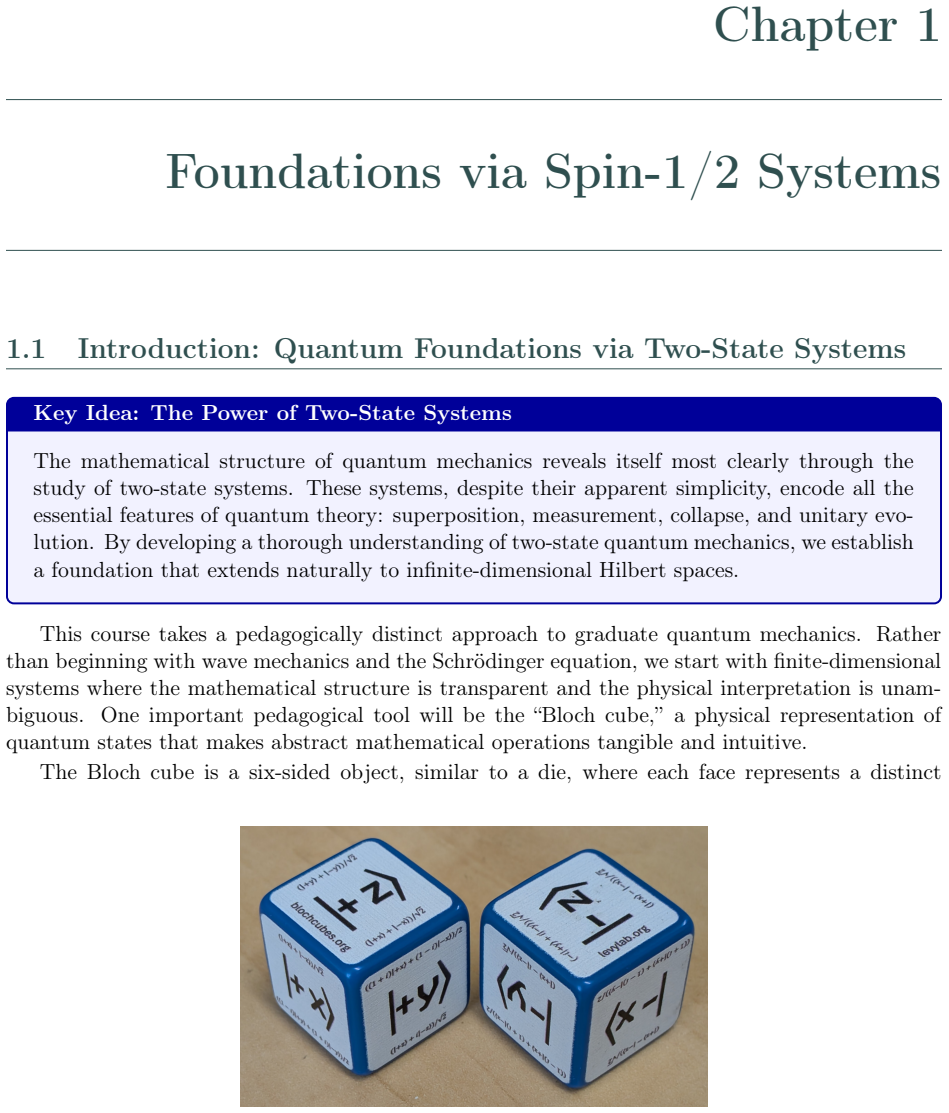
The textbook derives the standard apparatus of graduate quantum mechanics by beginning with a single qubit whose dynamics are confined to the six faces of a Bloch cube and then relaxing constraints one feature at a time. Tensor products introduce multiple qubits, lattices provide spatial structure, time evolution adds dynamics, the continuum limit yields wavefunctions, and further steps produce angular momentum, the hydrogen atom, perturbation theory, the Dirac equation via Lorentz invariance, and the renormalization group. The book concludes by returning to a constrained two-level system that is now a fault-tolerant logical qubit whose stability is guaranteed by an unstable RG fixed point.
What carries the argument
The process of controlled generalization by relaxing one constraint at a time from the initial qubit on a Bloch cube, allowing discrete-to-continuous transitions in dimension, space, time, and coupling to build up the full theory.
If this is right
- Tensor products of qubits while keeping single-qubit dynamics fixed lead to multi-particle quantum systems.
- Placing qubits on a lattice while keeping the Hilbert space discrete introduces real-space structure and lattice models.
- Taking the continuum limit in space and time produces continuous wavefunctions and the Schrödinger equation.
- Promoting the spinor lattice to Lorentz invariance yields the Dirac equation.
- Reimposing constraints via the renormalization group leads to quantum error correction and the fault-tolerance threshold as an unstable fixed point.
Where Pith is reading between the lines
- This sequential approach could be extended to derive other areas of physics like quantum field theory by further relaxations of constraints.
- The emphasis on RG fixed points for logical qubits suggests that hardware-independent quantum computation is a consequence of scaling behavior rather than a separate engineering problem.
- Similar relaxation methods might apply to teaching other subjects like classical mechanics or statistical mechanics by starting from minimal systems.
Load-bearing premise
All topics in standard graduate quantum mechanics can be derived without gaps or external additions solely by sequentially relaxing individual constraints from the initial qubit.
What would settle it
A demonstration that some essential graduate-level topic, such as time-dependent perturbation theory or identical particles, requires an independent assumption not obtainable from relaxing the qubit constraints.
Figures
read the original abstract
This textbook is drawn from notes for a two-semester graduate course in quantum mechanics. It begins with the most constrained quantum system, and recovers the rest of the subject by relaxing those constraints one at a time. The starting point is a single qubit, the smallest nontrivial Hilbert space with the strongest possible restriction on its dynamics, made concrete by a Bloch cube whose six faces are the cardinal states of a spin-1/2 system. Tensor products admit many qubits; lattices give them a place to live; time evolution sets them in motion; the continuum limit produces wavefunctions; three-dimensional angular momentum, the hydrogen atom, and perturbation theory follow; Lorentz invariance promotes the lattice of spinors to the Dirac equation; and the renormalization group asks how theories at different scales relate. Each chapter loosens one feature of the qubit while keeping the others fixed, so that the standard apparatus of graduate quantum mechanics arrives as a sequence of controlled generalizations rather than as separate topics. Discrete-to-continuous transitions recur at four scales: in Hilbert-space dimension, in real space, in time, and in coupling. The book closes by reimposing one of the original constraints, returning to a two-level system that is now a logical qubit protected by quantum error correction, with the fault-tolerance threshold appearing as an unstable RG fixed point and supplying the reason a logical qubit, independent of its underlying hardware, can exist at all.
Editorial analysis
A structured set of objections, weighed in public.
Referee Report
Summary. The manuscript is a two-semester graduate quantum mechanics textbook that starts from the most constrained system—a single qubit whose dynamics are restricted to the six cardinal states on a Bloch cube—and recovers the full subject by sequentially relaxing four constraints: Hilbert-space dimension (via tensor products), spatial discreteness (via lattices), time (via evolution operators), and coupling strength. This produces, in order, multi-qubit systems, continuum wavefunctions, three-dimensional angular momentum, the hydrogen atom, perturbation theory, the Dirac equation under Lorentz invariance, and the renormalization group; the text closes by re-imposing a two-level constraint to obtain logical qubits protected by quantum error correction, with the fault-tolerance threshold identified as an unstable RG fixed point.
Significance. If the claimed transitions are executed without external postulates, the book supplies a pedagogically coherent route through graduate QM in which discrete-to-continuous limits appear at four distinct scales rather than as isolated topics. The explicit linkage of the final error-correction chapter to an RG fixed point is a notable strength that connects foundational and modern material. The approach could reduce the perception of QM as a collection of unrelated formalisms and is therefore of interest to instructors seeking a unified narrative.
major comments (2)
- Abstract and overall structure: the central claim that 'the standard apparatus of graduate quantum mechanics arrives as a sequence of controlled generalizations' is load-bearing yet unsupported by any explicit mapping in the provided text showing that every core topic (identical particles, scattering, time-dependent perturbation theory beyond first order, etc.) emerges solely from relaxing one of the four listed constraints without additional assumptions.
- Chapter on continuum limit and wavefunctions: the transition from lattice spinors to the Schrödinger equation must be shown to preserve the inner-product structure and probability interpretation without inserting the usual position-basis postulates by hand; otherwise the 'controlled generalization' narrative breaks.
minor comments (2)
- Notation: the Bloch-cube description in the opening chapter should explicitly define the six cardinal states and their relation to the Pauli operators to avoid ambiguity for readers new to the qubit starting point.
- References: standard textbooks (e.g., Sakurai, Shankar) are cited for comparison, but the manuscript should add a short section contrasting its sequential-relaxation order with the conventional topic order to clarify the pedagogical novelty.
Simulated Author's Rebuttal
We thank the referee for the positive overall assessment and for identifying areas where the central narrative can be made more explicit. We address each major comment below and describe the revisions we will implement to strengthen the manuscript.
read point-by-point responses
-
Referee: Abstract and overall structure: the central claim that 'the standard apparatus of graduate quantum mechanics arrives as a sequence of controlled generalizations' is load-bearing yet unsupported by any explicit mapping in the provided text showing that every core topic (identical particles, scattering, time-dependent perturbation theory beyond first order, etc.) emerges solely from relaxing one of the four listed constraints without additional assumptions.
Authors: We acknowledge that while the text derives the listed core topics (multi-qubit systems, wavefunctions, angular momentum, the hydrogen atom, perturbation theory, the Dirac equation, and the renormalization group) directly from the four constraint relaxations, a consolidated mapping for every standard graduate topic is not presented in one location. In the revised version we will add a new appendix that provides an explicit mapping. Identical particles will be obtained from the tensor-product relaxation together with the requirement of overall antisymmetry under exchange; scattering will be recovered from the time-evolution operator on an extended lattice whose continuum limit yields asymptotic states; and higher-order time-dependent perturbation theory will follow from iterative application of the Dyson series generated by the same time-evolution operator. This appendix will demonstrate that these topics arise without external postulates beyond the four relaxations, thereby supporting the central claim. revision: yes
-
Referee: Chapter on continuum limit and wavefunctions: the transition from lattice spinors to the Schrödinger equation must be shown to preserve the inner-product structure and probability interpretation without inserting the usual position-basis postulates by hand; otherwise the 'controlled generalization' narrative breaks.
Authors: The manuscript already constructs the continuum limit by letting the lattice spacing approach zero while the discrete inner product remains the defining structure; the sum over lattice sites converges to the L2 integral and the norm is preserved at every finite spacing, ensuring unitarity and probability conservation. To eliminate any possible ambiguity, we will expand the relevant chapter with a self-contained derivation that explicitly tracks the inner-product limit and shows that the probability interpretation follows solely from the preservation of the norm under the relaxed spatial constraint, without introducing additional position-basis axioms. revision: yes
Circularity Check
No circularity: pedagogical reorganization of standard QM
full rationale
The manuscript is an expository graduate textbook that presents standard quantum mechanics topics by beginning with a single qubit (Bloch cube, spin-1/2 cardinal states) and sequentially relaxing four constraints (Hilbert-space dimension, real-space lattice, time evolution, coupling strength). No load-bearing derivations, equations, fitted parameters, or predictions are advanced whose validity depends on self-definition, self-citation chains, or renaming of known results. The structure is a controlled sequence of generalizations from the standard postulates; each step invokes conventional QM machinery rather than deriving it from the qubit inputs by construction. The closing discussion of quantum error correction and RG fixed points likewise re-applies textbook concepts without circular reduction. This is the expected non-finding for a purely pedagogical reorganization.
Axiom & Free-Parameter Ledger
axioms (1)
- standard math Standard quantum mechanics postulates: states in Hilbert space, observables as operators, unitary time evolution
Reference graph
Works this paper leans on
-
[1]
entropy always wins at any finiteT, destroying long-range order. The RG makes this manifest: at any finite temperature, coarse-graining eventually averages over domain walls, washing out correlations. Only atT= 0, where thermal fluctuations vanish, can order persist. This connects to our earlier discussion of finite vs. infinite systems: thermodynamic pha...
work page 1941
-
[2]
The empty subset (B=∅) contributes1; the full subset contributes(tanhK) 2NQ ⟨ij⟩ sisj
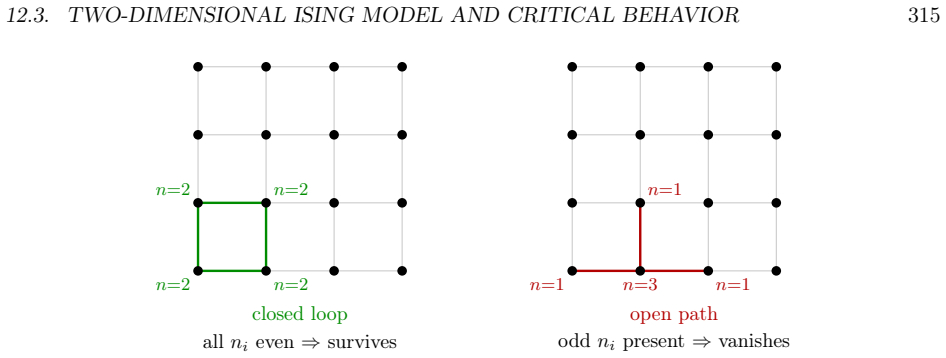
THE RENORMALIZATION GROUP where|B|is the number of bonds inBand the sum runs over all22N subsets of bonds. The empty subset (B=∅) contributes1; the full subset contributes(tanhK) 2NQ ⟨ij⟩ sisj. Every intermediate possibility appears exactly once. This is the same bookkeeping one uses to expand(1+a)(1+b)(1+ c) = 1 +a+b+c+ab+ac+bc+abc: each term is labeled ...
work page 1941
-
[3]
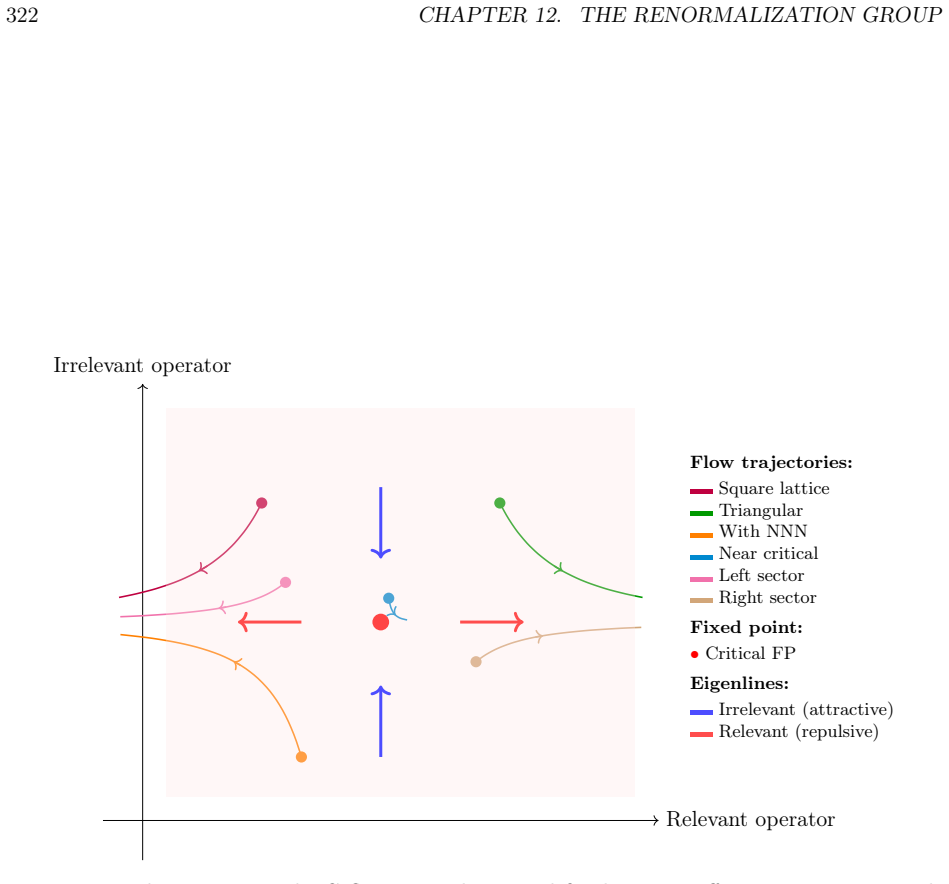
THE RENORMALIZATION GROUP Kadanoff (1966) cut through this difficulty with a physical argument rather than a calculation. Near a critical point the system is scale-invariant: fluctuations occur on every length scale simul- taneously and there is no characteristic microscopic scale. If we groupL×Lspins into blocks and assign each block a single block spin ...
work page 1966
-
[4]
(12.70) This last relation,2−α=dν, is thehyperscaling relation
THE RENORMALIZATION GROUP Therefore C(t, h)∼b 2yt−d C(b ytt, b yhh).(12.68) Seth= 0and chooseb=|t| −1/yt: C(t,0)∼ |t|−1/yt 2yt−d C(±1,0) =|t| −(2yt−d)/yt C(±1,0) =|t| d/yt−2 C(±1,0).(12.69) Comparing withC∼ |t| −α gives−α=d/y t −2, or α= 2− d yt = 2−dν. (12.70) This last relation,2−α=dν, is thehyperscaling relation. It connects the specific heat exponent ...
work page 1944
-
[5]
The QPT athc in the quantum model corresponds precisely to the thermal transition atT c in the classical model, and the two systems share the same universality class and the same RG fixed point. The full derivation parallels the single-qubit calculation above but with two basis labels per site (spatial position and time slice) and an additionalσzσz factor...
work page 1972
-
[6]
The renormalization group and theε-expansion
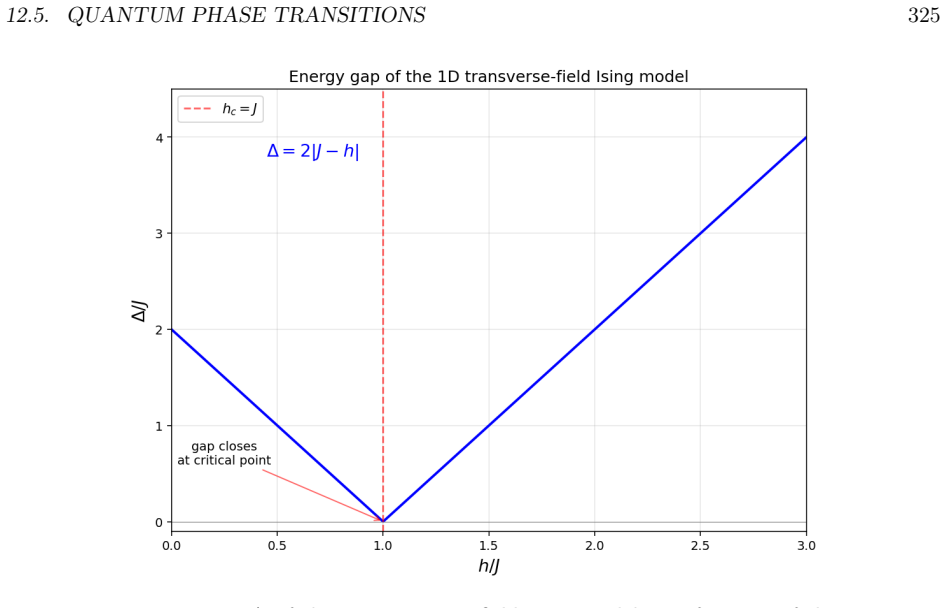
The defini- tive reference on quantum critical phenomena. Chapter 5 covers the transverse-field Ising model in detail, including the exact Jordan-Wigner solution used to obtain the gap shown in Figure 12.6. Wilson, K. G., and Kogut, J.“The renormalization group and theε-expansion.”Physics Re- ports12, 75–199 (1974). doi:10.1016/0370-1573(74)90023-4. The c...
discussion (0)
Sign in with ORCID, Apple, or X to comment. Anyone can read and Pith papers without signing in.