Limit Properties at Critical Indices of Linear Canonical Riesz Potentials and Their Applications to Security of Multi-Image Encryption
Pith reviewed 2026-05-10 16:32 UTC · model grok-4.3
The pith
Linear canonical Riesz potentials converge for grating functions where classical ones diverge and match polygon indicators away from boundaries, enabling secure multi-image encryption.
A machine-rendered reading of the paper's core claim, the machinery that carries it, and where it could break.
Core claim
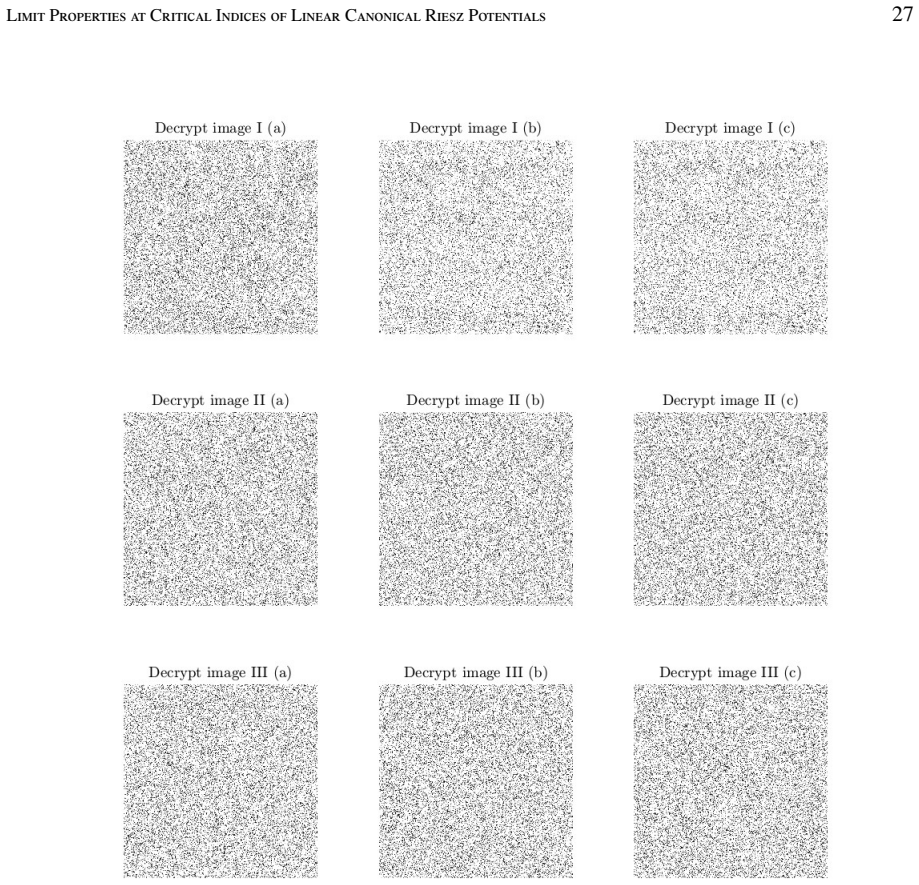
We introduce the linear canonical Riesz potential and give its symbol in terms of linear canonical transforms. For grating functions, classical Riesz potentials diverge while LCRPs converge due to chirp functions. For the characteristic function of a convex polygon, the limit at non-boundary points equals the function, but differs at boundaries, contrasting with Schwartz functions where limits always match. Based on these and the inverse linear canonical Laplacian, we propose an asymmetric cascaded LCRP method for multi-image encryption whose security evaluations show robustness, and which is more efficient than fractional Riesz potential approaches.
What carries the argument
The linear canonical Riesz potential, whose convergence at critical indices for grating and polygon indicator functions, combined with the linear canonical Laplacian as its inverse, carries the argument for the encryption application.
Load-bearing premise
The inverse of the LCRP is precisely the linear canonical Laplacian operator and that the observed convergence properties suffice to guarantee cryptographic security in the proposed system.
What would settle it
Finding a grating function where the LCRP diverges at the critical index, or an attack that breaks the encryption scheme despite the convergence properties, would falsify the central claims.
Figures




read the original abstract
In this article we introduce the linear canonical Riesz potential (for short, LCRP) and give its symbol in terms of linear canonical transforms. Driven by image processing, we establish the convergence/divergence of these LCRPs for different kinds of functions. Concretely, for grating functions, we prove that their classical Riesz potentials diverge, whereas their LCRP converge due to the key role of chirp functions. For the characteristic function ${\mathbf 1}_P$ of a convex polygon $P$, we show that the limit of its Riesz potential at any non-boundary point $\boldsymbol{x}$ equals ${\mathbf 1}_P(\boldsymbol{x})$, but its limit at the boundaries differ from ${\mathbf 1}_P$, while it is known that, for any Schwartz function $f$, the limit of its Riesz potential at any point $\boldsymbol{x}$ always equals $f(\boldsymbol{x})$. Based on these and the inverse operator of the LCRP (namely the linear canonical Laplacian operator), we propose an asymmetric cascaded LCRP method for the multi-image encryption and create an efficient and secure cryptosystem. Systematic security evaluations, including sensitivity, statistical, noise attack, and occlusion attack analyses, demonstrate its robustness and its security. Even for a single image, the proposed method is more efficient than the known encryption approach based on the fractional Riesz potential. The novelty of these results lies in that the convergence and the divergence of LCRTs at the critical indices, respectively, for ``good" Schwartz functions and for ``bad" discrete image functions essentially affect the security of image encryption and decryption.
Editorial analysis
A structured set of objections, weighed in public.
Referee Report
Summary. The manuscript introduces the linear canonical Riesz potential (LCRP) and its symbol in terms of linear canonical transforms. It establishes that classical Riesz potentials diverge on grating functions while LCRPs converge due to chirp functions, and that the limit of the Riesz potential of the characteristic function 1_P of a convex polygon recovers 1_P(x) at non-boundary points but differs at boundaries (contrasting with Schwartz functions where the limit always equals f(x)). Using these limit properties at critical indices together with the claim that the inverse of the LCRP is the linear canonical Laplacian, the authors construct an asymmetric cascaded LCRP scheme for multi-image encryption and report empirical security results from key sensitivity, statistical, noise, and occlusion tests, asserting that the analytic convergence/divergence behaviors essentially affect encryption security and that the method is more efficient than prior fractional Riesz potential approaches.
Significance. If the translation from the proven limit properties to cryptographic security can be made rigorous, the work would supply a novel analytic foundation for image encryption that exploits specific divergence at boundaries and chirp-induced convergence, potentially yielding efficiency gains and robustness. The introduction of the LCRP operator and its explicit symbol also contributes to the theory of linear canonical transforms and potential operators, with possible extensions to image processing.
major comments (2)
- Abstract and security evaluations: The central claim that 'the convergence and the divergence of LCRTs at the critical indices, respectively, for 'good' Schwartz functions and for 'bad' discrete image functions essentially affect the security' is load-bearing for the application but unsupported by a formal argument. The security analysis consists solely of standard empirical tests (key sensitivity, histogram, correlation, noise, occlusion) without a security game, reduction showing that the cited limit discrepancies (boundary mismatch for 1_P or chirp convergence for gratings) prevent plaintext/key recovery, or analysis of how these properties survive discretization to pixel arrays. This gap prevents verification that the analytic results confer the claimed security advantage.
- Inverse operator and decryption: The construction of the cascaded encryption scheme relies on the statement that the inverse of the LCRP is exactly the linear canonical Laplacian operator. The manuscript should provide or cite an explicit derivation of this inversion, including verification that it holds at the critical indices where the convergence/divergence results are established, as any mismatch would undermine the decryption step.
Simulated Author's Rebuttal
We thank the referee for the thorough review and constructive suggestions. We address each major comment below with clarifications and proposed revisions to strengthen the manuscript.
read point-by-point responses
-
Referee: Abstract and security evaluations: The central claim that 'the convergence and the divergence of LCRTs at the critical indices, respectively, for 'good' Schwartz functions and for 'bad' discrete image functions essentially affect the security' is load-bearing for the application but unsupported by a formal argument. The security analysis consists solely of standard empirical tests (key sensitivity, histogram, correlation, noise, occlusion) without a security game, reduction showing that the cited limit discrepancies (boundary mismatch for 1_P or chirp convergence for gratings) prevent plaintext/key recovery, or analysis of how these properties survive discretization to pixel arrays. This gap prevents verification that the analytic results confer the claimed security advantage.
Authors: We acknowledge that the manuscript relies on empirical security evaluations rather than a formal cryptographic reduction or game-based proof linking the limit properties directly to attack resistance. The analytic results on convergence for grating functions (via chirps) and boundary behavior for polygon indicators are presented as the motivation for selecting LCRP over classical Riesz potentials, ensuring the operator is well-defined on the discrete image data used in encryption. The empirical tests (key sensitivity, statistical, noise, and occlusion) then validate practical robustness, with efficiency gains over fractional Riesz methods also shown. We agree a more explicit discussion of how the properties survive pixel discretization would help. In revision we will add a dedicated paragraph in the introduction and security section clarifying the role of the limit properties in guaranteeing decryption invertibility for image-like functions, while noting that security claims remain empirically supported rather than formally reduced. revision: partial
-
Referee: Inverse operator and decryption: The construction of the cascaded encryption scheme relies on the statement that the inverse of the LCRP is exactly the linear canonical Laplacian operator. The manuscript should provide or cite an explicit derivation of this inversion, including verification that it holds at the critical indices where the convergence/divergence results are established, as any mismatch would undermine the decryption step.
Authors: The inverse relation is asserted based on the symbol of the LCRP in the linear canonical transform domain, where the multiplier is the reciprocal of that for the linear canonical Laplacian. We will insert an explicit derivation (including the symbol computation and inversion formula) into the section defining the LCRP operator. This derivation will be checked to hold at the specific critical indices used in the grating and polygon limit theorems, confirming that decryption recovers the plaintext without mismatch at those values. revision: yes
Circularity Check
No circularity in derivation chain
full rationale
The paper first proves convergence/divergence properties of LCRPs for grating functions (via chirp modulation) and for the indicator 1_P of convex polygons (limit equals 1_P away from boundaries) by direct comparison to classical Riesz potentials and Schwartz functions. It then invokes the inverse operator (linear canonical Laplacian) to define the encryption scheme and reports standard empirical security tests. No quoted step reduces by construction to its own inputs, no fitted parameter is relabeled as prediction, and no load-bearing self-citation or ansatz smuggling appears; the analytic results and cryptographic evaluations remain independent of each other.
Axiom & Free-Parameter Ledger
axioms (2)
- domain assumption The linear canonical transform is invertible and its symbol defines a valid potential operator
- domain assumption Convergence at critical indices for grating and polygon functions follows from the chirp modulation
invented entities (1)
-
Linear canonical Riesz potential (LCRP)
no independent evidence
Reference graph
Works this paper leans on
-
[1]
S. A. Abbas, Q. Sun and H. Foroosh, An exact and fast computation of discrete Fourier transform for polar and spherical grid, IEEE Trans. Signal Process. 65 (2017), 2033–2048
work page 2017
-
[2]
M. J. Bastiaans, The Wigner distribution function applied to optical signals and systems, Opt. Commun. 25 (1978), 26–30
work page 1978
-
[3]
L. M. Bernardo, ABCD matrix formalism of fractional Fourier optics, Opt. Eng. 35 (1996), 732– 740
work page 1996
-
[4]
N. Bi, Q. Sun, D. Huang, Z. Yang and J. Huang, Robust image watermarking based on multiband wavelets and empirical mode decomposition, IEEE Trans. Image Process. 16 (2007), 1956–1966
work page 2007
-
[5]
Boashash, Estimating and interpreting the instantaneous frequency of a signal
B. Boashash, Estimating and interpreting the instantaneous frequency of a signal. I. Fundamentals, Proc. IEEE 80 (1992), 520–538
work page 1992
-
[6]
H. Chen, X. Du, Z. Liu and C. Yang, Optical color image hiding scheme by using Gerchberg-Saxton algorithm in fractional Fourier domain, Opt. Lasers Eng. 66 (2015), 144–151
work page 2015
-
[7]
W. Chen, Z. Fu, L. Grafakos and Y . Wu, Fractional Fourier transforms onL p and applications, Appl. Comput. Harmon. Anal. 55 (2021), 71–96
work page 2021
-
[8]
Y . Chen, C. Cheng and Q. Sun, Graph Fourier transform based on singular value decomposition of the directed Laplacian, Sampl. Theory Signal Process. Data Anal. 21 (2023), Paper No. 24, 28 pp. LimitProperties atCriticalIndices ofLinearCanonicalRieszPotentials37
work page 2023
- [9]
-
[10]
C. K. Chui, Q. Jiang, L. Li and J. Lu, Analysis of a direct separation method based on adaptive chirplet transform for signals with crossover instantaneous frequencies, Appl. Comput. Harmon. Anal. 62 (2023), 24–40
work page 2023
-
[11]
C. K. Chui, Q. Jiang, L. Li and J. Lu, Time-scale-chirp rate operator for recovery of non-stationary signal components with crossover instantaneous frequency curves, Appl. Comput. Harmon. Anal. 54 (2021), 323–344
work page 2021
-
[12]
C. K. Chui, Q. Jiang, L. Li and J. Lu, Analysis of an adaptive short-time Fourier transform-based multicomponent signal separation method derived from linear chirp local approximation, J. Com- put. Appl. Math. 396 (2021), Paper No. 113607, 19 pp
work page 2021
-
[13]
N. C. Dias, M. de Gosson and J. N. Prata, A metaplectic perspective of uncertainty principles in the linear canonical transform domain, J. Funct. Anal. 287 (2024), Paper No. 110494, 54 pp
work page 2024
-
[14]
J. J. Ding and S. C. Pei, 2-D affine generalized fractional Fourier transform, in: Proceedings of 1999 IEEE International Conference on Acoustics, Speech, and Signal Processing, 1999, pp. 3181–3184, IEEE
work page 1999
-
[15]
L. C. Evans, Partial Differential Equations, Grad. Texts in Math. 19, American Mathematical Soci- ety, Providence, 2010
work page 2010
-
[16]
Z. Fu, L. Grafakos, Y . Lin, Y . Wu and S. Yang, Riesz transform associated with the fractional Fourier transform and applications in image edge detection, Appl. Comput. Harmon. Anal. 66 (2023), 211–235
work page 2023
-
[17]
Z. Fu, Y . Lin, D. Yang and S. Yang, Fractional Fourier transforms meet Riesz potentials and image processing, SIAM J. Imaging Sci.17 (2024), 476–500
work page 2024
-
[18]
Gabor, Theory of communication
D. Gabor, Theory of communication. Part 1: The analysis of information, J. Inst. Elec. Engrs. Part III 93 (1946), 429–441
work page 1946
-
[19]
H. Ge, W. Chen and M. K. Ng, New restricted isometry property analysis forℓ 1 −ℓ 2 minimization methods, SIAM J. Imaging Sci. 14 (2021), 530–557
work page 2021
-
[20]
H. Ge, W. Chen and M. K. Ng, On recovery of sparse signals with prior support information via weightedℓ p-minimization, IEEE Trans. Inform. Theory 67 (2021), 7579–7595
work page 2021
-
[21]
I. S. Gradshteyn and I. M. Ryzhik, Table of Integrals, Series, and Products, Academic Press, San Diego, 2014
work page 2014
-
[22]
Grafakos, Classical Fourier Analysis, Grad
L. Grafakos, Classical Fourier Analysis, Grad. Texts in Math. 249, Springer, New York, 2014
work page 2014
-
[23]
Grafakos, Fundamentals of Fourier analysis, Grad
L. Grafakos, Fundamentals of Fourier analysis, Grad. Texts in Math. 302, Springer, Cham, 2024
work page 2024
- [24]
- [25]
-
[26]
J. J. Healy, M. A. Kutay, H. M. Ozaktas and J. T. Sheridan, Linear canonical transforms, theory and applications, Springer, New York, 2015
work page 2015
-
[27]
J. Hua, L. Liu and G. Li, Extended fractional Fourier transforms, J. Opt. Soc. Amer. A 14 (1997), 3316–3322
work page 1997
-
[28]
L. Huo, W. Chen and H. Ge, Image restoration based on transformed total variation and deep image prior, Appl. Math. Model. 130 (2024), 191–207
work page 2024
-
[29]
D. F. V . James and G. S. Agarwal, The generalized Fresnel transform and its application to optics, Opt. Commun. 126 (1996), 207–212
work page 1996
-
[30]
G. J. O. Jameson, Evaluating Fresnel-type integrals, Math. Gaz. 99 (2015), 491–498
work page 2015
-
[31]
Q. Jiang, S. Li, J. Chen and L. Li, Synchrosqueezed X-ray wavelet-chirplet transform for accurate chirp rate estimation and retrieval of modes from multicomponent signals with crossover instanta- neous frequencies, Mech. Syst. Signal Proc. 238 (2025), Paper No. 113193, 23 pp. 38ZunweiFu, DachunYang andShuhuiYang
work page 2025
-
[32]
T. Sh. Kalmenov and D. Suragan, A boundary condition and spectral problems for the Newton potential, in: Modern Aspects of the Theory of Partial Differential Equations, pp. 187–210, Oper. Theory Adv. Appl. 216, Birkh¨auser/Springer, Basel, 2011
work page 2011
-
[33]
R. Kamalakkannan, R. Roopkumar and A. Zayed, Short time coupled fractional Fourier transform and the uncertainty principle, Fract. Calc. Appl. Anal. 24 (2021), 667–688
work page 2021
-
[34]
R. Kamalakkannan, R. Roopkumar and A. Zayed, On the extension of the coupled fractional Fourier transform and its properties, Integral Transforms Spec. Funct. 33 (2022), 65–80
work page 2022
-
[35]
R. Kamalakkannan, R. Roopkumar and A. Zayed, Quaternionic coupled fractional Fourier trans- form on Boehmians, in: Sampling, Approximation, and Signal Analysis–Harmonic Analysis in the spirit of J. Rowland Higgins, pp. 453–468, Appl. Numer. Harmon. Anal., Birkh¨auser/Springer, Cham, 2023
work page 2023
-
[36]
A. Koc, H. M. Ozaktas, C. Candan and M. A. Kutay, Digital computation of linear canonical transforms, IEEE Trans. Signal Process. 56 (2008), 2383–2394
work page 2008
-
[37]
D. Kong, X. Shen, Q. Xu, W. Xin and H. Guo, Multiple-image encryption scheme based on cas- caded fractional Fourier transform, Appl. Opt. 52 (2013), 2619–2625
work page 2013
-
[38]
L. Li, C. K. Chui and Q. Jiang, Direct signal separation via extraction of local frequencies with adaptive time-varying parameters, IEEE Trans. Signal Process. 70 (2022), 2321–2333
work page 2022
- [39]
-
[40]
S. Li, J. Chen, Q. Jiang and J. Lu, Synchrosqueezed windowed linear canonical transform: A method for mode retrieval from multicomponent signals with crossing instantaneous frequencies, Signal Process. 241 (2026), Paper No. 110384, 16 pp
work page 2026
-
[41]
Y . Li, F. Zhang, Y . Li and R. Tao, Asymmetric multiple-image encryption based on the cascaded fractional Fourier transform, Opt. Lasers Eng. 72 (2015), 18–25
work page 2015
- [42]
-
[43]
Z. Liu, C. Guo, J. Tan, W. Liu, J. Wu, Q. Wu, L. Pan and S. Liu, Securing color image by using phase-only encoding in Fresnel domains, Opt. Lasers Eng. 68 (2015), 87–92
work page 2015
- [44]
-
[45]
D. Mendlovic, R. G. Dorsch, A. W. Lohmann, Z. Zalevsky and C. Ferreira, Optical illustration of a varied fractional Fourier-transform order and the Radon–Wigner display, Appl. Opt. 35 (1996), 3925–3929
work page 1996
-
[46]
Namias, The fractional order Fourier transform and its application to quantum mechanics, IMA J
V . Namias, The fractional order Fourier transform and its application to quantum mechanics, IMA J. Appl. Math. 25 (1980), 241–265
work page 1980
-
[47]
S. C. Pei and J. J. Ding, Closed-form discrete fractional and affine Fourier transforms, IEEE Trans. Signal Process. 48 (2000), 1338–1353
work page 2000
-
[48]
S. C. Pei and J. J. Ding, Eigenfunctions of linear canonical transform, IEEE Trans. Signal Process. 50 (2002), 11–26
work page 2002
-
[49]
X. Peng, H. Wei and P. Zhang, Chosen-plaintext attack on lensless double-random phase encoding in the Fresnel domain, Opt. Lett. 31 (2006), 3261–3263
work page 2006
-
[50]
X. Peng, P. Zhang, H. Wei and B. Yu, Known-plaintext attack on optical encryption based on double random phase keys, Opt. Lett. 31 (2006), 1044–1046
work page 2006
- [51]
- [52]
-
[53]
P. Refregier and B. Javidi, Optical image encryption based on input plane and Fourier plane random encoding, Opt. Lett. 20 (1995), 767–769
work page 1995
-
[54]
Riesz, L’int ´egrale de Riemann–Liouville et le probl `eme de Cauchy, Acta Math
M. Riesz, L’int ´egrale de Riemann–Liouville et le probl `eme de Cauchy, Acta Math. 81 (1949), 1– 223. LimitProperties atCriticalIndices ofLinearCanonicalRieszPotentials39
work page 1949
- [55]
-
[56]
L. Shen and Q. Sun, Biorthogonal wavelet system for high-resolution image reconstruction, IEEE Trans. Signal Process. 52 (2004), 1997–2011
work page 2004
-
[57]
L. Sui, H. Lu, Z. Wang and Q. Sun, Double-image encryption using discrete fractional random transform and logistic maps, Opt. Lasers Eng. 56 (2014), 1–12
work page 2014
-
[58]
L. Sui, K. Duan, J. Liang and X. Hei, Asymmetric double-image encryption based on cascaded discrete fractional random transform and logistic maps, Opt. Express 22 (2014), 10605–10621
work page 2014
-
[59]
E. M. Stein, Singular Integrals and Differentiability Properties of Functions, Princeton Mathemati- cal Series, 30, Princeton University Press, Princeton, N.J., 1970
work page 1970
-
[60]
E. M. Stein, Harmonic Analysis: Real-Variable Methods, Orthogonality, and Oscillatory Integrals, Princeton Mathematical Series 43, Princeton University Press, Princeton, N.J., 1970
work page 1970
-
[61]
R. Tao, Y . Li and Y . Wang, Short-time fractional Fourier transform and its applications, IEEE Trans. Signal Process. 58 (2010), 2568–2580
work page 2010
-
[62]
X. Wang and D. Zhao, Double images encryption method with resistance against the specific attack based on an asymmetric algorithm, Opt. Express 20 (2012), 11994–12003
work page 2012
-
[63]
G. Xu, X. Wang and X. Xu, Generalized Hilbert transform and its properties in 2D LCT domain, Signal Process. 89 (2009), 1395–1402
work page 2009
-
[64]
S. Yang, Z. Fu, D. Yang, Y . Lin and Z. Li, Refining image edge detection via linear canonical Riesz transforms, SIAM J. Imaging Sci. 19 (2026), 410–445
work page 2026
-
[65]
Zayed, Hilbert transform associated with the fractional Fourier transform, IEEE Signal Process
A. Zayed, Hilbert transform associated with the fractional Fourier transform, IEEE Signal Process. Lett. 5 (1998), 206–208
work page 1998
-
[66]
A. Zayed, Two-dimensional fractional Fourier transform and some of its properties, Integral Trans- forms Spec. Funct. 29 (2018), 553–570
work page 2018
-
[67]
A. Zayed, A new perspective on the two-dimensional fractional Fourier transform and its relation with the Wigner distribution, J. Fourier Anal. Appl. 25 (2019), 460–487
work page 2019
-
[68]
Zayed, Fractional Integral Transforms: Theory and Applications, CRC Press, Abingdon, 2024
A. Zayed, Fractional Integral Transforms: Theory and Applications, CRC Press, Abingdon, 2024
work page 2024
-
[69]
Y . Zhang and B. Li,ϕ-linear canonical analytic signals, Signal Process. 143 (2018), 181–190
work page 2018
-
[70]
Y . Zhou, Generalizations of the fractional Fourier transform and their analytic properties, arXiv: 2409.11201. Zunwei Fu School of Mathematics and Statistics, Linyi University, Linyi 276000, The People’s Republic of China; College of Information Technology, The University of Suwon, Hwaseong-si 18323, South Korea E-mail:zwfu@suwon.ac.kr Dachun Yang (Corre...
discussion (0)
Sign in with ORCID, Apple, or X to comment. Anyone can read and Pith papers without signing in.