Statistics of Marginal Wavefunctions as a Real-Space Diagnostic of Quantum Entanglement
Pith reviewed 2026-05-10 16:19 UTC · model grok-4.3
The pith
An ensemble of one-body marginal wavefunctions yields the Schmidt spectrum via its Gram matrix, enabling real-space maps of entanglement entropy without the full many-body state.
A machine-rendered reading of the paper's core claim, the machinery that carries it, and where it could break.
Core claim
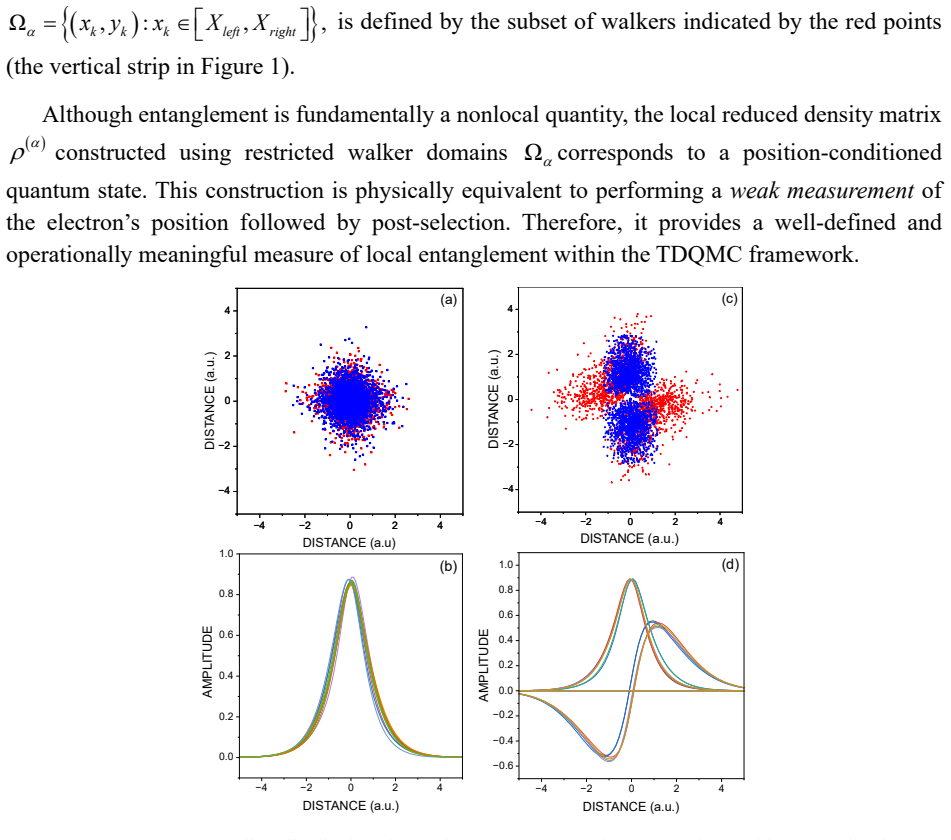
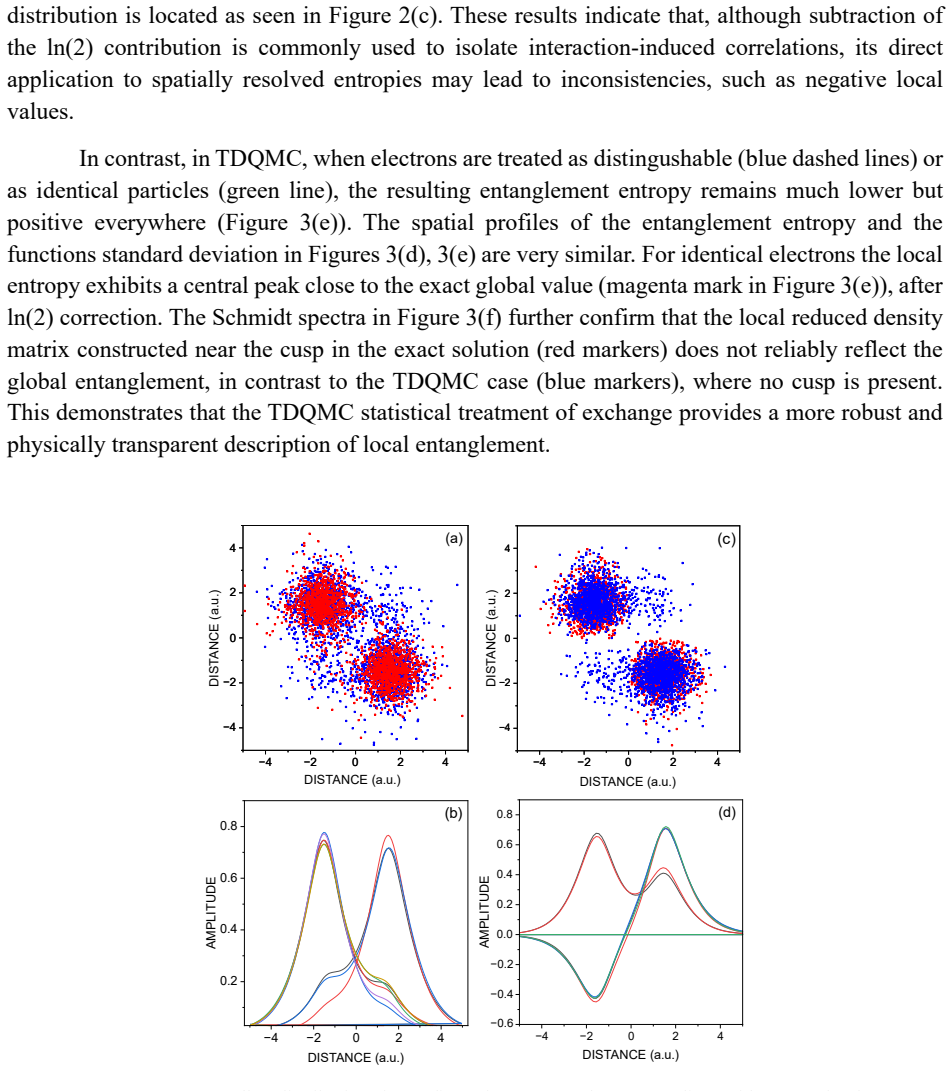
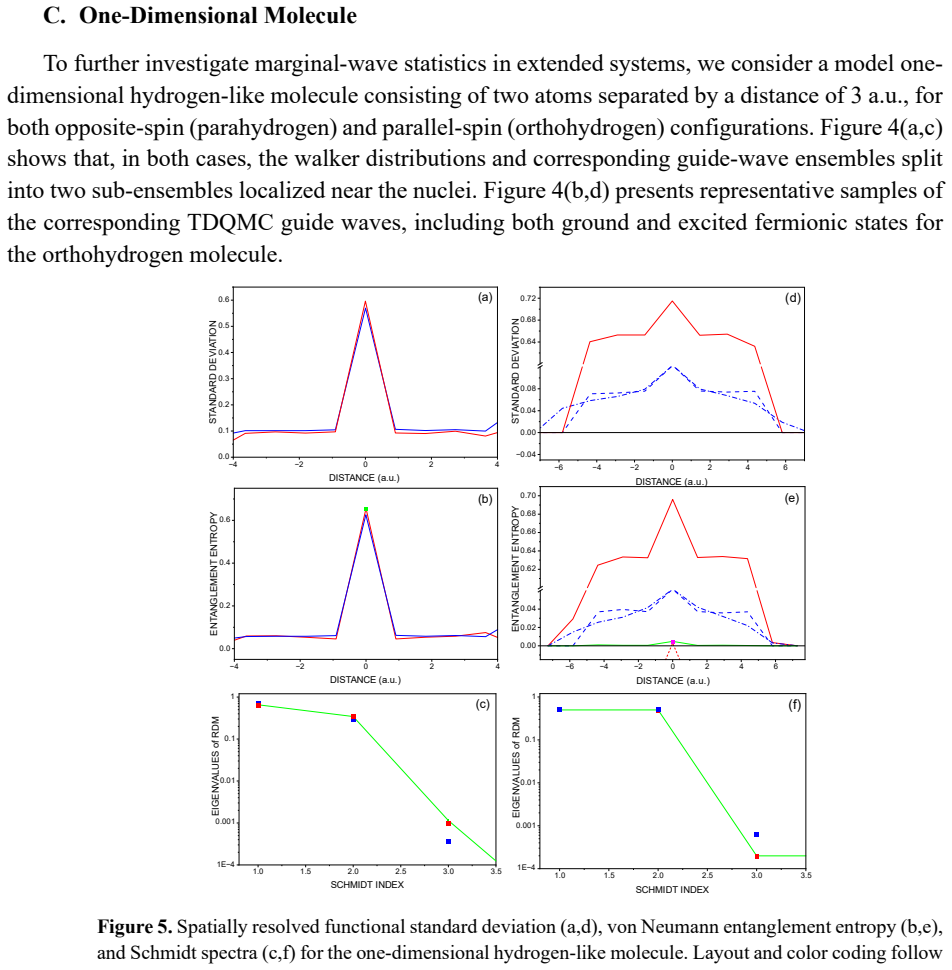
Treating the guide waves as a statistical mixture in Hilbert space, we show that the Gram matrix acts as a covariance operator whose spectrum coincides with the Schmidt spectrum. The associated functional standard deviation closely tracks the von Neumann entanglement entropy both globally and locally via walker partitioning, providing a physically transparent real-space diagnostic of quantum correlations without requiring construction of the full many-body wavefunction.
What carries the argument
The Gram matrix formed by the inner products of the marginal wavefunctions, which serves as the covariance operator that extracts the Schmidt spectrum from the ensemble.
Load-bearing premise
The guide waves produced by the TDQMC method can be treated as a statistical mixture in Hilbert space such that the spectrum of their Gram matrix exactly equals the Schmidt spectrum of the underlying many-body state.
What would settle it
In a solvable two-electron system, compute the eigenvalues of the Gram matrix from an independent TDQMC ensemble and compare them directly to the Schmidt coefficients obtained from the exact full wavefunction; systematic disagreement beyond sampling noise would falsify the claimed coincidence.
Figures
read the original abstract
We present a statistical framework for extracting spatially resolved entanglement directly from an ensemble of marginal (one-body) wavefunctions in Time-Dependent Quantum Monte Carlo (TDQMC). Treating the guide waves as a statistical mixture in Hilbert space, we show that the Gram matrix acts as a covariance operator whose spectrum coincides with the Schmidt spectrum. The associated functional standard deviation closely tracks the von Neumann entanglement entropy both globally and locally via walker partitioning, providing a physically transparent real-space diagnostic of quantum correlations without requiring construction of the full many-body wavefunction. Applications to one-dimensional two-electron bosonic and fermionic systems (helium atom and hydrogen-like molecule) demonstrate excellent agreement with strict conditional-wave results for opposite-spin electrons. For same-spin fermions, TDQMC statistical treatment of exchange symmetry yields positive, physically consistent local entropies. The method establishes a direct bridge between classical ensemble statistics and quantum entanglement measures, offering a computationally efficient real-space diagnostic tool for mapping the spatial distribution of correlations.
Editorial analysis
A structured set of objections, weighed in public.
Referee Report
Summary. The manuscript proposes a statistical framework for real-space entanglement diagnostics based on ensembles of marginal (one-body) guide waves generated by Time-Dependent Quantum Monte Carlo (TDQMC). Treating these guide waves as a statistical mixture in Hilbert space, the authors claim that the associated Gram matrix functions as a covariance operator whose eigenvalue spectrum exactly coincides with the Schmidt spectrum of the full many-body state; a functional standard deviation derived from this spectrum is shown to track the von Neumann entanglement entropy both globally and locally (via walker partitioning). Numerical applications to one-dimensional bosonic and fermionic two-electron systems (helium atom and H2-like molecule) are reported to yield excellent agreement with strict conditional-wave results for opposite-spin electrons and physically consistent positive local entropies for same-spin fermions.
Significance. If the central equivalence between the Gram-matrix spectrum and the Schmidt spectrum can be established rigorously and independently of TDQMC sampling details, the approach would supply a computationally lightweight, spatially resolved diagnostic that avoids explicit construction of the full many-body wavefunction. This could be particularly useful for scaling entanglement studies to larger systems. The reported numerical agreement on simple 1D models provides initial practical support, but the method's value ultimately hinges on whether the claimed coincidence is non-tautological and robust under finite-walker and symmetry constraints.
major comments (2)
- [Central derivation (likely §3)] The assertion that the Gram-matrix spectrum 'coincides with the Schmidt spectrum' (abstract and central derivation) is load-bearing for all subsequent claims about entropy tracking. The manuscript must supply an explicit, non-circular derivation showing that the walker-generated overlaps reproduce the exact reduced-density eigenvalues independently of the specific TDQMC propagation rules, finite-walker truncation, and exchange-symmetry projection; without this, the equivalence risks being an artifact of the chosen statistical-mixture representation.
- [Numerical applications and validation] The abstract reports 'excellent agreement' with conditional-wave results for both global and local entropies, yet supplies no error bars, quantitative discrepancy metrics, convergence tests with walker number, or data tables. This omission prevents assessment of whether the local walker-partitioning procedure remains accurate when the underlying TDQMC ensemble deviates from the exact reduced density matrix.
minor comments (2)
- [Method section] Define the functional standard deviation explicitly (including its relation to the Gram-matrix eigenvalues) and state the precise partitioning algorithm used for local entropy; this will aid reproducibility.
- [Fermionic applications] Clarify how exchange symmetry is enforced in the TDQMC ensemble for same-spin fermions and whether any residual sign problem or projection bias affects the positivity of the reported local entropies.
Simulated Author's Rebuttal
We thank the referee for their careful and constructive review. The comments identify important areas where the manuscript can be strengthened in rigor and presentation. We address each major comment below and outline the revisions we will make.
read point-by-point responses
-
Referee: [Central derivation (likely §3)] The assertion that the Gram-matrix spectrum 'coincides with the Schmidt spectrum' (abstract and central derivation) is load-bearing for all subsequent claims about entropy tracking. The manuscript must supply an explicit, non-circular derivation showing that the walker-generated overlaps reproduce the exact reduced-density eigenvalues independently of the specific TDQMC propagation rules, finite-walker truncation, and exchange-symmetry projection; without this, the equivalence risks being an artifact of the chosen statistical-mixture representation.
Authors: We agree that an explicit, standalone derivation is essential to establish the result rigorously. The equivalence follows from the fact that the Gram matrix constructed from any ensemble of marginal wavefunctions whose statistical weights reproduce the one-body reduced density matrix is, by definition, the covariance operator whose eigenvalues are the Schmidt coefficients of the full state. This holds for any complete ensemble and is independent of the underlying dynamics (TDQMC or otherwise) used to generate the marginals. The TDQMC rules enter only in producing a representative ensemble. Nevertheless, we acknowledge that the current presentation could be read as relying on the specific statistical-mixture representation without sufficient separation. In the revision we will add a dedicated appendix containing a self-contained proof of the spectrum coincidence in the infinite-walker limit, together with an analysis of finite-walker truncation errors and the effect of exchange-symmetry projections. This will make the non-tautological character of the result fully transparent. revision: yes
-
Referee: [Numerical applications and validation] The abstract reports 'excellent agreement' with conditional-wave results for both global and local entropies, yet supplies no error bars, quantitative discrepancy metrics, convergence tests with walker number, or data tables. This omission prevents assessment of whether the local walker-partitioning procedure remains accurate when the underlying TDQMC ensemble deviates from the exact reduced density matrix.
Authors: We concur that quantitative validation metrics are required for a convincing assessment. The current manuscript relies on visual comparison of curves without accompanying error estimates or convergence data. In the revised version we will add: (i) error bars derived from multiple independent TDQMC realizations, (ii) tables of relative discrepancies between the functional standard deviation and the von Neumann entropy for both global and local quantities, and (iii) explicit convergence plots versus walker number for the helium and H2-like systems. These additions will allow readers to judge the accuracy of the walker-partitioning procedure under finite sampling. revision: yes
Circularity Check
No circularity: Gram-matrix spectrum equivalence derived from statistical-mixture treatment of TDQMC guide waves
full rationale
The paper presents an explicit statistical framework in which an ensemble of marginal guide waves is treated as a mixture in Hilbert space; the Gram matrix is then constructed directly from their inner products and shown to function as the covariance operator whose eigenvalues match the Schmidt coefficients of the reduced density matrix. This equivalence follows from the definition of the mixture and the properties of the one-body marginals within the TDQMC representation, rather than from any redefinition of the target quantity or from a fitted parameter. Numerical demonstrations on 1D helium and H2 systems are reported as independent verification against conditional-wave results, and no load-bearing step reduces to a self-citation chain or to an ansatz smuggled from prior work. The derivation therefore remains self-contained against the paper's own inputs.
Axiom & Free-Parameter Ledger
axioms (1)
- domain assumption Guide waves in TDQMC can be treated as a statistical mixture in Hilbert space whose Gram matrix acts as a covariance operator
Reference graph
Works this paper leans on
-
[1]
Blitzstein, J. K.; Hwang, J. Introduction to Probability; Taylor & Francis: London, 2019
work page 2019
-
[2]
Hsing, T.; Eubank, R. Theoretical Foundations of Functional Data Analysis, with an Introduction to Linear Operators; John Wiley & Sons: Hoboken, 2015
work page 2015
-
[3]
Dauxious, J.; Pousse, A.; Romain, Y . Asymptotic theory for the principal component analysis of a vector random function: some applications to statistical inference. J. Multivariate Anal. 1982, 12, 136–154
work page 1982
-
[4]
Gonzalez, R. C.; Woods, R. E. Digital Image Processing, 2nd ed.; Prentice-Hall: New Jersey, 2002
work page 2002
-
[5]
Cressie, N. A. C. Statistics for Spatial Data; Wiley-Interscience: New York, 1993
work page 1993
-
[6]
Chun, Y .; Griffith, D. A. Spatial Statistics and Geostatistics; SAGE Publications: Los Angeles, 2013
work page 2013
-
[7]
Getis, A.; Ord, J. K. The analysis of spatial association by use of distance statistics. Geogr. Anal. 1992, 24, 189–206
work page 1992
-
[8]
Fischer, M. M.; Getis, A. Handbook of Applied Spatial Analysis: Software Tools, Methods and Applications; Springer, 2010
work page 2010
-
[9]
O’Sullivan, D.; Unwin, D. J. Geographic Information Analysis; Wiley: Hoboken, NJ, 2003
work page 2003
-
[10]
Chen, Y .; Vidal, G. Entanglement contour. J. Stat. Mech.: Theory Exp. 2014, P10011
work page 2014
-
[11]
Lin, H.-C.; Fisher, A. J. Configuration-space location of the entanglement between two subsystems. Phys. Rev. A 2007, 75, 032330
work page 2007
-
[12]
Christov, I. P. Time-dependent quantum Monte Carlo: preparation of the ground state. New J. Phys. 2007, 9, 70
work page 2007
-
[13]
Christov, I. P. Dynamic correlations with time-dependent quantum Monte Carlo. J. Chem. Phys. 2008, 128, 244106
work page 2008
-
[14]
Christov, I. P. Particle-wave dichotomy in quantum Monte Carlo: unlocking the quantum correlations. J. Opt. Soc. Am. B 2017, 34, 1817
work page 2017
-
[15]
Hammond, B. L.; Lester, W. A., Jr.; Reynolds, P. J. Monte Carlo Methods in Ab Initio Quantum Chemistry; World Scientific: Singapore, 1994
work page 1994
-
[16]
Christov, I. P. Spatial Entanglement of Fermions in One-Dimensional Quantum Dots. Entropy 2021, 23, 868. 21
work page 2021
-
[17]
Bengtsson, I.; Życzkowski, K. Geometry of Quantum States: An Introduction to Quantum Entanglement; Cambridge University Press: Cambridge, 2006
work page 2006
-
[18]
Schölkopf, B.; Smola, A.; Müller, K. R. Nonlinear component analysis as a kernel eigenvalue problem. Neural Comput. 1998, 10, 1299–1319
work page 1998
- [19]
-
[20]
Zanardi, P.; Styliaris, G.; Venuti, L. C. Phys. Rev. A 2017, 95, 052307
work page 2017
-
[21]
Distinguishability of states and von Neumann entropy
Jozsa, R.; Schlienz, J. Distinguishability of states and von Neumann entropy. Phys. Rev. A 2000, 62, 012301
work page 2000
-
[22]
The effective rank: A measure of effective dimensionality
Roy, O.; Vetterli, M. The effective rank: A measure of effective dimensionality. 15th European signal processing conference, 2007, 606-610
work page 2007
-
[23]
Nielsen, M. A.; Chuang, I. L. Quantum Computation and Quantum Information; Cambridge University Press: Cambridge, UK, 2010
work page 2010
-
[24]
Christov, I. P. Local entanglement of electrons in 1D hydrogen molecule. Entropy 2023, 25, 1308
work page 2023
-
[25]
Christov, I. P. Entanglement islands in 1D and 2D lattices with defects. Entropy 2025, 7, 1093
work page 2025
-
[26]
Entanglement in many-body systems
Amico, L.; Favio, R.; Osterloh, A.; Vedral, V . Entanglement in many-body systems. Rev. Mod. Phys. 2008, 80, 517–576
work page 2008
-
[27]
General criterion for the entanglement of two indistinguishable particles
Ghiradi, G., Marinatto, L. General criterion for the entanglement of two indistinguishable particles. Phys. Rev. A 2004, 70, 012109
work page 2004
-
[28]
Carlen, E. A.; Lieb, E. H.; Reuvers, R. Entropy and Entanglement Bounds for Reduced Density Matrices of Fermionic States. Commun. Math. Phys. 2016, 344, 655–671
work page 2016
discussion (0)
Sign in with ORCID, Apple, or X to comment. Anyone can read and Pith papers without signing in.