Chirality in BaTiOCu₄(PO₄)₄
Pith reviewed 2026-05-09 16:22 UTC · model grok-4.3
The pith
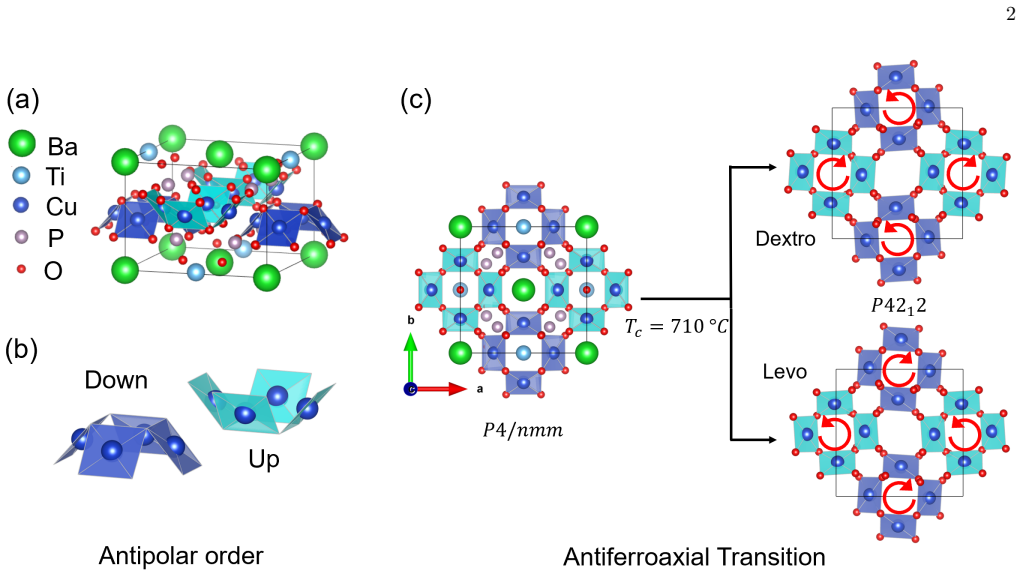
Antiferroically ordered electric toroidal dipoles serve as the order parameter for antiferroaxial rotations that establish chirality in BaTiOCu4(PO4)4.
A machine-rendered reading of the paper's core claim, the machinery that carries it, and where it could break.
Core claim
We show that antiferroically ordered atomic-site electric toroidal dipole moments act as an order parameter for the antiferroaxial rotations, and that the overall chiral order is parameterized by the composite order of the antipolar electric dipole and electric toroidal dipole moments.
What carries the argument
The composite order parameter formed by antipolar electric dipoles together with antiferroically ordered electric toroidal dipoles, which directly connects the observed structural rotations to the chiral state.
If this is right
- Some previously proposed order parameters for chirality can be excluded because they do not match the calculated multipole structure.
- The electric toroidal dipole moments provide a concrete, measurable signature that tracks the antiferroaxial component of the transition.
- The composite dipole-toroidal order offers a practical target for future experimental probes of chirality in this and related materials.
- The same multipole-analysis approach can be used to test candidate order parameters in other compounds that undergo ferrochiral transitions.
Where Pith is reading between the lines
- The same composite order parameter could be examined in other layered or phosphate-based materials that exhibit competing polar and axial structural distortions.
- If the toroidal moments are confirmed experimentally, resonant techniques sensitive to electric quadrupole or toroidal contributions might become standard tools for detecting hidden chiral order.
- The work implies that chirality in these systems is not a purely geometric property but is tied to a specific, symmetry-allowed multipolar pattern that could be tuned by strain or doping.
Load-bearing premise
The multipole moments obtained from the first-principles calculations faithfully represent the physical order parameters of the ferrochiral transition without substantial errors from approximations or incomplete structural models.
What would settle it
An experimental measurement, such as resonant X-ray scattering, that finds no correlation between the strength of the electric toroidal dipole moments and the antiferroaxial rotations or the chiral order would falsify the proposed parameterization.
Figures


read the original abstract
We present a first principles study of the ferrochiral phase transition in chiral BaTiOCu$_4$(PO$_4$)$_4$, which has been shown using X-ray diffraction to proceed via the antiferroaxial rotation of antipolar structural units. We analyze the atomic-site electric and magnetic multipole moments to identify connections between these multipoles and chirality and corroborate the previous experimental interpretation. We show that antiferroically ordered atomic-site electric toroidal dipole moments act as an order parameter for the antiferroaxial rotations, and that the overall chiral order is parameterized by the composite order of the antipolar electric dipole and electric toroidal dipole moments. Finally, we evaluate the suitability of various proposed order parameters for chirality, show that some can be excluded and suggest the most promising directions for future exploration.
Editorial analysis
A structured set of objections, weighed in public.
Referee Report
Summary. The paper presents a first-principles DFT study of the ferrochiral phase transition in BaTiOCu₄(PO₄)₄. It analyzes atomic-site electric and magnetic multipole moments extracted from the calculations to link them to the experimentally observed antiferroaxial rotations of antipolar structural units. The central claims are that antiferroically ordered electric toroidal dipole moments serve as the order parameter for these rotations and that the overall chiral order is captured by the composite of antipolar electric dipoles and electric toroidal dipoles. The work also evaluates the suitability of various proposed chirality order parameters, excluding some and identifying promising directions.
Significance. If the multipole extraction and mapping are robust, the results offer a microscopic computational corroboration of the experimental antiferroaxial mechanism for chirality in this material. This approach of using site-resolved multipoles to parameterize composite orders could be useful for understanding ferrochiral transitions in other systems and for guiding future experiments on toroidal moments or related phenomena.
major comments (3)
- [§3 and §4] §3 (Computational Methods) and §4 (Results): No convergence tests, k-point sampling details, or basis-set cutoff sensitivity are reported for the multipole moment calculations. Since the central claims rest on the numerical values of the electric toroidal dipole moments and their antiferroic ordering, the absence of these checks leaves open the possibility that the reported order-parameter behavior is affected by technical approximations in the DFT setup.
- [§4.2] §4.2 (Multipole Analysis): The mapping from computed atomic-site electric toroidal dipoles to the antiferroaxial rotation order parameter is presented without quantitative validation against the cited X-ray diffraction data (e.g., no direct comparison of computed vs. measured structural distortions or structure factors). This is load-bearing because the paper's claim that the multipoles 'corroborate the previous experimental interpretation' depends on this correspondence being faithful rather than an artifact of the structural model or partitioning scheme used to define the atomic sites.
- [§5] §5 (Order Parameter Evaluation): The composite order parameter (antipolar electric dipole + electric toroidal dipole) is asserted to parameterize the chiral order, but no explicit symmetry analysis or numerical test is shown demonstrating that this composite vanishes in the high-temperature achiral phase while being nonzero in the ferrochiral phase. Without this, it is unclear whether the composite is uniquely tied to chirality or could be mimicked by other multipole combinations.
minor comments (3)
- [Title and Abstract] Notation for the chemical formula is inconsistent between the title (BaTiOCu₄(PO₄)₄ with subscripts) and the abstract text (BaTiOCu4(PO4)4 without subscripts).
- [Figures] Figure captions for the multipole visualizations should explicitly state the isosurface values and the coordinate system used to define the toroidal dipole directions.
- [§3] The manuscript cites prior experimental work on the X-ray structure but does not include a brief table comparing key experimental bond lengths/angles to the relaxed DFT structure used for the multipole analysis.
Simulated Author's Rebuttal
We thank the referee for the careful reading of our manuscript and the constructive comments. We address each major comment below and will incorporate revisions to strengthen the presentation of our results.
read point-by-point responses
-
Referee: [§3 and §4] §3 (Computational Methods) and §4 (Results): No convergence tests, k-point sampling details, or basis-set cutoff sensitivity are reported for the multipole moment calculations. Since the central claims rest on the numerical values of the electric toroidal dipole moments and their antiferroic ordering, the absence of these checks leaves open the possibility that the reported order-parameter behavior is affected by technical approximations in the DFT setup.
Authors: We agree that explicit convergence tests are important for the robustness of the multipole results. We have now performed additional calculations varying the k-point mesh density and plane-wave cutoff energy, confirming that the electric toroidal dipole moments and their antiferroic ordering remain stable (changes < 8%) within the parameter ranges used in the original calculations. These tests will be added to §3 and an appendix in the revised manuscript. revision: yes
-
Referee: [§4.2] §4.2 (Multipole Analysis): The mapping from computed atomic-site electric toroidal dipoles to the antiferroaxial rotation order parameter is presented without quantitative validation against the cited X-ray diffraction data (e.g., no direct comparison of computed vs. measured structural distortions or structure factors). This is load-bearing because the paper's claim that the multipoles 'corroborate the previous experimental interpretation' depends on this correspondence being faithful rather than an artifact of the structural model or partitioning scheme used to define the atomic sites.
Authors: The calculations were performed on the experimental crystal structure determined by X-ray diffraction, so the atomic positions already encode the measured antiferroaxial rotations. The multipole analysis then identifies the toroidal moments as the microscopic signature of those rotations. While we did not recompute structure factors, we will add a table in the revised §4.2 directly comparing the key experimental atomic displacements with those in our input structure, together with a brief discussion of the partitioning scheme, to make the correspondence more quantitative. revision: yes
-
Referee: [§5] §5 (Order Parameter Evaluation): The composite order parameter (antipolar electric dipole + electric toroidal dipole) is asserted to parameterize the chiral order, but no explicit symmetry analysis or numerical test is shown demonstrating that this composite vanishes in the high-temperature achiral phase while being nonzero in the ferrochiral phase. Without this, it is unclear whether the composite is uniquely tied to chirality or could be mimicked by other multipole combinations.
Authors: We agree that an explicit demonstration strengthens the claim. We have performed a symmetry analysis (using the Bilbao Crystallographic Server) showing that the composite transforms according to the chiral irreducible representation of the high-temperature space group and must vanish above the transition. We have also evaluated the composite numerically on a symmetrized high-temperature structure and confirmed it is identically zero. These results and the symmetry table will be added to §5. revision: yes
Circularity Check
No significant circularity in derivation chain
full rationale
The paper's central claims follow from independent first-principles DFT computations of atomic-site electric and magnetic multipole moments extracted from the relaxed crystal structure. These computed multipoles are then interpreted as order parameters for the antiferroaxial rotations and composite chirality. No step reduces by construction to a fitted parameter, self-defined quantity, or load-bearing self-citation whose validity depends on the target result. The analysis is self-contained against external experimental benchmarks (X-ray diffraction) and does not rename known results or smuggle ansatze via prior work by the same authors. This is the standard non-circular workflow for multipole-based corroboration of a structural transition.
Axiom & Free-Parameter Ledger
Reference graph
Works this paper leans on
-
[1]
L. A. Nguyen, H. He, and C. Pham-Huy, Int. J. Biomed. Sci.2, 85 (2006)
work page 2006
- [2]
-
[3]
E. Zor, H. Bingol, and M. Ersoz, TrAC Trends in Ana- lytical Chemistry121, 115662 (2019)
work page 2019
-
[4]
B. P. Bloom, Y. Paltiel, R. Naaman, and D. H. Waldeck, Chem. Rev.124, 1950 (2024)
work page 1950
-
[5]
G. H. Fecher, J. K¨ ubler, and C. Felser, Materials15, 5812 (2022)
work page 2022
-
[6]
T. Hayashida, K. Kimura, D. Urushihara, T. Asaka, and T. Kimura, J. Am. Chem. Soc.143, 3638 (2021)
work page 2021
-
[7]
E. Bousquet, M. Fava, Z. Romestan, F. G´ omez-Ortiz, E. E. McCabe, and A. H. Romero, J. Phys. Condens. Matter37, 163004 (2025). 7
work page 2025
- [8]
-
[9]
H. Kusunose, J. Kishine, and H. M. Yamamoto, Applied Physics Letters124, 260501 (2024), arXiv:2404.13636 [cond-mat]
- [10]
- [11]
- [12]
-
[13]
J. P. Perdew, K. Burke, and M. Ernzerhof, Phys. Rev. Lett.77, 3865 (1996)
work page 1996
-
[14]
J. P. Perdew, A. Ruzsinszky, G. I. Csonka, O. A. Vydrov, G. E. Scuseria, L. A. Constantin, X. Zhou, and K. Burke, Phys. Rev. Lett.100, 136406 (2008)
work page 2008
-
[15]
A. Hallett and N. Spaldin, Supplemental materials, See Supplemental Materials for additional figures, computa- tional details, and data. (2025)
work page 2025
-
[16]
F. Cricchio, F. Bultmark, O. Gr˚ an¨ as, and L. Nordstr¨ om, Phys. Rev. Lett.103, 107202 (2009)
work page 2009
-
[17]
F. Bultmark, F. Cricchio, O. Gr˚ an¨ as, and L. Nordstr¨ om, Phys. Rev. B80, 035121 (2009)
work page 2009
- [18]
-
[19]
R. R¨ asta, I. Heinmaa, K. Kimura, T. Kimura, and R. Stern, Phys. Rev. B101, 054417 (2020)
work page 2020
- [20]
- [21]
-
[22]
N. A. Hill, J. Phys. Chem. B104, 6694 (2000)
work page 2000
-
[23]
G. V. d. Laan and B. T. Thole, J. Phys.: Condens. Matter 7, 9947 (1995)
work page 1995
-
[24]
M. Fava, A. H. Romero, and E. Bousquet, Phys. Rev. Lett.135, 146102 (2025)
work page 2025
- [25]
-
[26]
F. G´ omez-Ortiz, M. Fava, E. E. McCabe, A. H. Romero, and E. Bousquet, Phys. Rev. B110, 174112 (2024)
work page 2024
-
[27]
T. Hayashida, K. Kimura, and T. Kimura, J. Phys. Chem. Lett.13, 3857 (2022)
work page 2022
discussion (0)
Sign in with ORCID, Apple, or X to comment. Anyone can read and Pith papers without signing in.