Recognition: 2 theorem links
· Lean TheoremPipeMax: Enhancing Offline LLM Inference on Commodity GPU Servers
Pith reviewed 2026-05-08 18:42 UTC · model grok-4.3
The pith
PipeMax coordinates pipeline parallelism with KV cache offloading to expand effective GPU memory and sustain large-batch offline LLM inference on commodity servers.
A machine-rendered reading of the paper's core claim, the machinery that carries it, and where it could break.
Core claim
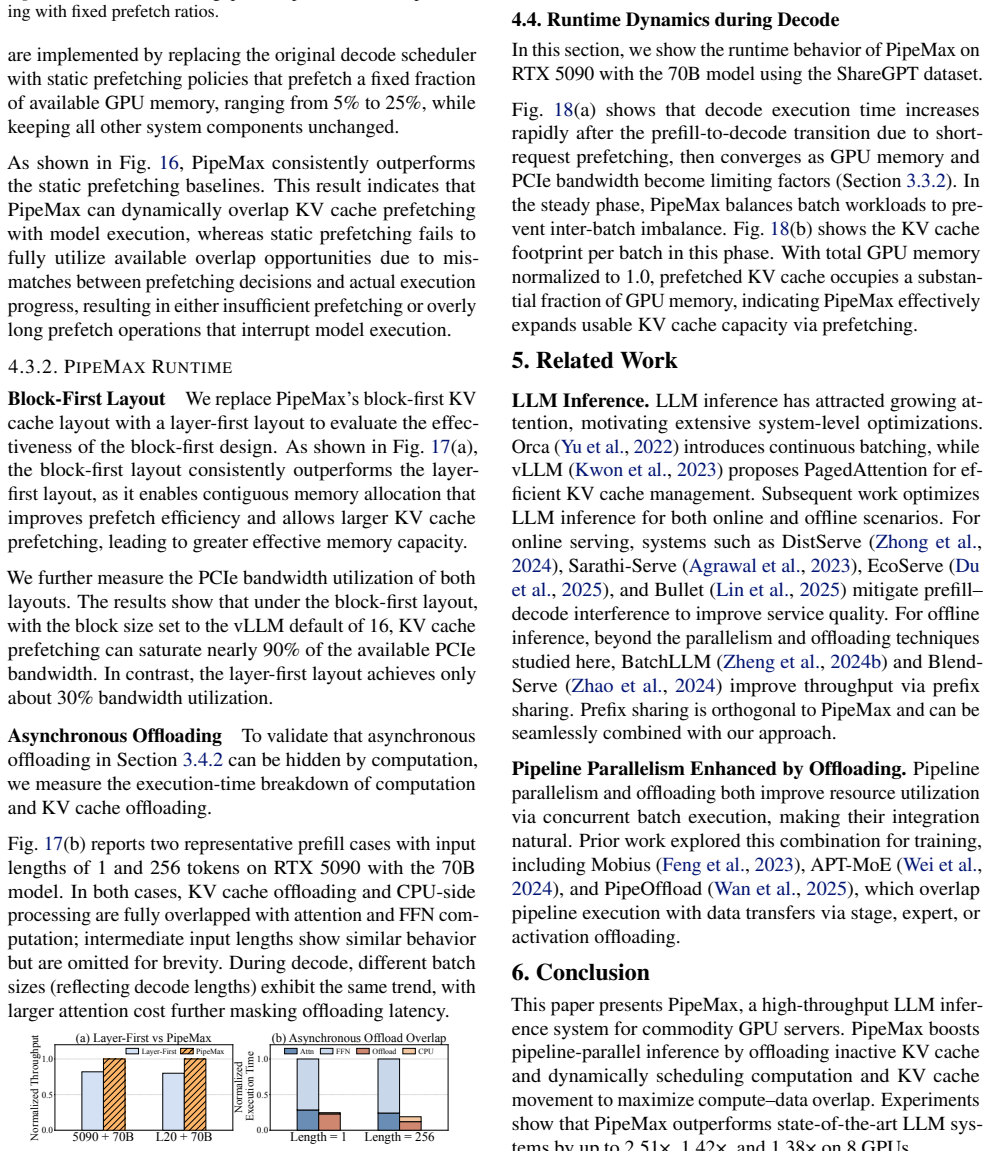
PipeMax integrates pipeline parallelism with offloading so that each GPU holds only one active batch while the KV caches of inactive batches are offloaded. This coordination expands the effective memory capacity, sustains large-batch execution, and produces up to 2.51 times higher throughput than vLLM and up to 1.42 times and 1.38 times higher throughput than other state-of-the-art high-throughput systems on an 8-GPU node.
What carries the argument
Pipeline parallelism that activates only one batch per GPU at a time, enabling safe offloading of KV caches for the remaining batches and thereby expanding usable memory capacity without high interconnect overhead.
Load-bearing premise
That offloading data movement can be timed with computation so that it expands effective memory and supports large batches without adding prohibitive interconnect or scheduling costs on ordinary servers.
What would settle it
Measurements on the same 8-GPU node and workloads showing that PipeMax throughput is no higher than vLLM once offloading overhead is included, or that large-batch execution collapses under realistic interconnect contention.
Figures




read the original abstract
Offline LLM inference seeks to maximize request processing under fixed budgets, making commodity GPU servers a promising choice. However, prior work typically considers offloading and parallelism in isolation, resulting in suboptimal performance. In this paper, we propose PipeMax, a high-throughput LLM inference system that integrates pipeline parallelism with offloading to overcome interconnect and memory constraints on GPU servers. Particularly, pipeline parallelism naturally incurs low communication overhead and keeps only one batch active on each GPU at a time, which enables offloading the KV cache of inactive batches. By coordinating computation with offloading data movement, PipeMax effectively expands GPU memory capacity and sustains large-batch execution. Experiments show that PipeMax achieves up to 2.51x higher throughput than vLLM, and up to 1.42x and 1.38x higher throughput than state-of-the-art high-throughput LLM systems, respectively, on an 8-GPU node.
Editorial analysis
A structured set of objections, weighed in public.
Referee Report
Summary. The manuscript presents PipeMax, a system for offline LLM inference on commodity 8-GPU servers that integrates pipeline parallelism with KV-cache offloading. Pipeline parallelism keeps only one batch active per GPU, allowing inactive KV caches to be offloaded while coordinating computation and data movement to expand effective memory capacity and sustain large batches. Experiments claim up to 2.51× throughput over vLLM and 1.42×/1.38× over other SOTA high-throughput LLM systems.
Significance. If the throughput gains hold with negligible offloading overhead on standard interconnects, the work would offer a practical systems-level advance for cost-effective, high-throughput offline LLM serving without specialized hardware, broadening accessibility for batch inference workloads.
major comments (2)
- Evaluation section: The reported throughput multipliers (2.51× vs. vLLM, 1.42× and 1.38× vs. SOTA) are aggregate figures only; no workload details, baseline configurations, run counts, error bars, or interconnect bandwidth measurements (PCIe 4.0/5.0 vs. NVLink) are provided, preventing verification that offloading stalls do not offset gains.
- System design and evaluation: No breakdown or bound is given for the fraction of runtime spent in offload waits versus compute (e.g., pipeline utilization or PCIe transfer time). This directly bears on the central claim that coordination keeps data-movement overhead negligible on commodity servers.
minor comments (1)
- Abstract: 'state-of-the-art high-throughput LLM systems' are referenced without naming them or citing the specific prior works being compared; add explicit references and names in the evaluation section for clarity.
Simulated Author's Rebuttal
We thank the referee for the constructive comments, which highlight important areas for strengthening the evaluation. We agree that additional details are needed to substantiate the throughput claims and the negligible-overhead argument. We will revise the manuscript to address both major comments fully.
read point-by-point responses
-
Referee: Evaluation section: The reported throughput multipliers (2.51× vs. vLLM, 1.42× and 1.38× vs. SOTA) are aggregate figures only; no workload details, baseline configurations, run counts, error bars, or interconnect bandwidth measurements (PCIe 4.0/5.0 vs. NVLink) are provided, preventing verification that offloading stalls do not offset gains.
Authors: We agree that the current presentation of results is insufficiently detailed. In the revised manuscript we will expand the evaluation section with: (1) complete workload specifications including model sizes, sequence lengths, and batch sizes; (2) exact hyper-parameter and configuration settings for vLLM and the other SOTA baselines; (3) the number of runs performed together with error bars or standard deviations; and (4) measured interconnect bandwidth on the testbed (PCIe generation and, where relevant, comparison to NVLink). These additions will allow readers to confirm that offloading stalls remain small relative to the reported gains. The underlying experimental data already exist and will be presented in tables and figures. revision: yes
-
Referee: System design and evaluation: No breakdown or bound is given for the fraction of runtime spent in offload waits versus compute (e.g., pipeline utilization or PCIe transfer time). This directly bears on the central claim that coordination keeps data-movement overhead negligible on commodity servers.
Authors: The referee correctly notes the absence of a quantitative runtime breakdown. Although the PipeMax design overlaps computation and offloading, the submitted manuscript does not report the resulting time fractions. We will add profiling results in the revised evaluation that quantify the fraction of runtime spent in offload waits, compute, and PCIe transfers, together with pipeline utilization metrics and explicit bounds on data-movement overhead for the commodity hardware used. This will directly support the claim that coordination renders offloading overhead negligible. We welcome any specific additional metrics the referee may suggest. revision: yes
Circularity Check
No circularity: systems integration with empirical validation
full rationale
The paper describes a practical systems design (PipeMax) that combines pipeline parallelism and KV-cache offloading for offline LLM inference on commodity GPU servers. No equations, fitted parameters, predictions, or first-principles derivations are present. Throughput claims rest on direct experimental measurements rather than any reduction to prior inputs or self-citations. The approach is self-contained against external benchmarks (vLLM and other systems) via reported speedups on an 8-GPU node.
Axiom & Free-Parameter Ledger
Lean theorems connected to this paper
-
Cost.FunctionalEquation (J-cost uniqueness)washburn_uniqueness_aczel unclear?
unclearRelation between the paper passage and the cited Recognition theorem.
PipeMax models the decode execution time of a batch as: α·b + β·L + δ, where α, β, and δ are parameters obtained via offline profiling
What do these tags mean?
- matches
- The paper's claim is directly supported by a theorem in the formal canon.
- supports
- The theorem supports part of the paper's argument, but the paper may add assumptions or extra steps.
- extends
- The paper goes beyond the formal theorem; the theorem is a base layer rather than the whole result.
- uses
- The paper appears to rely on the theorem as machinery.
- contradicts
- The paper's claim conflicts with a theorem or certificate in the canon.
- unclear
- Pith found a possible connection, but the passage is too broad, indirect, or ambiguous to say the theorem truly supports the claim.
Reference graph
Works this paper leans on
-
[1]
GitHub Copilot: Your AI Pair Programmer , howpublished =
-
[2]
Proceedings of the 54th International Conference on Parallel Processing , pages=
TD-Pipe: Temporally-Disaggregated Pipeline Parallelism Architecture for High-Throughput LLM Inference , author=. Proceedings of the 54th International Conference on Parallel Processing , pages=
-
[3]
2024 , eprint=
Large language models in healthcare and medical domain: A review , author=. 2024 , eprint=
2024
-
[4]
International Research Journal of Modernization in Engineering Technology and Science , volume=
Contribution and performance of ChatGPT and other Large Language Models (LLM) for scientific and research advancements: a double-edged sword , author=. International Research Journal of Modernization in Engineering Technology and Science , volume=
-
[5]
Frontiers of Computer Science , volume=
Large language models for generative information extraction: A survey , author=. Frontiers of Computer Science , volume=. 2024 , publisher=
2024
-
[6]
OpenRLHF: An Easy-to-use, Scalable and High-performance RLHF Framework
Openrlhf: An easy-to-use, scalable and high-performance rlhf framework , author=. arXiv preprint arXiv:2405.11143 , year=
work page internal anchor Pith review arXiv
-
[7]
arXiv preprint arXiv:2503.06433 , year=
Seesaw: High-throughput llm inference via model re-sharding , author=. arXiv preprint arXiv:2503.06433 , year=
-
[8]
International Conference on Machine Learning , pages=
Flexgen: High-throughput generative inference of large language models with a single gpu , author=. International Conference on Machine Learning , pages=. 2023 , organization=
2023
-
[9]
18th USENIX Symposium on Operating Systems Design and Implementation (OSDI 24) , pages=
\ DistServe \ : Disaggregating prefill and decoding for goodput-optimized large language model serving , author=. 18th USENIX Symposium on Operating Systems Design and Implementation (OSDI 24) , pages=
-
[10]
18th USENIX Symposium on Operating Systems Design and Implementation (OSDI 24) , pages=
Taming \ Throughput-Latency \ tradeoff in \ LLM \ inference with \ Sarathi-Serve \ , author=. 18th USENIX Symposium on Operating Systems Design and Implementation (OSDI 24) , pages=
-
[11]
arXiv preprint arXiv:2504.18154 , year=
EcoServe: Enabling Cost-effective LLM Serving with Proactive Intra-and Inter-Instance Orchestration , author=. arXiv preprint arXiv:2504.18154 , year=
-
[12]
Sarathi: Efficient llm inference by piggybacking decodes with chunked prefills,
Sarathi: Efficient llm inference by piggybacking decodes with chunked prefills , author=. arXiv preprint arXiv:2308.16369 , year=
-
[13]
Proceedings of the 29th symposium on operating systems principles , pages=
Efficient memory management for large language model serving with pagedattention , author=. Proceedings of the 29th symposium on operating systems principles , pages=
-
[14]
IEEE Transactions on Computers , year=
TightLLM: Maximizing Throughput for LLM Inference via Adaptive Offloading Policy , author=. IEEE Transactions on Computers , year=
-
[15]
Proceedings of the 28th ACM International Conference on Architectural Support for Programming Languages and Operating Systems, Volume 2 , pages=
Mobius: Fine tuning large-scale models on commodity gpu servers , author=. Proceedings of the 28th ACM International Conference on Architectural Support for Programming Languages and Operating Systems, Volume 2 , pages=
-
[16]
arXiv preprint arXiv:2503.01328 , year=
Pipeoffload: Improving scalability of pipeline parallelism with memory optimization , author=. arXiv preprint arXiv:2503.01328 , year=
-
[17]
Advances in neural information processing systems , volume=
Sglang: Efficient execution of structured language model programs , author=. Advances in neural information processing systems , volume=
-
[18]
SC24: International Conference for High Performance Computing, Networking, Storage and Analysis , pages=
APTMoE: Affinity-Aware Pipeline Tuning for MoE Models on Bandwidth-Constrained GPU Nodes , author=. SC24: International Conference for High Performance Computing, Networking, Storage and Analysis , pages=. 2024 , organization=
2024
-
[19]
IEEE Transactions on Parallel and Distributed Systems , volume=
Efficient KV Cache Spillover Management on Memory-Constrained GPU for LLM Inference , author=. IEEE Transactions on Parallel and Distributed Systems , volume=. 2025 , publisher=
2025
-
[20]
Proceedings of the 62nd annual meeting of the association for computational linguistics (volume 1: Long papers) , pages=
Longbench: A bilingual, multitask benchmark for long context understanding , author=. Proceedings of the 62nd annual meeting of the association for computational linguistics (volume 1: Long papers) , pages=
-
[21]
Batchllm: Optimizing large batched llm inference with global prefix sharing and throughput-oriented token batching , author=. arXiv preprint arXiv:2412.03594 , year=
work page internal anchor Pith review Pith/arXiv arXiv
-
[22]
arXiv preprint arXiv:2411.16102 , year=
Blendserve: Optimizing offline inference for auto-regressive large models with resource-aware batching , author=. arXiv preprint arXiv:2411.16102 , year=
-
[23]
arXiv preprint arXiv:2504.19516 , year=
Bullet: Boosting GPU Utilization for LLM Serving via Dynamic Spatial-Temporal Orchestration , author=. arXiv preprint arXiv:2504.19516 , year=
-
[24]
16th USENIX Symposium on Operating Systems Design and Implementation (OSDI 22) , year =
Gyeong-In Yu and Joo Seong Jeong and Geon-Woo Kim and Soojeong Kim and Byung-Gon Chun , title =. 16th USENIX Symposium on Operating Systems Design and Implementation (OSDI 22) , year =
-
[25]
Proceedings of Machine Learning and Systems , volume=
Optimizing llm queries in relational data analytics workloads , author=. Proceedings of Machine Learning and Systems , volume=
discussion (0)
Sign in with ORCID, Apple, or X to comment. Anyone can read and Pith papers without signing in.