Recognition: 3 theorem links
· Lean TheoremThe Impact of the Magnetised Cosmic Web on Ultra High Energy Cosmic Ray Propagation
Pith reviewed 2026-05-08 18:58 UTC · model grok-4.3
The pith
Extragalactic magnetic fields suppress the flux of ultra-high-energy protons below 3×10^19 eV by creating a magnetic horizon.
A machine-rendered reading of the paper's core claim, the machinery that carries it, and where it could break.
Core claim
Observationally motivated extragalactic magnetic fields progressively suppress the flux of arriving protons below E ≲ 3 × 10^19 eV through an effective Magnetic Horizon. The horizon radius is estimated at roughly 50 Mpc for 10^18 eV protons and 150 Mpc for 10^19 eV protons. This suppression must be included in any modeling of UHECR propagation and in interpretations of the spectrum measured in the local Universe.
What carries the argument
The magnetic horizon (MH) effect arising from deflections in magnetised cosmic-web structures, quantified by following proton trajectories through a sequence of time-evolving simulation snapshots.
If this is right
- Models of UHECR sources and spectra must correct for magnetic suppression when relating local observations to distant production sites.
- The effective horizon shrinks rapidly with decreasing energy, so protons at 10^18 eV are largely confined to sources within about 50 Mpc.
- The transition energy where extragalactic protons begin to dominate the spectrum shifts upward compared with unmagnetised calculations.
- Arrival-direction anisotropics and composition studies at energies below 3×10^19 eV must account for the filtering effect of the cosmic web.
Where Pith is reading between the lines
- This filtering could reduce the expected contribution of distant sources to the observed flux, implying that a larger fraction of the spectrum originates within the local supercluster.
- Future detectors sensitive to composition at 10^18–10^19 eV might see a sharper drop in proton fraction than predicted by source models alone.
Load-bearing premise
The magnetic field strengths and topologies in the cosmological simulations match real fields in cosmic-web filaments, and stepping through discrete time snapshots captures propagation without major artifacts.
What would settle it
A measured UHECR proton spectrum below 3×10^19 eV that shows no flux deficit relative to an unmagnetised propagation model, or arrival of significant numbers of such protons from sources beyond 150 Mpc.
Figures



read the original abstract
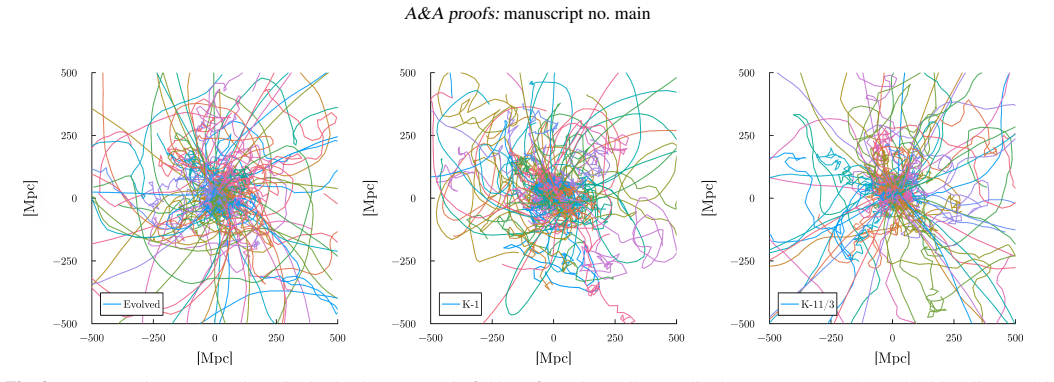
The origin of ultra-high-energy cosmic rays (UHECRs) remains an open question. Extragalactic magnetic fields can modify their propagation and, at sufficiently low energies, suppress the observed flux through the magnetic horizon (MH) effect.} {We quantify the impact of the MH on the propagation of UHECR protons using cosmological simulations and a dedicated numerical framework that follows cosmic rays in a time-evolving background.} {We use \texttt{UMAREL}, a parallel code developed for this study, to propagate UHECR protons through a cosmological volume simulated with ENZO. The magnetic-field configurations are chosen to be consistent with recent radio constraints on magnetic fields in cosmic-web filaments. Unlike stationary approaches, we follow particle trajectories through a sequence of time-evolving snapshots and compare the resulting arrival properties with those in an unmagnetised reference model.} {We find that observationally motivated extragalactic magnetic fields progressively suppress the flux of arriving protons below \(E \lesssim 3 \times 10^{19}\,\mathrm{eV}\) through an effective Magnetic Horizon (MH). We estimate \(R_{\mathrm{MH}} \sim 50\,\mathrm{Mpc}\) for protons with \(E = 10^{18}\,\mathrm{eV}\) and \(R_{\mathrm{MH}} \sim 150\,\mathrm{Mpc}\) for protons with \(E = 10^{19}\,\mathrm{eV}\).} {The MH generated by extragalactic magnetic fields must be taken into account when modelling UHECR propagation and interpreting the spectrum observed in the local Universe.}
Editorial analysis
A structured set of objections, weighed in public.
Referee Report
Summary. The paper uses ENZO cosmological simulations of the magnetized cosmic web (with field strengths consistent with radio constraints) and the UMAREL propagation code to follow UHECR proton trajectories through a sequence of time-evolving snapshots. It compares arrival fluxes to an unmagnetized reference and reports progressive flux suppression below E ≲ 3 × 10^19 eV, from which it extracts effective magnetic horizon radii R_MH ∼ 50 Mpc at 10^18 eV and ∼ 150 Mpc at 10^19 eV, concluding that the MH must be included in UHECR modeling.
Significance. If the time-dependent propagation is free of numerical artifacts, the work supplies the first quantitative, simulation-based estimates of the magnetic horizon scale for observationally motivated extragalactic fields. This directly affects the interpretation of the UHECR spectrum and source distances below a few × 10^19 eV and provides a falsifiable prediction that can be tested against future spectrum and composition data.
major comments (2)
- [Abstract / UMAREL propagation section] Abstract and propagation-method description: the headline R_MH values are obtained directly from the difference in arrival flux between magnetized time-evolving trajectories and the unmagnetized reference. No test is presented that compares these results against a stationary-field baseline using the same ENZO snapshots; without such a control, it is impossible to quantify possible artifacts from snapshot cadence or field interpolation that would scale directly into the reported horizon radii.
- [Abstract] Abstract: the statement that the ENZO magnetic-field configurations are 'consistent with recent radio constraints' is used to justify the adopted normalization, yet no quantitative comparison (e.g., filament B-field PDF or power spectrum) or uncertainty range on the normalization is provided. Because R_MH scales with the field strength, this omission leaves the numerical values of R_MH without a stated systematic uncertainty.
minor comments (2)
- [Abstract] The abstract states that trajectories are followed 'through a sequence of time-evolving snapshots' but does not specify the snapshot interval or interpolation scheme; adding this information would improve reproducibility.
- [Results section] The paper should clarify whether the reported R_MH is defined as the distance at which the magnetized flux drops to 1/e of the unmagnetized flux or by another explicit criterion.
Simulated Author's Rebuttal
We thank the referee for their careful and constructive review of our manuscript. The comments raise important methodological points that we have addressed through revisions to the paper. We provide detailed responses to each major comment below.
read point-by-point responses
-
Referee: [Abstract / UMAREL propagation section] Abstract and propagation-method description: the headline R_MH values are obtained directly from the difference in arrival flux between magnetized time-evolving trajectories and the unmagnetized reference. No test is presented that compares these results against a stationary-field baseline using the same ENZO snapshots; without such a control, it is impossible to quantify possible artifacts from snapshot cadence or field interpolation that would scale directly into the reported horizon radii.
Authors: We agree that a stationary-field control using the same snapshots would help isolate potential numerical effects from snapshot cadence and field interpolation. Our unmagnetized reference validates the propagation code but does not directly address the magnetized time-dependent case. In the revised manuscript we have added a new subsection in the methods section that presents results from a stationary-field propagation through a single fixed ENZO snapshot. This control shows flux differences of less than 5% relative to the time-evolving case at 10^18–10^19 eV, confirming that snapshot-related artifacts do not materially affect the reported magnetic horizon radii. The abstract and methods have been updated to include this validation test. revision: yes
-
Referee: [Abstract] Abstract: the statement that the ENZO magnetic-field configurations are 'consistent with recent radio constraints' is used to justify the adopted normalization, yet no quantitative comparison (e.g., filament B-field PDF or power spectrum) or uncertainty range on the normalization is provided. Because R_MH scales with the field strength, this omission leaves the numerical values of R_MH without a stated systematic uncertainty.
Authors: We acknowledge that an explicit quantitative comparison to radio constraints and an associated uncertainty range on the field normalization would better quantify the systematic uncertainty on R_MH. The manuscript already selects field strengths to match radio limits, but we agree that more detail is warranted. In the revised version we have expanded the methods section with a direct comparison of the simulated filament magnetic-field PDF and power spectrum against recent radio observations. We now also report an approximate ±25% uncertainty range on the normalization, which propagates to a corresponding range on the quoted R_MH values. These additions appear in the abstract, methods, and results sections. revision: yes
Circularity Check
No significant circularity; results from direct simulation
full rationale
The paper derives its R_MH estimates and flux suppression claims exclusively from numerical particle propagation in time-evolving ENZO magnetic-field snapshots using the newly developed UMAREL code, with fields selected to match independent radio constraints and compared against an unmagnetised reference run. No equation or result reduces by construction to a fitted parameter, self-defined quantity, or load-bearing self-citation; the central quantitative outputs are direct simulation products rather than tautological renamings or imported uniqueness theorems.
Axiom & Free-Parameter Ledger
free parameters (1)
- Magnetic field normalization in filaments
axioms (1)
- domain assumption The ENZO cosmological simulation provides a representative model of the magnetized cosmic web
Lean theorems connected to this paper
-
Cost.FunctionalEquation (J-cost is ratio-symmetric ½(x+x⁻¹)−1, unrelated to this exponential survival fit)washburn_uniqueness_aczel unclear?
unclearRelation between the paper passage and the cited Recognition theorem.
we parametrise the survival fraction of particles arriving within a given energy bin by modelling it with an exponential law: N(x)=N_0 e^{-λ/x}
What do these tags mean?
- matches
- The paper's claim is directly supported by a theorem in the formal canon.
- supports
- The theorem supports part of the paper's argument, but the paper may add assumptions or extra steps.
- extends
- The paper goes beyond the formal theorem; the theorem is a base layer rather than the whole result.
- uses
- The paper appears to rely on the theorem as machinery.
- contradicts
- The paper's claim conflicts with a theorem or certificate in the canon.
- unclear
- Pith found a possible connection, but the passage is too broad, indirect, or ambiguous to say the theorem truly supports the claim.
Reference graph
Works this paper leans on
-
[1]
U., Abe, M., Abu-Zayyad, T., et al
Abbasi, R. U., Abe, M., Abu-Zayyad, T., et al. 2021, ApJ, 909, 178
2021
-
[2]
& Berezinsky, V
Aloisio, R. & Berezinsky, V . 2004, ApJ, 612, 900
2004
-
[3]
Aloisio, R., Boncioli, D., di Matteo, A., et al. 2017, J. Cosmology Astropart. Phys., 2017, 009 Alves Batista, R., Dundovic, A., Erdmann, M., et al. 2016, J. Cosmology As- tropart. Phys., 2016, 038
2017
-
[4]
S., McClure-Griffiths, N
Anderson, C. S., McClure-Griffiths, N. M., Rudnick, L., et al. 2024, MNRAS, 533, 4068 Böss, L. M., Dolag, K., Steinwandel, U. P., et al. 2024, A&A, 692, A232
2024
-
[5]
& Vazza, F
Carretti, E. & Vazza, F. 2025, Universe, 11, 164
2025
-
[6]
2026, A&A, 707, A19
Cermenati, A., Aloisio, R., Blasi, P., & Evoli, C. 2026, A&A, 707, A19
2026
-
[7]
2023, Astroparticle Physics, 147, 102794 de Almeida, R
Coleman, A., Eser, J., Mayotte, E., et al. 2023, Astroparticle Physics, 147, 102794 de Almeida, R. & The Pierre Auger Collaboration. 2022, in 37th International Cosmic Ray Conference, 335
2023
-
[8]
K., Mori, W
Decyk, V . K., Mori, W. B., & Li, F. 2023, Computer Physics Communications, 282, 108559
2023
-
[9]
2003, in International Cosmic Ray Conference, V ol
Dolag, K., Grasso, D., Springel, V ., & Tkachev, I. 2003, in International Cosmic Ray Conference, V ol. 2, International Cosmic Ray Conference, 735
2003
-
[10]
& Blandford, R
Globus, N. & Blandford, R. D. 2025, ARA&A, 63, 339 González, J. M., Mollerach, S., & Roulet, E. 2021, Phys. Rev. D, 104, 063005
2025
-
[11]
1966, Phys
Greisen, K. 1966, Phys. Rev. Lett., 16, 748
1966
-
[12]
2016, MNRAS, 462, 3660
Hackstein, S., Vazza, F., Brüggen, M., Sigl, G., & Dundovic, A. 2016, MNRAS, 462, 3660
2016
-
[13]
G., & Gottlöber, S
Hackstein, S., Vazza, F., Brüggen, M., Sorce, J. G., & Gottlöber, S. 2018, MN- RAS, 475, 2519
2018
-
[14]
2019, in International Cosmic Ray Conference, V ol
Ivanov, D. 2019, in International Cosmic Ray Conference, V ol. 36, 36th Interna- tional Cosmic Ray Conference (ICRC2019), 298
2019
-
[15]
2005, Phys
Lemoine, M. 2005, Phys. Rev. D, 71, 083007
2005
-
[16]
2025, in 7th International Symposium on Ultra High Energy Cos- mic Rays, 2
Mollerach, S. 2025, in 7th International Symposium on Ultra High Energy Cos- mic Rays, 2
2025
-
[17]
2024, ApJ, 977, 128 Novotný, V
Mtchedlidze, S., Domínguez-Fernández, P., Du, X., et al. 2024, ApJ, 977, 128 Novotný, V . & The Pierre Auger Collaboration. 2022, in 37th International Cos- mic Ray Conference, 324 O’Sullivan, S. P., Brüggen, M., Vazza, F., et al. 2020, MNRAS, 495, 2607 The Pierre Auger Collaboration. 2017a, J. Cosmology Astropart. Phys., 2017, 038 The Pierre Auger Collab...
-
[18]
2025, A&A, 696, A58
Vazza, F., Gheller, C., Zanetti, F., et al. 2025, A&A, 696, A58
2025
-
[19]
2021, MNRAS, 505, 4178
Vernstrom, T., Heald, G., Vazza, F., et al. 2021, MNRAS, 505, 4178
2021
-
[20]
2023, Science Advances, 9, eade7233
Vernstrom, T., West, J., Vazza, F., et al. 2023, Science Advances, 9, eade7233
2023
-
[21]
& The Pierre Auger Collaboration
Yushkov, A. & The Pierre Auger Collaboration. 2019, in International Cos- mic Ray Conference, V ol. 36, 36th International Cosmic Ray Conference (ICRC2019), 482
2019
-
[22]
Zatsepin, G. T. & Kuz’min, V . A. 1966, Soviet Journal of Experimental and Theoretical Physics Letters, 4, 78 Article number, page 9 of 12 A&A proofs:manuscript no. main Appendix A: Tests on UMAREL This section is devoted to show the various tests needed to prove the physical validity ofUMARELand for simplicity they were conducted considering a single epo...
1966
discussion (0)
Sign in with ORCID, Apple, or X to comment. Anyone can read and Pith papers without signing in.