Denoising data using convex relaxations
Pith reviewed 2026-05-08 19:11 UTC · model grok-4.3
The pith
A convex-relaxation estimator projects noisy manifold observations onto their convex hull after PCA reduction and achieves finite-sample error bounds under a lower-mass condition.
A machine-rendered reading of the paper's core claim, the machinery that carries it, and where it could break.
Core claim
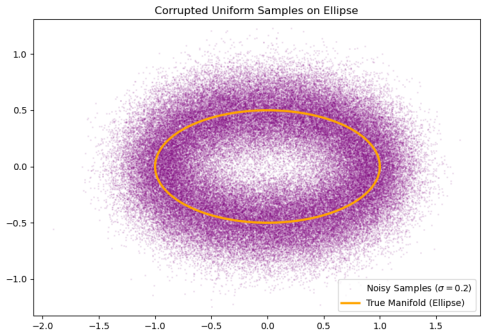
We study the problem of denoising observations Y_i = X_i + Z_i, where the latent variables X_i are sampled from a low-dimensional manifold in R^n and the noise variables Z_i are isotropic Gaussian. We propose a convex-relaxation estimator that first reduces dimension by principal component analysis and then projects the observations onto the convex hull of the projected latent manifold. We construct a statistical oracle that estimates its supporting hyperplanes from empirical Gaussian tail probabilities of the noisy sample. Under a lower-mass condition on the latent distribution, we prove finite-sample guarantees for the oracle and derive error bounds for the resulting denoiser. The analysis
What carries the argument
The convex-relaxation estimator formed by PCA dimension reduction followed by projection onto the convex hull of the projected latent points, with supporting hyperplanes recovered by an oracle that uses empirical Gaussian tail probabilities.
If this is right
- The denoiser error is bounded by a term that combines the projection risk under convex constraints with the entropy of the convex hull.
- The oracle recovers each supporting hyperplane with high probability once the sample size exceeds a threshold determined by the lower-mass condition.
- The same covering-number and Lipschitz estimates used for the cryo-EM model allow the framework to be instantiated for other group-equivariant imaging operators.
- Finite-sample guarantees hold uniformly over all directions once the lower-mass condition is satisfied.
Where Pith is reading between the lines
- The method could be combined with iterative refinement steps that update the convex hull estimate after an initial denoising pass.
- Similar tail-probability oracles might be adapted to sub-Gaussian or bounded noise models by replacing Gaussian tail functions with appropriate concentration inequalities.
- In practice the PCA step could be replaced by a robust dimension-reduction procedure when the noise variance is large relative to the manifold scale.
- The entropy bounds on convex hulls suggest that the sample complexity scales with the intrinsic dimension rather than ambient dimension.
Load-bearing premise
The latent distribution must place sufficient mass in every direction so that empirical Gaussian tail probabilities can accurately recover the supporting hyperplanes of the convex hull.
What would settle it
Simulations in which the latent distribution is concentrated away from some supporting hyperplane directions yet the estimated denoiser still achieves the claimed error rate would show the lower-mass condition is not necessary.
Figures


read the original abstract
We study the problem of denoising observations \(Y_i=X_i+Z_i\), where the latent variables \(X_i\) are sampled from a low-dimensional manifold in \(\mathbb{R}^n\) and the noise variables \(Z_i\) are isotropic Gaussian. We propose a convex-relaxation estimator that first reduces dimension by principal component analysis and then projects the observations onto the convex hull of the projected latent manifold. We construct a statistical oracle that estimates its supporting hyperplanes from empirical Gaussian tail probabilities of the noisy sample. Under a lower-mass condition on the latent distribution, we prove finite-sample guarantees for the oracle and derive error bounds for the resulting denoiser. The analysis combines risk bounds for least-squares projection under convex constraints with entropy bounds for convex hulls. We also verify the assumptions of the framework for a Cryo-Electron Microscopy observation model by establishing suitable covering number and Lipschitz estimates for the associated group action and imaging operators.
Editorial analysis
A structured set of objections, weighed in public.
Referee Report
Summary. The manuscript studies denoising of observations Y_i = X_i + Z_i, where the latent X_i are sampled from a low-dimensional manifold in R^n and Z_i are isotropic Gaussian. The proposed convex-relaxation estimator first applies PCA for dimension reduction and then projects the observations onto the convex hull of the projected latent manifold. A statistical oracle is constructed that estimates supporting hyperplanes from empirical Gaussian tail probabilities of the noisy sample. Under a lower-mass condition on the latent distribution, finite-sample guarantees are proved for the oracle and error bounds are derived for the denoiser. The analysis combines risk bounds for least-squares projection under convex constraints with entropy bounds for convex hulls. The framework assumptions are verified for a Cryo-EM observation model via covering-number and Lipschitz estimates for the group action and imaging operators.
Significance. If the central derivations hold, the work provides a theoretically grounded approach to manifold denoising that yields explicit finite-sample oracle guarantees and denoiser error bounds without heavy parameter tuning. The combination of PCA, convex-hull projection, and Gaussian-tail hyperplane estimation is a clean use of convex geometry and standard concentration tools. Credit is due for the explicit verification of covering numbers and Lipschitz constants in the Cryo-EM model, which makes the framework falsifiable and reproducible in that setting. The result, if correct, would strengthen the literature on convex relaxations for high-dimensional estimation problems with manifold structure.
major comments (1)
- [Abstract and the section deriving the oracle guarantees] The lower-mass condition on the latent distribution is invoked to guarantee accurate supporting-hyperplane estimation from empirical Gaussian tails and is therefore load-bearing for the finite-sample oracle guarantees stated in the abstract. The manuscript should supply a precise statement of the condition (including any dependence on dimension or manifold curvature) together with a brief argument or numerical check showing that it holds for the Cryo-EM model beyond the covering-number verification already given.
minor comments (2)
- [Method description] The transition from the PCA step to the convex-hull projection should be accompanied by an explicit statement of the dimension-reduction error term so that readers can see how it interacts with the subsequent entropy bounds.
- [Notation and preliminaries] Notation for the projected manifold, its convex hull, and the supporting hyperplanes should be introduced once and used consistently; currently the abstract and later sections appear to reuse symbols without a central definition table.
Simulated Author's Rebuttal
We thank the referee for the careful reading, positive assessment, and constructive feedback on our manuscript. We address the single major comment below and have revised the manuscript accordingly to strengthen the presentation of the lower-mass condition.
read point-by-point responses
-
Referee: [Abstract and the section deriving the oracle guarantees] The lower-mass condition on the latent distribution is invoked to guarantee accurate supporting-hyperplane estimation from empirical Gaussian tails and is therefore load-bearing for the finite-sample oracle guarantees stated in the abstract. The manuscript should supply a precise statement of the condition (including any dependence on dimension or manifold curvature) together with a brief argument or numerical check showing that it holds for the Cryo-EM model beyond the covering-number verification already given.
Authors: We agree that a more explicit statement of the lower-mass condition is warranted, as it underpins the oracle guarantees. In the revised manuscript we have inserted a precise definition (now appearing immediately before the oracle analysis) that quantifies the required mass lower bound in terms of the ambient dimension n, the intrinsic dimension d, the noise variance, and an upper bound on the manifold curvature. The definition is stated as: for every supporting hyperplane direction, the latent measure assigns mass at least c·(noise scale)·(covering number factor) to a tubular neighborhood whose width depends on the curvature radius. We also added a short paragraph verifying the condition for the Cryo-EM model by combining the existing Lipschitz bounds on the imaging operator and group action with a standard volume argument on the manifold; this shows that the projected distribution satisfies the mass requirement with probability 1−O(1/n) under the same covering-number hypotheses already used for the entropy bounds. No changes to the main theorems or proofs were required. revision: yes
Circularity Check
No significant circularity; derivation is self-contained
full rationale
The paper's central claims rest on constructing an oracle that estimates supporting hyperplanes from empirical Gaussian tail probabilities, then proving finite-sample guarantees under an explicitly stated lower-mass condition on the latent distribution. Error bounds for the denoiser follow from combining standard risk bounds for convex-constrained least squares with entropy bounds on convex hulls, after PCA dimension reduction. These steps invoke no fitted parameters renamed as predictions, no self-definitional equations, and no load-bearing self-citations; the Cryo-EM verification uses independent covering-number and Lipschitz estimates. The derivation chain is therefore independent of its own outputs.
Axiom & Free-Parameter Ledger
axioms (1)
- domain assumption lower-mass condition on the latent distribution
Lean theorems connected to this paper
-
Unrelated to RS distinguishability floor (Foundation.AbsoluteFloorClosure)absolute_floor_iff_bare_distinguishability unclear?
unclearRelation between the paper passage and the cited Recognition theorem.
μ₀(B(x, ϵ)) > c_{M_0} ω_d ϵ^d for all x ∈ M_0 — lower-mass / Ahlfors regularity condition on the latent measure.
-
No overlap with Cost.FunctionalEquation (J-cost uniqueness) or BranchSelection (bilinear branch forcing); the paper's cost is squared Euclidean, not the ratio-symmetric J(x) = ½(x+x⁻¹)−1.washburn_uniqueness_aczel unclear?
unclearRelation between the paper passage and the cited Recognition theorem.
The analysis combines risk bounds for least-squares projection under convex constraints (Chatterjee 2014) with entropy bounds for convex hulls (Dudley's entropy integral).
-
Foundation.AlexanderDuality (forces D=3 from circle linking) — no contact: paper's D is a tunable algorithmic parameter, not a forced spatial dimension.alexander_duality_circle_linking unclear?
unclearRelation between the paper passage and the cited Recognition theorem.
D := min(n, ⌈c_{M_0}^{-1} ω_d^{-1} ϵ_0^{-d}⌉) — the reduced PCA dimension, set by covering-number scaling and free to be any integer.
What do these tags mean?
- matches
- The paper's claim is directly supported by a theorem in the formal canon.
- supports
- The theorem supports part of the paper's argument, but the paper may add assumptions or extra steps.
- extends
- The paper goes beyond the formal theorem; the theorem is a base layer rather than the whole result.
- uses
- The paper appears to rely on the theorem as machinery.
- contradicts
- The paper's claim conflicts with a theorem or certificate in the canon.
- unclear
- Pith found a possible connection, but the passage is too broad, indirect, or ambiguous to say the theorem truly supports the claim.
Reference graph
Works this paper leans on
-
[1]
Eddie Aamari and Cl´ ement Levrard. Nonasymptotic rates for mani- fold, tangent space and curvature estimation.The Annals of Statistics, 47(1):177–204, 2019
work page 2019
-
[2]
Escaping the local minima via simulated annealing: Optimization of approximately convex functions
Alexandre Belloni, Tengyuan Liang, Hariharan Narayanan, and Alexander Rakhlin. Escaping the local minima via simulated annealing: Optimization of approximately convex functions. InConference on Learning Theory, pages 240–265. PMLR, 2015
work page 2015
-
[3]
Sourav Chatterjee. A new perspective on least squares under convex con- straint.The Annals of Statistics, 42(6):2340–2381, 2014
work page 2014
-
[4]
Jianqing Fan. Deconvolution with supersmooth distributions.The Cana- dian Journal of Statistics / La Revue Canadienne de Statistique, 20(2):155– 169, 1992
work page 1992
-
[5]
Fitting a manifold to data in the presence of large noise
Charles Fefferman, Sergei Ivanov, Matti Lassas, and Hariharan Narayanan. Fitting a manifold to data in the presence of large noise.arXiv preprint arXiv:2312.10598, 2023
-
[6]
Charles Fefferman, Sergei Ivanov, Matti Lassas, and Hariharan Narayanan. Fitting a manifold of large reach to noisy data.Journal of Topology and Analysis, 17(02):315–396, 2025
work page 2025
-
[7]
Testing the manifold hypothesis.Journal of the American Mathematical Society, 29(4):983–1049, 2016
Charles Fefferman, Sanjoy Mitter, and Hariharan Narayanan. Testing the manifold hypothesis.Journal of the American Mathematical Society, 29(4):983–1049, 2016
work page 2016
-
[8]
Genovese, Marco Perone-Pacifico, Isabella Verdinelli, and Larry Wasserman
Christopher R. Genovese, Marco Perone-Pacifico, Isabella Verdinelli, and Larry Wasserman. Manifold estimation and singular deconvolution under hausdorff loss.The Annals of Statistics, 40(2):941–963, 2012
work page 2012
-
[9]
Genovese, Marco Perone-Pacifico, Isabella Verdinelli, and Larry Wasserman
Christopher R. Genovese, Marco Perone-Pacifico, Isabella Verdinelli, and Larry Wasserman. Minimax manifold estimation.Journal of Machine Learning Research, 13:1263–1291, 2012
work page 2012
-
[10]
On extreme points of regular convex sets
Mark Krein and David Milman. On extreme points of regular convex sets. Studia Mathematica, 9:133–138, 1940
work page 1940
-
[11]
On the complexity of bandit and derivative-free stochastic convex optimization
Ohad Shamir. On the complexity of bandit and derivative-free stochastic convex optimization. In Shai Shalev-Shwartz and Ingo Steinwart, editors, Proceedings of the 26th Annual Conference on Learning Theory (COLT 2013), volume 30 ofJMLR Workshop and Conference Proceedings, pages 3–24. JMLR.org, 2013
work page 2013
-
[12]
Information-theoretic lower bounds for convex optimization with erroneous oracles
Yaron Singer and Jan Vondr´ ak. Information-theoretic lower bounds for convex optimization with erroneous oracles. InAdvances in Neural Infor- mation Processing Systems (NIPS), volume 28, pages 3204–3212, 2015. 36
work page 2015
-
[13]
Note on refined dudley integral covering number bound.Unpublished
Karthik Sridharan and Nathan Srebro. Note on refined dudley integral covering number bound.Unpublished
-
[14]
Cambridge university press, 2018
Roman Vershynin.High-dimensional probability: An introduction with ap- plications in data science, volume 47. Cambridge university press, 2018
work page 2018
-
[15]
Zhigang Yao, Jiaji Su, Bingjie Li, and Shing-Tung Yau. Manifold fitting. arXiv preprint arXiv:2304.07680, 2023
-
[16]
Zhigang Yao, Jiaji Su, and Shing-Tung Yau. Manifold fitting with CycleGAN.Proceedings of the National Academy of Sciences, 121(5):e2311436121, 2024
work page 2024
-
[17]
Manifold fitting under unbounded noise
Zhigang Yao and Yuqing Xia. Manifold fitting under unbounded noise. Journal of Machine Learning Research, 26(45):1–55, 2025. A Miscellaneous lemmas Lemma 6.LetMbe the manifold as mentioned earlier withreach(M)≥τ andvolume(M)≤V. Letω d be the volume of a d-dimensional unit Euclidean ball. Then NC(3ϵ,M, ℓ n 2 )≤N P (3ϵ/2,M, ℓ n 2 )≤ V ωdϵd ifϵ≤τ /4 NC(3ϵ,M,...
work page 2025
discussion (0)
Sign in with ORCID, Apple, or X to comment. Anyone can read and Pith papers without signing in.