Design and Performance Evaluation of a BLE-Based IoT Authentication System
Pith reviewed 2026-05-08 19:19 UTC · model grok-4.3
The pith
A BLE IoT system verifies a PIN sent from a keypad peripheral to an LCD central node before permitting real-time temperature data transmission.
A machine-rendered reading of the paper's core claim, the machinery that carries it, and where it could break.
Core claim
The authors built a functional prototype in which the peripheral node sends a user-entered PIN wirelessly via BLE, the central node checks it in real time and shows the result, and only then allows the peripheral to transmit temperature sensor data; across experiments the collected RSSI values exhibit a consistent decaying logarithmic dependence on distance.
What carries the argument
BLE-based PIN verification that gates subsequent sensor data transmission between a keypad peripheral node and an LCD central node.
Load-bearing premise
The PIN verification steps and RSSI measurements performed in the reported scenarios are sufficient to establish security and reliability for actual IoT use.
What would settle it
A demonstration that an external device can spoof or intercept the BLE PIN exchange to gain data access, or that RSSI values in repeated distance trials deviate from the logarithmic decay, would falsify the performance claims.
Figures


read the original abstract
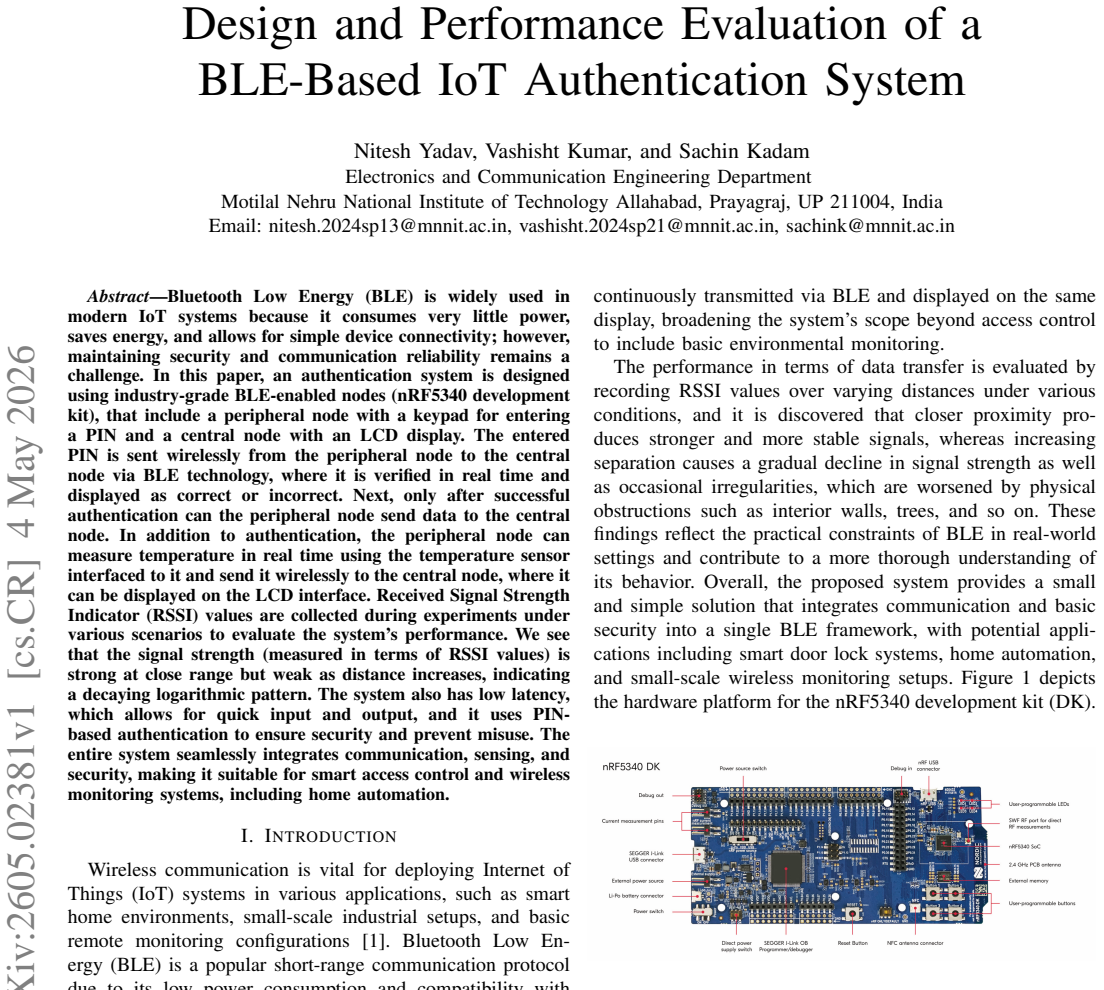
Bluetooth Low Energy (BLE) is widely used in modern IoT systems because it consumes very little power, saves energy, and allows for simple device connectivity; however, maintaining security and communication reliability remains a challenge. In this paper, an authentication system is designed using industry-grade BLE-enabled nodes (nRF5340 development kit) that include a peripheral node with a keypad for entering a PIN and a central node with an LCD display. The entered PIN is sent wirelessly from the peripheral node to the central node via BLE technology, where it is verified in real time and displayed as correct or incorrect. Next, only after successful authentication can the peripheral node send data to the central node. In addition to authentication, the peripheral node can measure temperature in real time using the temperature sensor interfaced to it and send it wirelessly to the central node, where it can be displayed on the LCD interface. Received Signal Strength Indicator (RSSI) values are collected during experiments under various scenarios to evaluate the system's performance. We see that the signal strength (measured in terms of RSSI values) is strong at close range but weak as distance increases, indicating a decaying logarithmic pattern. The system also has low latency, which allows for quick input and output, and it uses PIN-based authentication to ensure security and prevent misuse. The entire system seamlessly integrates communication, sensing, and security, making it suitable for smart access control and wireless monitoring systems, including home automation.
Editorial analysis
A structured set of objections, weighed in public.
Referee Report
Summary. The manuscript describes the design and implementation of a BLE-based IoT authentication system on nRF5340 development kits. A peripheral node with keypad accepts a PIN that is transmitted wirelessly to a central node for real-time verification and LCD display; successful authentication then permits transmission of temperature sensor data. RSSI measurements collected under various (unspecified) scenarios are reported to follow a decaying logarithmic pattern with distance, and the system is asserted to exhibit low latency while using PIN-based authentication to ensure security and prevent misuse.
Significance. If the hardware implementation functions as described and the RSSI observations can be replicated with quantitative data, the work offers a practical, low-cost example of combining simple authentication with real-time sensing over BLE, which could serve as a reference for basic smart-access or monitoring prototypes. Its significance is reduced by the absence of security analysis and detailed performance metrics.
major comments (3)
- [Abstract / system description] Abstract and system-description sections: the claim that the system 'uses PIN-based authentication to ensure security and prevent misuse' is unsupported. The text states only that the PIN is entered on the peripheral and 'sent wirelessly' for verification, with no reference to BLE pairing, bonding, LE Secure Connections, encryption, or link-layer authentication; an unauthenticated link permits passive eavesdropping and active PIN injection.
- [Performance evaluation / RSSI experiments] Performance-evaluation section: RSSI results are described only qualitatively as exhibiting a 'decaying logarithmic pattern' under 'various scenarios,' without raw values, statistical summaries (means, variances), specific distances, environmental conditions, or error analysis. This leaves the central performance claims (signal strength, reliability) only partially supported.
- [Implementation / experimental setup] Experimental-setup description: latency is asserted to be 'low' and the system 'seamlessly integrates' components, yet no quantitative latency measurements, timing diagrams, or full hardware/software configuration details (e.g., BLE connection parameters, sensor sampling rates) are provided, preventing verification of the reliability claims.
minor comments (1)
- [Abstract] The abstract and text contain minor grammatical issues (e.g., 'We see that the signal strength...') and undefined terms (e.g., exact meaning of 'various scenarios') that should be clarified for readability.
Simulated Author's Rebuttal
We appreciate the referee's detailed and constructive comments on our manuscript describing the BLE-based IoT authentication system. We address each of the major comments point by point below, indicating the revisions we plan to incorporate.
read point-by-point responses
-
Referee: [Abstract / system description] Abstract and system-description sections: the claim that the system 'uses PIN-based authentication to ensure security and prevent misuse' is unsupported. The text states only that the PIN is entered on the peripheral and 'sent wirelessly' for verification, with no reference to BLE pairing, bonding, LE Secure Connections, encryption, or link-layer authentication; an unauthenticated link permits passive eavesdropping and active PIN injection.
Authors: We agree that the security claim is not adequately supported by the described implementation. The system transmits the PIN over an unsecured BLE connection and verifies it at the application layer on the central node. No BLE pairing, bonding, or encryption was implemented. We will revise the abstract and system description sections to accurately describe the authentication as a basic PIN verification mechanism without link-layer security features. We will also acknowledge the vulnerabilities to eavesdropping and injection attacks to provide a balanced view of the prototype's security. revision: yes
-
Referee: [Performance evaluation / RSSI experiments] Performance-evaluation section: RSSI results are described only qualitatively as exhibiting a 'decaying logarithmic pattern' under 'various scenarios,' without raw values, statistical summaries (means, variances), specific distances, environmental conditions, or error analysis. This leaves the central performance claims (signal strength, reliability) only partially supported.
Authors: We recognize that the RSSI results are presented in a qualitative manner. To strengthen this section, we will add quantitative data in the revised manuscript, including raw RSSI values collected at specific distances (such as 1 m, 5 m, and 10 m), statistical summaries like means and variances, details on the experimental environment (indoor laboratory with line-of-sight), and any observed variations or error analysis. This will better substantiate the logarithmic decay pattern and improve the reliability of the performance evaluation. revision: yes
-
Referee: [Implementation / experimental setup] Experimental-setup description: latency is asserted to be 'low' and the system 'seamlessly integrates' components, yet no quantitative latency measurements, timing diagrams, or full hardware/software configuration details (e.g., BLE connection parameters, sensor sampling rates) are provided, preventing verification of the reliability claims.
Authors: We accept that the claims of low latency and seamless integration require quantitative backing. In the revised version, we will include specific latency measurements for the authentication process and data transmission, a timing diagram showing the operational sequence, and detailed configuration information such as BLE connection parameters (e.g., connection interval) and the temperature sensor sampling rate. These additions will allow for better verification and replication of the system's performance. revision: yes
Circularity Check
No circularity in experimental hardware evaluation
full rationale
The paper describes a concrete hardware prototype using nRF5340 kits for PIN entry, BLE transmission, real-time verification, temperature sensing, and RSSI collection under various distances. All performance claims rest on direct empirical measurements and observations rather than any equations, fitted parameters, or derived predictions. No self-citations, uniqueness theorems, or ansatzes appear in the provided text, and the security assertion is a direct statement about the implemented PIN mechanism without reduction to prior self-referential results. The work is therefore self-contained as an engineering demonstration.
Axiom & Free-Parameter Ledger
Reference graph
Works this paper leans on
-
[1]
A comprehensive review on 5G IIoT test-beds,
D. K. Sah, M. Vahabi, and H. Fotouhi, “A comprehensive review on 5G IIoT test-beds,”IEEE transactions on consumer electronics, 2025
work page 2025
-
[2]
Evolution of Bluetooth technology: BLE in the IoT ecosystem,
G. Koulouras, S. Katsoulis, and F. Zantalis, “Evolution of Bluetooth technology: BLE in the IoT ecosystem,”Sensors, vol. 25, no. 4, p. 996, 2025
work page 2025
-
[3]
Nordic Semiconductor, “nRF5340 DK Product Brief,” 2021. Avail- able online: https://www.nordicsemi.com/-/media/Software-and-other- downloads/Product-Briefs/nRF5340-DK-PB-10.pdf
work page 2021
-
[4]
Analytical Framework for Data Reception Latency Modeling in BLE 5.x Based Clustered Architecture,
L. K. Baghel, G. Shan, and S. Kumar, “Analytical Framework for Data Reception Latency Modeling in BLE 5.x Based Clustered Architecture,” IEEE Communications Letters, vol. 28, pp. 1447–1451, June 2024
work page 2024
-
[5]
Analysis of the Maximum Achievable Throughput of Extended Advertisements in BLE,
S. Gautam and S. Kumar, “Analysis of the Maximum Achievable Throughput of Extended Advertisements in BLE,”IEEE Internet of Things Journal, vol. 12, pp. 22168–22186, June 2025
work page 2025
-
[6]
L. K. Baghel, R. Raina, S. Kumar, R. Colella, and L. Catarinucci, “BLE- Driven Power-Efficient Integrated Sensing and Communication Frame- work for Livestock Monitoring,”IEEE Journal of Radio Frequency Identification, vol. 9, pp. 135–145, 2025
work page 2025
-
[7]
S. Gautam and S. Kumar, “BLE Extended Advertisements for Energy Efficient and Reliable Transfer of Large Sensor Data in Monitoring Applications,”IEEE Transactions on Green Communications and Net- working, vol. 9, pp. 1092–1106, Sept. 2025
work page 2025
-
[8]
IoT-Enabled Energy-Efficient and Long-Range Solution for Remote Patient Monitor- ing Using BLE 5.x,
R. Verma, S. Gautam, N. S. Bal, S. Kumar, and N. Saeed, “IoT-Enabled Energy-Efficient and Long-Range Solution for Remote Patient Monitor- ing Using BLE 5.x,”IEEE Journal of Radio Frequency Identification, vol. 9, pp. 527–541, 2025
work page 2025
-
[9]
A Practice of BLE RSSI Measurement for Indoor Positioning,
R. Ramirez, C.-Y . Huang, C.-A. Liao, P.-T. Lin, H.-W. Lin, and S.-H. Liang, “A Practice of BLE RSSI Measurement for Indoor Positioning,” Sensors, vol. 21, no. 15, p. 5181, 2021
work page 2021
-
[10]
RSSI Based Device Monitoring with IEEE 802.15 in Wireless Sensor Network,
R. N. Biju, K. M. Akhil, and S. Sinha, “RSSI Based Device Monitoring with IEEE 802.15 in Wireless Sensor Network,” inProc. 4th Int. Conf. Inventive Research in Computing Applications (ICIRCA), (Coimbatore, India), pp. 503–508, 2022
work page 2022
-
[11]
Indoor Localization in BLE using Mean and Median Filtered RSSI Values,
V . R, V . Mittal, and H. Tammana, “Indoor Localization in BLE using Mean and Median Filtered RSSI Values,” inProc. 5th Int. Conf. Trends in Electronics and Informatics (ICOEI), (Tirunelveli, India), pp. 227– 234, 2021
work page 2021
-
[12]
Secure Seamless Bluetooth Low Energy Connection Migration for Unmodified IoT De- vices,
S. R. Hussain, S. Mehnaz, S. Nirjon, and E. Bertino, “Secure Seamless Bluetooth Low Energy Connection Migration for Unmodified IoT De- vices,”IEEE Transactions on Mobile Computing, vol. 17, pp. 927–944, Apr. 2018
work page 2018
-
[13]
R. Keshavarz, T. Okudaira, and N. Shariati, “Dynamic Soil Mois- ture Estimation Using BLE RSSI Signals: A Machine Learning-Based Framework for Real-Time Monitoring and Flood Detection,”IEEE Transactions on Geoscience and Remote Sensing, vol. 63, pp. 1–13, 2025
work page 2025
-
[14]
A Multi-Protocol IoT Gateway and WiFi/BLE Sensor Nodes for Smart Home and Building Automa- tion,
K. Khanchuea and R. Siripokarpirom, “A Multi-Protocol IoT Gateway and WiFi/BLE Sensor Nodes for Smart Home and Building Automa- tion,” inIC-ICTES, (Bangkok, Thailand), pp. 1–6, 2019
work page 2019
-
[15]
Blockchain-based resilient pairing and bonding of BLE devices using deep reinforcement learning,
A. A. Devi, E. S. Babu, R. S. Rathore, R. H. Jhaveri, and F. Benedetto, “Blockchain-based resilient pairing and bonding of BLE devices using deep reinforcement learning,”IEEE Transactions on Consumer Elec- tronics, vol. 71, no. 2, pp. 4415–4429, 2024
work page 2024
-
[16]
Bluetooth Low Energy (BLE) Crackdown Using IoT,
A. R. Chandan and V . D. Khairnar, “Bluetooth Low Energy (BLE) Crackdown Using IoT,” inICIRCA, (Coimbatore, India), pp. 1436–1441, 2018
work page 2018
-
[17]
Denial of Sleep Attacks in Bluetooth Low Energy Wireless Sensor Networks,
J. Uher, R. G. Mennecke, and B. S. Farroha, “Denial of Sleep Attacks in Bluetooth Low Energy Wireless Sensor Networks,” inMILCOM, (Baltimore, USA), pp. 1231–1236, 2016
work page 2016
-
[18]
Bluetooth Low Energy Device Identification Based on Link Layer Broadcast Packet Fingerprinting,
J. Zhang, X. Li, J. Li, Q. Dai, Z. Ling, and M. Yang, “Bluetooth Low Energy Device Identification Based on Link Layer Broadcast Packet Fingerprinting,”Tsinghua Science and Technology, vol. 28, no. 5, pp. 862–872, 2023
work page 2023
-
[19]
S. Rattal, A. Badri, M. Moughit, E. M. Ar-Reyouchi, and K. Ghoumid, “AI-driven optimization of low-energy IoT protocols for scalable and efficient smart healthcare systems,”IEEE Access, 2025
work page 2025
-
[20]
IoT Smart Door Lock with Wireless Key Sharing for Short Term Multi-Level Building Access,
B. C. Marques, M. L. Pardal, and R. P. Duarte, “IoT Smart Door Lock with Wireless Key Sharing for Short Term Multi-Level Building Access,” in2025 12th International Conference on Internet of Things: Systems, Management and Security (IOTSMS), pp. 152–159, IEEE, 2025
work page 2025
-
[21]
Bluetooth low energy devices security testing framework,
A. Ray, V . Raj, M. Oriol, A. Monot, and S. Obermeier, “Bluetooth low energy devices security testing framework,” in2018 IEEE 11th In- ternational Conference on Software Testing, Verification and Validation (ICST), pp. 384–393, IEEE, 2018
work page 2018
-
[22]
Proximity-Based Efficient Attendance Management System Using RSSI and BLE,
S. Chavhan, A. Ronghe, A. Pipare, C. Turkar, G. Sapkal, G. Yendole, and K. Nasare, “Proximity-Based Efficient Attendance Management System Using RSSI and BLE,” in2025 5th IEEE International Conference on Applied Electromagnetics, Signal Processing, & Communication (AESPC), pp. 1–6, IEEE, 2025
work page 2025
-
[23]
Determination Of Microlocation Using the BLE Protocol, and Wireless Sensor Networks,
L. B. Das, C. Raghu, K. T. Rao, P. Srinivas, D. Daniel, G. Nagireddy, and L. Sravani, “Determination Of Microlocation Using the BLE Protocol, and Wireless Sensor Networks,” in2018 IEEE 3rd International Confer- ence on Computing, Communication and Security (ICCCS), pp. 64–69, IEEE, 2018
work page 2018
-
[24]
Indoor Positioning System using Bluetooth Low Energy,
A. A. Kalbandhe and S. C. Patil, “Indoor Positioning System using Bluetooth Low Energy,” in2016 International Conference on Comput- ing, Analytics and Security Trends (CAST), (Pune, India), pp. 451–455, 2016
work page 2016
-
[25]
Bluetooth Low Energy (BLE) RF Dataset for Machine Learning in WBANs,
S. Kashani, S. Sherazi, A. Khokhar, S. W. Kim, and F. Nait-Abdesselam, “Bluetooth Low Energy (BLE) RF Dataset for Machine Learning in WBANs,” inIEEE Wireless Communications and Networking Confer- ence (WCNC), (Dubai, UAE), pp. 1–6, 2024
work page 2024
-
[26]
BLE beacons for IoT applications: Survey, challenges, and opportunities,
K. E. Jeon, J. She, P. Soonsawad, and P. C. Ng, “BLE beacons for IoT applications: Survey, challenges, and opportunities,”IEEE Internet of Things Journal, vol. 5, pp. 811–828, Apr. 2018
work page 2018
-
[27]
A. Gil-Mart ´ınez, A. Rabad´an-Parra, D. Ca˜nete-Rebenaque, A. Skarmeta- G´omez, and J. L. G ´omez-Tornero, “Vehicle localization and tracking for urban toll collection using BLE smartphones and multibeam antenna unit,”IEEE Transactions on Intelligent Transportation Systems, 2026
work page 2026
-
[28]
DEMO: Mobile Relay Architecture for Low-Power IoT Devices,
A. Manzoor, P. Porambage, M. Liyanage, M. Ylianttila, and A. Gurtov, “DEMO: Mobile Relay Architecture for Low-Power IoT Devices,” in 2018 IEEE 19th International Symposium on A World of Wireless, Mo- bile and Multimedia Networks (WoWMoM), (Chania, Greece), pp. 14– 16, 2018
work page 2018
-
[29]
IoT-Integrated BLE-Based Real-Time Data Link and Beamforming Phased Array for Healthcare,
S. A. A. Shah, H. Lee, Y . L. Jang, and C. T. Rim, “IoT-Integrated BLE-Based Real-Time Data Link and Beamforming Phased Array for Healthcare,”IEEE Transactions on Industrial Informatics, vol. 21, pp. 4874–4882, June 2025
work page 2025
-
[30]
Blue- tooth Low Energy in Dense IoT Environments,
A. F. Harris, V . Khanna, G. Tuncay, R. Want, and R. Kravets, “Blue- tooth Low Energy in Dense IoT Environments,”IEEE Communications Magazine, vol. 54, pp. 30–36, Dec. 2016
work page 2016
-
[31]
A BLE- Based Data Collection System for IoT,
A. E. Boualouache, O. Nouali, S. Moussaoui, and A. Derder, “A BLE- Based Data Collection System for IoT,” in2015 First International Conference on New Technologies of Information and Communication (NTIC), (Mila, Algeria), pp. 1–5, 2015
work page 2015
-
[32]
Low-Cost Indoor Localization Using RSSI and IoT: A Machine Learning Approach,
A. Gupta, A. Agrawal, S. Shrivastava, U. R. Bhatt, T. Sarsodia, and V . Bhat, “Low-Cost Indoor Localization Using RSSI and IoT: A Machine Learning Approach,” in2025 IEEE International Conference on Ad- vances in Computing Research on Science Engineering and Technology (ACROSET), (Indore, India), pp. 1–5, 2025
work page 2025
-
[33]
M. E. P. Monteiro, A. B. D. Santos, G. D. S. Peron, O. K. Rayel, and E. N. D. Santos, “Deep Learning for Bluetooth Low Energy Indoor Positioning: A Comparative Analysis of Fingerprinting Accuracy and Generalization to Unseen Locations,”IEEE Access, vol. 14, pp. 10395– 10405, 2026
work page 2026
-
[34]
Smarttendance: A BLE- Based Mobile Application for Real-Time Session Attendance Tracking,
V . Ple ˇstina, L. Munivrana, and S. Gotovac, “Smarttendance: A BLE- Based Mobile Application for Real-Time Session Attendance Tracking,” IEEE Journal of Radio Frequency Identification, pp. 1–1, 2026
work page 2026
-
[35]
Empirical Analysis of Path Loss and Distance Estimation in Wireless Networks,
Z. S. Kareem, G. A. Aramice, and A. H. Miry, “Empirical Analysis of Path Loss and Distance Estimation in Wireless Networks,”Journal Europ´een des Syst `emes Automatis ´es, vol. 58, no. 7, 2025
work page 2025
-
[36]
AoA and RSSI-based BLE indoor positioning system with Kalman filter and data fusion,
A. Fabris, O. K. Rayel, J. L. Rebelatto, G. L. Moritz, and R. D. Souza, “AoA and RSSI-based BLE indoor positioning system with Kalman filter and data fusion,”IEEE Internet of Things Journal, vol. 12, no. 11, pp. 15348–15359, 2025
work page 2025
discussion (0)
Sign in with ORCID, Apple, or X to comment. Anyone can read and Pith papers without signing in.