Recognition: 3 theorem links
· Lean TheoremDetectability of Magnetar-Induced Vacuum Birefringence with IXPE and eXTP
Pith reviewed 2026-05-08 18:38 UTC · model grok-4.3
The pith
Magnetars induce vacuum birefringence with time delays large enough for IXPE and eXTP to measure quantitatively.
A machine-rendered reading of the paper's core claim, the machinery that carries it, and where it could break.
Core claim
By modeling magnetar magnetic fields realistically and applying Adler's integral formula, the analysis reveals time delays between polarization components that exceed previous predictions by up to an order of magnitude. Computation of the Stokes parameters for all catalogued magnetars shows that the resulting polarization signatures fall within the measurable range of both IXPE and eXTP, with 1RXS J170849.0-400910 offering the strongest signal for detection of vacuum birefringence.
What carries the argument
Adler's integral formula for the phase difference and time delay in photon propagation through a magnetic field, evaluated using a realistic magnetar B-field profile.
If this is right
- Quantitative detection of the birefringence would provide a direct probe of quantum vacuum effects in ultra-strong magnetic fields.
- The larger predicted time delays increase the likelihood of successful measurements with current and upcoming polarimeters.
- Selection of 1RXS J170849.0-400910 as the prime target guides observational strategies for both IXPE and eXTP.
- Successful measurement could validate the adopted magnetic field model or reveal discrepancies requiring refined profiles.
Where Pith is reading between the lines
- If confirmed, such detections might allow differentiation between competing models of magnetar internal structure.
- Similar birefringence effects could be sought in other astrophysical environments with strong fields, such as neutron star mergers.
- Non-detection in the best candidate would require reassessment of either the field profile or the dominance of vacuum birefringence over other propagation effects.
- Future missions with higher sensitivity could extend this to a larger sample of magnetars.
Load-bearing premise
The realistic magnetic field profile accurately captures the actual structure of magnetar fields, and other propagation effects do not overwhelm the vacuum birefringence contribution to the time delay.
What would settle it
A measurement by IXPE or eXTP of the polarization properties of 1RXS J170849.0-400910 that shows no significant phase difference or time delay inconsistent with the calculated values would indicate the claim is incorrect.
Figures



read the original abstract
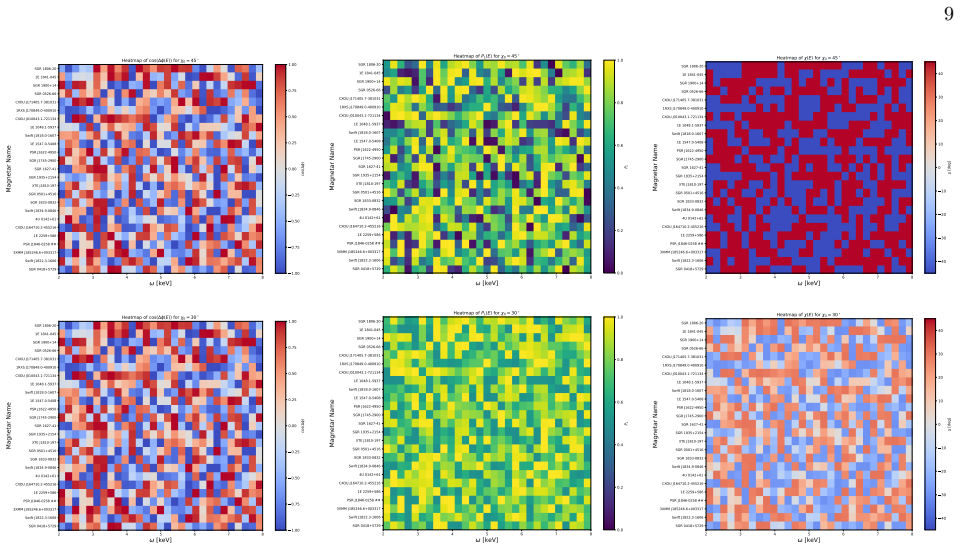
We analyze the prospects of quantitatively detecting vacuum birefringence from magnetars using the IXPE and eXTP experiments. We adopt a realistic profile to model the magnetic field of magnetars, and use it to calculate the time delay and phase difference in the parallel and perpendicular components of polarization eigenmodes using Adler's integral formula. We find that the time delay could be an order of magnitude larger than previous estimates in the literature. We also calculate the Stokes parameters for all known magnetars and show that both IXPE and eXTP are capable of quantitatively measuring birefringence from magnetars, with the magnetar dubbed 1RXS J170849.0-400910 being the best candidate for detection.
Editorial analysis
A structured set of objections, weighed in public.
Referee Report
Summary. The manuscript analyzes prospects for detecting magnetar-induced vacuum birefringence with IXPE and eXTP. It adopts one realistic magnetic field profile, integrates it via Adler's integral formula to compute time delay Δt and phase difference Δφ between polarization eigenmodes, reports that Δt can be an order of magnitude larger than prior literature values, computes Stokes parameters for all catalogued magnetars, and concludes that both instruments can quantitatively measure the effect, identifying 1RXS J170849.0-400910 as the best candidate.
Significance. If the central calculations prove robust, the work would be significant for providing concrete, observationally actionable predictions of a QED vacuum birefringence signal in strong-field astrophysics. Surveying all known magnetars and nominating a specific target supplies useful guidance for IXPE/eXTP campaigns. The use of standard formulas (Adler's integral) together with catalogued magnetar properties is a strength that supports reproducibility, though the absence of validation against alternatives limits the strength of the order-of-magnitude claim.
major comments (3)
- [Magnetic field profile section] Magnetic field profile section: The manuscript adopts a single 'realistic' B(r) profile and integrates it in Adler's formula to obtain the reported Δt and Δφ values. No comparison is made to alternative profiles (e.g., twisted dipole or multipolar) nor is it shown that this profile is required by existing magnetar observations. Because this choice directly produces the order-of-magnitude larger time delay, the detectability conclusion for IXPE/eXTP rests on an untested assumption.
- [Propagation and competing effects] Propagation and competing effects: The calculation of time delay and phase difference via Adler's integral does not include an assessment of whether plasma dispersion, geometric propagation effects, or higher-order QED terms remain sub-dominant along the line of sight. If any of these dominate or partially cancel the birefringence signal, the predicted Stokes parameters and the claim that both instruments can quantitatively measure the effect would no longer hold.
- [Stokes parameters and detectability results] Stokes parameters and detectability results: The Stokes-parameter calculations for the full magnetar catalog (including the highlighted source 1RXS J170849.0-400910) provide no error budgets, instrument-response folding, or numerical validation against IXPE/eXTP sensitivity. Without these, the quantitative measurability assertion cannot be verified from the presented material.
minor comments (2)
- [Abstract] The abstract states that the time delay 'could be' an order of magnitude larger; the main text should state the precise numerical factor obtained with the adopted profile and the conditions under which it applies.
- [Methods] Notation for the polarization eigenmodes and the definition of the integral limits in Adler's formula should be made fully explicit in the methods section to allow direct reproduction.
Simulated Author's Rebuttal
We thank the referee for the careful and constructive review. The comments highlight important aspects of robustness and validation that we address point by point below. We indicate where revisions will be made to strengthen the manuscript.
read point-by-point responses
-
Referee: [Magnetic field profile section] The manuscript adopts a single 'realistic' B(r) profile and integrates it in Adler's formula to obtain the reported Δt and Δφ values. No comparison is made to alternative profiles (e.g., twisted dipole or multipolar) nor is it shown that this profile is required by existing magnetar observations. Because this choice directly produces the order-of-magnitude larger time delay, the detectability conclusion for IXPE/eXTP rests on an untested assumption.
Authors: The adopted profile is drawn from recent magnetar models that incorporate a twisted magnetosphere, consistent with observational constraints from burst activity and spin-down behavior. This choice yields stronger fields at larger radii than a pure dipole, directly explaining the larger integrated delays relative to prior literature that used simpler profiles. We agree that an explicit comparison would improve robustness. In the revised manuscript we will add a short subsection comparing the time delays obtained with the realistic profile versus a standard dipole, confirming the order-of-magnitude difference while clarifying that the profile is a representative realistic case rather than uniquely required by all observations. revision: partial
-
Referee: [Propagation and competing effects] The calculation of time delay and phase difference via Adler's integral does not include an assessment of whether plasma dispersion, geometric propagation effects, or higher-order QED terms remain sub-dominant along the line of sight. If any of these dominate or partially cancel the birefringence signal, the predicted Stokes parameters and the claim that both instruments can quantitatively measure the effect would no longer hold.
Authors: For the X-ray band and distances involved, the plasma frequency lies well below the photon energies, rendering plasma dispersion negligible compared with the QED contribution; geometric propagation is already incorporated via the line-of-sight integration in Adler's formula. Higher-order QED corrections are suppressed by additional factors of α and (B/B_crit). To make these estimates explicit and address the concern directly, we will insert a new subsection in the revised manuscript that quantifies the relative magnitudes of these effects for the relevant parameter range and demonstrates they remain sub-dominant. revision: yes
-
Referee: [Stokes parameters and detectability results] The Stokes-parameter calculations for the full magnetar catalog (including the highlighted source 1RXS J170849.0-400910) provide no error budgets, instrument-response folding, or numerical validation against IXPE/eXTP sensitivity. Without these, the quantitative measurability assertion cannot be verified from the presented material.
Authors: The Stokes parameters were derived from the computed phase and time delays under idealized conditions to illustrate the magnitude of the birefringence signature. We recognize that a complete assessment requires instrument-specific considerations. In the revision we will add approximate error budgets based on expected source count rates and the published polarization sensitivities of IXPE and eXTP, together with a discussion of how the predicted changes in Stokes parameters compare to the minimum detectable polarization after folding with representative instrument responses. revision: yes
Circularity Check
No significant circularity; forward calculation from adopted external profile and standard formulas
full rationale
The derivation adopts a realistic B(r) profile as input, integrates it via Adler's integral formula (an external QED result), computes Δt/Δφ and Stokes parameters for catalogued magnetar properties, and concludes detectability. No parameter is fitted to the target observables, no self-citation chain justifies the central premise, and no result is renamed or defined in terms of itself. The order-of-magnitude claim is a direct numerical comparison to prior external literature. The chain is therefore self-contained and non-circular.
Axiom & Free-Parameter Ledger
axioms (1)
- standard math Adler's integral formula accurately gives the phase difference and time delay for polarization eigenmodes in a magnetized vacuum
Lean theorems connected to this paper
-
IndisputableMonolith/Cost/FunctionalEquation.lean — J(x)=½(x+x⁻¹)−1 uniquenesswashburn_uniqueness_aczel unclear?
unclearRelation between the paper passage and the cited Recognition theorem.
We adopt a realistic profile to model the magnetic field of magnetars, and use it to calculate the time delay and phase difference in the parallel and perpendicular components of polarization eigenmodes using Adler's integral formula.
-
IndisputableMonolith/Foundation/AlphaDerivationExplicit.lean — α from forced 44π structurealphaProvenanceCert unclear?
unclearRelation between the paper passage and the cited Recognition theorem.
B(r) = B0 for r ≤ R_M; B0 (R_M/r)^3 for r > R_M ... Δt = (1/c) ∫ Δn(B(√(b²+z²))) dz
-
Foundation/BlackBodyRadiationDeep.lean — J-cost-shaped EM observablesblackBodyRadiationDeepCert unclear?
unclearRelation between the paper passage and the cited Recognition theorem.
n_∥ = 1 + (14α²/45 m⁴)(1 + 1315α/252π) B², n_⊥ = 1 + (8α²/45 m⁴)(1 + 40α/9π) B²
What do these tags mean?
- matches
- The paper's claim is directly supported by a theorem in the formal canon.
- supports
- The theorem supports part of the paper's argument, but the paper may add assumptions or extra steps.
- extends
- The paper goes beyond the formal theorem; the theorem is a base layer rather than the whole result.
- uses
- The paper appears to rely on the theorem as machinery.
- contradicts
- The paper's claim conflicts with a theorem or certificate in the canon.
- unclear
- Pith found a possible connection, but the passage is too broad, indirect, or ambiguous to say the theorem truly supports the claim.
Reference graph
Works this paper leans on
-
[1]
For an incident photon of energyω, the accumulated phase retardation for each mode can be 1 Note that this solution is only valid forr∼R M
In addition to ∆t, birefringence will lead to a phase difference between the parallel and perpendicular eigenmodes. For an incident photon of energyω, the accumulated phase retardation for each mode can be 1 Note that this solution is only valid forr∼R M. We only extend the lines beyond that for visual clarity. 7 10 2 10 1 100 101 102 103 104 B/Bc 10 11 1...
2021
-
[2]
Consequences of Dirac Theory of the Positron
W. Heisenberg and H. Euler, “Consequences of Dirac’s theory of positrons,” Z. Phys.98, no.11-12, 714-732 (1936) physics/physics/0605038. I, I
work page Pith review arXiv 1936
-
[3]
V. F. Weisskopf, Dan. Mat. Fys. Medd. 14, 1 (1936) I, I
1936
-
[4]
On gauge invariance and vacuum polarization,
J. S. Schwinger, “On gauge invariance and vacuum polarization,” Phys. Rev.82, 664-679 (1951) I, I
1951
-
[5]
¨Uber die Streuung kurzwelligerγ-Strahlen,
L. Meitner and H. K¨ osters, “¨Uber die Streuung kurzwelligerγ-Strahlen,” Z. Phys.84, no.3-4, 137-144 (1933) I
1933
-
[6]
Note added in proof by M. Delbr¨ uck,
M. Delbr¨ uck, “Note added in proof by M. Delbr¨ uck,” Z. Phys.84, no.3-4, 144 (1933) I
1933
-
[7]
Uber das Verhalten eines Elektrons im homogenen elektrischen Feld nach der relativistischen Theorie Diracs,
F. Sauter, “Uber das Verhalten eines Elektrons im homogenen elektrischen Feld nach der relativistischen Theorie Diracs,” Z. Phys.69, 742-764 (1931) I
1931
-
[8]
Photon splitting and photon dispersion in a strong magnetic field,
S. L. Adler, “Photon splitting and photon dispersion in a strong magnetic field,” Annals Phys.67, 599-647 (1971) I, I, II
1971
-
[9]
Delbruck scattering of 7.9 MeV photons,
R. Moreh and S. Kahana, “Delbruck scattering of 7.9 MeV photons,” Phys. Lett. B47, 351-354 (1973) I 15
1973
-
[10]
Giant dipole resonance and Coulomb correction effect in Delbruck scattering studied by elastic and Raman scattering of 8.5 to 11.4 MeV photons,
P. Rullhusen, U. Zurmuhl, F. Smend, M. Schumacher, H. G. Borner and S. A. Kerr, “Giant dipole resonance and Coulomb correction effect in Delbruck scattering studied by elastic and Raman scattering of 8.5 to 11.4 MeV photons,” Phys. Rev. C27, 559-568 (1983)
1983
-
[11]
Measurement of delbrueck scattering and observation of photon splitting at high energies,
G. Jarlskog, L. Joensson, S. Pruenster, H. D. Schulz, H. J. Willutzki and G. G. Winter, “Measurement of delbrueck scattering and observation of photon splitting at high energies,” Phys. Rev. D8, 3813-3823 (1973) I
1973
-
[12]
D. d’Enterria and G. G. da Silveira, “Observing light-by-light scattering at the Large Hadron Collider,” Phys. Rev. Lett.111, 080405 (2013) [erratum: Phys. Rev. Lett.116, no.12, 129901 (2016)]hep-ph/1305.7142. I
-
[13]
M. Aaboudet al.[ATLAS], “Evidence for light-by-light scattering in heavy-ion collisions with the ATLAS detector at the LHC,” Nature Phys.13, no.9, 852-858 (2017)hep-ex/1702.01625. I
-
[14]
Searches for axion- and graviton-like particles viaγγfusion at FCC-hh
A. M. Sirunyanet al.[CMS], “Evidence for light-by-light scattering and searches for axion-like particles in ultra- peripheral PbPb collisions at √sNN = 5.02 TeV,”hep-ex/1810.04602. I
- [15]
-
[16]
J. C. Yang, Z. B. Qing, X. Y. Han, Y. C. Guo and T. Li, “Tri-photon at muon collider: a new process to probe the anomalous quartic gauge couplings,” JHEP22, 053 (2020)hep-ph/2204.08195. I
-
[17]
Probing anomalousγγγγcouplings at a future muon collider,
H. Amarkhail, S. C. Inan and A. V. Kisselev, “Probing anomalousγγγγcouplings at a future muon collider,” Nucl. Phys. B1005, 116592 (2024)hep-ph/2306.03653
-
[18]
Analysis of anomalousHγγcoupling in light-by-light collision at future muon collider,
S. Spor and E. Gurkanli, “Analysis of anomalousHγγcoupling in light-by-light collision at future muon collider,” hep-ph/2412.02346. I
-
[19]
Realization of laser intensity over 1023 W/cm2,
J. W. Yoon, J. W. Yoon, Y. G. Kim, Y. G. Kim, I. W. Choi, I. W. Choi, J. H. Sung, J. H. Sung, H. W. Lee and S. K. Lee,et al.“Realization of laser intensity over 1023 W/cm2,” Optica8, no.5, 630-635 (2021) I
2021
-
[20]
Petawatt and exawatt class lasers worldwide,
C. N. Danson, C. Haefner, J. Bromage, T. Butcher, J. C. F. Chanteloup, E. A. Chowdhury, A. Galvanauskas, L. A. Gizzi, J. Hein and D. I. Hillier,et al.“Petawatt and exawatt class lasers worldwide,” High Power Laser Sci. Eng.7, e54 (2019) I
2019
-
[21]
F. Della Valle, A. Ejlli, U. Gastaldi, G. Messineo, E. Milotti, R. Pengo, G. Ruoso and G. Zavattini, “The PVLAS experiment: measuring vacuum magnetic birefringence and dichroism with a birefringent Fabry–Perot cavity,” Eur. Phys. J. C76, no.1, 24 (2016)physics.optics/1510.08052. I
-
[22]
Polarized x-rays from a magnetar,
R. Taverna, R. Turolla, F. Muleri, J. Heyl, S. Zane, L. Baldini, D. G. Caniulef, M. Bachetti, J. Rankin and I. Caiazzo,et al.“Polarized x-rays from a magnetar,”astro-ph.HE/2205.08898. I, IV
-
[23]
McGill Online Magnetar Catalog,
“McGill Online Magnetar Catalog,”http://www.physics.mcgill.ca/ ~pulsar/magnetar/main.htmlI, III
-
[24]
Foundations of the new field theory,
M. Born and L. Infeld, “Foundations of the new field theory,” Proc. Roy. Soc. Lond. A144, no.852, 425-451 (1934) I
1934
-
[25]
Towards LHC physics with nonlocal Standard Model,
T. Biswas and N. Okada, “Towards LHC physics with nonlocal Standard Model,” Nucl. Phys. B898, 113-131 (2015)hep-ph/1407.3331. I
-
[26]
A proposed renormalization scheme for non-local QFTs and application to the hierarchy problem,
F. Abu-Ajamieh and S. K. Vempati, “A proposed renormalization scheme for non-local QFTs and application to the hierarchy problem,” Eur. Phys. J. C83, no.11, 1070 (2023)hep-th/2304.07965
-
[27]
Anomalies in string-inspired nonlocal extensions of QED,
F. Abu-Ajamieh, P. Chattopadhyay, A. Ghoshal and N. Okada, “Anomalies in string-inspired nonlocal extensions of QED,” Phys. Rev. D109, no.7, 076013 (2024)hep-th/2307.01589
-
[28]
F. Abu-Ajamieh, N. Okada and S. K. Vempati, “Corrected calculation for the non-local solution to the g−2 anomaly and novel results in non-local QED,” JHEP01, 015 (2024)2309.08417/arXivhep-ph. I
-
[29]
Negative Metric and the Unitarity of the S Matrix,
T. D. Lee and G. C. Wick, “Negative Metric and the Unitarity of the S Matrix,” Nucl. Phys. B9, 209-243 (1969) I
1969
-
[30]
Finite Theory of Quantum Electrodynamics,
T. D. Lee and G. C. Wick, “Finite Theory of Quantum Electrodynamics,” Phys. Rev. D2, 1033-1048 (1970)
1970
-
[31]
Phenomenological aspects of Lee-Wick QED,
F. Abu-Ajamieh, P. Chattopadhyay and M. Frasca, “Phenomenological aspects of Lee-Wick QED,” Nucl. Phys. B 1011, 116799 (2025)hep-ph/2406.16699
-
[32]
Aspects of non-local QED and the weak gravity conjecture,
F. Abu-Ajamieh, N. Okada and S. K. Vempati, “Aspects of non-local QED and the weak gravity conjecture,” Eur. Phys. J. C85, no.5, 527 (2025)hep-ph/2411.04877. I
-
[33]
Light propagation in nontrivial QED vacua,
W. Dittrich and H. Gies, “Light propagation in nontrivial QED vacua,” Phys. Rev. D58, 025004 (1998) hep-ph/hep-ph/9804375. II
-
[34]
Magnetars as laboratories for strong field QED,
C. M. Kim and S. P. Kim, “Magnetars as laboratories for strong field QED,” AIP Conf. Proc.2874, no.1, 020013 (2024)astro-ph.HE/2112.02460. II
-
[35]
Nonlinear electromagnetic and gravitational actions of neutron star fields on electromagnetic wave propagation,
V. I. Denisov and S. I. Svertilov, “Nonlinear electromagnetic and gravitational actions of neutron star fields on electromagnetic wave propagation,” Phys. Rev. D71, 063002 (2005) III, III
2005
-
[36]
Nonlinear vacuum electrodynamics birefringence effect in a 16 pulsar’s strong magnetic field,
V. I. Denisov, V. A. Sokolov and M. I. Vasili’ev, “Nonlinear vacuum electrodynamics birefringence effect in a 16 pulsar’s strong magnetic field,” Phys. Rev. D90, no.2, 023011 (2014)
2014
-
[37]
Some astrophysical effects of nonlinear vacuum electrodynamics in the magnetosphere of a pulsar,
M. Abishev, Y. Aimuratov, Y. Aldabergenov, N. Beissen, Z. Bakytzhan and M. Takibayeva, “Some astrophysical effects of nonlinear vacuum electrodynamics in the magnetosphere of a pulsar,” Astropart. Phys.73, 8-13 (2016) gr-qc/1411.3127
-
[38]
Nonperturbative QED vacuum birefringence,
V. I. Denisov, E. E. Dolgaya and V. A. Sokolov, “Nonperturbative QED vacuum birefringence,” JHEP05, 105 (2017)hep-ph/1612.09086
-
[39]
Effects of non-linear electrodynamics of vacuum in the magnetic quadrupole field of a pulsar,
M. E. Abishev, S. Toktarbay, N. A. Beissen, F. B. Belissarova, M. K. Khassanov, A. S. Kudussov and A. Z. Aby- layeva, “Effects of non-linear electrodynamics of vacuum in the magnetic quadrupole field of a pulsar,” Mon. Not. Roy. Astron. Soc.481, no.1, 36-43 (2018) III, III
2018
-
[40]
The IXPE instrument calibration equipment,
F. Muleri, R. Piazzolla, A. Di Marco, S. Fabiani, F. La Monaca, C. Lefevre, A. Morbidini, J. Rankin, P. Sof- fitta and A. Tobia,et al.“The IXPE instrument calibration equipment,” Astropart. Phys.136, 102658 (2022) astro-ph.IM/2111.02066. III, IV
-
[41]
The enhanced X-ray Timing and Polarimetry mission - eXTP
S. N. Zhanget al.[eXTP], “The enhanced X-ray Timing and Polarimetry mission—eXTP,” Sci. China Phys. Mech. Astron.62, no.2, 29502 (2019)astro-ph.IM/1812.04020. III, IV
work page Pith review arXiv 2019
discussion (0)
Sign in with ORCID, Apple, or X to comment. Anyone can read and Pith papers without signing in.