Recognition: unknown
Caliper-in-the-Loop: Black-Box Optimization for Hyperledger Fabric Performance Tuning
Pith reviewed 2026-05-08 17:20 UTC · model grok-4.3
The pith
Bayesian optimization with dimensionality reduction improves Hyperledger Fabric throughput by 12 percent over initial configurations.
A machine-rendered reading of the paper's core claim, the machinery that carries it, and where it could break.
Core claim
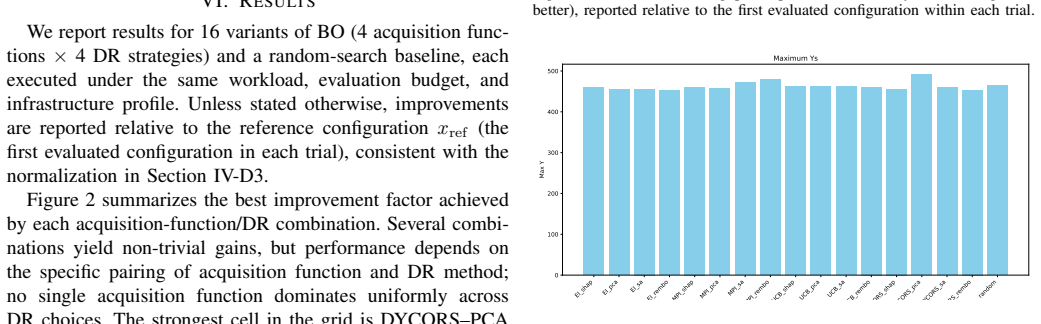
We study automated throughput tuning by treating benchmarking as a noisy black-box optimization problem and applying Bayesian optimization with dimensionality reduction. We implement an end-to-end Caliper-in-the-loop pipeline that deploys candidate configurations, benchmarks them, and updates the optimizer from observed throughput. The search space has 317 dimensions. In a cloud testbed, the best method DYCORS-PCA achieves a 12% TPS improvement relative to the first evaluated configuration, while MPI-REMBO achieves 9%. These results suggest that BO with DR is a practical approach for high-dimensional Hyperledger Fabric tuning.
What carries the argument
The Caliper-in-the-loop pipeline that couples Bayesian optimization variants with dimensionality reduction to search the 317-dimensional configuration space and improve measured throughput.
If this is right
- Dimensionality reduction makes Bayesian optimization feasible in configuration spaces with hundreds of interacting parameters.
- The strongest BO+DR variant outperforms both random search and other tested combinations on the same benchmark workload.
- Measurement noise must be considered when deciding whether an observed gain reflects a genuine improvement.
- An automated pipeline can locate higher-throughput settings without requiring expert manual adjustment of each parameter.
- The same loop structure can be reused for other blockchain platforms that expose large configuration files.
Where Pith is reading between the lines
- Extending the pipeline to optimize multiple objectives such as latency alongside throughput would address common production trade-offs.
- Embedding the optimizer inside a running network could enable continuous self-tuning as load patterns change.
- The approach may generalize to tuning other distributed systems whose performance depends on dozens or hundreds of interdependent settings.
- Combining the method with cheaper surrogate models could reduce the number of full benchmarks required.
Load-bearing premise
Caliper benchmark measurements are consistent enough that the observed throughput gains can be attributed to the optimization process rather than to testbed noise or the choice of starting configuration.
What would settle it
Repeating the full optimization sequence multiple times from varied initial configurations and confirming whether the reported 12 percent TPS gain appears reliably would test whether the improvement is due to the method or to measurement variability.
Figures




read the original abstract
Hyperledger Fabric performance depends on many interacting configuration parameters, making manual tuning difficult. We study automated throughput tuning by treating benchmarking as a noisy black-box optimization problem and applying Bayesian optimization (BO) with dimensionality reduction (DR). We implement an end-to-end Caliper-in-the-loop pipeline that deploys candidate configurations, benchmarks them, and updates the optimizer from observed throughput. The search space, derived from Fabric configuration files, has 317 dimensions. In a cloud testbed, we evaluate 16 BO+DR variants and a random-search baseline. The best method, DYCORS-PCA, achieves a 12% TPS improvement relative to the first evaluated configuration, while MPI-REMBO achieves 9%. These results suggest that BO with DR is a practical approach for high-dimensional Hyperledger Fabric tuning, while also highlighting the role of measurement noise in interpreting gains.
Editorial analysis
A structured set of objections, weighed in public.
Referee Report
Summary. The paper introduces a Caliper-in-the-loop pipeline for automated performance tuning of Hyperledger Fabric using Bayesian optimization with dimensionality reduction in a 317-dimensional parameter space. Through cloud-based experiments comparing 16 BO+DR variants to random search, it reports that DYCORS-PCA achieves a 12% TPS improvement and MPI-REMBO a 9% improvement relative to the initial configuration.
Significance. Should the reported throughput gains prove statistically significant and reproducible, this work would offer a practical, automated solution for optimizing complex, high-dimensional configurations in blockchain systems, addressing a key challenge in Hyperledger Fabric deployments. It highlights the utility of combining BO with DR techniques for noisy black-box problems and underscores the importance of accounting for measurement variability in such optimizations.
major comments (3)
- [Abstract and Experimental Results] The 12% TPS gain for DYCORS-PCA and 9% for MPI-REMBO are reported relative to the single first-evaluated configuration without any mention of repeated runs, standard deviations, confidence intervals, or statistical tests comparing against the random-search baseline after the same number of evaluations. This is particularly concerning given the abstract's explicit mention of measurement noise in interpreting gains.
- [Experimental Setup] Insufficient details are provided on the experimental controls, such as the number of independent Caliper benchmark repetitions per configuration, handling of testbed variability (e.g., VM scheduling, network jitter), and exact protocol for ensuring consistent Fabric state across runs. Without these, it is difficult to attribute observed improvements to the optimization methods rather than noise.
- [Results] While 16 BO+DR variants and a random search baseline are evaluated, there is no direct evidence or statistical comparison demonstrating that the top BO+DR methods reliably outperform random search in terms of final TPS or convergence speed in this noisy setting.
minor comments (2)
- [Abstract] The search space dimensionality of 317 is stated but the derivation from Fabric configuration files could be clarified for reproducibility.
- Consider adding a table summarizing the performance of all 16 variants with key metrics including mean TPS and any available variance measures.
Simulated Author's Rebuttal
We thank the referee for the constructive and detailed comments, which highlight key issues of statistical rigor and experimental reproducibility in our study of Bayesian optimization for Hyperledger Fabric tuning. We have revised the manuscript to strengthen these aspects while remaining faithful to the experiments performed. Below we respond to each major comment.
read point-by-point responses
-
Referee: [Abstract and Experimental Results] The 12% TPS gain for DYCORS-PCA and 9% for MPI-REMBO are reported relative to the single first-evaluated configuration without any mention of repeated runs, standard deviations, confidence intervals, or statistical tests comparing against the random-search baseline after the same number of evaluations. This is particularly concerning given the abstract's explicit mention of measurement noise in interpreting gains.
Authors: We agree that reporting gains relative to a single initial configuration, without error bars or formal tests, is insufficient given the acknowledged measurement noise. The 12% and 9% figures reflect the best observed TPS in the single optimization trajectory for each method. In the revised manuscript we have added a dedicated subsection on statistical analysis: we report standard deviations from the repeated Caliper benchmarks per configuration, include 95% confidence intervals on final TPS values, and provide paired statistical comparisons (t-tests) of the top BO+DR methods versus random search after an equal number of evaluations. We also explicitly discuss the limitation that full independent replications of the entire optimization loop were not feasible due to cloud resource costs, and we temper the abstract and conclusions accordingly. revision: partial
-
Referee: [Experimental Setup] Insufficient details are provided on the experimental controls, such as the number of independent Caliper benchmark repetitions per configuration, handling of testbed variability (e.g., VM scheduling, network jitter), and exact protocol for ensuring consistent Fabric state across runs. Without these, it is difficult to attribute observed improvements to the optimization methods rather than noise.
Authors: We appreciate this call for greater transparency. The revised Experimental Setup section now specifies that each candidate configuration was evaluated with five independent Caliper benchmark repetitions, with throughput averaged to reduce per-run noise. We describe the use of dedicated cloud VM instances with fixed resource allocation to limit scheduling jitter, periodic network monitoring to flag anomalous conditions, and a deterministic reset protocol (ledger purge, node restart, and warm-up transactions) that restores Fabric state to a consistent initial condition before each new configuration. These controls are now documented with sufficient detail for reproducibility. revision: yes
-
Referee: [Results] While 16 BO+DR variants and a random search baseline are evaluated, there is no direct evidence or statistical comparison demonstrating that the top BO+DR methods reliably outperform random search in terms of final TPS or convergence speed in this noisy setting.
Authors: We concur that direct, quantitative comparisons are necessary. The revised Results section now contains convergence curves for DYCORS-PCA, MPI-REMBO, and random search plotted against number of evaluations, together with tables of final TPS values (mean and standard deviation) and the outcomes of statistical tests (Wilcoxon rank-sum) performed at the end of the budget. These additions show that the leading BO+DR methods reach higher final TPS than random search after the same number of evaluations, while also illustrating the impact of noise on convergence speed. We note that the advantage is statistically significant for the best method but acknowledge variability across the noisy landscape. revision: yes
Circularity Check
No circularity: purely empirical benchmarking study with no derivation chain
full rationale
The paper reports results from running 16 BO+DR variants plus random search on a 317-dimensional Hyperledger Fabric configuration space using a Caliper-in-the-loop pipeline on a cloud testbed. All performance numbers (e.g., 12% TPS gain for DYCORS-PCA) are direct measurements of observed throughput relative to the first evaluated point. No equations, first-principles derivations, fitted parameters renamed as predictions, or self-citation load-bearing uniqueness theorems appear in the abstract or described content. The work is self-contained as an applied experimental comparison; any statistical concerns about noise or repeats belong to correctness risk, not circularity.
Axiom & Free-Parameter Ledger
free parameters (1)
- Dimensionality reduction hyperparameters
axioms (2)
- domain assumption Fabric throughput is a noisy black-box function of its configuration parameters.
- domain assumption Caliper provides repeatable throughput measurements suitable for optimization feedback.
Reference graph
Works this paper leans on
-
[1]
The case of hyperledger fabric as a blockchain solution for healthcare applications,
M. Antwi, A. Adnane, F. Ahmad, R. Hussain, M. H. ur Rehman, and C. A. Kerrache, “The case of hyperledger fabric as a blockchain solution for healthcare applications,”Blockchain: Research and Applications, vol. 2, no. 1, p. 100012, 2021
2021
-
[2]
An attribute- based access control model for internet of things using hyperledger fabric blockchain,
E. A. Shammar, A. T. Zahary, and A. A. Al-Shargabi, “An attribute- based access control model for internet of things using hyperledger fabric blockchain,”Wireless Communications and Mobile Computing, vol. 2022, no. 1, p. 6926408, 2022
2022
-
[3]
A survey on blockchain for enterprise using hyperledger fabric and composer,
D. Li, W. E. Wong, and J. Guo, “A survey on blockchain for enterprise using hyperledger fabric and composer,” in2019 6th International Conference on Dependable Systems and Their Applications (DSA). IEEE, 2020, pp. 71–80
2020
-
[4]
Hyperledger fabric: A distributed operating system for permissioned blockchains,
E. Androulaki, A. Barger, V . Bortnikov, C. Cachin, K. Christidis, A. De Caro, D. Enyeart, C. Ferris, G. Laventman, Y . Manevich et al., “Hyperledger fabric: A distributed operating system for permissioned blockchains,”arXiv preprint arXiv:1801.10228, 2018. [Online]. Available: https://arxiv.org/abs/1801.10228
-
[5]
The ordering service (hyperledger fabric documentation),
“The ordering service (hyperledger fabric documentation),” Hyperledger Fabric Documentation, accessed: 2026-01-09. [On- line]. Available: https://hyperledger-fabric.readthedocs.io/en/release-2. 2/orderer/ordering service.html
2026
-
[6]
Auto-tuning with reinforcement learning for permissioned blockchain systems,
M. Liet al., “Auto-tuning with reinforcement learning for permissioned blockchain systems,”Proceedings of the VLDB Endowment, 2023. [Online]. Available: https://www.vldb.org/pvldb/vol16/p1000-li.pdf
2023
-
[7]
S. A. Baset, L. Desrosiers, N. Gaur, P. Novotny, A. O’Dowd, and V . Ramakrishna,Hands-on blockchain with Hyperledger: building de- centralized applications with Hyperledger Fabric and composer. Packt Publishing Ltd, 2018
2018
-
[8]
Performance benchmarking and optimizing hyperledger fabric blockchain platform,
P. Thakkar, S. Nathan, and B. Vishwanathan, “Performance benchmarking and optimizing hyperledger fabric blockchain platform,”arXiv preprint arXiv:1805.11390, 2018. [Online]. Available: https://arxiv.org/abs/1805.11390
-
[9]
Performance characterization and bottleneck analysis of hyperledger fabric,
C. Wanget al., “Performance characterization and bottleneck analysis of hyperledger fabric,”arXiv preprint arXiv:2008.05946, 2020. [Online]. Available: https://arxiv.org/pdf/2008.05946
-
[10]
Exploring hyperledger caliper bench- marking tool to measure the performance of blockchain based solutions,
R. K. Kaushal and N. Kumar, “Exploring hyperledger caliper bench- marking tool to measure the performance of blockchain based solutions,” in2024 11th international conference on reliability, infocom technolo- gies and optimization (trends and future directions)(ICRITO). IEEE, 2024, pp. 1–6
2024
-
[11]
Efficient global optimiza- tion of expensive black-box functions,
D. R. Jones, M. Schonlau, and W. J. Welch, “Efficient global optimiza- tion of expensive black-box functions,”Journal of Global Optimization, vol. 13, no. 4, pp. 455–492, 1998
1998
-
[12]
Performance considerations,
“Performance considerations,” Hyperledger Fabric Documentation, accessed: 2026-01-10. [Online]. Available: https://hyperledger-fabric. readthedocs.io/en/latest/performance.html
2026
-
[14]
Practical Bayesian Optimization of Machine Learning Algorithms
[Online]. Available: https://arxiv.org/abs/1206.2944
-
[15]
A Tutorial on Bayesian Optimization
P. I. Frazier, “A tutorial on bayesian optimization,”arXiv preprint arXiv:1807.02811, 2018. [Online]. Available: https://arxiv.org/pdf/1807. 02811
work page internal anchor Pith review arXiv 2018
-
[16]
High-dimensional bayesian optimization with sparse axis-aligned subspaces,
D. Eriksson and M. Jankowiak, “High-dimensional bayesian optimization with sparse axis-aligned subspaces,”arXiv preprint arXiv:2103.00349, 2021. [Online]. Available: https://arxiv.org/pdf/2103. 00349
-
[17]
Scalable global optimization via local Bayesian optimization,
D. Eriksson, M. Pearce, J. R. Gardner, R. Turner, and M. Poloczek, “Scalable global optimization via local Bayesian optimization,” in Advances in Neural Information Processing Systems (NeurIPS),
-
[18]
Available: https://proceedings.neurips.cc/paper/2019/ file/6c990b7aca7bc7058f5e98ea909e924b-Paper.pdf
[Online]. Available: https://proceedings.neurips.cc/paper/2019/ file/6c990b7aca7bc7058f5e98ea909e924b-Paper.pdf
2019
-
[19]
Bayesian optimization in high dimensions via random embeddings,
Z. Wang, M. Zoghi, F. Hutter, D. Matheson, and N. de Freitas, “Bayesian optimization in high dimensions via random embeddings,” inProceedings of the Twenty-Third International Joint Conference on Artificial Intelligence (IJCAI), 2013. [Online]. Available: https: //www.ijcai.org/Proceedings/13/Papers/263.pdf
2013
-
[20]
Performance characterization of hyper- ledger fabric,
A. Baliga, N. Solankiet al., “Performance characterization of hyper- ledger fabric,” https://www.persistent.com/wp-content/uploads/2020/09/ research-paper-performance-characterization-of-hyperledger-fabric.pdf, accessed 2026-01-09
2020
-
[21]
Architecture,
“Architecture,” Hyperledger Caliper documentation / archived repository, accessed: 2026-01-03. [Online]. Available: https://github. com/hyperledger-archives/caliper/blob/master/docs/Architecture.md
2026
-
[22]
Gaussian process optimization in the bandit setting: No regret and experimental design,
N. Srinivas, A. Krause, S. M. Kakade, and M. Seeger, “Gaussian process optimization in the bandit setting: No regret and experimental design,” inProceedings of the 27th International Conference on Machine Learning (ICML), 2010. [Online]. Available: https: //icml.cc/Conferences/2010/papers/422.pdf
2010
-
[23]
J. A. Chackoet al., “Should my blockchain learn to drive? a study of self-driving parameter tuning for permissioned blockchains,” arXiv preprint arXiv:2406.06318, 2024. [Online]. Available: https: //arxiv.org/pdf/2406.06318
-
[24]
Vm platforms,
“Vm platforms,” Yandex Cloud Documentation, accessed: 2026-01-
2026
-
[25]
Available: https://yandex.cloud/en/docs/compute/concepts/ vm-platforms
[Online]. Available: https://yandex.cloud/en/docs/compute/concepts/ vm-platforms
-
[26]
vcpu performance levels,
“vcpu performance levels,” Yandex Cloud Documentation, accessed: 2026-01-03. [Online]. Available: https://yandex.cloud/en/docs/compute/ concepts/performance-levels
2026
-
[27]
Transaction flow,
“Transaction flow,” Hyperledger Fabric Documentation, accessed: 2026-01-03. [Online]. Available: https://hyperledger-fabric.readthedocs. io/en/release-2.2/txflow.html
2026
-
[28]
Hyperledger caliper: A blockchain performance benchmark framework,
“Hyperledger caliper: A blockchain performance benchmark framework,” GitHub repository, accessed: 2026-01-03. [Online]. Available: https://github.com/hyperledger-caliper/caliper
2026
-
[29]
Caliper architecture,
“Caliper architecture,” Hyperledger Caliper documentation (archived), accessed: 2026-01-03. [Online]. Available: https://github.com/ hyperledger-archives/caliper/blob/master/docs/Architecture.md
2026
-
[30]
Hyperledger caliper: Benchmarking framework,
“Hyperledger caliper: Benchmarking framework,” Project website, accessed: 2026-01-03. [Online]. Available: https://hyperledger-caliper. github.io/caliper/
2026
-
[31]
Measuring blockchain performance with hyperledger caliper,
“Measuring blockchain performance with hyperledger caliper,” LF Decentralized Trust blog, accessed: 2026-01-03. [On- line]. Available: https://www.lfdecentralizedtrust.org/blog/2018/03/19/ measuring-blockchain-performance-with-hyperledger-caliper
2026
-
[33]
Blockchain performance metrics white paper,
“Blockchain performance metrics white paper,” LF De- centralized Trust publication, accessed: 2026-01-03. [On- line]. Available: https://www.lfdecentralizedtrust.org/learn/publications/ blockchain-performance-metrics
2026
-
[34]
Benchmark configuration,
“Benchmark configuration,” Hyperledger Caliper documentation, accessed: 2026-01-03. [Online]. Available: https://aklenik.github.io/ caliper/v0.4.2/bench-config/
2026
-
[35]
Performance testing smart contracts developed within vs code using hyperledger caliper,
“Performance testing smart contracts developed within vs code using hyperledger caliper,” IBM Developer tutorial, accessed: 2026-01-03. [Online]. Available: https://developer.ibm.com/tutorials/ blockchain-performance-testing-smart-contracts-vscode-caliper/
2026
discussion (0)
Sign in with ORCID, Apple, or X to comment. Anyone can read and Pith papers without signing in.