Automated experimental design for high-probability entanglement generation
Pith reviewed 2026-05-08 18:38 UTC · model grok-4.3
The pith
An automated algorithm designs photonic experiments that generate entangled states at higher success probabilities by optimizing topologies and source parameters while including higher-order emissions.
A machine-rendered reading of the paper's core claim, the machinery that carries it, and where it could break.
Core claim
We present an automated discovery algorithm that explores alternative design topologies subject to hardware constraints, tunes the squeezing parameters of each source to manage higher-order multi-pair terms, and yields experimental configurations for heralded Bell states, W states, and NOON states whose success probability and fidelity both surpass previous proposals.
What carries the argument
Automated search over design topologies and source parameters that incorporates the full squeeze-operator expansion rather than its perturbative truncation.
If this is right
- Heralded Bell-state generation can reach higher success probabilities without sacrificing fidelity.
- W-state and NOON-state experiments become feasible at rates that reduce total run time.
- Higher-order emissions can be turned from a liability into a resource by appropriate parameter choice.
- Hardware-specific constraints are directly folded into the optimization so the resulting designs remain realizable.
Where Pith is reading between the lines
- The same search strategy could be applied to other multi-photon quantum tasks such as cluster-state generation or boson sampling.
- If the model holds, many low-probability protocols previously ruled out on rate grounds may become viable once higher-order terms are included in the design.
- The approach suggests that future experiments should routinely co-optimize layout and source strength rather than fixing the layout first.
Load-bearing premise
The mathematical model of the photon-pair source as a squeeze operator, including all higher-order terms, matches the actual behavior of laboratory sources without important unmodeled noise.
What would settle it
Implement one of the algorithm's proposed setups in a photonic table-top experiment and measure whether the observed rate of successful entanglement generation exceeds the rate of the best prior manual design for the same state and hardware constraints.
Figures




read the original abstract
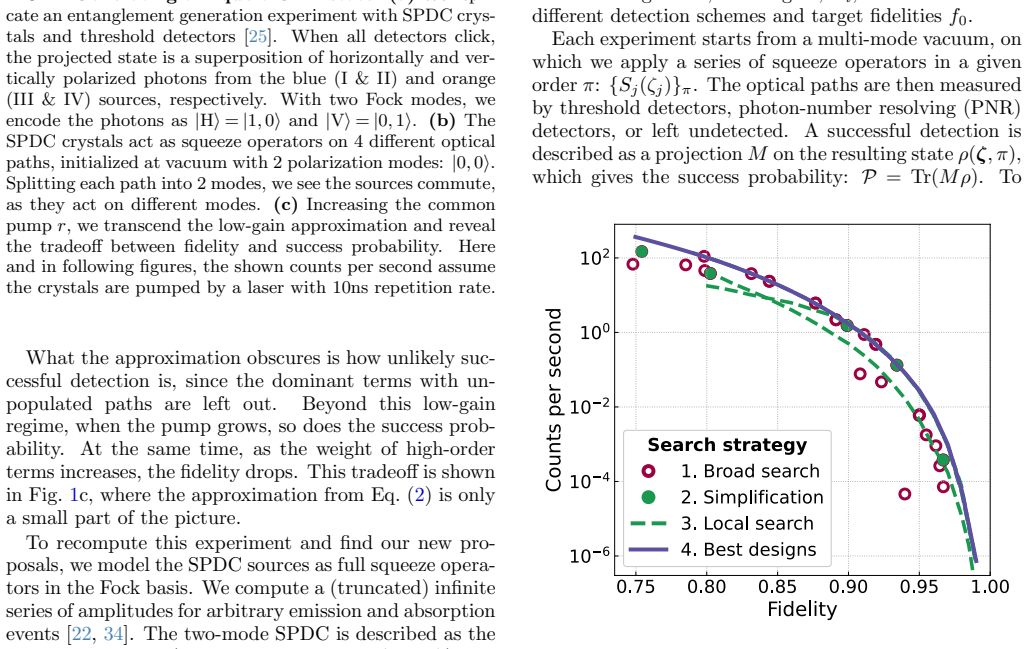
Entangled photons are widely used in quantum technologies. Many photonic experiments generate them with probabilistic photon-pair sources that can be modeled as squeeze operators. In practice, these sources are usually treated in the low-gain (perturbative) regime, keeping only the leading single-pair term and neglecting higher-order multi-pair emission events. In pursuit of fidelity, the probability of successful entanglement generation can become extremely small, a tradeoff often ignored. Here we develop an automated design algorithm for quantum experiments to optimize both fidelity and success probability while accounting for higher-order multi-pair emissions. Our discovery algorithm explores different design topologies subject to varying hardware constraints. It optimizes the source parameters to reduce undesired higher-order terms or even benefit from them. The experiments presented outperform previous proposals for widely used states, including heralded Bell states, W states, and NOON states, paving the way for more efficient photonic technologies.
Editorial analysis
A structured set of objections, weighed in public.
Referee Report
Summary. The paper introduces an automated design algorithm for photonic quantum experiments that generate entangled photon states using squeezed sources. It explores different experimental topologies under hardware constraints and optimizes source parameters (such as squeezing strength) while explicitly including higher-order multi-pair emission terms from the squeeze operator, rather than truncating at the single-pair level. The central claim is that this approach yields designs with improved success probability at high fidelity for heralded Bell states, W states, and NOON states, outperforming prior proposals that neglect higher-order terms.
Significance. If the reported outperformance is robust and the squeeze-operator model with higher-order terms is representative of real hardware, the work could meaningfully advance photonic quantum information experiments by relaxing the usual fidelity-probability tradeoff. The automated topology search and parameter optimization represent a potentially useful methodological contribution for designing more efficient entanglement sources.
major comments (2)
- [Abstract] Abstract: the claim that 'the experiments presented outperform previous proposals' for Bell, W, and NOON states is load-bearing for the central contribution, yet no quantitative metrics (fidelities, success probabilities, or direct numerical comparisons), error bars, or baseline implementations are supplied, rendering the magnitude and reliability of any improvement unverifiable from the manuscript.
- [Abstract] Abstract and method description: the automated discovery procedure is asserted to find superior designs by exploring topologies and tuning source parameters to reduce or benefit from higher-order terms, but no evidence is given of exhaustive enumeration for small cases, convergence diagnostics, ablation against alternative optimizers, or guarantees against local optima; this directly undermines that the reported gains are due to inclusion of higher-order terms rather than search artifacts.
Simulated Author's Rebuttal
We thank the referee for their careful reading and constructive comments. We address the two major comments point by point below, indicating the revisions we will make to the manuscript.
read point-by-point responses
-
Referee: [Abstract] Abstract: the claim that 'the experiments presented outperform previous proposals' for Bell, W, and NOON states is load-bearing for the central contribution, yet no quantitative metrics (fidelities, success probabilities, or direct numerical comparisons), error bars, or baseline implementations are supplied, rendering the magnitude and reliability of any improvement unverifiable from the manuscript.
Authors: We agree that the abstract would be strengthened by including explicit quantitative metrics. The full manuscript already contains detailed numerical comparisons (in the results sections and supplementary tables) of fidelities, success probabilities, and direct baselines for our optimized designs versus prior proposals that truncate the squeeze operator. These include Monte Carlo error bars from multiple simulation runs. We will revise the abstract to summarize the key improvements with specific values (e.g., success probability and fidelity for each state class) while remaining within length limits. This makes the outperformance claim directly verifiable from the abstract. revision: yes
-
Referee: [Abstract] Abstract and method description: the automated discovery procedure is asserted to find superior designs by exploring topologies and tuning source parameters to reduce or benefit from higher-order terms, but no evidence is given of exhaustive enumeration for small cases, convergence diagnostics, ablation against alternative optimizers, or guarantees against local optima; this directly undermines that the reported gains are due to inclusion of higher-order terms rather than search artifacts.
Authors: We acknowledge that the current manuscript does not provide exhaustive enumeration, convergence diagnostics, or ablation studies for the automated optimizer. We will add a new subsection (and appendix) that includes: exhaustive enumeration results for small topologies to cross-validate the search; convergence plots and statistics from repeated runs with varied random seeds and initial conditions; and ablations comparing our procedure against random search and alternative optimizers. These additions will empirically demonstrate robustness and that performance gains arise from accounting for higher-order terms. Formal guarantees against local optima are not feasible for the heuristic search method used, but the expanded empirical validation will address concerns about search artifacts. revision: yes
Circularity Check
No significant circularity; optimization on standard models is self-contained.
full rationale
The paper introduces an automated search algorithm that enumerates design topologies and tunes squeeze-operator parameters (including higher-order terms) to maximize fidelity and success probability under hardware constraints. No equation or claim reduces by construction to a fitted input renamed as prediction, nor does any load-bearing premise rest on a self-citation whose validity is presupposed. The squeeze-operator model is the standard perturbative expansion from quantum optics; the reported outperformance for Bell, W, and NOON states is obtained by direct numerical comparison against prior hand-designed proposals, not by any self-referential redefinition. Absence of convergence proofs or exhaustive enumeration for the heuristic is a limitation on claimed global optimality, but does not constitute circularity under the enumerated patterns.
Axiom & Free-Parameter Ledger
free parameters (1)
- source parameters (squeezing strength/gain)
axioms (1)
- domain assumption Photon-pair sources are accurately modeled by squeeze operators including higher-order terms
Lean theorems connected to this paper
-
Cost.FunctionalEquation / Foundation.AlphaCoordinateFixationwashburn_uniqueness_aczel (J(x)=½(x+x⁻¹)−1) unclear?
unclearRelation between the paper passage and the cited Recognition theorem.
S₂(r,θ) = exp(−e^{iθ} tanh r·a†b†) × exp(−ln(cosh r)(a†a+b†b+1)) × exp(e^{−iθ} tanh r·ab)
-
Foundation.LogicAsFunctionalEquationn/a — multi-weight heuristic loss, not a forced cost unclear?
unclearRelation between the paper passage and the cited Recognition theorem.
Lπ(r,θ) = −w₁ log P + w₂ log((F − f₀)²) + w₃‖r‖₁ + w₄‖θ‖₁ + w₅ E
-
Foundation (parameter-free chain)reality_from_one_distinction unclear?
unclearRelation between the paper passage and the cited Recognition theorem.
Sweeping the target fidelity f₀ from 75% to 99%, we find the Pareto front of the design. Since P may fluctuate by orders of magnitude, the weights, w_i, must be tuned for different detection schemes and target fidelities f₀.
What do these tags mean?
- matches
- The paper's claim is directly supported by a theorem in the formal canon.
- supports
- The theorem supports part of the paper's argument, but the paper may add assumptions or extra steps.
- extends
- The paper goes beyond the formal theorem; the theorem is a base layer rather than the whole result.
- uses
- The paper appears to rely on the theorem as machinery.
- contradicts
- The paper's claim conflicts with a theorem or certificate in the canon.
- unclear
- Pith found a possible connection, but the passage is too broad, indirect, or ambiguous to say the theorem truly supports the claim.
Reference graph
Works this paper leans on
-
[1]
R. Horodecki, P. Horodecki, M. Horodecki, and K. Horodecki, Quantum entanglement, Rev. Mod. Phys. 81, 865 (2009)
work page 2009
-
[2]
J. E. Bourassa, R. N. Alexander, M. Vasmer, A. Patil, I. Tzitrin, T. Matsuura, D. Su, B. Q. Baragiola, B. Gupt, K. K. Sabapathy,et al., Blueprint for a scalable pho- tonic fault-tolerant quantum computer, Quantum5, 392 (2021)
work page 2021
-
[3]
H. Aghaee Rad, T. Ainsworth, R. N. Alexander, B. Al- tieri, M. F. Askarani, R. Baby, L. Banchi, B. Q. Bara- giola, J. E. Bourassa, R. Chadwick,et al., Scaling and networking a modular photonic quantum computer, Na- ture638, 912 (2025)
work page 2025
-
[4]
PsiQuantum, A manufacturable platform for photonic quantum computing, Nature641, 876 (2025)
work page 2025
- [5]
-
[6]
A. Ma, A. G. Magnoni, M. A. Larotonda, and L. T. Knoll, Unraveling quantum phase estimation: exploring the impact of multi-photon interference on the quantum fisher information, Quantum Science and Technology10, 035021 (2025)
work page 2025
- [7]
- [8]
-
[9]
W. Luo, L. Cao, Y. Shi, L. Wan, H. Zhang, S. Li, G. Chen, Y. Li, S. Li, Y. Wang,et al., Recent progress in quantum photonic chips for quantum communication and internet, Light: Science & Applications12, 175 (2023)
work page 2023
-
[10]
H. Wang, T. C. Ralph, J. J. Renema, C.-Y. Lu, and J.- W. Pan, Scalable photonic quantum technologies, Nature Materials24, 1883 (2025)
work page 2025
-
[11]
T. van Leent, M. Bock, F. Fertig, R. Garthoff, S. Eppelt, Y. Zhou, P. Malik, M. Seubert, T. Bauer, W. Rosenfeld, et al., Entangling single atoms over 33 km telecom fibre, Nature607, 69 (2022)
work page 2022
-
[12]
A. Krˇ ziˇ c, S. Sharma, C. Spiess, U. Chandrashekara, S. T¨ opfer, G. Sauer, L. J. Gonz´ alez-Mart´ ın del Campo, T. Kopf, S. Petscharnig, T. Grafenauer,et al., Towards metropolitan free-space quantum networks, npj Quan- tum Information9, 95 (2023)
work page 2023
- [13]
-
[14]
M. Pittaluga, Y. S. Lo, A. Brzosko, R. I. Woodward, D. Scalcon, M. S. Winnel, T. Roger, J. F. Dynes, K. A. Owen, S. Ju´ arez,et al., Long-distance coherent quantum communications in deployed telecom networks, Nature 640, 911 (2025)
work page 2025
-
[15]
K. H. Nielsen, Y. Wang, E. C. Deacon, P. I. Sund, Z. Liu, S. Scholz, A. D. Wieck, A. Ludwig, L. Midolo, A. S. Sørensen,et al., Programmable nonlinear quantum pho- tonic circuits, Nature Communications (2025)
work page 2025
-
[16]
C. Ruiz-Gonzalez, S. Arlt, J. Petermann, S. Sayyad, T. Jaouni, E. Karimi, N. Tischler, X. Gu, and M. Krenn, Digital discovery of 100 diverse quantum experiments with Pytheus, Quantum7, 1204 (2023)
work page 2023
- [17]
-
[18]
A. Chizhov and B. Murzakhmetov, Photon statistics and phase properties of two-mode squeezed number states, Physics Letters A176, 33 (1993)
work page 1993
-
[19]
N. Quesada, L. Helt, M. Menotti, M. Liscidini, and J. Sipe, Beyond photon pairs—nonlinear quantum pho- tonics in the high-gain regime: a tutorial, Advances in Optics and Photonics14, 291 (2022)
work page 2022
-
[20]
J. F. F. Bulmer, S. Paesani, R. S. Chadwick, and N. Que- sada, Threshold detection statistics of bosonic states, Phys. Rev. A106, 043712 (2022)
work page 2022
-
[21]
K. Chinni and N. Quesada, Beyond the parametric approximation: Pump depletion, entanglement, and squeezing in macroscopic down-conversion, Phys. Rev. A 110, 013712 (2024)
work page 2024
- [22]
-
[23]
X. Gu, L. Chen, A. Zeilinger, and M. Krenn, Quantum experiments and graphs III: High-dimensional and mul- tiparticle entanglement, Phys. Rev. A99, 032338 (2019)
work page 2019
-
[24]
C. ´Sliwa and K. Banaszek, Conditional preparation of maximal polarization entanglement, Physical Review A 67, 030101 (2003)
work page 2003
- [25]
-
[26]
X. Y. Zou, L. J. Wang, and L. Mandel, Induced co- herence and indistinguishability in optical interference, Phys. Rev. Lett.67, 318 (1991)
work page 1991
-
[27]
L. J. Wang, X. Y. Zou, and L. Mandel, Induced coherence without induced emission, Phys. Rev. A44, 4614 (1991)
work page 1991
- [28]
-
[29]
A. Hochrainer, M. Lahiri, M. Erhard, M. Krenn, and A. Zeilinger, Quantum indistinguishability by path iden- tity and with undetected photons, Reviews of Modern Physics94, 025007 (2022)
work page 2022
-
[30]
G. Barreto Lemos, M. Lahiri, S. Ramelow, R. Lap- kiewicz, and W. N. Plick, Quantum imaging and metrol- ogy with undetected photons: tutorial, Journal of the Optical Society of America B39, 2200 (2022)
work page 2022
-
[31]
K. Wang, Z. Hou, K. Qian, L. Chen, M. Krenn, S. Zhu, and X.-S. Ma, Entangling independent particles by path identity, Phys. Rev. Lett.133, 233601 (2024)
work page 2024
-
[32]
X.-M. Hu, C.-X. Huang, N. d’Alessandro, G. Cobucci, C. Zhang, Y. Guo, Y.-F. Huang, C.-F. Li, G.-C. Guo, X. Gao, M. Huber, A. Tavakoli, and B.-H. Liu, Ob- servation of genuine high-dimensional multi-partite non- locality in entangled photon states, Nature Communica- tions16, 5017 (2025)
work page 2025
-
[33]
R. Bernecker, B. Baghdasaryan, and S. Fritzsche, Engi- 6 neering of maximally entangled orbital angular momen- tum states via path identity, Physical Review A112, 063701 (2025)
work page 2025
-
[34]
A. DasGupta, Disentanglement formulas: An alternative derivation and some applications to squeezed coherent states, American Journal of Physics64, 1422 (1996)
work page 1996
- [35]
- [36]
- [37]
- [38]
-
[39]
X. Gu, M. Erhard, A. Zeilinger, and M. Krenn, Quan- tum experiments and graphs II: Quantum interference, computation, and state generation, Proceedings of the National Academy of Sciences116, 4147 (2019)
work page 2019
- [40]
-
[41]
P. Agrawal and A. Pati, Perfect teleportation and super- dense coding with W states, Phys. Rev. A74, 062320 (2006)
work page 2006
-
[42]
J. S. Bell, On the Einstein Podolsky Rosen paradox, Physics Physique Fizika1, 195 (1964)
work page 1964
-
[43]
C. Wagenknecht, C.-M. Li, A. Reingruber, X.-H. Bao, A. Goebel, Y.-A. Chen, Q. Zhang, K. Chen, and J.-W. Pan, Experimental demonstration of a heralded entan- glement source, Nature Photonics4, 549 (2010)
work page 2010
-
[44]
M. J. Holland and K. Burnett, Interferometric detection of optical phase shifts at the Heisenberg limit, Phys. Rev. Lett.71, 1355 (1993)
work page 1993
-
[45]
X. Deng, S. Li, Z.-J. Chen, Z. Ni, Y. Cai, J. Mai, L. Zhang, P. Zheng, H. Yu, C.-L. Zou,et al., Quantum- enhanced metrology with large Fock states, Nature Physics20, 1874 (2024)
work page 2024
-
[46]
S. L. Braunstein and P. Van Loock, Quantum infor- mation with continuous variables, Reviews of modern physics77, 513 (2005)
work page 2005
-
[47]
C. Weedbrook, S. Pirandola, R. Garc´ ıa-Patr´ on, N. J. Cerf, T. C. Ralph, J. H. Shapiro, and S. Lloyd, Gaussian quantum information, Rev. Mod. Phys.84, 621 (2012)
work page 2012
-
[48]
C. S. Hamilton, R. Kruse, L. Sansoni, S. Barkhofen, C. Silberhorn, and I. Jex, Gaussian boson sampling, Phys. Rev. Lett.119, 170501 (2017)
work page 2017
-
[49]
N. Killoran, J. Izaac, N. Quesada, V. Bergholm, M. Amy, and C. Weedbrook, Strawberry fields: A software plat- form for photonic quantum computing, Quantum3, 129 (2019)
work page 2019
-
[50]
B. Gupt, J. Izaac, and N. Quesada, The Walrus: a library for the calculation of hafnians, Hermite polynomials and Gaussian boson sampling, Journal of Open Source Soft- ware4, 1705 (2019)
work page 2019
-
[51]
Xanadu Quantum Technologies, Mr Mustard: A differen- tiable bridge between phase space and Fock space (2024)
work page 2024
- [52]
-
[53]
M. Y. Vardi and Z. Zhang, Solving quantum-inspired per- fect matching problems via tutte-theorem-based hybrid boolean constraints, Proceedings of the Thirty-Second International Joint Conference on Artificial Intelligence , 2039 (2023)
work page 2039
-
[54]
L. S. Chandran, R. Gajjala, and A. M. Illickan, Krenn-Gu conjecture for sparse graphs, in49th International Sym- posium on Mathematical Foundations of Computer Sci- ence (MFCS 2024)(Schloss Dagstuhl–Leibniz-Zentrum f¨ ur Informatik, 2024) pp. 41–1
work page 2024
-
[55]
L. S. Chandran and R. Gajjala, Graph-theoretic insights on the constructability of complex entangled states, Quantum8, 1396 (2024)
work page 2024
-
[56]
D. R. Truax, Baker-campbell-hausdorff relations and uni- tarity of SU(2) and SU(1, 1) squeeze operators, Physical Review D31, 1988 (1985)
work page 1988
-
[57]
Stoler, Equivalence classes of minimum uncertainty packets, Phys
D. Stoler, Equivalence classes of minimum uncertainty packets, Phys. Rev. D1, 3217 (1970)
work page 1970
- [58]
-
[59]
Two-mode squeezing SPDC sources can be modeled by a squeezer opera- tor,S 2(ζ) = exp ζ ∗ab−ζa †b† , acting over 2-mode Fock states.ζ=re iθ is the complex squeezing parameter, and a(a †) andb(b †) are the annihilation (creation) operators of the 2 modes. Using the disentanglement formula for the SU(1,1) Lie algebra [34, 56], the squeezer operator can be re...
-
[60]
Single-mode squeezing While the 2-mode squeezing is our main workhorse, we use single mode squeezing for the N00N states:S 1(ζ) = exp 1 2(ζ ∗a2 −ζ(a †)2) . Again,ζ=re iθ is the complex squeezing parameter, anda(a †) is the annihilation (cre- ation) operator [57]. From a similar Lie algebra to that for the 2-mode case, we obtain the normal-ordered form S1(...
-
[61]
4-qubit W state For the W state, the baseline we surpassed was intro- duced as the following path identity experiment [23]. |0,0⟩ ≥1 |0,0⟩ ≥1 |0,0⟩ ≥1 |0,0⟩ ≥1 A B C D E F G The squeezing parameter is the same for all 7 sources. From 5040 possible permutations, there are only 54 canonical sortings. These are obtained from the partial commutation relations...
-
[62]
Heralded Bell state The heralded Bell state we surpassed was not presented as an undirected graph, but as the following setup [24]. 8 FIG. 5.54 canonical sortings for the baseline design. When generating the W state, the sources’ ordering in the baseline design leads to different tradeoffs between fidelity and success probability. The positions of sources...
-
[63]
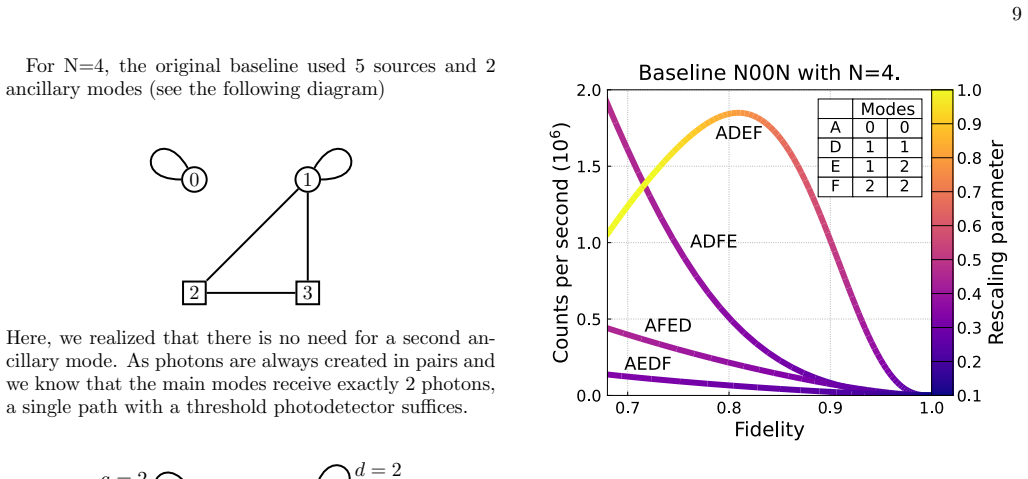
2-mode N00N states The N00N state experiments use two main modes and one ancillary mode. Therefore, without repetition, we have at most 6 sources with 180 unique sequences, 89 if we consider the equivalence between the first 2 modes. |0⟩ |0⟩ =N |0⟩ ≥τ A B C D E F The baselines were even smaller [16]. For N=3, the base- line used only 5 sources, introduced...
discussion (0)
Sign in with ORCID, Apple, or X to comment. Anyone can read and Pith papers without signing in.