Recognition: unknown
The Complexity of Stoquastic Sparse Hamiltonians
Pith reviewed 2026-05-08 01:40 UTC · model grok-4.3
The pith
The Stoquastic Sparse Hamiltonians problem is StoqMA-complete.
A machine-rendered reading of the paper's core claim, the machinery that carries it, and where it could break.
Core claim
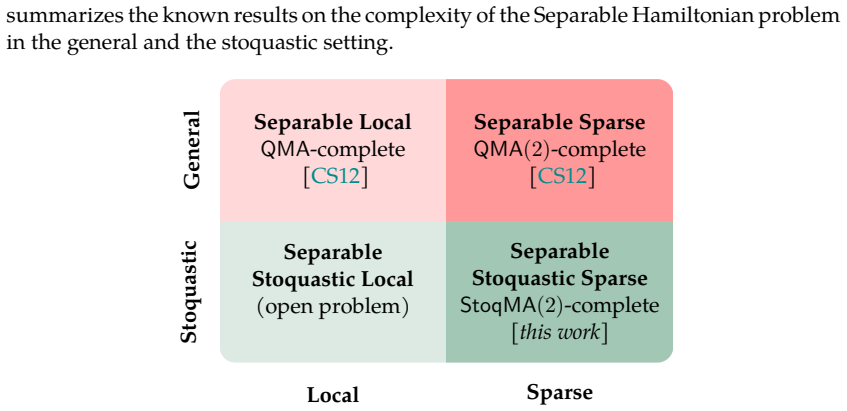
We show that the Stoquastic Sparse Hamiltonians problem (StoqSH) is in StoqMA. Since Stoquastic Local Hamiltonians are StoqMA-hard, this implies that StoqSH is StoqMA-complete. We complement this result by showing that the separable version of StoqSH is StoqMA(2)-complete.
What carries the argument
The StoqSH decision problem together with a StoqMA verification protocol whose reduction from the local case preserves the stoquastic sign structure and the promise gap.
If this is right
- Local and sparse stoquastic Hamiltonians have identical complexity status under StoqMA.
- StoqMA is the exact class capturing the verification power of stoquastic Hamiltonian problems.
- The separable variant requires exactly two unentangled proofs to achieve completeness in StoqMA(2).
Where Pith is reading between the lines
- If StoqMA collapses to MA, then both sparse and local stoquastic Hamiltonian problems would lie in MA.
- Sparsity alone does not weaken the proof-verification requirements for stoquastic Hamiltonians.
- Similar completeness results may extend to other restricted interaction graphs that still admit a stoquastic-preserving reduction.
Load-bearing premise
Any reduction or protocol that places StoqSH inside StoqMA must preserve both the stoquastic property of the Hamiltonian and the energy-gap promise without adding extra entanglement.
What would settle it
An explicit family of stoquastic sparse Hamiltonians whose ground-state energy decision cannot be verified by any StoqMA protocol with polynomial-size proofs and polynomial-time verification would refute the membership claim.
Figures


read the original abstract
Despite having an unnatural definition, $\mathsf{StoqMA}$ plays a central role in Hamiltonian complexity, e.g., in the classification theorem of the complexity of Hamiltonians by Cubitt and Montanaro (SICOMP 2016). Moreover, it lies between the two randomized extensions of $\mathsf{NP}$, $\mathsf{MA}$ and $\mathsf{AM}$. Therefore, understanding the exact power of $\mathsf{StoqMA}$ (and hopefully collapsing it with more natural complexity classes) is of great interest for different reasons. In this work, we take a step further in understanding this complexity class by showing that the Stoquastic Sparse Hamiltonians problem ($\mathsf{StoqSH}$) is in $\mathsf{StoqMA}$. Since Stoquastic Local Hamiltonians are $\mathsf{StoqMA}$-hard, this implies that $\mathsf{StoqSH}$ is $\mathsf{StoqMA}$-complete. We complement this result by showing that the separable version of $\mathsf{StoqSH}$ is $\mathsf{StoqMA}(2)$-complete, where $\mathsf{StoqMA}(2)$ is the version of $\mathsf{StoqMA}$ that receives two unentangled proofs.
Editorial analysis
A structured set of objections, weighed in public.
Referee Report
Summary. The manuscript claims that the Stoquastic Sparse Hamiltonians problem (StoqSH) is StoqMA-complete. It establishes membership of StoqSH in StoqMA and notes that Stoquastic Local Hamiltonians are StoqMA-hard; since local stoquastic Hamiltonians are a subclass of sparse ones, hardness transfers directly. It further shows that the separable version of StoqSH is StoqMA(2)-complete.
Significance. If the membership proof holds, the result clarifies the complexity landscape for stoquastic Hamiltonians, which is central to the Cubitt-Montanaro classification theorem. The direct inheritance of hardness via the identity map (no non-trivial reduction needed) means the claim rests on the new upper bound; the stress-test concern about reduction preservation does not land, as the subclass relation automatically preserves stoquasticity and the promise gap.
minor comments (1)
- [Abstract] Abstract: the phrasing 'since Stoquastic Local Hamiltonians are StoqMA-hard, this implies...' could briefly note that the implication follows from the subclass relation rather than a constructed reduction.
Simulated Author's Rebuttal
We thank the referee for their positive review, accurate summary of our results, and recommendation for minor revision. We appreciate the recognition that the hardness of StoqSH follows directly from the subclass relation with Stoquastic Local Hamiltonians, with no additional reduction required, and that stoquasticity and the promise gap are automatically preserved.
Circularity Check
No significant circularity in the derivation chain
full rationale
The paper proves StoqSH membership in StoqMA directly and inherits StoqMA-hardness from the established StoqMA-hardness of Stoquastic Local Hamiltonians (Cubitt-Montanaro 2016, external citation). Hardness transfers via the identity map on the subclass, preserving stoquasticity and promise gap with no additional reduction steps. The separable StoqSH result uses standard unentangled-proof techniques. No equations, self-definitions, fitted parameters, or load-bearing self-citations reduce any claim to its own inputs by construction. The argument is self-contained against external benchmarks.
Axiom & Free-Parameter Ledger
axioms (2)
- domain assumption Stoquastic Local Hamiltonians is StoqMA-hard (Cubitt-Montanaro)
- standard math Standard definitions of StoqMA and StoqMA(2)
Reference graph
Works this paper leans on
-
[1]
Berry, Dominic W. and Childs, Andrew M. and Cleve, Richard and Kothari, Robin and Somma, Rolando D. , title =. Proceedings of the Forty-Sixth Annual ACM Symposium on Theory of Computing , pages =. 2014 , isbn =. doi:10.1145/2591796.2591854 , abstract =
-
[2]
and Oliveira, Roberto and Terhal, Barbara M
Bravyi, Sergey and Divincenzo, David P. and Oliveira, Roberto and Terhal, Barbara M. , title =. Quantum Info. Comput. , month = may, pages =. 2008 , issue_date =
2008
-
[3]
Merlin--Arthur games and stoquastic complexity
Sergey Bravyi and Arvid J. Bessen and Barbara M. Terhal , year=. Merlin-. quant-ph/0611021 , archivePrefix=
-
[4]
Proceedings of the Thirty-Fifth Annual ACM Symposium on Theory of Computing , pages =
Aharonov, Dorit and Ta-Shma, Amnon , title =. Proceedings of the Thirty-Fifth Annual ACM Symposium on Theory of Computing , pages =. 2003 , isbn =. doi:10.1145/780542.780546 , abstract =
-
[5]
and Chuang, Isaac L
Nielsen, Michael A. and Chuang, Isaac L. , year=. Quantum Computation and Quantum Information: 10th Anniversary Edition , publisher=
-
[6]
Termwise versus globally stoquastic local hamiltonians: questions of complexity and sign-curing,
Ioannou, Marios and Piddock, Stephen and Marvian, Milad and Klassen, Joel and Terhal, Barbara M. Termwise versus globally stoquastic local Hamiltonians: questions of complexity and sign-curing. 2020. arXiv:2007.11964
-
[7]
The Complexity of the Separable Hamiltonian Problem , year=
Chailloux, André and Sattath, Or , booktitle=. The Complexity of the Separable Hamiltonian Problem , year=
-
[8]
Kitaev, A. Yu. and Shen, A. H. and Vyalyi, M. N. , title =. 2002 , isbn =
2002
-
[9]
Mehdi Soleimanifar and John Wright , title =. Proceedings of the 2022 Annual ACM-SIAM Symposium on Discrete Algorithms (SODA) , chapter =. 2022 , pages =. doi:10.1137/1.9781611977073.68 , URL =. https://epubs.siam.org/doi/pdf/10.1137/1.9781611977073.68 , abstract =
-
[10]
and Montanaro, Ashley , title =
Harrow, Aram W. and Montanaro, Ashley , title =. J. ACM , month = feb, articleno =. 2013 , issue_date =. doi:10.1145/2432622.2432625 , abstract =
-
[11]
Liu, Yi-Kai , title =. Proceedings of the 9th International Conference on Approximation Algorithms for Combinatorial Optimization Problems, and 10th International Conference on Randomization and Computation , pages =. 2006 , isbn =. doi:10.1007/11830924_40 , abstract =
-
[12]
2007 , eprint=
The Local Consistency Problem for Stoquastic and 1-D Quantum Systems , author=. 2007 , eprint=
2007
-
[13]
Proceedings of the 2014 IEEE 29th Conference on Computational Complexity , pages =
Aaronson, Scott and Impagliazzo, Russell and Moshkovitz, Dana , title =. Proceedings of the 2014 IEEE 29th Conference on Computational Complexity , pages =. 2014 , isbn =. doi:10.1109/CCC.2014.13 , abstract =
-
[14]
The Power of Adiabatic Quantum Computation with No Sign Problem
Hastings, Matthew B. , journal =. The. doi:10.22331/q-2021-12-06-597 , url =
-
[15]
Gily\'. (Sub)Exponential advantage of adiabatic Quantum computation with no sign problem , year =. Proceedings of the 53rd Annual ACM SIGACT Symposium on Theory of Computing , pages =. doi:10.1145/3406325.3451060 , abstract =
-
[16]
Proof for an upper bound in fixed-node Monte Carlo for lattice fermions , author =. Phys. Rev. B , volume =. 1995 , month =. doi:10.1103/PhysRevB.51.13039 , url =
-
[17]
Bravyi, Sergey and Carleo, Giuseppe and Gosset, David and Liu, Yinchen , journal =. A rapidly mixing. doi:10.22331/q-2023-11-07-1173 , url =
-
[18]
Local Hamiltonian Problem with Succinct Ground State is MA-Complete
Local Hamiltonian Problem with Succinct Ground State is MA-Complete , author =. PRX Quantum , volume =. 2025 , month =. doi:10.1103/PRXQuantum.6.020312 , url =
-
[19]
Complexity Classification of Local Hamiltonian Problems
Cubitt, Toby and Montanaro, Ashley , title =. SIAM Journal on Computing , volume =. 2016 , doi =. https://doi.org/10.1137/140998287 , abstract =
-
[20]
Schaefer, Thomas J. , title =. Proceedings of the Tenth Annual ACM Symposium on Theory of Computing , pages =. 1978 , isbn =. doi:10.1145/800133.804350 , abstract =
-
[21]
Bravyi, Sergey and Terhal, Barbara , title =. SIAM Journal on Computing , volume =. 2010 , doi =. https://doi.org/10.1137/08072689X , abstract =
-
[22]
Randomness , author=
Stoquastic PCP vs. Randomness , author=. 2019 IEEE 60th Annual Symposium on Foundations of Computer Science (FOCS) , pages=. 2019 , organization=
2019
-
[23]
2025 , eprint=
Complexity of geometrically local stoquastic Hamiltonians , author=. 2025 , eprint=
2025
-
[24]
2025 , eprint=
The Complexity of Local Stoquastic Hamiltonians on 2D Lattices , author=. 2025 , eprint=
2025
-
[25]
StoqMA vs. MA: the power of error reduction
Aharonov, Dorit and Grilo, Alex B. and Liu, Yupan , journal =. Stoq. doi:10.22331/q-2025-09-11-1853 , url =
-
[26]
StoqMA Meets Distribution Testing
Liu, Yupan , title =. 16th Conference on the Theory of Quantum Computation, Communication and Cryptography (TQC 2021) , pages =. 2021 , volume =. doi:10.4230/LIPIcs.TQC.2021.4 , annote =
-
[27]
Communications in Mathematical Physics , volume=
On complexity of the quantum Ising model , author=. Communications in Mathematical Physics , volume=. 2017 , publisher=
2017
-
[28]
Kitaev, Alexei , journal=. Quantum
-
[29]
Quantum Info
Piddock, Stephen and Montanaro, Ashley , title =. Quantum Info. Comput. , month = jun, pages =. 2017 , issue_date =
2017
-
[30]
Quantum Fingerprinting , author =. Phys. Rev. Lett. , volume =. 2001 , month =. doi:10.1103/PhysRevLett.87.167902 , url =
-
[31]
The Complexity of the Local Hamiltonian Problem
Kempe, Julia and Kitaev, Alexei and Regev, Oded , title =. SIAM Journal on Computing , volume =. 2006 , doi =. https://doi.org/10.1137/S0097539704445226 , abstract =
-
[32]
and Gosset, David and Webb, Zak
Childs, Andrew M. and Gosset, David and Webb, Zak. The Bose-Hubbard Model is QMA-complete. Automata, Languages, and Programming. 2014
2014
-
[33]
The Power of Quantum Systems on a Line , year=
Aharonov, Dorit and Gottesman, Daniel and Irani, Sandy and Kempe, Julia , booktitle=. The Power of Quantum Systems on a Line , year=
-
[34]
Liu, Yupan and Wu, Pei , year = 2026, month = apr, number =. Unentangled Stoquastic. doi:10.48550/arXiv.2604.27886 , urldate =. arXiv , keywords =:2604.27886 , primaryclass =
work page internal anchor Pith review Pith/arXiv arXiv doi:10.48550/arxiv.2604.27886 2026
discussion (0)
Sign in with ORCID, Apple, or X to comment. Anyone can read and Pith papers without signing in.