Calibration of the underlying surface parameters for urban flood using latent variables and adjoint equation
Pith reviewed 2026-05-10 16:14 UTC · model grok-4.3
The pith
Latent variables and adjoint equations enable efficient Bayesian calibration of urban flood surface parameters.
A machine-rendered reading of the paper's core claim, the machinery that carries it, and where it could break.
Core claim
By embedding latent variables in the Bayesian maximum-likelihood framework and deriving the adjoint equation of the urban flood dynamical system model, with added parameter sharing and localization, the calibration procedure converges rapidly and recovers Manning's coefficient values for urban roads within relative errors of 1.16 percent to 13.88 percent.
What carries the argument
The adjoint equation of the urban flood dynamical system model augmented with latent variables, which supplies the gradient for optimization while the latent variables represent additional uncertainties.
If this is right
- The method can calibrate additional surface parameters beyond Manning's coefficient in the same framework.
- Calibration remains reliable across varying observation time intervals.
- Parameter sharing and localization keep the adjoint computation tractable for larger models.
- The latent-variable approach integrates machine-learning style uncertainty modeling directly into physical parameter calibration.
Where Pith is reading between the lines
- The technique may allow dynamic updating of parameters during an ongoing flood event if observations arrive in real time.
- Similar adjoint-plus-latent constructions could apply to other environmental surrogate models such as groundwater or air-quality simulations.
- Scaling the approach to full city-scale domains would require checking whether the localization technique continues to control memory and runtime costs.
Load-bearing premise
The urban flood dynamical system model is an accurate surrogate for real-world flooding processes, and the latent variables properly represent uncertainties without introducing systematic bias or overfitting in the calibration.
What would settle it
Apply the calibrated parameters to an independent flood event dataset from the same urban setting and check whether the simulated inundation depths and timings match observed values within the reported error bounds; large systematic mismatches would disprove the claim.
Figures

read the original abstract
Calibrating the urban underlying surface parameters is crucial for urban flood simulation. We formulate the parameter calibration problem into an optimization problem within the Bayesian framework using the maximum likelihood principle. We adopt the urban flood dynamical system model as the surrogate model and innovatively introduce latent variables inspired by machine learning to represent more uncertainties, which can also be compatible with common physical parameter calibration. For more efficient optimization, we construct the adjoint equation of the surrogate model to obtain gradient information and propose the parameter sharing technique and the localization technique to reduce the computation complexity of the adjoint equation. A simple case verifies the proposed method can converge quickly and is insensitive to the observation time interval. In the case derived from Test 8A, we calibrate Manning's coefficient of urban roads, with a maximum relative error of 13.88% and a minimum of 1.16%.
Editorial analysis
A structured set of objections, weighed in public.
Referee Report
Summary. The manuscript formulates urban flood parameter calibration as a Bayesian maximum-likelihood optimization problem. It employs an urban flood dynamical system model as surrogate, introduces latent variables to capture uncertainties (compatible with physical parameters), derives the adjoint equation for gradients, and applies parameter sharing plus localization to reduce adjoint complexity. Validation on a simple case and a Test 8A-derived synthetic case shows rapid convergence, insensitivity to observation time interval, and Manning's n relative errors between 1.16% and 13.88%.
Significance. If the surrogate remains unbiased and latent variables do not absorb model error, the combination of adjoint gradients with latent-variable Bayesian calibration could enable efficient, uncertainty-aware parameter estimation for urban flood models. The reported quick convergence and time-interval robustness on the synthetic Test 8A case are positive indicators of computational practicality.
major comments (1)
- [case study / experiments] The case-study validation (derived from Test 8A) generates observations from the identical dynamical system used as surrogate. This setup cannot detect systematic bias when the surrogate omits real-world processes (infiltration, building drag, spatially variable rainfall). Because the central claim is that the method delivers usable calibrated parameters for urban flood simulation, this self-consistent synthetic test is load-bearing and insufficient.
minor comments (2)
- [method] The abstract and method description should explicitly state the prior and likelihood forms used in the Bayesian MLE, and how the latent variables are jointly optimized with the physical parameters.
- [adjoint construction] Clarify the precise definition and implementation of the 'parameter sharing technique' and 'localization technique' when constructing the adjoint equation; a short pseudocode or diagram would improve reproducibility.
Simulated Author's Rebuttal
We thank the referee for the constructive feedback on our manuscript. We address the major comment regarding the validation experiments below, providing an honest assessment of its implications for our claims.
read point-by-point responses
-
Referee: [case study / experiments] The case-study validation (derived from Test 8A) generates observations from the identical dynamical system used as surrogate. This setup cannot detect systematic bias when the surrogate omits real-world processes (infiltration, building drag, spatially variable rainfall). Because the central claim is that the method delivers usable calibrated parameters for urban flood simulation, this self-consistent synthetic test is load-bearing and insufficient.
Authors: We agree that the Test 8A-derived case generates observations from the identical surrogate model, constituting a twin experiment that cannot expose systematic biases from omitted physical processes such as infiltration, building drag, or spatially variable rainfall. This setup is standard for isolating and verifying the numerical behavior of a new calibration algorithm (convergence rate, sensitivity to observation intervals, and parameter recovery accuracy) under the assumption that the forward model is exact. The manuscript's central contribution lies in the Bayesian formulation with latent variables, the derivation of the adjoint equation, and the parameter-sharing/localization techniques for computational efficiency; the reported relative errors (1.16% to 13.88%) and rapid convergence demonstrate these properties. We do not claim in the current text that the method is robust to model structural error or immediately ready for operational urban flood simulation with real data. To strengthen the manuscript, we will revise the discussion and conclusions sections to explicitly acknowledge this limitation of the synthetic validation, clarify the scope of the presented results, and outline future work on validation with imperfect surrogates or observational datasets. revision: partial
Circularity Check
No circularity: standard Bayesian calibration with adjoint gradients verified on synthetic data
full rationale
The paper formulates parameter calibration as a Bayesian maximum-likelihood optimization problem, introduces latent variables for uncertainty representation, derives the adjoint equation for gradients, and applies parameter sharing/localization for efficiency. These steps constitute a self-contained numerical method. The reported verification uses a synthetic case derived from Test 8A to recover Manning coefficients with bounded errors (1.16–13.88 %), but this is an external consistency check on generated data rather than a result forced by construction from the inputs. No self-definitional loops, fitted quantities renamed as predictions, or load-bearing self-citations appear in the derivation chain. The central claims remain independent of the test data.
Axiom & Free-Parameter Ledger
free parameters (1)
- latent variables
axioms (1)
- domain assumption The urban flood dynamical system model accurately represents the physical flooding process as a surrogate.
Reference graph
Works this paper leans on
-
[1]
Introduction With the ongoing global climate change, the frequency and intensity of flood disasters are escalating globally (IPCC, 2021). Meanwhile, as urbanization progresses and industrial clusters develop, the losses resulting from urban floods are growing increasingly severe (ADREM, 2021 ). Hence, urban flood management assumes particular significance...
work page 2021
-
[2]
Method 2.1 Parameter calibration framework The parameter calibration problem can be regarded as a subproblem of data assimilation, and we will introduce our parameter calibration method within the Bayesian framework, with the principal idea coming from the work of Law, Stuart et al. (Law et al., 2015). 6 The urban flood surrogate model is denoted as ℳ(ℎ,𝑡...
work page 2015
-
[3]
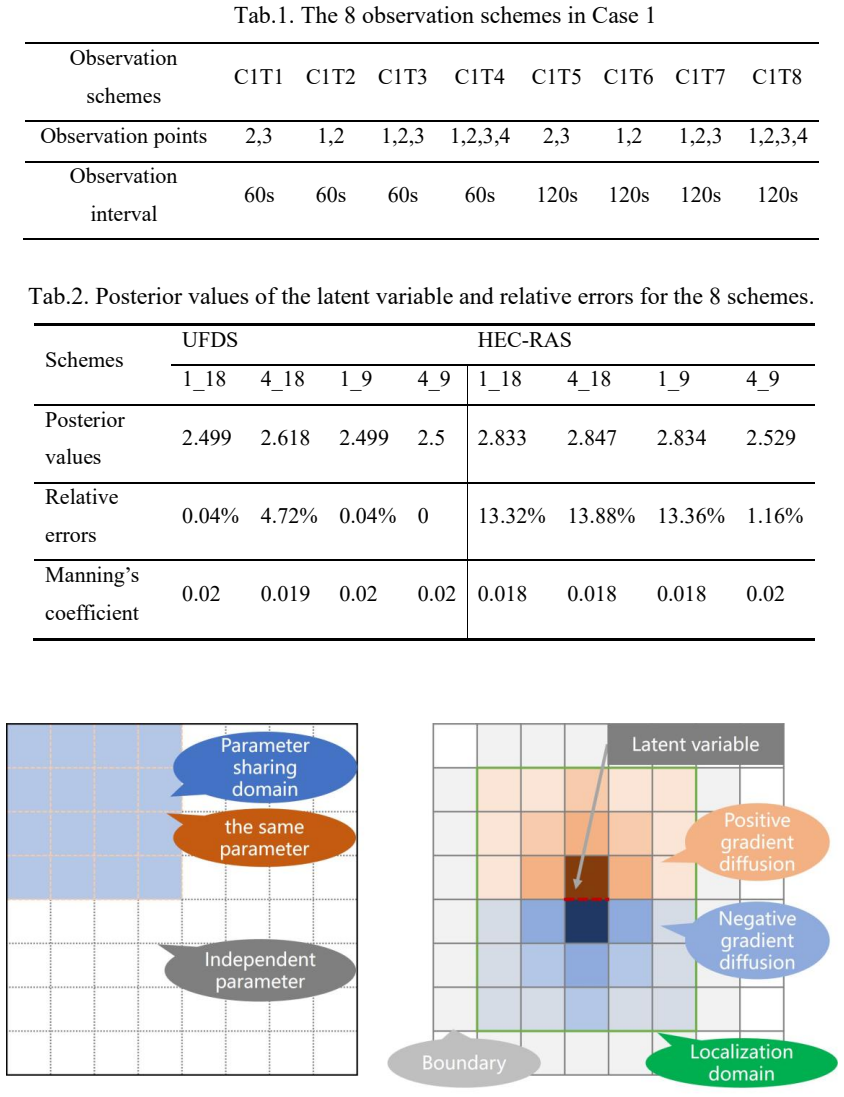
Cases and Results 3.1 Case 1: Simple Case We initially establish a simple case to observe, deliberate, and validate the diverse properties and calibration effects of the parameter calibration method proposed. Case 1 simulates a square area consisting of a total of 30*30 cells, with a cell edge length of 10m as depicted in Fig.2. The cell field is divided ...
-
[4]
Among them, regions 1 and 4 have a ground elevation of 1m, while regions 2 and 3 have a ground elevation of 0.8m. Latent variables configuration. The latent variables are allocated to the four adjacent sides of the four regions, as indicated by the red lines in Fig.2. The latent variables are numbered successively. The latent variables along the red verti...
work page 2023
-
[5]
Conclusion This paper presents a parameter calibration method for urban underlying surface parameters based on the latent variable approach and the adjoint equation of the surrogate model, and validates it in a simple case and a city case, yielding the following conclusions: By introducing the latent variable approach from machine learning into the calibr...
-
[6]
https://doi.org/ARTN 13188510.1016/j.jhydrol.2024.131885 Suriya, S., & Mudgal, B. V. (2012). Impact of urbanization on flooding: The Thirusoolam sub watershed - A case study. Journal of Hydrology, 412, 210-219. https://doi.org/10.1016/j.jhydrol.2011.05.008 Virtanen, P., Gommers, R., Oliphant, T. E., Haberland, M., Reddy, T., Cournapeau, D., Burovski, E., ...
discussion (0)
Sign in with ORCID, Apple, or X to comment. Anyone can read and Pith papers without signing in.