Recognition: 3 theorem links
· Lean TheoremClosing the knowledge gap in semileptonic Brightarrow X_cellν decays
Pith reviewed 2026-05-08 17:45 UTC · model grok-4.3
The pith
The unmeasured part of the semileptonic B to charm decay rate is dominated by final states that contain no D mesons.
A machine-rendered reading of the paper's core claim, the machinery that carries it, and where it could break.
Core claim
When the measured exclusive semileptonic branching fractions are supplemented by the available ratios to semi-inclusive B to D X lepton neutrino decays, the unmeasured fraction of the total inclusive B to Xc lepton neutrino rate is shown to arise predominantly from final states that contain no D meson, indicating substantial roles for baryonic modes and Ds mesons.
What carries the argument
Branching-fraction ratios measured relative to the semi-inclusive B to D X lepton neutrino final states, used to infer the composition of the unmeasured exclusive components.
Load-bearing premise
The published measurements of branching fractions relative to semi-inclusive D-containing modes give an unbiased picture of what the unmeasured exclusive decays actually contain.
What would settle it
A new measurement that finds the unmeasured components are instead dominated by additional D-meson final states would directly contradict the claim.
Figures

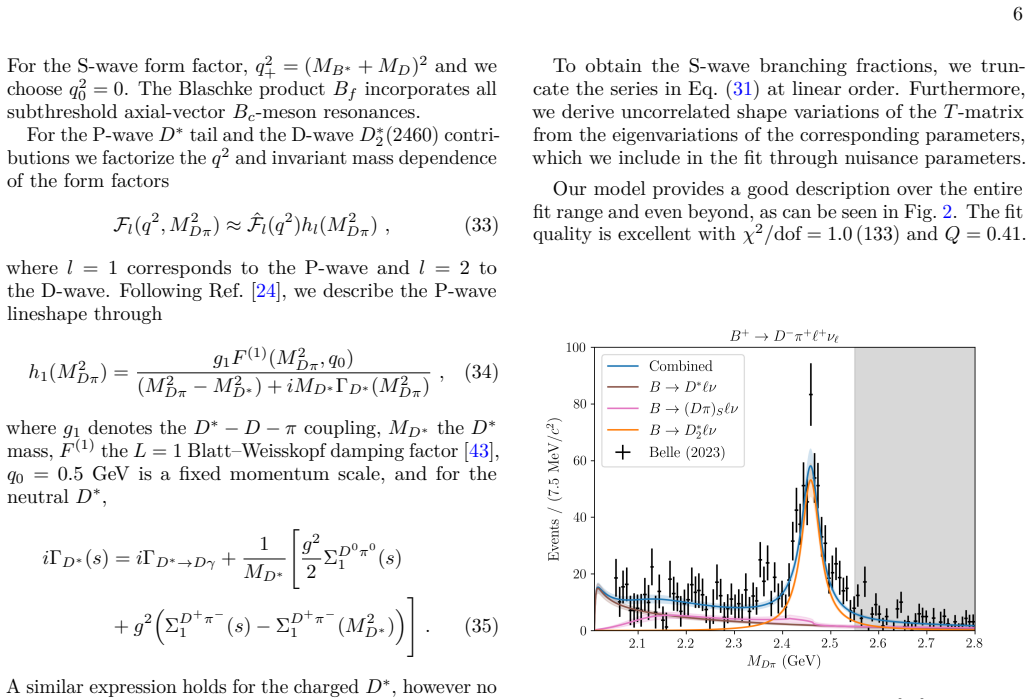


read the original abstract
In this work we summarize the current status of measured exclusive semileptonic branching fractions containing charm mesons. We use the available experimental data to evaluate the difference between the sum of exclusive measurements and the inclusive determination. By including experimental results of branching fractions relative to semi-inclusive $B\rightarrow D X\ell\nu$ decays, we demonstrate that the unmeasured components of the total branching fraction are dominated by final states devoid of $D$ mesons, hinting towards sizeable contributions from baryonic final states and $D_s$ mesons. Based on the obtained fractions, we discuss candidates that could potentially close the remaining difference and propose searches for promising final states. Furthermore, we provide simplified models for S-wave $B\rightarrow D\eta\ell\nu$ and $B\rightarrow D_s K\ell\nu$ decays that contribute marginally to the unmeasured components of the total inclusive rate.
Editorial analysis
A structured set of objections, weighed in public.
Referee Report
Summary. The manuscript summarizes the current status of measured exclusive semileptonic B→Xcℓν branching fractions involving charm mesons. It evaluates the difference between the sum of these exclusive measurements and the inclusive rate. By incorporating experimental results on branching fractions relative to semi-inclusive B→DXℓν decays, the authors conclude that the unmeasured components are dominated by final states without D mesons, suggesting sizeable contributions from baryonic final states and Ds mesons. The paper discusses candidate modes to close the gap, proposes searches for promising final states, and provides simplified models for S-wave B→Dηℓν and B→DsKℓν decays.
Significance. If the central inference holds after addressing the data-handling details, the work is useful for the field as it identifies likely sources for the inclusive-exclusive discrepancy in semileptonic B decays and directs attention to baryonic and Ds channels that have received less experimental focus. The provision of simplified models for marginal S-wave contributions is a constructive addition for phenomenology. The approach of leveraging existing relative branching-fraction data is a strength when the inputs are robustly treated.
major comments (1)
- [section discussing inclusion of relative branching fractions to semi-inclusive B→DXℓν] The demonstration that unmeasured components are dominated by final states devoid of D mesons (and the subsequent hint at baryonic and Ds contributions) rests on the use of experimental branching fractions relative to semi-inclusive B→DXℓν decays. The manuscript provides no details on data selection criteria, systematic uncertainty treatment, potential reconstruction biases, or a quantitative breakdown of the dominance calculation, which is load-bearing for the subtraction that isolates the non-D fraction.
minor comments (1)
- The abstract states that the models 'contribute marginally'; a short quantitative estimate of their size relative to the gap would improve clarity for readers.
Simulated Author's Rebuttal
We thank the referee for the careful reading of the manuscript and the constructive assessment of its significance. We address the major comment below and outline the revisions we will make to strengthen the presentation of the analysis.
read point-by-point responses
-
Referee: [section discussing inclusion of relative branching fractions to semi-inclusive B→DXℓν] The demonstration that unmeasured components are dominated by final states devoid of D mesons (and the subsequent hint at baryonic and Ds contributions) rests on the use of experimental branching fractions relative to semi-inclusive B→DXℓν decays. The manuscript provides no details on data selection criteria, systematic uncertainty treatment, potential reconstruction biases, or a quantitative breakdown of the dominance calculation, which is load-bearing for the subtraction that isolates the non-D fraction.
Authors: We agree that the manuscript would benefit from greater transparency on the treatment of the relative branching-fraction inputs. These measurements originate from published BaBar and Belle analyses that employ inclusive reconstruction of the D meson to define the semi-inclusive B→DXℓν reference sample, thereby minimizing certain reconstruction biases. In the revised manuscript we will insert a dedicated paragraph (or short subsection) that summarizes the principal data-selection criteria, the dominant systematic uncertainties, and the approach to bias control as reported in the original experimental papers, with explicit citations. We will also provide an explicit quantitative breakdown of the subtraction procedure, including the numerical values of the measured relative fractions, the resulting non-D component, and the propagated uncertainties. These additions will render the isolation of the non-D fraction fully reproducible without changing the central conclusions. revision: yes
Circularity Check
No circularity: central inference uses external experimental branching-fraction data without self-referential reduction
full rationale
The paper's derivation consists of summing published exclusive B→Xcℓν branching fractions, subtracting from the inclusive rate, and incorporating independent experimental measurements of branching fractions relative to the semi-inclusive B→DXℓν normalization to isolate the non-D fraction. This subtraction and inference step draws directly on external data rather than any internal fit, self-defined quantity, or prior self-citation that would force the result by construction. No equations reduce the claimed non-D dominance to a fitted parameter or ansatz introduced within the paper itself, and no uniqueness theorem or renaming of known results is invoked to close the argument. The analysis therefore remains self-contained against external benchmarks.
Axiom & Free-Parameter Ledger
Lean theorems connected to this paper
-
Cost/FunctionalEquation.lean (J = ½(x+x⁻¹)−1)washburn_uniqueness_aczel — the paper's z-expansion is a phenomenological parameterization unrelated to the RS reciprocal cost J. unclear?
unclearRelation between the paper passage and the cited Recognition theorem.
P(q^2) = 1/B_f(q^2) Σ a_i z^i (z-expansion for the S-wave form factor)
What do these tags mean?
- matches
- The paper's claim is directly supported by a theorem in the formal canon.
- supports
- The theorem supports part of the paper's argument, but the paper may add assumptions or extra steps.
- extends
- The paper goes beyond the formal theorem; the theorem is a base layer rather than the whole result.
- uses
- The paper appears to rely on the theorem as machinery.
- contradicts
- The paper's claim conflicts with a theorem or certificate in the canon.
- unclear
- Pith found a possible connection, but the passage is too broad, indirect, or ambiguous to say the theorem truly supports the claim.
Reference graph
Works this paper leans on
-
[1]
cocktail
Sequential decays of the form D∗∗→D′∗∗(→ D(∗)π)π. This case also includes a component from theD∗tail, a fraction of which will contribute to the Dππchannel due to the D∗πmodes. Furthermore, Belle reported a preference for a dominant S-wave Dπcomponent in D1(2420)→Dππdecays [34]. In this case, the measured D(∗)π+π−modes account for 4/9 of the totalD (∗)ππc...
-
[2]
J. Charles, A. Hocker, H. Lacker, S. Laplace, F. R. Le Diberder, J. Malcles, J. Ocariz, M. Pivk, and L. Roos (CKMfitter Group), Eur. Phys. J. C41, 1 (2005), arXiv:hep-ph/0406184
-
[3]
Banerjeeet al.(Heavy Flavor Averaging Group (HFLAV)), Phys
S. Banerjeeet al.(Heavy Flavor Averaging Group (HFLAV)), Phys. Rev. D113, 012008 (2026), arXiv:2411.18639 [hep-ex]
-
[4]
M. Bonaet al.(UTfit), Rend. Lincei Sci. Fis. Nat.34, 37 (2023), arXiv:2212.03894 [hep-ph]
-
[5]
Navaset al.(Particle Data Group), Phys
S. Navaset al.(Particle Data Group), Phys. Rev. D110, 030001 (2024)
2024
-
[6]
R. van Tonderet al.(Belle), Phys. Rev. D104, 112011 (2021), arXiv:2109.01685 [hep-ex]
-
[7]
L. Caoet al.(Belle), Phys. Rev. D104, 012008 (2021), arXiv:2102.00020 [hep-ex]
-
[8]
Abumusabhet al.(Belle-II), Phys
M. Abumusabhet al.(Belle-II), Phys. Rev. D113, 032004 (2026), arXiv:2512.08056 [hep-ex]
-
[9]
R. Aaijet al.(LHCb), Phys. Rev. Lett.131, 111802 (2023), arXiv:2302.02886 [hep-ex]
-
[10]
R. Aaijet al.(LHCb), Phys. Rev. D108, 012018 (2023), arXiv:2305.01463 [hep-ex]
-
[11]
I. Adachiet al.(Belle-II), Phys. Rev. Lett.132, 211804 (2024), arXiv:2311.07248 [hep-ex]
-
[12]
I. Adachiet al.(Belle-II), Phys. Rev. D110, 072020 (2024), arXiv:2401.02840 [hep-ex]
-
[13]
I. Adachiet al.(Belle-II), Phys. Rev. D112, 032010 (2025), arXiv:2504.11220 [hep-ex]
-
[14]
R. Aaijet al.(LHCb), Phys. Rev. D85, 032008 (2012), arXiv:1111.2357 [hep-ex]
-
[15]
Aaijet al.(LHCb Collaboration), Phys
R. Aaijet al.(LHCb), Phys. Rev. D100, 031102 (2019), arXiv:1902.06794 [hep-ex]
-
[16]
Extracting production fractions of $b$ hadrons from exclusive semi-leptonic decays
C. Bolognani, M. Jung, M. Reboud, and K. Keri Vos, (2026), arXiv:2605.00181 [hep-ph]
work page internal anchor Pith review Pith/arXiv arXiv 2026
- [17]
- [18]
- [19]
-
[20]
D. Becirevic, A. Le Yaouanc, L. Oliver, J.-C. Raynal, P. Roudeau, and J. Serrano, Phys. Rev. D87, 054007 (2013), arXiv:1206.5869 [hep-ph]
-
[21]
F. Meieret al.(Belle), Phys. Rev. D107, 092003 (2023), arXiv:2211.09833 [hep-ex]
- [22]
-
[23]
A. Le Yaouanc, J.-P. Leroy, and P. Roudeau, Phys. Rev. D99, 073010 (2019), arXiv:1806.09853 [hep-ph]
-
[24]
A. Le Yaouanc, J.-P. Leroy, and P. Roudeau, Phys. Rev. D105, 013004 (2022), arXiv:2102.11608 [hep-ph]
- [25]
-
[26]
B. Aubertet al.(BaBar), Phys. Rev. Lett.100, 151802 (2008), arXiv:0712.3503 [hep-ex]
-
[27]
del Amo Sanchezet al.(BaBar), Phys
P. del Amo Sanchezet al.(BaBar), Phys. Rev. Lett.107, 041804 (2011), arXiv:1012.4158 [hep-ex]
-
[28]
J. Stypulaet al.(Belle), Phys. Rev. D86, 072007 (2012), arXiv:1207.6244 [hep-ex]
-
[29]
B. Aubertet al.(BaBar), Phys. Rev. D76, 051101 (2007), arXiv:hep-ex/0703027
-
[30]
R. Aaijet al.(LHCb), Phys. Rev. D99, 092009 (2019), arXiv:1807.10722 [hep-ex]. 14
-
[31]
The𝑞2 moments in inclusive semileptonic𝑏decays, 2024
G. Finauri and P. Gambino, JHEP02, 206 (2024), arXiv:2310.20324 [hep-ph]
-
[32]
L¨ uck,Determination of the CKM-matrix element|Vub| from the electron energy spectrum measured in inclu- sive B→Xueνdecay with the BABAR detector, Ph.D
T. L¨ uck,Determination of the CKM-matrix element|Vub| from the electron energy spectrum measured in inclu- sive B→Xueνdecay with the BABAR detector, Ph.D. thesis, Humboldt-Universit¨ at zu Berlin, Mathematisch- Naturwissenschaftliche Fakult¨ at I (2013)
2013
- [33]
-
[34]
M. Rudolph, Int. J. Mod. Phys. A33, 1850176 (2018), arXiv:1805.05659 [hep-ph]
-
[35]
K. Abeet al.(Belle), Phys. Rev. Lett.94, 221805 (2005), arXiv:hep-ex/0410091
-
[36]
E. Higson, W. Handley, M. Hobson, and A. Lasenby, Stat. Comput.29, 891 (2018), arXiv:1704.03459 [stat.CO]
-
[37]
J. S. Speagle, Mon. Not. Roy. Astron. Soc.493, 3132 (2020), arXiv:1904.02180 [astro-ph.IM]
work page internal anchor Pith review arXiv 2020
-
[38]
van Dyket al.(EOS Authors), Eur
D. van Dyket al.(EOS Authors), Eur. Phys. J. C82, 569 (2022), arXiv:2111.15428 [hep-ph]
-
[39]
EOS version 1.10.19,
D. van Dyket al.(EOS Authors), “EOS version 1.10.19,” (2025)
2025
-
[40]
Albrechtet al.(ARGUS), Z
H. Albrechtet al.(ARGUS), Z. Phys. C60, 11 (1993)
1993
- [41]
- [42]
- [43]
-
[44]
Von Hippel and C
F. Von Hippel and C. Quigg, Phys. Rev. D5, 624 (1972)
1972
- [45]
-
[46]
K. Hornbostel, G. P. Lepage, C. T. H. Davies, R. J. Dowdall, H. Na, and J. Shigemitsu, Phys. Rev. D85, 031504 (2012), arXiv:1111.1363 [hep-lat]
-
[47]
Bazavovet al.(Fermilab Lattice, MILC, Fermilab Lat- tice, MILC), Eur
A. Bazavovet al.(Fermilab Lattice, MILC, Fermilab Lat- tice, MILC), Eur. Phys. J. C82, 1141 (2022), [Erratum: Eur. Phys. J. C83, 21 (2023)], arXiv:2105.14019 [hep-lat]
-
[48]
D. Liventsevet al.(Belle), Phys. Rev. D77, 091503 (2008), arXiv:0711.3252 [hep-ex]
-
[49]
M. Albaladejo, P. Fernandez-Soler, F.-K. Guo, and J. Nieves, Phys. Lett. B767, 465 (2017), arXiv:1610.06727 [hep-ph]
-
[50]
Meißner, Symmetry12, 981 (2020), arXiv:2005.06909 [hep-ph]
U.-G. Meißner, Symmetry12, 981 (2020), arXiv:2005.06909 [hep-ph]
-
[51]
Aaijet al.(LHCb), JHEP03, 146 (2020), arXiv:1911.08187 [hep-ex]
R. Aaijet al.(LHCb), JHEP03, 146 (2020), arXiv:1911.08187 [hep-ex]
-
[52]
N. Gabyshevet al.(Belle), Phys. Rev. Lett.97, 242001 (2006), arXiv:hep-ex/0409005
-
[53]
B. Aubertet al.(BaBar), Phys. Rev. D78, 112003 (2008), arXiv:0807.4974 [hep-ex]
-
[54]
Aaijet al.(LHCb), JHEP08, 132 (2024), arXiv:2405.12688 [hep-ex]
R. Aaijet al.(LHCb), JHEP08, 132 (2024), arXiv:2405.12688 [hep-ex]
-
[55]
R. Aaijet al.(LHCb), Phys. Rev. D94, 072001 (2016), arXiv:1608.01289 [hep-ex]
-
[56]
R. Aaijet al.(LHCb), Phys. Rev. D101, 032005 (2020), arXiv:1911.05957 [hep-ex]
-
[57]
S. Godfrey and K. Moats, Phys. Rev. D93, 034035 (2016), arXiv:1510.08305 [hep-ph]
-
[58]
B. Aubertet al.(BaBar), Phys. Rev. Lett.100, 231803 (2008), arXiv:0712.3493 [hep-ex]
-
[59]
B. Aubertet al.(BaBar), Phys. Rev. D77, 032002 (2008), arXiv:0705.4008 [hep-ex]
-
[60]
E. Waheedet al.(Belle), Phys. Rev. D100, 052007 (2019), [Erratum: Phys.Rev.D 103, 079901 (2021)], arXiv:1809.03290 [hep-ex]
- [61]
-
[62]
I. Adachiet al.(Belle-II), Phys. Rev. D108, 092013 (2023), arXiv:2310.01170 [hep-ex]
- [63]
-
[64]
Adlarsonet al.(WASA-at-COSY), Phys
P. Adlarsonet al.(WASA-at-COSY), Phys. Lett. B770, 418 (2017), arXiv:1610.02187 [nucl-ex]
- [65]
- [66]
-
[67]
G. Bonviciniet al.(CLEO), Phys. Rev. D57, 6604 (1998), arXiv:hep-ex/9712008
-
[68]
D. J. Lange, Nucl. Instrum. Meth. A462, 152 (2001)
2001
-
[69]
On the simulated kinematic distributions of heavy meson decays
F. Herren and R. van Tonder, (2026), arXiv:2602.18378 [hep-ph]
work page internal anchor Pith review Pith/arXiv arXiv 2026
-
[70]
Abumusabh et al.arXiv:2510.27174, 2025
M. Abumusabhet al.(Belle-II), (2025), arXiv:2510.27174 [hep-ex]
-
[71]
P. Averyet al.(CLEO), Phys. Lett. B331, 236 (1994), [Erratum: Phys.Lett.B 342, 453–453 (1995)], arXiv:hep- ph/9403359
- [72]
-
[73]
M. Jung and S. Schacht, (2026), arXiv:2604.08391 [hep- ph]
work page internal anchor Pith review Pith/arXiv arXiv 2026
-
[74]
D’Agostini, Nucl
G. D’Agostini, Nucl. Instrum. Meth. A346, 306 (1994)
1994
-
[75]
M. De Cian, N. Feliks, M. Rotondo, and K. Keri Vos, JHEP06, 158 (2024), arXiv:2312.05147 [hep-ph]
discussion (0)
Sign in with ORCID, Apple, or X to comment. Anyone can read and Pith papers without signing in.