A missing causal principle: Coordination
Pith reviewed 2026-05-08 18:14 UTC · model grok-4.3
The pith
Perfect coordination among parties on a uniformly random output requires them to share a common cause.
A machine-rendered reading of the paper's core claim, the machinery that carries it, and where it could break.
Core claim
The central claim is that perfect coordination among N parties—agreement on one uniformly random output—occurs only if those parties share a common cause. Quantum information theory satisfies the principle in arbitrary networks, which yields testable, noise-tolerant inequalities for certifying common causes. A concrete counterexample probabilistic theory is built that respects no-signaling yet allows perfect coordination without common cause; this construction requires fully general causal scenarios that include intermediate transformations. Preparation of a multipartite GHZ state is shown to demand a quantum common cause that the derived inequalities can detect.
What carries the argument
The coordination principle: perfect agreement on a uniformly random output among N parties is possible only if the parties share a common cause.
If this is right
- Quantum theory obeys the principle in every network, so common causes can be certified by noise-tolerant inequalities.
- Preparing a multipartite GHZ state requires a quantum common cause that can be verified experimentally.
- The principle is independent of no-signaling and independence alone once intermediate operations are permitted.
- Bell-like inequalities derived from the principle apply to arbitrary causal networks in quantum settings.
Where Pith is reading between the lines
- The principle may supply new certification tools for multipartite quantum resources beyond standard Bell tests.
- Approximate versions could quantify tolerable noise levels before coordination without common cause becomes possible.
- The distinction between quantum and post-quantum theories might be sharpened by checking which obey the principle in general scenarios.
Load-bearing premise
The constructed operational probabilistic theory that allows perfect coordination without a common cause via intermediate transformations is a reasonable and physically motivated model.
What would settle it
An explicit quantum experiment or calculation demonstrating perfect coordination among three parties with no shared common cause and no intermediate transformations between preparations and measurements would falsify the claim that quantum theory obeys the principle.
Figures





read the original abstract
We introduce the coordination principle, which states that perfect coordination, in the form of agreement on a uniformly random output, among N parties is possible only if they share a common cause. This principle is purely causal and can be viewed as a multipartite generalization of Reichenbach's common cause principle. We prove that quantum information theory satisfy the coordination principle in any network, and derive noise-tolerant Bell-like inequalities that certify the presence of a common cause. We further show that the principle is not a consequence of no-signaling and independence alone by constructing a concrete operational probabilistic theory that obeys both principles while still allowing perfect coordination without a common cause. This possibility arises only in fully general causal scenarios with intermediate transformations between preparations and measurements. We also formulate a genuinely quantum coordination task, showing that the preparation of a multipartite GHZ state requires a quantum common cause, which can be certified by Bell-like inequalities which are experimentally testable. Finally, we discuss the open problem of finding a quantitative, noise-tolerant version of the coordination principle that constrains approximate coordination in any reasonable causal theory. This work is the extended version of the more compact letter and provides all the technical details of the proofs.
Editorial analysis
A structured set of objections, weighed in public.
Referee Report
Summary. The paper introduces the coordination principle, which states that perfect coordination (agreement on a uniformly random output) among N parties is possible only if they share a common cause; this is presented as a multipartite generalization of Reichenbach's common cause principle. It proves that quantum theory satisfies the principle in arbitrary networks, derives noise-tolerant Bell-like inequalities to certify common causes, constructs a counterexample operational probabilistic theory that obeys no-signaling and independence yet permits coordination without a common cause (possible only when intermediate transformations between preparations and measurements are allowed), formulates a quantum coordination task showing that GHZ-state preparation requires a quantum common cause (certifiable by testable inequalities), and identifies the open problem of a quantitative noise-tolerant version applicable to approximate coordination.
Significance. If the proofs and constructions hold, the work supplies a new, purely causal principle that strengthens the toolkit for analyzing causality in quantum networks and nonlocality. The explicit quantum satisfaction proof, the noise-tolerant inequalities, and the GHZ coordination task provide falsifiable, experimentally relevant predictions. The counterexample construction is a strength, as it demonstrates that the principle does not follow from no-signaling and independence alone and isolates the role of intermediate transformations. These elements advance the understanding of multipartite causal structures beyond standard assumptions.
major comments (1)
- [Counterexample construction] Counterexample construction (the operational probabilistic theory section): the explicit verification that the theory respects no-signaling and independence without introducing a hidden common cause via the allowed intermediate transformations is load-bearing for the central claim that the coordination principle is independent of those two assumptions; without a self-contained check that no effective common cause is smuggled in by the transformation rules, the separation from no-signaling + independence remains unverified.
minor comments (2)
- [Introduction / Definition of the principle] Definition of perfect coordination: the precise meaning of 'uniformly random output' and the operational criterion for 'agreement' in the N-party case should be stated formally at the outset (e.g., as a joint probability distribution) to prevent ambiguity when generalizing Reichenbach's principle.
- [Derivation of inequalities] Noise-tolerant inequalities: confirm in the text that the derived inequalities reduce exactly to the standard Bell inequalities in the zero-noise limit and state whether they are tight for the coordination task.
Simulated Author's Rebuttal
We thank the referee for their careful reading, positive assessment, and constructive feedback on our manuscript. We address the major comment below and will incorporate the suggested clarification in the revised version.
read point-by-point responses
-
Referee: [Counterexample construction] Counterexample construction (the operational probabilistic theory section): the explicit verification that the theory respects no-signaling and independence without introducing a hidden common cause via the allowed intermediate transformations is load-bearing for the central claim that the coordination principle is independent of those two assumptions; without a self-contained check that no effective common cause is smuggled in by the transformation rules, the separation from no-signaling + independence remains unverified.
Authors: We agree that an explicit, self-contained verification strengthens the central claim. In the revised manuscript we will add a dedicated paragraph (or short appendix subsection) that directly computes the joint output probabilities for the constructed theory under the allowed intermediate transformations. We will show that these probabilities factorize according to no-signaling and independence while still permitting perfect coordination without any shared common cause, thereby confirming that no effective common cause is introduced by the transformation rules. This addition will make the separation from no-signaling + independence fully transparent without altering the existing construction. revision: yes
Circularity Check
No significant circularity
full rationale
The paper defines the coordination principle explicitly as a new multipartite causal statement and then proves it holds in quantum networks via direct derivations from the causal structure of quantum theory. It separately constructs an explicit operational probabilistic theory obeying no-signaling and independence yet permitting coordination without common cause, thereby showing the principle is not entailed by those assumptions alone. No derivation step reduces by construction to a fitted parameter, self-citation, or renamed input; the counterexample and quantum proofs are independent of the principle itself. The argument chain is self-contained against external benchmarks.
Axiom & Free-Parameter Ledger
axioms (2)
- ad hoc to paper Coordination principle: perfect coordination among N parties on a uniformly random output is possible only if they share a common cause
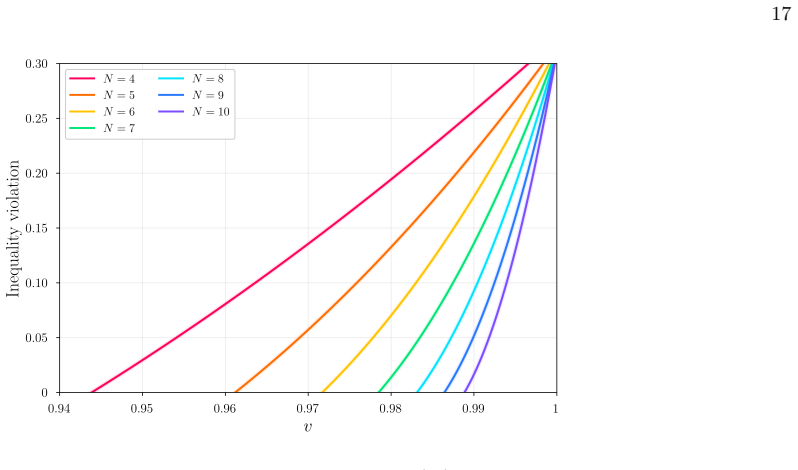
- domain assumption Standard no-signaling and independence assumptions in operational probabilistic theories
Lean theorems connected to this paper
-
Cost.FunctionalEquation / J(x)=½(x+x⁻¹)−1washburn_uniqueness_aczel unclear?
unclearRelation between the paper passage and the cited Recognition theorem.
P_{A_1,...,A_N} = (1/2)([0...0]+[1...1])
What do these tags mean?
- matches
- The paper's claim is directly supported by a theorem in the formal canon.
- supports
- The theorem supports part of the paper's argument, but the paper may add assumptions or extra steps.
- extends
- The paper goes beyond the formal theorem; the theorem is a base layer rather than the whole result.
- uses
- The paper appears to rely on the theorem as machinery.
- contradicts
- The paper's claim conflicts with a theorem or certificate in the canon.
- unclear
- Pith found a possible connection, but the passage is too broad, indirect, or ambiguous to say the theorem truly supports the claim.
Reference graph
Works this paper leans on
-
[1]
Coordination requires a common cause in Quantum Theory,
D. Centeno, A. Coquet, M. C. Ala˜ n´ on, L. Tendick, M.-O. Renou, and E. Wolfe, “Coordination requires a common cause in Quantum Theory,” (2026), companion paper, arxiv to appear
2026
-
[2]
Pearl,Causality, 2nd ed
J. Pearl,Causality, 2nd ed. (Cambridge University Press, 2009)
2009
-
[3]
On the einstein podolsky rosen paradox,
J. S. Bell, “On the einstein podolsky rosen paradox,” Physics Physique Fizika1, 195 (1964)
1964
-
[4]
Strong Loophole-Free Test of Local Realism∗,
L. K. Shalm, E. Meyer-Scott, B. G. Christensen, P. Bier- horst, M. A. Wayne, M. J. Stevens, T. Gerrits, S. Glancy, D. R. Hamel, M. S. Allman, K. J. Coakley, S. D. Dyer, C. Hodge, A. E. Lita, V. B. Verma, C. Lambrocco, E. Tor- torici, A. L. Migdall, Y. Zhang, D. R. Kumor, W. H. Farr, F. Marsili, M. D. Shaw, J. A. Stern, C. Abell´ an, W. Amaya, V. Pruneri, ...
2015
-
[5]
Significant-Loophole-Free Test of Bell’s Theorem with Entangled Photons,
M. Giustina, M. A. M. Versteegh, S. Wengerowsky, J. Handsteiner, A. Hochrainer, K. Phelan, F. Steinlechner, J. Kofler, J.-˚A. Larsson, C. Abell´ an, W. Amaya, V. Pruneri, M. W. Mitchell, J. Beyer, T. Gerrits, A. E. Lita, L. K. Shalm, S. W. Nam, T. Scheidl, R. Ursin, B. Wittmann, and A. Zeilinger, “Significant-Loophole-Free Test of Bell’s Theorem with Enta...
2015
-
[6]
Loophole- free Bell inequality violation using electron spins separated by 1.3 kilometres,
B. Hensen, H. Bernien, A. E. Dr´ eau, A. Reiserer, N. Kalb, M. S. Blok, J. Ruitenberg, R. F. L. Vermeulen, R. N. Schouten, C. Abell´ an, W. Amaya, V. Pruneri, M. W. Mitchell, M. Markham, D. J. Twitchen, D. Elkouss, S. Wehner, T. H. Taminiau, and R. Hanson, “Loophole- free Bell inequality violation using electron spins separated by 1.3 kilometres,” Nature ...
2015
-
[7]
Event-Ready Bell Test Using Entangled Atoms Simultaneously Closing Detection and Locality Loopholes,
W. Rosenfeld, D. Burchardt, R. Garthoff, K. Redeker, N. Ortegel, M. Rau, and H. Weinfurter, “Event-Ready Bell Test Using Entangled Atoms Simultaneously Closing Detection and Locality Loopholes,” Phys. Rev. Lett.119, 010402 (2017)
2017
-
[8]
Bell nonlocality,
N. Brunner, D. Cavalcanti, S. Pironio, V. Scarani, and S. Wehner, “Bell nonlocality,” Rev. Mod. Phys.86, 419 (2014)
2014
-
[9]
Bell nonlocality in networks,
A. Tavakoli, A. Pozas-Kerstjens, M.-X. Luo, and M.-O. 19 Renou, “Bell nonlocality in networks,” Reports on Progress in Physics85, 056001 (2022)
2022
-
[10]
General properties of nonsignaling theories,
L. Masanes, A. Acin, and N. Gisin, “General properties of nonsignaling theories,” Phys. Rev. A73, 012112 (2006)
2006
-
[11]
Self-testing of quantum systems: a review,
I. ˇSupi´ c and J. Bowles, “Self-testing of quantum systems: a review,” Quantum4, 337 (2020)
2020
-
[12]
Quantum cryptography based on Bell’s theorem,
A. K. Ekert, “Quantum cryptography based on Bell’s theorem,” Phys. Rev. Lett.67, 661 (1991)
1991
-
[13]
Device-Independent Security of Quantum Cryptography against Collective Attacks,
A. Ac´ ın, N. Brunner, N. Gisin, S. Massar, S. Pironio, and V. Scarani, “Device-Independent Security of Quantum Cryptography against Collective Attacks,” Phys. Rev. Lett.98, 230501 (2007)
2007
-
[14]
Quantum And Relativistic Protocols For Secure Multi-Party Computation,
R. Colbeck, “Quantum And Relativistic Protocols For Secure Multi-Party Computation,” (2009)
2009
-
[15]
Random numbers certi- fied by Bell’s theorem,
S. Pironio, A. Ac´ ın, S. Massar, A. B. de la Giroday, D. N. Matsukevich, P. Maunz, S. Olmschenk, D. Hayes, L. Luo, T. A. Manning, and C. Monroe, “Random numbers certi- fied by Bell’s theorem,” Nature464, 1021–1024 (2010)
2010
-
[16]
Any physical theory of nature must be boundlessly multipartite nonlocal,
X. Coiteux-Roy, E. Wolfe, and M.-O. Renou, “Any physical theory of nature must be boundlessly multipartite nonlocal,” Physical Review A104, 052207 (2021)
2021
-
[17]
No bipartite- nonlocal causal theory can explain nature’s correlations,
X. Coiteux-Roy, E. Wolfe, and M.-O. Renou, “No bipartite- nonlocal causal theory can explain nature’s correlations,” Physical review letters127, 200401 (2021)
2021
-
[18]
Theory-independent limits on correlations from generalized Bayesian networks,
J. Henson, R. Lal, and M. F. Pusey, “Theory-independent limits on correlations from generalized Bayesian networks,” New J. Phys.16, 113043 (2014)
2014
-
[19]
The Inflation Technique for Causal Inference with Latent Variables,
E. Wolfe, R. W. Spekkens, and T. Fritz, “The Inflation Technique for Causal Inference with Latent Variables,” J. Causal Inference7, 0020 (2019)
2019
-
[20]
Con- straints on nonlocality in networks from no-signaling and independence,
N. Gisin, J.-D. Bancal, Y. Cai, P. Remy, A. Tavakoli, E. Zambrini Cruzeiro, S. Popescu, and N. Brunner, “Con- straints on nonlocality in networks from no-signaling and independence,” Nature Communications11(2020)
2020
-
[21]
Reichenbach,The Direction of Time, Dover Books on Physics (Dover Publications, 2012)
H. Reichenbach,The Direction of Time, Dover Books on Physics (Dover Publications, 2012)
2012
-
[22]
Quantum nonlocality as an axiom,
S. Popescu and D. Rohrlich, “Quantum nonlocality as an axiom,” Foundations of Physics24, 379 (1994)
1994
-
[23]
Information processing in generalized proba- bilistic theories,
J. Barrett, “Information processing in generalized proba- bilistic theories,” Phys. Rev. A75, 032304 (2007)
2007
-
[24]
Generalizations of Boxworld,
P. Janotta, “Generalizations of Boxworld,” Electronic Pro- ceedings in Theoretical Computer Science95, 183–192 (2012)
2012
-
[25]
Generic quantum nonlocal- ity,
S. Popescu and D. Rohrlich, “Generic quantum nonlocal- ity,” Physics Letters A166, 293 (1992)
1992
-
[26]
Information causality as a physical principle,
M. Paw lowski, T. Paterek, D. Kaszlikowski, V. Scarani, A. Winter, and M. ˙Zukowski, “Information causality as a physical principle,” Nature461, 1101–1104 (2009)
2009
-
[27]
Local orthogonality as a multi- partite principle for quantum correlations,
T. Fritz, A. Sainz, R. Augusiak, J. B. Brask, R. Chaves, A. Leverrier, and A. Ac´ ın, “Local orthogonality as a multi- partite principle for quantum correlations,” Nature Com- munications4(2013)
2013
-
[28]
Limit on Nonlocality in Any World in Which Communication Complexity Is Not Trivial,
G. Brassard, H. Buhrman, N. Linden, A. A. M´ ethot, A. Tapp, and F. Unger, “Limit on Nonlocality in Any World in Which Communication Complexity Is Not Trivial,” Phys. Rev. Lett.96, 250401 (2006)
2006
-
[29]
Quan- tum Nonlocality and Beyond: Limits from Nonlocal Com- putation,
N. Linden, S. Popescu, A. J. Short, and A. Winter, “Quan- tum Nonlocality and Beyond: Limits from Nonlocal Com- putation,” Phys. Rev. Lett.99, 180502 (2007)
2007
-
[30]
Comparing causality principles,
J. Henson, “Comparing causality principles,” Studies In History and Philosophy of Science Part B: Studies In History and Philosophy of Modern Physics36, 519 (2005)
2005
-
[31]
The principle of the common cause faces the Bernstein paradox,
J. Uffink, “The principle of the common cause faces the Bernstein paradox,” Philosophy of Science66, S512 (1999)
1999
-
[32]
Information-theoretic inference of common ancestors,
B. Steudel and N. Ay, “Information-theoretic inference of common ancestors,” Entropy17, 2304 (2015)
2015
-
[33]
Distinguishing quantum causal scenarios with indistinguishable classical analogs: The significance of intermediate latents,
D. Centeno and E. Wolfe, “Distinguishing quantum causal scenarios with indistinguishable classical analogs: The significance of intermediate latents,” Physical Review A 112, 042206 (2025)
2025
-
[34]
Quantum inflation: A gen- eral approach to quantum causal compatibility,
E. Wolfe, A. Pozas-Kerstjens, M. Grinberg, D. Rosset, A. Ac´ ın, and M. Navascu´ es, “Quantum inflation: A gen- eral approach to quantum causal compatibility,” Physical Review X11, 021043 (2021)
2021
-
[35]
An order-theoretic circuit syntax and characterisation of the concept lattice,
T. van der Lugt, “An order-theoretic circuit syntax and characterisation of the concept lattice,” arXiv preprint arXiv:2507.05428 (2025)
-
[36]
M. A. Nielsen and I. L. Chuang,Quantum computation and quantum information(Cambridge university press,
-
[37]
A convergent hierarchy of semidefinite programs characterizing the set of quantum correlations,
M. Navascu´ es, S. Pironio, and A. Ac´ ın, “A convergent hierarchy of semidefinite programs characterizing the set of quantum correlations,” New Journal of Physics10, 073013 (2008)
2008
-
[38]
G. M. D’Ariano, G. Chiribella, and P. Perinotti,Quantum theory from first principles: an informational approach (Cambridge University Press, 2017)
2017
-
[39]
Experimental demonstration that no tripartite-nonlocal causal theory explains nature’s correlations,
H. Cao, M.-O. Renou, C. Zhang, G. Mass´ e, X. Coiteux-Roy, B.-H. Liu, Y.-F. Huang, C.-F. Li, G.-C. Guo, and E. Wolfe, “Experimental demonstration that no tripartite-nonlocal causal theory explains nature’s correlations,” Physical Re- view Letters129, 150402 (2022)
2022
-
[40]
Elemental and tight monogamy relations in nonsignaling theories,
R. Augusiak, M. Demianowicz, M. Paw lowski, J. Tura, and A. Ac´ ın, “Elemental and tight monogamy relations in nonsignaling theories,” Physical Review A90, 052323 (2014)
2014
-
[41]
Photonic source of heralded Greenberger-Horne-Zeilinger states,
H. Cao, L. Hansen, F. Giorgino, L. Carosini, P. Zah´ alka, F. Zilk, J. Loredo, and P. Walther, “Photonic source of heralded Greenberger-Horne-Zeilinger states,” Physical Review Letters132, 130604 (2024)
2024
-
[42]
Heralded three-photon entanglement from a single-photon source on a photonic chip,
S. Chen, L.-C. Peng, Y.-P. Guo, X.-M. Gu, X. Ding, R.- Z. Liu, J.-Y. Zhao, X. You, J. Qin, Y.-F. Wang,et al., “Heralded three-photon entanglement from a single-photon source on a photonic chip,” Physical Review Letters132, 130603 (2024)
2024
-
[43]
The genuinely multipartite nonlocality of graph states is model-dependent,
X. Coiteux-Roy, O. Makuta, F. Curran, R. Augusiak, and M.-O. Renou, “The genuinely multipartite nonlocality of graph states is model-dependent,” npj Quantum Informa- tion11, 90 (2025)
2025
-
[44]
Ruling out N-partite quantum causal networks as a complete theory of Nature,
A. Coquet, “Ruling out N-partite quantum causal networks as a complete theory of Nature,” ETH Z¨ urich Master’s thesis supervised by Prof. Marc-Olivier Renou and Prof. Renato Renner (2024). 20 Appendix A: Proof of Lemma 3 In this appendix we formally prove Lemma 3. However, let us first show a proposition that serves as an interme- diate step in order to ...
2024
-
[45]
Take all the largest sets of observed nodes that share a common cause and, for each of them, add a nonclassical latent node which has all the nodes in the set as children
-
[46]
Find the largest sets of common descendants for all sets of theaddednonclassical common causes (note that as we are considering common descendants, the sets of common causes has size two or more). For each distinct maximal set of common descendants of size larger or equal than two, Si (where i is an index for each of these sets), take the set of all their...
-
[47]
We write it only for the N-partite case, as they are completely analogous
Proof of Theorems 6 and 1 (noise-robust version) Finally, we give the formal proof of Theorems 6 and 1 (noise-robust version). We write it only for the N-partite case, as they are completely analogous. Proof. By Lemma 9, any inequality that we derive for the set of probability distributions compatible with g∗ N is an inequality that must be satisfied by a...
-
[47]
We write it only for the N-partite case, as they are completely analogous
Proof of Theorems 6 and 1 (noise-robust version) Finally, we give the formal proof of Theorems 6 and 1 (noise-robust version). We write it only for the N-partite case, as they are completely analogous. Proof. By Lemma 9, any inequality that we derive for the set of probability distributions compatible with g∗ N is an inequality that must be satisfied by a...
-
[48]
N vmin,N fmin,N 4 0.9417 0.9454 5 0.9617 0.9629 6 0.9730 0.9735 7 0.9800 0.9802 8 0.9846 0.9847 9 0.9878 0.9878 10 0.9901 0.9901 TABLE VI
Note that indeed only for N =4 the minimum value for positivity is smaller for the inequality provided in this appendix. N vmin,N fmin,N 4 0.9417 0.9454 5 0.9617 0.9629 6 0.9730 0.9735 7 0.9800 0.9802 8 0.9846 0.9847 9 0.9878 0.9878 10 0.9901 0.9901 TABLE VI. Numerical values (up to the fourth decimal) of vmin,N and fmin,N derived from inequality C1 for d...
discussion (0)
Sign in with ORCID, Apple, or X to comment. Anyone can read and Pith papers without signing in.