Fault-tolerant measurement-device-independent quantum key distribution with noisy non-Gaussian error correction
Pith reviewed 2026-05-07 17:43 UTC · model grok-4.3
The pith
GKP oscillators-to-oscillators codes suppress loss and operation errors below break-even in asymmetric CV-MDI-QKD without heralding delays.
A machine-rendered reading of the paper's core claim, the machinery that carries it, and where it could break.
Core claim
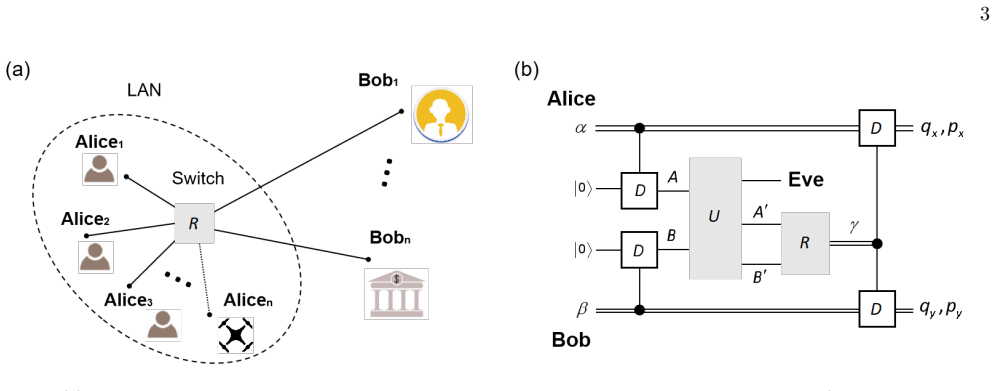
GKP oscillators-to-oscillators codes, with noise correlation via a pair of symplectic transforms, suppress both loss error and operation error below the break-even point in the asymmetric CV-MDI-QKD protocol without any delays caused by classical heralding signals. Numerical analysis shows the composable finite-size security of the protocol under the collective Gaussian attack, encompassing noiseless and noisy GKP states, with both wired and wireless configurations. The residual errors of the GKP code can be further reduced by the concatenation method but has a trade-off between the layers number and the finite GKP squeezing.
What carries the argument
GKP oscillators-to-oscillators codes that correlate noise between data and ancilla modes via symplectic transforms, extract error syndromes from ancilla stabilizer measurements, and apply corrective displacements to the data mode.
If this is right
- The protocol achieves composable finite-size security under collective Gaussian attacks for both noiseless and noisy GKP states.
- Security holds for asymmetric configurations in both fiber-based wired and free-space wireless channels.
- Concatenation of GKP codes further reduces residual errors, subject to a trade-off between layer number and finite GKP squeezing level.
Where Pith is reading between the lines
- The deterministic character of the correction could allow direct integration with high-speed classical networks for real-time key distribution.
- Similar symplectic noise-correlation techniques may improve other continuous-variable protocols that rely on measurement-based nodes.
- Verification of the required symplectic transform correlations in physical oscillator systems would be the next concrete experimental test.
Load-bearing premise
GKP oscillators-to-oscillators codes with noise correlation via a pair of symplectic transforms can suppress both loss error and operation error below the break-even point without any delays caused by classical heralding signals.
What would settle it
An experiment in which the residual error rate after GKP correction exceeds the break-even threshold required for a positive finite-size key rate under collective Gaussian attacks would falsify the security claim.
Figures


read the original abstract
It is well known that the repeater node is an essential ingredient for the future global quantum network, which will enable high-rate private communication and entanglement distribution over very long distances. The near-term repeater architecture uses the measurement-based node that operate without both entanglement and quantum memory, which is the main idea of the measurement-device-independent quantum key distribution (MDI-QKD) protocol. The MDI-QKD protocol removes the trust condition from the inter repeaters, while its continuous variable (CV) version, when proposed, benefited from its deterministic nature, compatible with the classical devices, and shows a high rate for the short-range local area network (LAN). Whilst the theoretical backbone of CV-MDI-QKD protocol is well established, its secure transmission range is yet limited for practical LAN. In this study, we propose an enhanced scheme for the asymmetric CV-MDI-QKD protocol by using Gottesman-Kitaev-Preskill (GKP) oscillators-to-oscillators codes, where both loss error and operation error are suppressed to below the break-even point, without any delays caused by classical heralding signals. In particular, the proposed scheme, which correlates the noises of the data and ancilla via a pair of symplectic transforms, extracts the error syndromes from stabilizer measurements on the ancilla mode and informs the data mode for a corrective displacement. Numerical analysis shows the composable finite-size security of the protocol under the collective Gaussian attack, encompassing noiseless and noisy GKP states, with both wired (i.e., fiber-based) and wireless (i.e., free-space) configurations. In addition, we demonstrate that the residual errors of the GKP code can be further reduced by the concatenation method but has a trade-off between the layers number and the finite GKP squeezing.
Editorial analysis
A structured set of objections, weighed in public.
Referee Report
Summary. The paper proposes an enhanced asymmetric continuous-variable measurement-device-independent quantum key distribution (CV-MDI-QKD) protocol that incorporates Gottesman-Kitaev-Preskill (GKP) oscillators-to-oscillators codes. Noise correlation is achieved via a pair of symplectic transforms; error syndromes are extracted from ancilla stabilizer measurements and used for corrective displacements on the data mode. This is claimed to suppress both loss and operation errors below the break-even point without delays from classical heralding signals. Numerical analysis is presented for the composable finite-size security under collective Gaussian attacks, covering noiseless and noisy GKP states in both fiber-based (wired) and free-space (wireless) configurations, with optional concatenation layers trading off against finite GKP squeezing.
Significance. If the central claims on error suppression and security hold after addressing modeling details, the work would offer a concrete route to extend the range of practical CV-MDI-QKD using near-term GKP hardware, while remaining compatible with deterministic, memory-free repeater nodes. The treatment of both wired/wireless channels and noisy GKP states increases relevance to realistic deployments. The numerical security analysis under standard Gaussian attacks provides a starting point for finite-size key-rate estimates, though its load-bearing assumptions require tighter verification.
major comments (3)
- [Protocol description and security analysis] Protocol description (abstract and main protocol section): The central claim that the scheme suppresses errors 'without any delays caused by classical heralding signals' rests on the untrusted MDI relay performing the measurement while ancilla syndromes are extracted and fed back for data-mode correction. The manuscript does not specify the classical communication channel for syndrome transfer, its timing relative to the quantum transmission, or how any associated latency or bit-flip errors are folded into the finite-size composable security bound and the optimality of the collective Gaussian attack model.
- [Numerical security analysis] Numerical security analysis section: The reported composable finite-size key rates under Gaussian attacks for noiseless and noisy GKP states lack explicit derivations of the covariance matrices after symplectic noise correlation, the precise optimization procedure over GKP squeezing and concatenation layers, error-bar estimation, and data-exclusion criteria. Without these, it is not possible to confirm that residual errors are suppressed below break-even or to reproduce the claimed security advantage over standard CV-MDI-QKD.
- [GKP code construction] GKP code construction (oscillators-to-oscillators section): The assumption that a pair of symplectic transforms fully correlates loss and operation noise between data and ancilla modes in the MDI channel must be shown to remain valid when the measurement occurs at an untrusted relay; any additional noise introduced by the relay's homodyne detection or the subsequent classical feedback could invalidate the break-even suppression and the Gaussian-attack security reduction.
minor comments (2)
- [Title and abstract] The title refers to 'noisy non-Gaussian error correction' while the body focuses on GKP codes; a brief clarification of the precise non-Gaussian aspect (e.g., the GKP code itself versus additional non-Gaussian operations) would improve readability.
- [Figures and tables] Figure captions and parameter tables should explicitly list the exact GKP squeezing values, number of concatenation layers, and channel-loss ranges used for each plotted curve to allow direct comparison with the text.
Simulated Author's Rebuttal
We thank the referee for their thorough review and valuable comments on our manuscript. We address each of the major comments point by point below, providing clarifications and indicating revisions where necessary to strengthen the paper.
read point-by-point responses
-
Referee: Protocol description (abstract and main protocol section): The central claim that the scheme suppresses errors 'without any delays caused by classical heralding signals' rests on the untrusted MDI relay performing the measurement while ancilla syndromes are extracted and fed back for data-mode correction. The manuscript does not specify the classical communication channel for syndrome transfer, its timing relative to the quantum transmission, or how any associated latency or bit-flip errors are folded into the finite-size composable security bound and the optimality of the collective Gaussian attack model.
Authors: We clarify that the syndrome extraction and feedback occur after the MDI measurement at the relay, using a standard authenticated classical channel for post-processing, which does not introduce heralding delays since the protocol operates deterministically without conditional success probabilities. The timing is such that the classical communication happens after quantum transmission, and any latency is accounted for in the overall protocol timing but does not affect the quantum channel security analysis. Bit-flip errors on the classical channel are assumed negligible under standard QKD assumptions or can be corrected with error-correcting codes, and we will explicitly state this in the revised manuscript. The collective Gaussian attack model remains optimal as the additional classical noise is independent of the quantum part. We will add a detailed description of the classical channel and timing in the protocol section. revision: yes
-
Referee: Numerical security analysis section: The reported composable finite-size key rates under Gaussian attacks for noiseless and noisy GKP states lack explicit derivations of the covariance matrices after symplectic noise correlation, the precise optimization procedure over GKP squeezing and concatenation layers, error-bar estimation, and data-exclusion criteria. Without these, it is not possible to confirm that residual errors are suppressed below break-even or to reproduce the claimed security advantage over standard CV-MDI-QKD.
Authors: We agree that additional details would improve reproducibility. In the revised manuscript, we will include an appendix with the explicit derivations of the covariance matrices following the symplectic transforms, describe the optimization procedure used for choosing GKP squeezing levels and concatenation layers (including the trade-off analysis), specify the method for error-bar estimation (e.g., via Monte Carlo simulations or analytical bounds), and clarify the data-exclusion criteria applied in the numerical security analysis. This will allow verification that errors are suppressed below break-even. revision: yes
-
Referee: GKP code construction (oscillators-to-oscillators section): The assumption that a pair of symplectic transforms fully correlates loss and operation noise between data and ancilla modes in the MDI channel must be shown to remain valid when the measurement occurs at an untrusted relay; any additional noise introduced by the relay's homodyne detection or the subsequent classical feedback could invalidate the break-even suppression and the Gaussian-attack security reduction.
Authors: The symplectic transforms are applied locally at the transmitter prior to sending the modes through the channel, ensuring that the noise correlation is established before any channel noise or relay operations. The MDI relay performs a joint measurement on the incoming modes, but since the correlation is in the quadrature operators via the symplectic map, the effective noise on the data mode after correction remains correlated as modeled. The homodyne detection at the relay introduces Gaussian noise which is already accounted for in the overall channel noise model under the Gaussian attack assumption. The classical feedback for correction is applied at the receiver after receiving the syndrome, and any errors there are treated as part of the post-processing. Our numerical results demonstrate the suppression below break-even even with these considerations. We will add a clarifying paragraph in the GKP code construction section to explicitly justify the validity under untrusted relay operations. revision: partial
Circularity Check
No significant circularity detected in derivation chain
full rationale
The paper defines a GKP-based CV-MDI-QKD protocol with symplectic noise correlation and ancilla-based syndrome extraction, then performs numerical finite-size key-rate analysis under the standard collective Gaussian attack model for both noiseless and noisy GKP states. No step reduces by construction to a fitted parameter renamed as a prediction, a self-definitional loop, or a load-bearing self-citation chain; the security evaluation is an independent numerical computation on the modeled channel. The assumption that corrections occur without heralding delays is an explicit protocol choice rather than a derived quantity that tautologically equals its input. The derivation therefore remains self-contained against external benchmarks.
Axiom & Free-Parameter Ledger
free parameters (2)
- GKP squeezing level
- Number of concatenation layers
axioms (2)
- domain assumption Collective Gaussian attacks represent the optimal eavesdropping strategy for security analysis
- standard math Symplectic transformations preserve the phase-space structure of continuous-variable quantum states
Reference graph
Works this paper leans on
-
[1]
Fiber scenario First, we consider the scenario where both Alice and Bob are connected to the relay using SMF. Fig. 5(a) shows the reverse coherent information (RCI) of the bosonic system with and without GKP codes, which stands as the lower bound on the optimal key rate R [7]. Here, we first remove the imperfection of data post- processing for the optimal...
-
[2]
Free-space scenarios Next, we extend to the free-space scenario, where Alice uses a horizontal fading link to connect to the relay (Bob still uses SMF). In this scenario, Alice can be located in a building, but also be moving aircraft or drones with more flexible links. Unlike the fiber scenario, the transmittance along a fading channel is not fixed, but ...
-
[3]
(A3) When only the pre-amplification is used, θ becomes θ = σ2 A − 2τA + τBσ2 B + 4
-
[4]
(A4) 12 Note that for any outcomeγ, the conditional remote state ψab|γ has always the same CMVab|γ , while its mean value varies with γ. In the asymptotic regime (N ≫ 1, where N is the total number of received pulse), the secret key rate follows the Csiszar-Korner theorem given by [65] Rasy = β0I − χ, (A5) where β0 represents the reconciliation efficiency...
-
[5]
H. J. Kimble, The quantum internet, Nature 453, 1023 (2008)
work page 2008
-
[6]
S. Pirandola and S. L. Braunstein, Physics: Unite to build a quantum internet, Nature 532, 169 (2016)
work page 2016
- [7]
- [8]
-
[9]
S. Pirandola, U. L. Andersen, L. Banchi, M. Berta, D. Bunandar, R. Colbeck, D. Englund, T. Gehring, C. Lupo, C. Ottaviani, et al., Advances in quantum cryp- tography, Advances in optics and photonics 12, 1012 (2020)
work page 2020
- [10]
-
[11]
S. Pirandola, R. Laurenza, C. Ottaviani, and L. Banchi, Fundamental limits of repeaterless quantum communica- tions, Nature communications 8, 15043 (2017)
work page 2017
-
[12]
S. Pirandola, End-to-end capacities of a quantum com- munication network, Communications Physics 2, 51 (2019)
work page 2019
-
[13]
C. Harney and S. Pirandola, Analytical methods for high- rate global quantum networks, PRX Quantum 3, 010349 (2022)
work page 2022
- [14]
-
[15]
Pirandola, Architectures for qkd networks, in Photon- ics for Quantum 2022 , Vol
S. Pirandola, Architectures for qkd networks, in Photon- ics for Quantum 2022 , Vol. 12243 (SPIE, 2022) pp. 51– 58
work page 2022
-
[16]
S. L. Braunstein and S. Pirandola, Side-channel-free quantum key distribution, Phys. Rev. Lett. 108, 130502 (2012)
work page 2012
-
[17]
H.-K. Lo, M. Curty, and B. Qi, Measurement-device- independent quantum key distribution, Physical review letters 108, 130503 (2012)
work page 2012
-
[18]
F. Xu, X. Ma, Q. Zhang, H.-K. Lo, and J.-W. Pan, Secure quantum key distribution with realistic devices, Reviews of modern physics 92, 025002 (2020)
work page 2020
-
[19]
M. Lucamarini, Z. L. Yuan, J. F. Dynes, and A. J. Shields, Overcoming the rate–distance limit of quantum key distribution without quantum repeaters, Nature557, 400 (2018)
work page 2018
-
[20]
Y. Tian, P. Wang, J. Liu, S. Du, W. Liu, Z. Lu, X. Wang, and Y. Li, Experimental demonstration of continuous- variable measurement-device-independent quantum key distribution over optical fiber, Optica 9, 492 (2022)
work page 2022
-
[21]
A. A. Hajomer, U. L. Andersen, and T. Gehring, High-rate continuous-variable measurement device- independent quantum key distribution with finite-size security, Quantum Science and Technology 10, 025032 (2025)
work page 2025
-
[22]
A. Fletcher, C. Harney, M. Ghalaii, P. Papanastasiou, A. G. Mountogiannakis, G. Spedalieri, A. Hajomer, T. Gehring, and S. Pirandola, An overview of cv-mdi- qkd, Reports on Progress in Physics (2025)
work page 2025
-
[23]
P. Jouguet, S. Kunz-Jacques, and E. Diamanti, Pre- venting calibration attacks on the local oscillator in continuous-variable quantum key distribution, Physical 14 Review A—Atomic, Molecular, and Optical Physics 87, 062313 (2013)
work page 2013
-
[24]
H. Qin, R. Kumar, and R. All´ eaume, Quantum hack- ing: Saturation attack on practical continuous-variable quantum key distribution, Physical Review A 94, 012325 (2016)
work page 2016
-
[25]
H. Qin, R. Kumar, V. Makarov, and R. All´ eaume, Homodyne-detector-blinding attack in continuous- variable quantum key distribution, Physical Review A 98, 012312 (2018)
work page 2018
-
[26]
S. Pirandola, C. Ottaviani, G. Spedalieri, C. Weedbrook, S. L. Braunstein, S. Lloyd, T. Gehring, C. S. Jacob- sen, and U. L. Andersen, High-rate measurement-device- independent quantum cryptography, Nature Photonics9, 397 (2015)
work page 2015
-
[27]
S. Fossier, E. Diamanti, T. Debuisschert, R. Tualle- Brouri, and P. Grangier, Improvement of continuous- variable quantum key distribution systems by using op- tical preamplifiers, Journal of Physics B: Atomic, Molec- ular and Optical Physics 42, 114014 (2009)
work page 2009
-
[28]
R. Blandino, A. Leverrier, M. Barbieri, J. Etesse, P. Grangier, and R. Tualle-Brouri, Improving the maxi- mum transmission distance of continuous-variable quan- tum key distribution using a noiseless amplifier, Physical Review A—Atomic, Molecular, and Optical Physics 86, 012327 (2012)
work page 2012
-
[29]
H. M. Chrzanowski, N. Walk, S. M. Assad, J. Janousek, S. Hosseini, T. C. Ralph, T. Symul, and P. K. Lam, Measurement-based noiseless linear amplification for quantum communication, Nature Photonics 8, 333 (2014)
work page 2014
-
[30]
M. N. Notarnicola and S. Olivares, Long-distance continuous-variable quantum key distribution with fea- sible physical noiseless linear amplifiers, Physical Review A 108, 022404 (2023)
work page 2023
-
[31]
B. M. Terhal, Quantum error correction for quantum memories, Reviews of Modern Physics 87, 307 (2015)
work page 2015
-
[32]
T. M. Stace, S. D. Barrett, and A. C. Doherty, Thresh- olds for topological codes in the presence of loss, Physical review letters 102, 200501 (2009)
work page 2009
-
[33]
S. Muralidharan, J. Kim, N. L¨ utkenhaus, M. D. Lukin, and L. Jiang, Ultrafast and fault-tolerant quantum com- munication across long distances, Physical review letters 112, 250501 (2014)
work page 2014
- [34]
-
[35]
D. Gottesman, A. Kitaev, and J. Preskill, Encoding a qubit in an oscillator, Physical Review A 64, 012310 (2001)
work page 2001
-
[36]
M. H. Michael, M. Silveri, R. Brierley, V. V. Albert, J. Salmilehto, L. Jiang, and S. M. Girvin, New class of quantum error-correcting codes for a bosonic mode, Physical Review X 6, 031006 (2016)
work page 2016
- [37]
- [38]
-
[39]
C. Vuillot, H. Asasi, Y. Wang, L. P. Pryadko, and B. M. Terhal, Quantum error correction with the toric gottesman-kitaev-preskill code, Physical Review A 99, 032344 (2019)
work page 2019
- [40]
- [41]
-
[42]
K. Noh, S. Girvin, and L. Jiang, Encoding an oscilla- tor into many oscillators, Physical Review Letters 125, 080503 (2020)
work page 2020
-
[43]
A. J. Brady, A. Eickbusch, S. Singh, J. Wu, and Q. Zhuang, Advances in bosonic quantum error correc- tion with gottesman–kitaev–preskill codes: Theory, engi- neering and applications, Progress in Quantum Electron- ics 93, 100496 (2024)
work page 2024
- [44]
-
[45]
B.-H. Wu, Z. Zhang, and Q. Zhuang, Continuous-variable quantum repeaters based on bosonic error-correction and teleportation: architecture and applications, Quantum Science and Technology 7, 025018 (2022)
work page 2022
- [46]
-
[47]
M. V. Larsen, J. E. Bourassa, S. Kocsis, J. F. Tasker, R. S. Chadwick, C. Gonz´ alez-Arciniegas, J. Hastrup, C. E. Lopetegui-Gonz´ alez, F. M. Miatto, A. Motamedi, et al. , Integrated photonic source of gottesman–kitaev– preskill qubits, Nature 642, 587 (2025)
work page 2025
-
[48]
C. Weedbrook, S. Pirandola, R. Garc´ ıa-Patr´ on, N. J. Cerf, T. C. Ralph, J. H. Shapiro, and S. Lloyd, Gaus- sian quantum information, Reviews of Modern Physics 84, 621 (2012)
work page 2012
-
[49]
P. Papanastasiou, C. Ottaviani, and S. Pirandola, Finite- size analysis of measurement-device-independent quan- tum cryptography with continuous variables, Physical Review A 96, 042332 (2017)
work page 2017
-
[50]
P. Papanastasiou, A. G. Mountogiannakis, and S. Pi- randola, Composable security of cv-mdi-qkd with secret key rate and data processing, Scientific reports 13, 11636 (2023)
work page 2023
-
[51]
K. Noh, V. V. Albert, and L. Jiang, Quantum capacity bounds of gaussian thermal loss channels and achievable rates with gottesman-kitaev-preskill codes, IEEE Trans- actions on Information Theory 65, 2563 (2018)
work page 2018
-
[52]
K. Duivenvoorden, B. M. Terhal, and D. Weigand, Single- mode displacement sensor, Physical Review A95, 012305 (2017)
work page 2017
-
[53]
J. Wu, A. J. Brady, and Q. Zhuang, Optimal encoding of oscillators into more oscillators, Quantum7, 1082 (2023)
work page 2023
-
[54]
B. Zhou, A. J. Brady, and Q. Zhuang, Enhancing dis- tributed sensing with imperfect error correction, Physical Review A 106, 012404 (2022)
work page 2022
-
[55]
M. Ghalaii, P. Papanastasiou, and S. Pirandola, Compos- able end-to-end security of gaussian quantum networks with untrusted relays, npj Quantum Information 8, 105 (2022)
work page 2022
-
[56]
N. Jain, H.-M. Chin, H. Mani, C. Lupo, D. S. Nikolic, A. Kordts, S. Pirandola, T. B. Pedersen, M. Kolb, B. ¨Omer, et al. , Practical continuous-variable quantum 15 key distribution with composable security, Nature com- munications 13, 4740 (2022)
work page 2022
-
[57]
Z. Zuo, M. Ghalaii, and S. Pirandola, Realistic threat models for fiber and free-space continuous variable quantum key distribution, Physical Review Research 8, 013185 (2026)
work page 2026
-
[58]
S. Pirandola and P. Papanastasiou, Improved composable key rates for cv-qkd, Physical Review Research 6, 023321 (2024)
work page 2024
-
[59]
M. Tomamichel, C. Schaffner, A. Smith, and R. Ren- ner, Leftover hashing against quantum side informa- tion, IEEE Transactions on Information Theory 57, 5524 (2011)
work page 2011
-
[60]
M. Ghalaii and S. Pirandola, Capacity-approaching quantum repeaters for quantum communications, Physi- cal Review A 102, 062412 (2020)
work page 2020
-
[61]
A. A. Hajomer, C. Bruynsteen, I. Derkach, N. Jain, A. Bomhals, S. Bastiaens, U. L. Andersen, X. Yin, and T. Gehring, Continuous-variable quantum key distribu- tion at 10 gbaud using an integrated photonic-electronic receiver, Optica 11, 1197 (2024)
work page 2024
- [62]
-
[63]
M. Ghalaii, S. Bahrani, C. Liorni, F. Grasselli, H. Kam- permann, L. Wooltorton, R. Kumar, S. Pirandola, T. P. Spiller, A. Ling, et al. , Satellite-based quantum key dis- tribution in the presence of bypass channels, PRX Quan- tum 4, 040320 (2023)
work page 2023
-
[64]
Z. Zuo, Y. Wang, D. Huang, and Y. Guo, Atmospheric ef- fects on satellite-mediated continuous-variable quantum key distribution, Journal of Physics A: Mathematical and Theoretical 53, 465302 (2020)
work page 2020
-
[65]
S. Pirandola, Limits and security of free-space quantum communications, Physical Review Research 3, 013279 (2021)
work page 2021
-
[66]
D. Vasylyev, W. Vogel, and F. Moll, Satellite-mediated quantum atmospheric links, Physical Review A 99, 053830 (2019)
work page 2019
-
[67]
L. Ruppert, C. Peuntinger, B. Heim, K. G¨ unthner, V. C. Usenko, D. Elser, G. Leuchs, R. Filip, and C. Marquardt, Fading channel estimation for free-space continuous- variable secure quantum communication, New Journal of Physics 21, 123036 (2019)
work page 2019
-
[68]
G. Spedalieri, C. Ottaviani, and S. Pirandola, Covari- ance matrices under bell-like detections, Open Systems & Information Dynamics 20, 1350011 (2013)
work page 2013
-
[69]
I. Csisz´ ar and J. Korner, Broadcast channels with confi- dential messages, IEEE transactions on information the- ory 24, 339 (2003)
work page 2003
discussion (0)
Sign in with ORCID, Apple, or X to comment. Anyone can read and Pith papers without signing in.