Recognition: unknown
Adaptive Dual-Path Framework for Covert Semantic Communication
Pith reviewed 2026-05-07 16:37 UTC · model grok-4.3
The pith
A dual-path adaptive framework embeds covert data in semantic features to suppress attacker detection to near-random levels while improving task performance.
A machine-rendered reading of the paper's core claim, the machinery that carries it, and where it could break.
Core claim
The authors claim that their adaptive dual-path framework for covert semantic communication integrates covert information transmission with task-oriented semantic coding by embedding covert data within task-specific features via semantic-level intrinsic encoding. The framework uses dual encoding paths—an Explicit path for public task execution and a Stego path that jointly encodes both through contrastive representation alignment—along with a Gumbel-Softmax enabled adaptive path selection. This multi-objective optimization ensures accurate semantic understanding and reliable covert transmission, with experimental results on the Cityscapes dataset showing the attacker's detection accuracy at
What carries the argument
Dual encoding paths with an Explicit path for public tasks and a Stego path for joint public-covert encoding via contrastive representation alignment, plus Gumbel-Softmax adaptive block selection.
If this is right
- The method suppresses the attacker's detection accuracy to a near-random 56.12 percent on Cityscapes.
- It maintains superior performance on primary semantic tasks compared to baselines.
- It enables joint encoding of public and covert information at the semantic level without power-domain superposition.
- The multi-objective optimization balances accurate semantic understanding with reliable covert transmission.
Where Pith is reading between the lines
- This semantic-level embedding approach might extend to other datasets or dynamic wireless environments where task requirements shift rapidly.
- If the concealment holds, similar dual-path designs could reduce dependence on traditional physical-layer security in broader communication systems.
- The adaptive selection mechanism suggests potential for handling multiple simultaneous semantic tasks with embedded covert channels.
- Future work could test whether jointly optimizing the attacker and defender changes the observed security margin.
Load-bearing premise
The assumption that an independently trained attacker is the strongest possible threat and that contrastive representation alignment sufficiently conceals the covert information without allowing detection by more sophisticated or adaptive methods.
What would settle it
Training an attacker with knowledge of the dual-path architecture or using advanced techniques like adversarial training against the contrastive alignment and checking whether detection accuracy on Cityscapes rises substantially above 56.12 percent.
Figures



read the original abstract
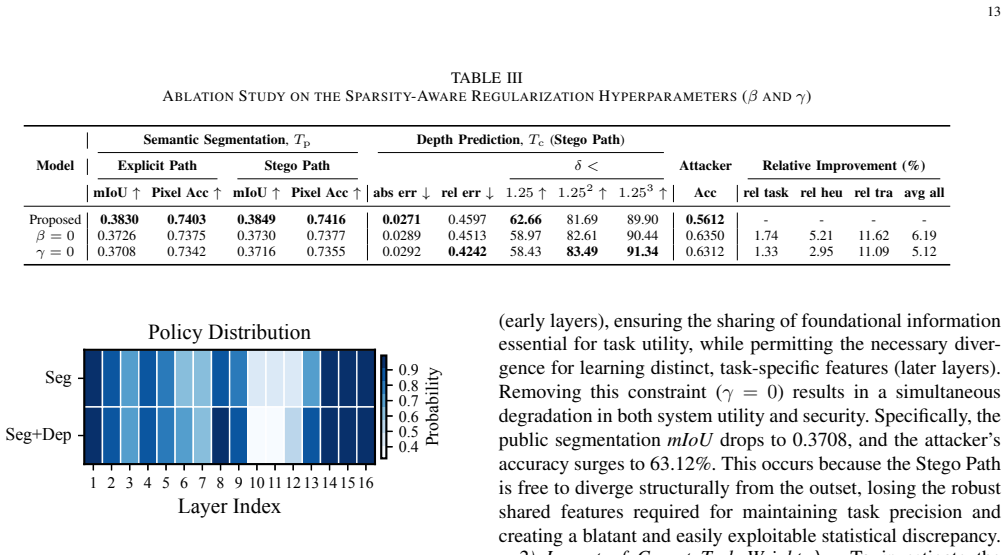
This paper proposes a novel adaptive dual-path framework for covert semantic communication (SemCom), which integrates covert information transmission with task-oriented semantic coding. Unlike conventional covert communication methods that embed hidden messages through power-domain signal superposition, our framework embeds covert data within task-specific features via semantic-level intrinsic encoding. This new architecture introduces dual encoding paths with adaptive block selection: an Explicit path for public task execution and a Stego path that jointly encodes both public and covert information through contrastive representation alignment. A Gumbel-Softmax enabled adaptive path selection mechanism dynamically activates network blocks based on task require- ments. We formulate a multi-objective optimization framework that simultaneously ensures accurate semantic understanding and reliable covert transmission. We rigorously evaluate our framework's security against a powerful, independently trained attacker. Experimental results on the Cityscapes dataset demon- strate a state-of-the-art level of covertness: our method suppresses the attacker's detection accuracy to a near-random guessing level of 56.12%. This robust security is achieved while simultaneously maintaining superior performance on the primary semantic tasks compared to the baselines.
Editorial analysis
A structured set of objections, weighed in public.
Referee Report
Summary. The paper proposes a novel adaptive dual-path framework for covert semantic communication that combines an explicit path for standard task-oriented semantic coding with a stego path that embeds covert information through contrastive representation alignment. It introduces Gumbel-Softmax-based adaptive block selection and a multi-objective optimization to balance semantic task performance with covert transmission security. On the Cityscapes dataset, the framework is reported to achieve superior semantic task results while reducing an independently trained attacker's detection accuracy to 56.12%, presented as near-random and state-of-the-art covertness.
Significance. If the security evaluation holds under stronger threat models, the work could advance covert semantic communication by shifting from power-domain superposition to semantic-level intrinsic encoding within task features. The integration of contrastive alignment for concealment and adaptive path selection offers a concrete architecture with specific performance numbers on Cityscapes, providing a useful baseline for future secure SemCom research. The experimental focus on both primary task metrics and attacker detection is a strength.
major comments (2)
- [§5] §5 (Experimental Results, security evaluation subsection): The headline claim of 'robust security' and 'state-of-the-art level of covertness' rests on suppressing an independently trained attacker's detection accuracy to 56.12%. However, the manuscript does not report results against adaptive attackers that have white-box access to the dual-path architecture or are trained jointly to exploit the contrastive alignment in the stego path. This is load-bearing for the central security claim, as the fixed-attacker setup may allow the framework to overfit to that specific threat model.
- [§4] §4 (Multi-objective optimization formulation): The optimization includes free parameters for the loss weights balancing semantic accuracy, covert transmission, and contrastive alignment, plus the Gumbel-Softmax temperature. The manuscript should include sensitivity analysis or ablation showing how variations in these parameters affect the reported 56.12% detection figure and task performance, to substantiate that the covertness is not an artifact of post-hoc tuning.
minor comments (2)
- [Abstract] Abstract: Typographical artifacts from line breaks appear as 'require- ments' and 'demon- strate'; these should be corrected for readability.
- [Abstract and §5] The abstract and experimental sections lack explicit mention of data splits, error bars on the 56.12% figure, or full baseline implementation details, which would improve reproducibility even if not central to the claims.
Simulated Author's Rebuttal
We thank the referee for the constructive comments, which help clarify the scope of our security claims and the robustness of our optimization. We address each major comment below, indicating the revisions we will incorporate to strengthen the manuscript.
read point-by-point responses
-
Referee: §5 (Experimental Results, security evaluation subsection): The headline claim of 'robust security' and 'state-of-the-art level of covertness' rests on suppressing an independently trained attacker's detection accuracy to 56.12%. However, the manuscript does not report results against adaptive attackers that have white-box access to the dual-path architecture or are trained jointly to exploit the contrastive alignment in the stego path. This is load-bearing for the central security claim, as the fixed-attacker setup may allow the framework to overfit to that specific threat model.
Authors: We agree that the evaluated threat model is limited to an independently trained attacker and that stronger adaptive or white-box attacks would provide a more comprehensive assessment. Our current evaluation follows the standard practice in covert communication literature, where the attacker is trained separately without access to the transmitter's internal parameters or joint optimization. This setup reflects a realistic scenario in which the covert framework is not fully exposed. Nevertheless, we acknowledge that the 56.12% detection result may not generalize to all possible attacks. In the revision, we will add a dedicated limitations subsection discussing adaptive attack scenarios, including potential joint training of the attacker to exploit the contrastive alignment. We will also moderate the language around 'robust security' and 'state-of-the-art covertness' to explicitly tie these claims to the independent-attacker model while outlining future directions for stronger threat models. revision: yes
-
Referee: §4 (Multi-objective optimization formulation): The optimization includes free parameters for the loss weights balancing semantic accuracy, covert transmission, and contrastive alignment, plus the Gumbel-Softmax temperature. The manuscript should include sensitivity analysis or ablation showing how variations in these parameters affect the reported 56.12% detection figure and task performance, to substantiate that the covertness is not an artifact of post-hoc tuning.
Authors: We appreciate this observation regarding the hyperparameters in the multi-objective loss and the Gumbel-Softmax temperature. These parameters were selected via validation-set performance to balance the primary semantic tasks with covert transmission objectives. To demonstrate that the reported covertness is not an artifact of specific tuning, we will include an expanded ablation study in the revised manuscript. This will report results for a range of loss-weight combinations and temperature values, showing their effects on both semantic segmentation metrics (e.g., mIoU on Cityscapes) and attacker detection accuracy. The added analysis will substantiate the stability of the 56.12% detection figure within reasonable parameter ranges. revision: yes
Circularity Check
No significant circularity detected; framework and security evaluation are self-contained
full rationale
The paper introduces a dual-path encoder with contrastive alignment and Gumbel-Softmax selection, then reports an experimental security result (56.12% attacker detection on Cityscapes) obtained by training an independent attacker. No load-bearing step reduces the architecture, optimization, or measured covertness to a self-definition, a fitted parameter renamed as a prediction, or a self-citation chain; the multi-objective loss and external evaluation benchmark remain independent of the claimed outcomes.
Axiom & Free-Parameter Ledger
free parameters (2)
- multi-objective loss weights
- Gumbel-Softmax temperature
axioms (2)
- domain assumption Neural networks can learn task-specific and covert-aligned representations via contrastive loss
- standard math Gumbel-Softmax provides a differentiable approximation to discrete block selection
Reference graph
Works this paper leans on
-
[1]
Rethinking wireless communication security in semantic internet of things,
H. Du, J. Wang, D. Niyato, J. Kang, Z. Xiong, X. Shen, and D. I. Kim, “Rethinking wireless communication security in semantic internet of things,” IEEE Wireless Commun. , vol. 30, no. 3, pp. 36–43, Jun. 2023
2023
-
[2]
Beyond transmitting bits: Context, seman- tics, and task-oriented communications,
D. Gündüz, Z. Qin, I. E. Aguerri, H. S. Dhillon, Z. Y ang, A. Y ener, K. K. Wong, and C.-B. Chae, “Beyond transmitting bits: Context, seman- tics, and task-oriented communications,” IEEE J. Sel. Areas Commun. , vol. 41, no. 1, pp. 5–41, Jan. 2023
2023
-
[3]
Deep joint source- channel coding for wireless image transmission,
E. Bourtsoulatze, D. B. Kurka, and D. Gündüz, “Deep joint source- channel coding for wireless image transmission,” IEEE Trans. Cogn. Commun. Netw., vol. 5, no. 3, pp. 567–579, May 2019
2019
-
[4]
Semantics-empowered communications: A tutorial-cum-survey,
Z. Lu, R. Li, K. Lu, X. Chen, E. Hossain, Z. Zhao, and H. Zhang, “Semantics-empowered communications: A tutorial-cum-survey,” IEEE Commun. Surv. Tutor ., vol. 26, no. 1, pp. 41–79, Jan. 2024
2024
-
[5]
Secure semantic communications: Fundamentals and challenges,
Z. Y ang, M. Chen, G. Li, Y . Y ang, and Z. Zhang, “Secure semantic communications: Fundamentals and challenges,” IEEE Netw. , vol. 38, no. 6, pp. 513–520, Nov. 2024
2024
-
[6]
Covert communications: A comprehensive survey,
X. Chen, J. An, Z. Xiong, C. Xing, N. Zhao, F. R. Y u, and A. Nal- lanathan, “Covert communications: A comprehensive survey,” IEEE Commun. Surv. Tutor ., vol. 25, no. 2, pp. 1173–1198, Apr. 2023
2023
-
[7]
Multi- agent reinforcement learning for covert semantic communications over wireless networks,
Y . Wang, Y . Hu, Z. Y ang, W. Saad, K.-K. Wong, and S. Cui, “Multi- agent reinforcement learning for covert semantic communications over wireless networks,” in Proc. IEEE Int. Conf. Acoust. Speech Signal Process., Jun. 2023, pp. 1–5
2023
-
[8]
Covert semantic communi- cation with finite blocklength,
S. Hu, S. Y an, X. Zhou, F. Shu, and J. Li, “Covert semantic communi- cation with finite blocklength,” IEEE Wireless Commun. Lett. , vol. 12, no. 4, pp. 689–693, Apr. 2023
2023
-
[9]
Covert uav data transmission via semantic communication: A drl-driven joint position and power optimization method,
Y . Wang, Y . Hu, H. Du, T. Luo, D. Niyato, H. Kang, and Z. Kang, “Covert uav data transmission via semantic communication: A drl-driven joint position and power optimization method,” IEEE Internet Things J. , vol. 11, no. 15, pp. 25 776–25 790, Aug. 2024
2024
-
[10]
Multi-agent rein- forcement learning for covert semantic communications over wireless networks,
Y . Wang, Y . Hu, H. Du, T. Luo, and D. Niyato, “Multi-agent rein- forcement learning for covert semantic communications over wireless networks,” IEEE Trans. V eh. Technol. , vol. 73, no. 2, pp. 2626–2641, Feb. 2024
2024
-
[11]
Secret agent radio: Covert communication through dirty constellations,
A. Dutta, D. Saha, D. Grunwald, and D. Sicker, “Secret agent radio: Covert communication through dirty constellations,” in Proc. Int. Work- shop Inf. Hiding , 2013, pp. 160–175
2013
-
[12]
Embedding covert information in broadcast communications,
K. S. K. Arumugam and M. R. Bloch, “Embedding covert information in broadcast communications,” IEEE Trans. Inf. F orensics Secur ., vol. 14, no. 10, pp. 2787–2801, 2019
2019
-
[13]
Biologically inspired covert underwater acoustic communication by mimicking dolphin whistles,
S. Liu, T. Ma, G. Qiao, L. Ma, and Y . Yin, “Biologically inspired covert underwater acoustic communication by mimicking dolphin whistles,” Appl. Acoust. , vol. 120, pp. 120–128, 2017
2017
-
[14]
Sad thug: Structural anomaly detection for transmissions of high-value information using graphics,
J. P . Chapman, “Sad thug: Structural anomaly detection for transmissions of high-value information using graphics,” in Proc. 27th USENIX Security Symp. (USENIX Security) , Aug. 2018, pp. 1147–1164
2018
-
[15]
Covert communication with time uncertainty in time-critical wireless networks,
X. Lu, S. Y an, W. Y ang, M. Li, and D. W. K. Ng, “Covert communication with time uncertainty in time-critical wireless networks,” IEEE Trans. Wirel. Commun., vol. 22, no. 2, pp. 1116–1129, Feb. 2023
2023
-
[16]
Covert communication over asynchronous channels with timing advantage,
V . Dani, V . Ramaiyan, and D. Jalihal, “Covert communication over asynchronous channels with timing advantage,” in Proc. IEEE Inf. Theory Workshop (ITW) , Oct. 2021, pp. 1–6. 15 0 2 4 Training Step ×10 4 0.5 0.6 0.7 0.8seg_error (a) Public Task 0 2 4 Training Step ×10 4 0.5 0.6 0.7seg_ste_error (b) Public Task (Stego) 0 2 4 Training Step ×10 4 0.025 0.03...
2021
-
[17]
Extension of the covert perfor- mance evaluation system for underwater spread spectrum communica- tion,
Y . Hu, S. Han, Y . Zhang, and J. Du, “Extension of the covert perfor- mance evaluation system for underwater spread spectrum communica- tion,” in Proc. Int. Conf. Electron. Inf. Eng. Comput. Technol. (EIECT) , Nov. 2023
2023
-
[18]
Bionic covert hydroacoustic spread spectrum communication based on improved adaptive filtering algorithm,
J. Du, Y . Zhang, Y . Hu, and S. Han, “Bionic covert hydroacoustic spread spectrum communication based on improved adaptive filtering algorithm,” in Proc. Int. Conf. Neural Netw. Inf. Commun. Eng. (NNICE), Jan. 2024
2024
-
[19]
Multi-antenna covert communications in random wireless networks,
T.-X. Zheng, H.-M. Wang, D. W. K. Ng, and J. Y uan, “Multi-antenna covert communications in random wireless networks,” IEEE Trans. Wirel. Commun., vol. 18, no. 3, pp. 1974–1987, Mar. 2019
1974
-
[20]
Intelligent reflecting surface- assisted multi-antenna covert communications: Joint active and passive beamforming optimization,
C. Wang, Z. Li, J. Shi, and D. W. K. Ng, “Intelligent reflecting surface- assisted multi-antenna covert communications: Joint active and passive beamforming optimization,” IEEE Trans. Commun. , vol. 69, no. 6, pp. 3984–4000, Jun. 2021
2021
-
[21]
Covert communi- cation achieved by a greedy relay in wireless networks,
J. Hu, S. Y an, X. Zhou, F. Shu, J. Li, and J. Wang, “Covert communi- cation achieved by a greedy relay in wireless networks,” IEEE Trans. Wirel. Commun., vol. 17, no. 7, pp. 4766–4779, Jul. 2018
2018
-
[22]
Delay-constrained covert communica- tions with a full-duplex receiver,
F. Shu, T. Xu, J. Hu, and S. Y an, “Delay-constrained covert communica- tions with a full-duplex receiver,” IEEE Wireless Commun. Lett. , vol. 8, no. 3, pp. 813–816, Jun. 2019
2019
-
[23]
Covert communication in downlink noma systems with random transmit power,
L. Tao, W. Y ang, S. Y an, D. Niyato, Y .-C. Liang, and X. Y ou, “Covert communication in downlink noma systems with random transmit power,” IEEE Wireless Commun. Lett., vol. 9, no. 11, pp. 2000–2004, Nov. 2020
2000
-
[24]
Joint optimization of beamforming and noise injection for covert downlink transmissions in cell-free internet of things networks,
J. Xing, J. Li, Z. Li, and D. W. K. Ng, “Joint optimization of beamforming and noise injection for covert downlink transmissions in cell-free internet of things networks,” IEEE Internet Things J. , vol. 11, no. 6, pp. 10 525–10 536, Mar. 2024
2024
-
[25]
Latency minimization in covert communication enabled federated learning network,
T. T. V . Nguyen, N. C. Luong, S. Feng, D. T. Hoang, D. Niyato, and D. I. Kim, “Latency minimization in covert communication enabled federated learning network,” IEEE Trans. V eh. Technol., vol. 70, no. 12, pp. 13 447–13 452, Dec. 2021
2021
-
[26]
Covert wireless commu- nication against jamming-assisted proactive detection,
B. Che, H. Shi, Z. Li, Y . Wu, and L. Y ang, “Covert wireless commu- nication against jamming-assisted proactive detection,” IEEE Wireless Commun. Lett. , vol. 12, no. 8, pp. 1304–1308, Aug. 2023
2023
-
[27]
Semantic communication approach for multi-task image transmission,
Z. Zhang, Y . Zhou, Y . Hu, G. Zhang, and D. W. K. Ng, “Semantic communication approach for multi-task image transmission,” in Proc. IEEE 96th V eh. Technol. Conf. (VTC2022-Fall) , Sep. 2022, pp. 1–2
2022
-
[28]
Image semantic communications: An extended rate-distortion theory based scheme,
W. Tong, Z. Wang, M. Li, Q. Pei, and F. R. Y u, “Image semantic communications: An extended rate-distortion theory based scheme,” in Proc. IEEE Globecom Workshops (GC Wkshps) , Dec. 2022, pp. 1723– 1728
2022
-
[29]
A multi-task semantic communication system for natural language processing,
Y . Sheng, G. Zhang, Q. Hu, Y . Cai, and G. Y u, “A multi-task semantic communication system for natural language processing,” in Proc. IEEE 96th V eh. Technol. Conf. (VTC2022-Fall), Sep. 2022, pp. 1–5
2022
-
[30]
Scalable multi-task semantic communication system with feature importance ranking,
J. Hu, F. Hu, S. Han, and L. Liu, “Scalable multi-task semantic communication system with feature importance ranking,” in Proc. IEEE Int. Conf. Acoust. Speech Signal Process. (ICASSP) , Jun. 2023, pp. 1–5
2023
-
[31]
A unified multi-task semantic communication system for multimodal data,
G. Zhang, Q. Hu, Z. Qin, Y . Cai, and G. Y u, “A unified multi-task semantic communication system for multimodal data,” IEEE Trans. Commun., vol. 72, no. 7, pp. 3938–3953, Jul. 2024
2024
-
[32]
Privacy-aware communication over a wiretap channel with generative networks,
E. Erdemir, T. Hamza, and D. Gündüz, “Privacy-aware communication over a wiretap channel with generative networks,” in Proc. IEEE Int. Conf. Acoust. Speech Signal Process. , May 2022, pp. 2989–2993
2022
-
[33]
Adversarial networks for secure wireless communications,
T. Marchioro, N. Laurenti, and D. Gündüz, “Adversarial networks for secure wireless communications,” in Proc. IEEE Int. Conf. Acoust. Speech Signal Process. , May 2020, pp. 8748–8752
2020
-
[34]
Deep joint encryption and source-channel coding: An image privacy protection approach,
J. Xu, B. Ai, W. Chen, A. Y ang, P . Sun, and M. Rodrigues, “Deep joint encryption and source-channel coding: An image privacy protection approach,” arXiv preprint arXiv:2111.03234 , Nov. 2021
-
[35]
Deep joint source-channel and encryption coding: Secure semantic communications,
T.-Y . Tung and D. Gündüz, “Deep joint source-channel and encryption coding: Secure semantic communications,” in Proc. IEEE Int. Conf. Commun., May 2023, pp. 5620–5625
2023
-
[36]
Disentangled in- formation bottleneck guided privacy-protective joint source and channel coding for image transmission,
L. Sun, Y . Y ang, M. Chen, W. Saad, and H. V . Poor, “Disentangled in- formation bottleneck guided privacy-protective joint source and channel coding for image transmission,” IEEE Trans. Commun. , vol. 72, no. 11, pp. 6992–7005, Nov. 2024
2024
-
[37]
Mitigating information leakage in image representations: A maximum entropy approach,
P . C. Roy and V . N. Boddeti, “Mitigating information leakage in image representations: A maximum entropy approach,” in Proc. IEEE Conf. Comput. Vis. Pattern Recog. (CVPR) , Jun. 2019, pp. 2586–2594
2019
-
[38]
An overview of information-theoretic security and privacy: Metrics, limits and applications,
M. Bloch, O. Günlü, A. Y ener, F. Oggier, H. V . Poor, L. Sankar, and R. F. Schaefer, “An overview of information-theoretic security and privacy: Metrics, limits and applications,” IEEE J. Sel. Areas Inf. Theory , vol. 2, no. 1, pp. 5–22, Mar. 2021
2021
-
[39]
Embedding covert information in broadcast communications,
K. S. K. Arumugam and M. R. Bloch, “Embedding covert information in broadcast communications,” IEEE Trans. Inf. F orensics Secur ., vol. 14, no. 10, pp. 2787–2801, Oct. 2019
2019
-
[40]
Learning-based power control for secure covert semantic communication,
Y . Liu, J. Wen, G. Nan, Q. Cui, and X. Tao, “Learning-based power control for secure covert semantic communication,” arXiv preprint arXiv:2407.07475, Jul. 2024
-
[41]
Covert and reliable semantic communication against cross-layer privacy inference over wireless edge networks,
R. Xu, J. Xie, J. Hu, and Y . Wang, “Covert and reliable semantic communication against cross-layer privacy inference over wireless edge networks,” in Proc. IEEE Wireless Commun. Netw. Conf. (WCNC) , Apr. 2024, pp. 1–6
2024
-
[42]
Landscape more secure than portrait? zooming into the directionality of digital images with security implications,
B. Lorch and R. Böhme, “Landscape more secure than portrait? zooming into the directionality of digital images with security implications,” in Proc. 33rd USENIX Security Symp. (USENIX Security) , Aug. 2024, pp. 6903–6920
2024
-
[43]
Adashare: Learning what to share for efficient deep multi-task learning,
X. Sun, R. Panda, R. Feris, and K. Saenko, “Adashare: Learning what to share for efficient deep multi-task learning,” in Adv. Neural Inf. Process. Syst., Nov. 2020, pp. 1–13
2020
-
[44]
Categorical Reparameterization with Gumbel-Softmax
E. Jang, S. Gu, and B. Poole, “Categorical reparameterization with gumbel-softmax,” arXiv preprint arXiv:1611.01144 , Aug. 2017
work page internal anchor Pith review arXiv 2017
-
[45]
The cityscapes dataset for semantic urban scene understanding,
M. Cordts, M. Omran, S. Ramos, T. Rehfeld, M. Enzweiler, R. Benen- son, U. Franke, S. Roth, and B. Schiele, “The cityscapes dataset for semantic urban scene understanding,” in Proc. IEEE Conf. Comput. Vis. Pattern Recognit. (CVPR) , Jun. 2016, pp. 3213–3223
2016
-
[46]
Deep residual learning for image recognition,
K. He, X. Zhang, S. Ren, and J. Sun, “Deep residual learning for image recognition,” in Proc. IEEE/CVF Conf. Comput. Vis. Pattern Recognit. (CVPR), Jun. 2016, pp. 770–778
2016
-
[47]
Deep learning hierarchical representations for image steganalysis,
J. Y e, J. Ni, and Y . Yi, “Deep learning hierarchical representations for image steganalysis,” IEEE Trans. Inf. F orensics Secur ., vol. 12, no. 11, pp. 2545–2557, Nov. 2017
2017
-
[48]
Adam: A Method for Stochastic Optimization
D. P . Kingma and J. Ba, “Adam: A method for stochastic optimization,” arXiv preprint arXiv:1412.6980 , Dec. 2014
work page internal anchor Pith review arXiv 2014
-
[49]
Stochastic estimation of the maximum of a regression function,
J. Kiefer and J. Wolfowitz, “Stochastic estimation of the maximum of a regression function,” Ann. Math. Stat. , vol. 23, no. 3, pp. 462–466, Sep. 1952. 16
1952
-
[50]
Genran: Genfusion-guided reversible anonymization network for face privacy preserving,
R. Wang, L. Gu, J. Li, J. Wang, J. Sun, and W. Wan, “Genran: Genfusion-guided reversible anonymization network for face privacy preserving,” Inf. Fusion , vol. 113, pp. 103–120, Sep. 2025
2025
-
[51]
Multilevel feature transmission in dynamic channels: A semantic knowledge base and deep-reinforcement-learning-enabled approach,
L. Y an, Z. Qin, R. Zhang, Y . Li, and G. Y . Li, “Multilevel feature transmission in dynamic channels: A semantic knowledge base and deep-reinforcement-learning-enabled approach,” IEEE Internet Things J., vol. 10, no. 16, pp. 14 599–14 612, 2023. Xi Yu (Graduate Student Member, IEEE) received the B.E. degree in communication engineering from Beijing Univ...
2023
discussion (0)
Sign in with ORCID, Apple, or X to comment. Anyone can read and Pith papers without signing in.