Recognition: unknown
High-Redshift Gravitational Lens Discoveries in JWST NIRCam Using AnomalyMatch
Pith reviewed 2026-05-07 15:43 UTC · model grok-4.3
The pith
A semi-supervised neural network trained on eleven known lenses identifies 58 gravitational lenses in JWST NIRCam data, including 37 previously uncatalogued systems.
A machine-rendered reading of the paper's core claim, the machinery that carries it, and where it could break.
Core claim
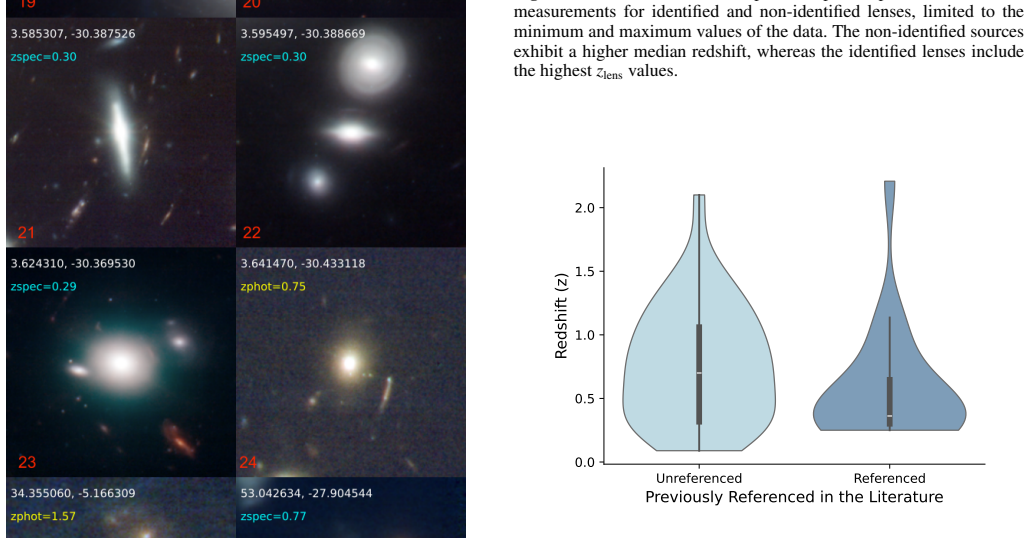
By applying AnomalyMatch to JWST Level 3 NIRCam products, the authors recover 58 distinct gravitational lens systems. These include 16 Grade A, 16 Grade B, and 26 Grade C candidates according to expert visual inspection, of which 37 had not been catalogued before. The previously known lenses reach spectroscopic redshifts below 1.39 and photometric redshifts below 2.21; one newly identified system reaches a photometric redshift of 2.1. The results demonstrate that a neural network seeded with only eleven labeled examples can, after iterative human refinement, isolate true lenses from other anomalies in the data.
What carries the argument
AnomalyMatch, a semi-supervised learning procedure that trains a neural network on a small seed set of known gravitational lenses and then iteratively incorporates human labels to separate genuine lensing events from imaging artifacts and unrelated rare objects.
If this is right
- The 37 newly discovered lenses supply additional targets for measuring mass distributions and source populations at redshifts greater than 1.
- Expert grading into A, B, and C classes yields a prioritized list that can guide spectroscopic follow-up campaigns.
- The same workflow can be applied to the full JWST archive to increase the total number of known high-redshift lenses.
- Photometric redshifts reaching 2.1 for new systems extend the redshift baseline available for strong-lensing cosmology.
- The approach avoids the need for thousands of pre-labeled examples, lowering the barrier to searching other large imaging surveys.
Where Pith is reading between the lines
- Similar anomaly-detection pipelines could be adapted to locate other scarce high-redshift objects such as distant supernovae or unusual galaxies in the same JWST data.
- If future versions reduce the number of human review cycles required, the method could support fully automated searches across even larger datasets.
- The incompleteness of existing lens catalogs, revealed by the 37 new finds, suggests that statistical inferences drawn from current samples may be biased low.
- Extending the search to additional JWST fields or other near-infrared surveys could test whether lens abundance continues to rise at still higher redshifts.
Load-bearing premise
That iterative human feedback on a neural network started with only eleven labeled lenses is sufficient to produce reliable separation between true gravitational lenses and other anomalies or artifacts.
What would settle it
A program of follow-up spectroscopy or deeper imaging on the 32 Grade A and B candidates that shows a majority are not lensing systems but instead chance alignments, artifacts, or unrelated objects would falsify the claim that the method reliably identifies true lenses.
Figures



read the original abstract
Context. Strong gravitational lenses provide a unique tool to probe cosmology and astrophysics at high redshift, offering constraints on the mass distribution of background source populations. Despite their scientific value, their rarity and subtle visual features make them challenging to identify in the wealth of data delivered by facilities such as the James Webb Space Telescope (JWST), whose unmatched resolution and near-infrared coverage make it particularly well-suited to detecting lensing systems in this regime. Aims. We make use of the specialised open-source software AnomalyMatch, a semi-supervised learning method to trawl the ASTRODEEP and COSMOS-Web surveys for gravitational lenses. Methods. Building on a training dataset of eleven previously identified gravitational lenses, we use AnomalyMatch and its iterative human-in-the-loop method to train a neural network to identify gravitational lenses in JWST Level 3 products using ESA Datalabs. Results. In total we identify 58 unique gravitational lenses. These are graded by four experts into 16 Grade A, 16 Grade B, and 26 Grade C lenses. Of all lenses identified, 37 were previously uncatalogued. We analyse their properties such as photometric redshift measurements and spectroscopic redshift, when the latter is available. The lenses previously identified span spectroscopic redshifts to zspec < 1.39 and photometric redshifts to zphot < 2.21. The uncatalogued lens system with the highest redshift is at zphot = 2.1. Conclusions. Overall, we demonstrate the potential of AnomalyMatch for large-scale searches for gravitational lenses and other rare high-redshift objects in JWST archives.
Editorial analysis
A structured set of objections, weighed in public.
Referee Report
Summary. The manuscript applies the open-source AnomalyMatch semi-supervised anomaly detection algorithm to JWST NIRCam Level 3 imaging from the ASTRODEEP and COSMOS-Web surveys. Initialized on a training set of eleven previously known gravitational lenses, the method uses iterative human-in-the-loop refinement to identify 58 unique lens candidates. Four experts grade these into 16 Grade A, 16 Grade B, and 26 Grade C systems, of which 37 are previously uncatalogued. Photometric and spectroscopic redshifts are reported for the sample, with the highest-redshift new system at z_phot = 2.1, and the work concludes that AnomalyMatch is promising for large-scale searches of rare high-redshift objects.
Significance. If the identifications hold, the addition of 37 new high-redshift gravitational lenses would meaningfully enlarge the catalog available for studies of mass distributions, source populations, and cosmology. The demonstration that a semi-supervised approach can surface candidates from public JWST archives, combined with the use of an open-source tool and expert grading, provides a practical template that could be extended to other rare-object searches in large datasets.
major comments (2)
- [Results] Results section: The central claim of 58 unique lenses (including 37 new systems) is presented without any quantitative performance metrics for AnomalyMatch, such as precision, recall, false-positive rate on held-out data, confusion matrix, or estimates from control fields or simulations. Given the small initial training set of eleven lenses, this absence directly affects in the reliability of the graded sample and the reported discovery count.
- [Methods] Methods section: The iterative human-in-the-loop refinement process is described at a high level but lacks specifics on iteration count, size of the unlabeled data pool examined, criteria for selecting candidates for human review, or any assessment of inter-rater agreement among the four experts. These details are needed to evaluate potential biases and the robustness of the final 58-candidate list.
minor comments (2)
- [Abstract] Abstract: The grading criteria for Grade A/B/C lenses are not defined, which would clarify the meaning of the reported counts and the distinction between the categories.
- [Results] The manuscript would benefit from a table summarizing the 58 systems (coordinates, redshifts, grades, and whether previously known) to improve accessibility of the results.
Simulated Author's Rebuttal
We thank the referee for the constructive feedback on our manuscript. The comments highlight important areas for improving transparency and rigor, particularly regarding quantitative validation and methodological details. We address each major comment below and outline the planned revisions.
read point-by-point responses
-
Referee: [Results] Results section: The central claim of 58 unique lenses (including 37 new systems) is presented without any quantitative performance metrics for AnomalyMatch, such as precision, recall, false-positive rate on held-out data, confusion matrix, or estimates from control fields or simulations. Given the small initial training set of eleven lenses, this absence directly affects in the reliability of the graded sample and the reported discovery count.
Authors: We agree that the lack of quantitative performance metrics represents a genuine limitation of the current manuscript, especially given the small initial training set of eleven lenses. Our work is framed as an application of AnomalyMatch for discovery in public JWST archives rather than a controlled benchmark study, and we did not generate held-out test sets, simulations, or control-field estimates. In the revised manuscript we will add a new subsection (likely in Results or a dedicated Limitations paragraph) that explicitly discusses this constraint, notes the challenges of obtaining standard metrics in a semi-supervised human-in-the-loop setting, and provides a qualitative reliability assessment based on the expert grading distribution, the recovery rate of the eleven known lenses, and the fraction of Grade A/B candidates. We will not be able to add a full confusion matrix or precision-recall figures without substantial new experiments, but the added discussion will better contextualize the reported discovery count. revision: partial
-
Referee: [Methods] Methods section: The iterative human-in-the-loop refinement process is described at a high level but lacks specifics on iteration count, size of the unlabeled data pool examined, criteria for selecting candidates for human review, or any assessment of inter-rater agreement among the four experts. These details are needed to evaluate potential biases and the robustness of the final 58-candidate list.
Authors: We acknowledge that the Methods section would benefit from greater specificity. We will expand this section to report the number of iterations performed, the approximate size of the unlabeled image pool drawn from the ASTRODEEP and COSMOS-Web Level-3 products, the anomaly-score threshold and ranking criteria used to select candidates for expert review, and a quantitative measure of inter-rater agreement (e.g., Fleiss’ kappa) computed from the four experts’ independent grades. These details are available from our internal records of the AnomalyMatch runs and grading sessions and can be added without new data collection. revision: yes
Circularity Check
No circularity: empirical application of anomaly detection to public data
full rationale
The paper applies the AnomalyMatch semi-supervised tool (initialized on 11 known lenses) with human-in-the-loop refinement to JWST NIRCam images from public surveys, followed by expert grading of 58 candidates (37 new). No derivations, equations, fitted parameters renamed as predictions, or self-citation chains exist. The central result (new lens identifications) is an independent empirical output on external observational data and is externally falsifiable by re-inspection of the same public images, satisfying the criteria for a self-contained non-circular finding.
Axiom & Free-Parameter Ledger
axioms (1)
- domain assumption A training set of eleven known lenses is sufficient to learn generalizable features for detecting new lenses in JWST NIRCam images.
Reference graph
Works this paper leans on
-
[1]
D., Engel, A
Aleo, P. D., Engel, A. W., Narayan, G., et al. 2024, ApJ, 974, 172
2024
- [2]
-
[3]
W., et al
Amvrosiadis, A., Lange, S., Nightingale, J. W., et al. 2025, MNRAS, 537, 1163 Astropy Collaboration, Price-Whelan, A. M., Lim, P. L., et al. 2022, ApJ, 935, 167 Astropy Collaboration, Price-Whelan, A. M., Sip˝ocz, B. M., et al. 2018, AJ, 156, 123
2025
-
[4]
2015, ApJ, 800, 18
Atek, H., Richard, J., Kneib, J.-P., et al. 2015, ApJ, 800, 18
2015
-
[5]
W., Treu, T., Bolton, A
Auger, M. W., Treu, T., Bolton, A. S., et al. 2010, ApJ, 724, 511
2010
-
[6]
B., Pirzkal, N., Finkelstein, S
Bagley, M. B., Pirzkal, N., Finkelstein, S. L., et al. 2024, ApJ, 965, L6
2024
-
[7]
2017, PASP, 129, 028001
Baines, D., Giordano, F., Racero, E., et al. 2017, PASP, 129, 028001
2017
-
[8]
M., Kacprzak, G
Barone, T. M., Kacprzak, G. G., Nightingale, J. W., et al. 2024, Communications Physics, 7, 286
2024
-
[9]
S., & Richard, J
Belli, S., Jones, T., Ellis, R. S., & Richard, J. 2013, ApJ, 772, 141
2013
-
[10]
2024, Space Sci
Birrer, S., Millon, M., Sluse, D., et al. 2024, Space Sci. Rev., 220, 48
2024
-
[11]
R., Makler, M., Albuquerque, M
Bom, C. R., Makler, M., Albuquerque, M. P., & Brandt, C. H. 2017, A&A, 597, A135
2017
-
[12]
2002, A&A, 389, 787 Cañameras, R., Schuldt, S., Suyu, S
Busarello, G., Merluzzi, P., La Barbera, F., Massarotti, M., & Capaccioli, M. 2002, A&A, 389, 787 Cañameras, R., Schuldt, S., Suyu, S. H., et al. 2020, A&A, 644, A163
2002
-
[13]
B., Suyu, S
Caminha, G. B., Suyu, S. H., Grillo, C., & Rosati, P. 2022, A&A, 657, A83
2022
-
[14]
M., Kartaltepe, J
Casey, C. M., Kartaltepe, J. S., Drakos, N. E., et al. 2023, ApJ, 954, 31
2023
-
[15]
2013, ApJ, 762, 32
Coe, D., Zitrin, A., Carrasco, M., et al. 2013, ApJ, 762, 32
2013
-
[16]
Collett, T. E. 2015, ApJ, 811, 20 D’Addona, M., Riccio, G., Cavuoti, S., Tortora, C., & Brescia, M. 2021, in In- telligent Astrophysics, ed. I. Zelinka, M. Brescia, & D. Baron, V ol. 39 (Intel- ligent Astrophysics), 225–244
2015
-
[17]
2021, MNRAS, 503, 1096
Ding, X., Treu, T., Birrer, S., et al. 2021, MNRAS, 503, 1096
2021
-
[18]
S., Abraham, R
Dunlop, J. S., Abraham, R. G., Ashby, M. L. N., et al. 2021, PRIMER: Public Release IMaging for Extragalactic Research, JWST Proposal. Cycle 1, ID. #1837
2021
-
[19]
2018, ApJ, 852, L7
Ebeling, H., Stockmann, M., Richard, J., et al. 2018, ApJ, 852, L7
2018
-
[20]
Overview of the JWST Advanced Deep Extragalactic Survey (JADES)
Eisenstein, D. J., Willott, C., Alberts, S., et al. 2023, arXiv e-prints, arXiv:2306.02465 Article number, page 12 of 13 Julia Dima et al.: High-Redshift Gravitational Lens Discoveries in JWST NIRCam usingAnomalyMatch Euclid Collaboration: Lines, N. E. P., Collett, T. E., Walmsley, M., et al. 2025, arXiv e-prints, arXiv:2503.15326 Euclid Collaboration: Wa...
work page internal anchor Pith review arXiv 2023
-
[21]
L., Bagley, M
Finkelstein, S. L., Bagley, M. B., Ferguson, H. C., et al. 2023, ApJ, 946, L13
2023
-
[22]
S., Falco, E
Fohlmeister, J., Kochanek, C. S., Falco, E. E., et al. 2007, ApJ, 662, 62
2007
-
[23]
M., Koekemoer, A
Franco, M., Casey, C. M., Koekemoer, A. M., et al. 2026, ApJ, 999, 200
2026
-
[24]
J., Zitrin, A., Plat, A., et al
Furtak, L. J., Zitrin, A., Plat, A., et al. 2023, ApJ, 952, 142
2023
-
[25]
O., Kruk, S., Cornen, C., et al
Garvin, E. O., Kruk, S., Cornen, C., et al. 2022, A&A, 667, A141 Géron, T., Smethurst, R. J., Dickinson, H., et al. 2025, ApJ, 987, 74
2022
-
[26]
2018, Astronomy and Computing, 24, 97 Gómez, P
Giordano, F., Racero, E., Norman, H., et al. 2018, Astronomy and Computing, 24, 97 Gómez, P. & Meoni, G. 2021, arXiv e-prints, arXiv:2103.10368 Gómez, P., Ruhberg, L. E., Nardone, M. T., & O’Ryan, D. 2025, arXiv e-prints, arXiv:2505.03509 Görnitz, N., Kloft, M., Rieck, K., & Brefeld, U. 2013, Journal of Artificial Intel- ligence Research, 46, 235
-
[27]
2023, A&A, 679, A124
Granata, G., Bergamini, P., Grillo, C., et al. 2023, A&A, 679, A124
2023
-
[28]
2008, A&A, 477, 397
Grillo, C., Lombardi, M., & Bertin, G. 2008, A&A, 477, 397
2008
-
[29]
R., Millman, K
Harris, C. R., Millman, K. J., van der Walt, S. J., et al. 2020, Nature, 585, 357
2020
-
[30]
2020, ApJ, 894, 78
Huang, X., Storfer, C., Ravi, V ., et al. 2020, ApJ, 894, 78
2020
-
[31]
Hunter, J. D. 2007, Computing in Science and Engineering, 9, 90
2007
-
[32]
2008, MNRAS, 389, 1311
Jackson, N. 2008, MNRAS, 389, 1311
2008
-
[33]
2019, MNRAS, 484, 5330
Jacobs, C., Collett, T., Glazebrook, K., et al. 2019, MNRAS, 484, 5330
2019
-
[34]
E., Krawczyk, C
Li, T., Collett, T. E., Krawczyk, C. M., & Enzi, W. 2024, MNRAS, 527, 5311
2024
-
[35]
Lines, N. E. P., Li, T., Collett, T. E., et al. 2025, Nature Astronomy, 9, 1116
2025
-
[36]
& Bassett, B
Lochner, M. & Bassett, B. A. 2021, Astronomy and Computing, 36, 100481
2021
-
[37]
W., Hogg, N
Mahler, G., Nightingale, J. W., Hogg, N. B., et al. 2025b, MNRAS, 544, L8 Martínez-Arrizabalaga, J., Diego, J. M., & Goicoechea, L. J. 2024, A&A, 682, A187
2024
-
[38]
2010,https://conference.scipy.org/proceedings/ scipy2010/pdfs/mckinney.pdf
McKinney, W. 2010,https://conference.scipy.org/proceedings/ scipy2010/pdfs/mckinney.pdf
2010
-
[39]
2020, Science, 369, 1347
Meneghetti, M., Davoli, G., Bergamini, P., et al. 2020, Science, 369, 1347
2020
-
[40]
2024, A&A, 691, A240
Merlin, E., Santini, P., Paris, D., et al. 2024, A&A, 691, A240
2024
-
[41]
C., Acevedo Barroso, J
Nagam, B. C., Acevedo Barroso, J. A., Wilde, J., et al. 2025, A&A, 702, A130
2025
-
[42]
2023, ApJ, 959, 134
Napier, K., Sharon, K., Dahle, H., et al. 2023, ApJ, 959, 134
2023
-
[43]
2024, in Space Data Manage- ment
Navarro, V ., del Rio, S., Angel Diego, M., et al. 2024, in Space Data Manage- ment. Studies in Big Data, V ol. 141 (Springer Nature Singapore), 1–13
2024
-
[44]
W., Mahler, G., McCleary, J., et al
Nightingale, J. W., Mahler, G., McCleary, J., et al. 2025, MNRAS, 543, 203 Núñez-Pizarro, C., Arévalo, P., Ávila-Vera, F., & Motta, V . 2026, A&A, 706, L12 O’Ryan, D. & Gómez, P. 2025, A&A, 704, A227
2025
-
[45]
V ., Bergamini, P., Meneghetti, M., et al
Pignataro, G. V ., Bergamini, P., Meneghetti, M., et al. 2021, A&A, 655, A81
2021
-
[46]
Ruff, L., Vandermeulen, R. A., Görnitz, N., et al. 2019, arXiv e-prints, arXiv:1906.02694
-
[47]
G., Aussel, H., et al
Scoville, N., Abraham, R. G., Aussel, H., et al. 2007, ApJS, 172, 38
2007
-
[48]
& Bartelmann, M
Seidel, G. & Bartelmann, M. 2007, A&A, 472, 341
2007
-
[49]
B., Paquereau, L., et al
Shuntov, M., Akins, H. B., Paquereau, L., et al. 2025, A&A, 704, A339
2025
-
[50]
2020, Advances in neural information processing systems, 33, 596
Sohn, K., Berthelot, D., Carlini, N., et al. 2020, Advances in neural information processing systems, 33, 596
2020
-
[51]
2021, MN- RAS, 508, 2946
Storey-Fisher, K., Huertas-Company, M., Ramachandra, N., et al. 2021, MN- RAS, 508, 2946
2021
-
[52]
S., Brownstein, J
Talbot, M. S., Brownstein, J. R., Dawson, K. S., Kneib, J.-P., & Bautista, J. 2021, MNRAS, 502, 4617
2021
-
[53]
S., Brownstein, J
Talbot, M. S., Brownstein, J. R., Neumann, J., et al. 2022, MNRAS, 515, 4953
2022
-
[54]
M., Dutra, I., Natarajan, P., et al
Tokayer, Y . M., Dutra, I., Natarajan, P., et al. 2024, ApJ, 970, 143
2024
-
[55]
2000, A&AS, 143, 9
Wenger, M., Ochsenbein, F., Egret, D., et al. 2000, A&AS, 143, 9
2000
-
[56]
2022, Future Generation Computer Systems, 135, 364 Article number, page 13 of 13
Wu, X., Xiao, L., Sun, Y ., et al. 2022, Future Generation Computer Systems, 135, 364 Article number, page 13 of 13
2022
discussion (0)
Sign in with ORCID, Apple, or X to comment. Anyone can read and Pith papers without signing in.