Primordial high energy neutrinos
Pith reviewed 2026-05-07 14:12 UTC · model grok-4.3
The pith
Long-lived relics could produce high-energy neutrinos today with sharp spectral features detectable by telescopes.
A machine-rendered reading of the paper's core claim, the machinery that carries it, and where it could break.
Core claim
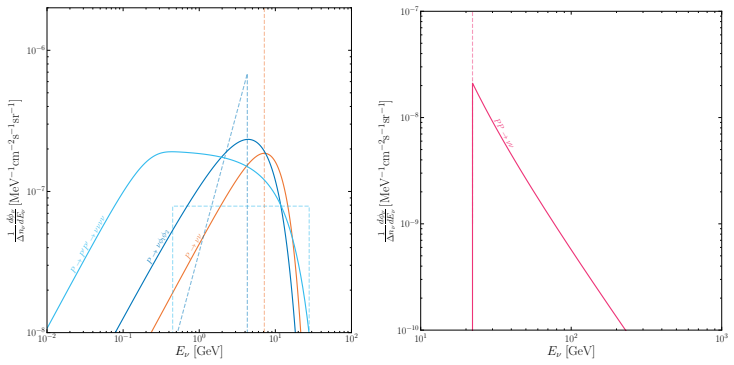
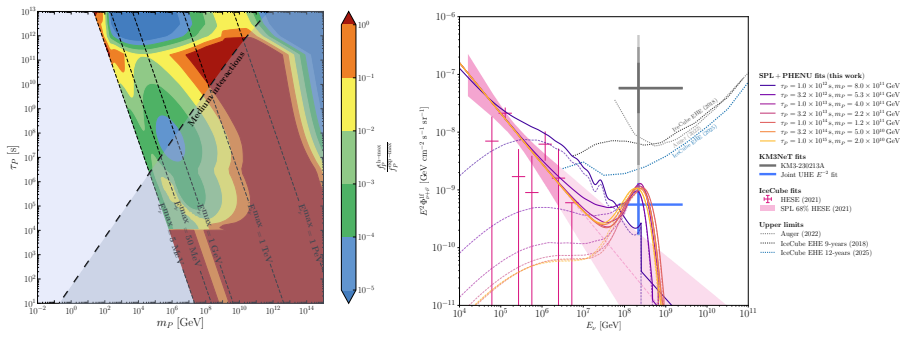
Primordial high energy neutrinos from the decay or annihilation of long-lived relics before or around recombination arrive today with GeV-PeV energies and exhibit sharp spectral features. The parameter space for such relics is bounded by BBN and CMB constraints, yet viable regions exist that current and future neutrino telescopes could probe. A dedicated Monte Carlo code calculates the spectral distortion caused by final state radiation and cosmic neutrino background interactions during propagation and is applied to assess a primordial origin for the KM3-230213A event.
What carries the argument
The dedicated Monte Carlo code that computes distortions to the Phenu spectrum from final state radiation and interactions with the cosmic neutrino background.
If this is right
- Sharp spectral features would distinguish Phenus from conventional astrophysical neutrinos.
- BBN and CMB data already exclude large portions of the relic mass-lifetime-decay parameter space.
- Remaining viable regions lie within the sensitivity reach of present and planned neutrino telescopes.
- The Monte Carlo code supplies a quantitative tool for checking whether any future high-energy event has a primordial origin.
Where Pith is reading between the lines
- Observation of Phenus would give a direct probe of particle lifetimes and decays at early-universe temperatures inaccessible to other messengers.
- The same propagation framework could be adapted to assess primordial contributions to other cosmic-ray or gamma-ray signals.
- Non-observation at next-generation detectors would tighten bounds on long-lived relics beyond current cosmological limits.
- Compatibility of the KM3-230213A event with a primordial spectrum would motivate dedicated searches for similar events with the predicted features.
Load-bearing premise
Long-lived relics exist with masses, lifetimes and decay channels that yield observable GeV-PeV neutrinos without violating BBN or CMB limits, and the Monte Carlo code correctly captures all relevant propagation physics.
What would settle it
A high-statistics measurement of the high-energy neutrino spectrum that either reveals or rules out the predicted sharp features, or a Monte Carlo run showing that the KM3-230213A event properties are incompatible with any primordial propagation history.
Figures
read the original abstract
Among the few ways to probe the early Universe, neutrinos offer a particular window on high energy phenomena occurring before recombination. We discuss the opportunities of observing primordial high energy neutrinos (Phenus): neutrinos produced before or around recombination from the decay or annihilation of long-lived relics, arriving at detectors today with energies in the GeV-PeV range. We summarise the results of a general study of this scenario, covering the sharp spectral features such fluxes would display, the theoretical (BBN and CMB) and experimental constraints on the source particle parameter space, and the regions that could realistically be probed by current and future neutrino telescopes. We also present a dedicated Monte Carlo code for computing the distortion of the Phenu spectrum by final state radiation and interactions with the cosmic neutrino background during propagation, and apply it to assess the primordial origin hypothesis for the KM3-230213A ultrahigh energy neutrino event.
Editorial analysis
A structured set of objections, weighed in public.
Referee Report
Summary. The paper discusses opportunities for observing primordial high energy neutrinos (Phenus) produced before or around recombination from decay or annihilation of long-lived relics, arriving today with GeV-PeV energies. It summarizes a general study of sharp spectral features, BBN/CMB and experimental constraints on source particle parameter space, and regions probeable by current/future neutrino telescopes. It presents a dedicated Monte Carlo code to model Phenu spectrum distortions from final state radiation and cosmic neutrino background interactions during propagation, and applies the code to assess the primordial origin hypothesis for the KM3-230213A ultrahigh energy neutrino event.
Significance. If the central claims hold, this work opens a new window on early-Universe high-energy phenomena via neutrinos, complementing BBN and CMB probes. The dedicated Monte Carlo code for propagation effects and its application to a specific observed event (KM3-230213A) are concrete strengths that ground the discussion in data and could guide future telescope searches. The use of external standard BBN/CMB results reduces circularity risk.
major comments (1)
- [§4] §4 (Monte Carlo code section): The description of the dedicated MC code lacks explicit validation against analytical limits or existing neutrino propagation codes, as well as details on error handling and any post-hoc selections in the simulation runs. This is load-bearing for the reliability of the assessment of the KM3-230213A event's primordial origin.
minor comments (1)
- [Abstract] The abstract and introduction could more explicitly state the assumed ranges for relic mass, lifetime, and branching ratios explored in the parameter-space study.
Simulated Author's Rebuttal
We thank the referee for their careful reading of the manuscript and for the constructive comment on the Monte Carlo code. We address the point below and will revise the manuscript to incorporate additional details that strengthen the presentation.
read point-by-point responses
-
Referee: [§4] §4 (Monte Carlo code section): The description of the dedicated MC code lacks explicit validation against analytical limits or existing neutrino propagation codes, as well as details on error handling and any post-hoc selections in the simulation runs. This is load-bearing for the reliability of the assessment of the KM3-230213A event's primordial origin.
Authors: We agree that more explicit validation and implementation details will improve the clarity and robustness of §4. The current manuscript introduces the dedicated Monte Carlo code and outlines its treatment of final-state radiation and cosmic neutrino background interactions, but does not include direct comparisons to analytical limits or other codes. In the revised version we will add a dedicated subsection that (i) shows code outputs against analytical expectations for limiting cases (e.g., pure final-state radiation with no propagation or negligible interactions), (ii) provides benchmark comparisons to existing neutrino propagation frameworks where the physics overlaps, (iii) specifies the error-handling procedure (including event statistics, convergence criteria, and uncertainty estimation), and (iv) states that no post-hoc selections were applied beyond the physical modeling itself. These additions will be placed in §4 and will directly support the reliability of the KM3-230213A analysis without changing the reported results or conclusions. revision: yes
Circularity Check
No significant circularity
full rationale
The paper summarizes a parameter-space study of primordial high-energy neutrinos from long-lived relics, grounding constraints in external standard BBN and CMB results rather than internal fits. It introduces a new Monte Carlo code to model propagation distortions (final-state radiation and cosmic neutrino background interactions) and applies the code to an independently observed event (KM3-230213A). No load-bearing step reduces by construction to a fitted parameter, self-defined quantity, or self-citation chain; the derivation chain remains self-contained against external benchmarks and data.
Axiom & Free-Parameter Ledger
axioms (1)
- domain assumption Standard BBN and CMB constraints can be directly applied to limit the source particle parameter space for relic decays and annihilations
Reference graph
Works this paper leans on
-
[1]
P.H. Frampton and S.L. Glashow. Unstable heavy particles.Phys. Rev. Lett., 44:1481, 1980
work page 1980
-
[2]
P. Gondolo, G. Gelmini, and S. Sarkar. Cosmic neutrinos from unstable relic particles. Nucl. Phys. B, 392:111, 1993
work page 1993
-
[3]
T. Kanzaki, M. Kawasaki, K. Kohri, and T. Moroi. Cosmological constraints on neutrino injection.Phys. Rev. D, 76:105017, 2007
work page 2007
-
[4]
Y. Ema, R. Jinno, and T. Moroi. Cosmic-ray neutrinos from the decay of long-lived particle and the recent IceCube result.Phys. Lett. B, 733:120, 2014
work page 2014
-
[5]
Y. Ema, R. Jinno, and T. Moroi. Cosmological implications of high-energy neutrino emission from the decay of long-lived particle.JHEP, 10:150, 2014
work page 2014
-
[6]
D. McKeen. Cosmic neutrino background search experiments as decaying dark matter detectors.Phys. Rev. D, 100:015028, 2019
work page 2019
-
[7]
K.V. Berghaus, M.D. Diamond, and D.E. Kaplan. Decays of long-lived relics and their signatures at IceCube.JHEP, 05:145, 2019
work page 2019
-
[8]
J. Jaeckel and W. Yin. Boosted neutrinos and relativistic dark particles as messengers from reheating.JCAP, 02:044, 2021
work page 2021
-
[9]
IceCube Collaboration. Evidence for high-energy extraterrestrial neutrinos at the IceCube detector.Science, 342:1242856, 2013
work page 2013
-
[10]
Nicolas Grimbaum Yamamoto and Thomas Hambye. Primordial high energy neutrinos: theoretical/observational constraints and sharp spectral features.JCAP, 10:092, 2025
work page 2025
-
[11]
S. Bianco, P.F. Depta, J. Frerick, T. Hambye, M. Hufnagel, and K. Schmidt-Hoberg. Photo- and hadrodisintegration constraints on massive relics decaying into neutrinos. 2025
work page 2025
-
[12]
S.K. Acharya and R. Khatri. CMB anisotropy and BBN constraints on pre-recombination decay of dark matter to visible particles.JCAP, 12:046, 2019
work page 2019
-
[13]
The KM3NeT event: a primordial high energy neutrino? 4 2026
Nicolas Grimbaum Yamamoto and Thomas Hambye. The KM3NeT event: a primordial high energy neutrino? 4 2026
work page 2026
-
[14]
Observation of an ultra-high-energy cosmic neutrino with KM3NeT.Nature, 638:376, 2025
KM3NeT Collaboration. Observation of an ultra-high-energy cosmic neutrino with KM3NeT.Nature, 638:376, 2025
work page 2025
-
[15]
C.W. Bauer, N.L. Rodd, and B.R. Webber. Dark matter spectra from the electroweak to the Planck scale.JHEP, 06:121, 2021
work page 2021
discussion (0)
Sign in with ORCID, Apple, or X to comment. Anyone can read and Pith papers without signing in.