Recognition: unknown
Tempered Guided Diffusion
Pith reviewed 2026-05-07 12:56 UTC · model grok-4.3
The pith
Tempered Guided Diffusion uses annealed SMC to produce consistent particle approximations to posteriors from diffusion priors.
A machine-rendered reading of the paper's core claim, the machinery that carries it, and where it could break.
Core claim
TGD is an annealed sequential Monte Carlo framework that targets tempered posterior distributions over the clean signal by using noisy diffusion states as auxiliary variables. Reconstructions are proposed at each noise level, reweighted by incremental likelihood ratios, resampled, and propagated to the next level. Under idealized exact-reconstruction assumptions the resulting particle approximation is consistent for the posterior as the number of particles tends to infinity. The accelerated version (A-TGD) retains early particle exploration but prunes to a single high-likelihood trajectory partway through sampling to reduce cost.
What carries the argument
Annealed sequential Monte Carlo with tempering, in which noisy diffusion states serve as auxiliary variables for proposing reconstructions that are then reweighted and propagated by incremental likelihood ratios across noise levels.
If this is right
- The particle approximation converges to the true posterior under the idealized assumptions as the number of particles grows.
- A-TGD retains early exploration benefits while reducing later computation to a single path for expensive reconstructions.
- Experiments demonstrate improved posterior approximation quality and better speed-quality tradeoffs than independent multi-trajectory guided diffusion on both 2D and image inverse problems.
Where Pith is reading between the lines
- The same annealed-SMC structure could be transferred to other generative priors that admit a natural noise schedule.
- Adaptive choice of tempering levels based on effective sample size might further improve robustness when the observation model is misspecified.
- Viewing diffusion sampling as particle propagation suggests natural extensions for handling multimodal conditionals by maintaining diversity longer.
Load-bearing premise
Exact reconstruction from noisy states is possible at every step and the diffusion prior remains appropriate when the target distribution is tempered.
What would settle it
In the controlled two-dimensional inverse problem where the true posterior is known exactly, the total variation distance or moment error between the TGD particle approximation and the true posterior should decrease toward zero as the number of particles increases.
Figures




read the original abstract
Training-free conditional diffusion provides a flexible alternative to task-specific conditional model training, but existing samplers often allocate computation inefficiently: independent guided trajectories can vary widely in quality, and additional function evaluations along a single trajectory may not recover from poor early decisions. We propose Tempered Guided Diffusion (TGD), an annealed sequential Monte Carlo framework for training-free conditional sampling with diffusion priors. TGD targets tempered posterior distributions over the clean signal, using noisy diffusion states only as auxiliary variables for proposing reconstructions and propagating particles. Particles are reweighted by incremental likelihood ratios, resampled, and propagated across noise levels, concentrating computation on trajectories plausible under both the prior and observation. Under idealized exact-reconstruction assumptions, full TGD yields a consistent particle approximation to the posterior as the number of particles grows. For expensive reconstruction tasks, Accelerated TGD (A-TGD) retains early particle exploration but prunes to a single high-likelihood trajectory partway through sampling. Experiments on a controlled two-dimensional inverse problem and image inverse problems show improved posterior approximation and favorable wall-clock speed-quality tradeoffs over independent multi-trajectory baselines.
Editorial analysis
A structured set of objections, weighed in public.
Referee Report
Summary. The paper proposes Tempered Guided Diffusion (TGD), an annealed sequential Monte Carlo framework for training-free conditional sampling from diffusion priors. It targets tempered posteriors over the clean signal, treating noisy diffusion states as auxiliary variables for proposing reconstructions and propagating particles via reweighting by incremental likelihood ratios, resampling, and propagation across noise levels. Under idealized exact-reconstruction assumptions, full TGD is claimed to produce a consistent particle approximation to the posterior as the number of particles grows. An accelerated variant (A-TGD) prunes to a single high-likelihood trajectory for efficiency. Experiments on a controlled 2D inverse problem and image inverse problems report improved posterior approximation and favorable speed-quality tradeoffs versus independent multi-trajectory baselines.
Significance. If the consistency result holds under the stated assumptions, the work provides a principled SMC-based mechanism for allocating computation more efficiently in guided diffusion by focusing on plausible trajectories, which could advance training-free conditional generation methods. The explicit conditioning of the consistency claim on idealized assumptions and the use of standard SMC principles applied to tempered diffusion posteriors are strengths, as is the inclusion of controlled experiments demonstrating practical gains over baselines.
major comments (1)
- The central consistency claim (abstract and theoretical section) is explicitly conditioned on idealized exact-reconstruction assumptions; the manuscript should include a concrete discussion or counterexample showing how violation of this assumption affects finite-particle behavior, as this is load-bearing for the practical interpretation of the result.
minor comments (3)
- The abstract mentions 'lacks full derivation details, error analysis, or code'; if the full manuscript provides these in the theoretical section, they should be explicitly cross-referenced in the abstract for clarity.
- Notation for the tempered posterior and auxiliary diffusion variables should be introduced with a clear table or diagram early in the methods section to aid readers unfamiliar with SMC applications to diffusion.
- In the experiments section, the 2D inverse problem setup would benefit from an explicit statement of the observation model and noise levels used, to allow direct reproduction of the reported improvements.
Simulated Author's Rebuttal
We thank the referee for their positive assessment and recommendation for minor revision. We address the single major comment below.
read point-by-point responses
-
Referee: The central consistency claim (abstract and theoretical section) is explicitly conditioned on idealized exact-reconstruction assumptions; the manuscript should include a concrete discussion or counterexample showing how violation of this assumption affects finite-particle behavior, as this is load-bearing for the practical interpretation of the result.
Authors: We agree that elaborating on the practical effects of violating the exact-reconstruction assumption strengthens the interpretation of the consistency result. In the revised manuscript we will add a dedicated paragraph (or short subsection) in the theoretical section. This will explicitly note that the consistency guarantee is asymptotic and holds only under the idealized assumption; when reconstruction is approximate (as occurs in all practical settings), finite-particle approximations can exhibit bias in the weights. We will illustrate this with a simple numerical counterexample on the controlled 2D inverse problem, replacing the exact reconstructor with a deliberately noisy approximation and showing the resulting degradation in posterior approximation quality for small particle counts, while still demonstrating that the tempered SMC procedure outperforms independent guided trajectories. revision: yes
Circularity Check
No significant circularity detected
full rationale
The derivation applies standard annealed SMC consistency results to a tempered posterior constructed from a diffusion prior and observation likelihood. The central consistency claim is explicitly conditioned on idealized exact-reconstruction assumptions and does not reduce any target quantity to a fitted parameter or self-referential definition internal to TGD. No load-bearing step equates a prediction to its own inputs by construction, nor does the argument rely on self-citations whose content is unverified outside the present work. The framework remains self-contained against external SMC theory.
Axiom & Free-Parameter Ledger
axioms (2)
- domain assumption Diffusion models define a valid prior over clean signals via the reverse noising process.
- ad hoc to paper Exact reconstruction of the clean signal is possible under idealized conditions.
Reference graph
Works this paper leans on
- [1]
- [2]
-
[3]
Universal guidance for diffusion models
Arpit Bansal, Hong-Min Chu, Avi Schwarzschild, Roni Sengupta, Micah Goldblum, Jonas Geiping, and Tom Goldstein. Universal guidance for diffusion models. InThe Twelfth Inter- national Conference on Learning Representations, 2024. URL https://openreview.net/ forum?id=pzpWBbnwiJ
2024
-
[4]
Sliced and Radon Wasserstein Barycenters of Measures , journal =
Nicolas Bonneel, Julien Rabin, Gabriel Peyré, and Hanspeter Pfister. Sliced and radon wasserstein barycenters of measures.Journal of Mathematical Imaging and Vision, 51: 22–45, 2015. doi: 10.1007/s10851-014-0506-3. URL https://doi.org/10.1007/ s10851-014-0506-3
-
[5]
Markovian flow matching: Acceler- ating mcmc with continuous normalizing flows.Advances in Neural Information Processing Systems, 37:104383–104411, 2024
Alberto Cabezas, Louis Sharrock, and Christopher Nemeth. Markovian flow matching: Acceler- ating mcmc with continuous normalizing flows.Advances in Neural Information Processing Systems, 37:104383–104411, 2024
2024
-
[6]
An introduction to sequential monte carlo
Nicolas Chopin. An introduction to sequential monte carlo. Technical report, University of Bristol, 2004. Technical report
2004
-
[7]
Improving diffusion models for inverse problems using manifold constraints
Hyungjin Chung, Byeongsu Sim, Dohoon Ryu, and Jong Chul Ye. Improving diffusion models for inverse problems using manifold constraints. In Alice H. Oh, Alekh Agarwal, Danielle Belgrave, and Kyunghyun Cho, editors,Advances in Neural Information Processing Systems,
-
[8]
URLhttps://openreview.net/forum?id=nJJjv0JDJju
-
[9]
Diffusion Posterior Sampling for General Noisy Inverse Problems
Hyungjin Chung, Jeongsol Kim, Michael T. Mccann, Marc L. Klasky, and Jong Chul Ye. Diffusion posterior sampling for general noisy inverse problems, 2024. URL https://arxiv. org/abs/2209.14687
work page internal anchor Pith review arXiv 2024
-
[10]
Springer New York, New York, NY , 2004
Pierre Del Moral.Feynman-Kac Formulae, pages 47–93. Springer New York, New York, NY , 2004. ISBN 978-1-4684-9393-1. doi: 10.1007/978-1-4684-9393-1_2. URL https: //doi.org/10.1007/978-1-4684-9393-1_2
-
[11]
Sequential monte carlo samplers.Journal of the Royal Statistical Society: Series B (Statistical Methodology), 68(3):411–436, 2006
Pierre Del Moral, Arnaud Doucet, and Ajay Jasra. Sequential monte carlo samplers.Journal of the Royal Statistical Society: Series B (Statistical Methodology), 68(3):411–436, 2006
2006
-
[12]
Imagenet: A large-scale hierarchical image database
Jia Deng, Wei Dong, Richard Socher, Li-Jia Li, Kai Li, and Li Fei-Fei. Imagenet: A large-scale hierarchical image database. InProceedings of the IEEE Conference on Computer Vision and Pattern Recognition (CVPR), pages 248–255, 2009
2009
-
[13]
Diffusion Models Beat GANs on Image Synthesis
Prafulla Dhariwal and Alex Nichol. Diffusion models beat gans on image synthesis, 2021. URL https://arxiv.org/abs/2105.05233. 10
work page internal anchor Pith review arXiv 2021
-
[14]
Diffusion posterior sampling for linear inverse problem solving: A filtering perspective
Zehao Dou and Yang Song. Diffusion posterior sampling for linear inverse problem solving: A filtering perspective. InThe Twelfth International Conference on Learning Representations,
-
[15]
URLhttps://openreview.net/forum?id=tplXNcHZs1
-
[16]
Statistics for Engineering and Information Science
Arnaud Doucet, Nando de Freitas, and Neil Gordon.Sequential Monte Carlo Methods in Practice. Statistics for Engineering and Information Science. Springer, New York, 2001
2001
-
[17]
Oates, and Chris Sherlock.Scalable Monte Carlo for Bayesian Learning
Paul Fearnhead, Christopher Nemeth, Chris J. Oates, and Chris Sherlock.Scalable Monte Carlo for Bayesian Learning. Institute of Mathematical Statistics Monographs. Cambridge University Press, 2025
2025
-
[18]
Alaya, Aurélie Boisbunon, Stanislas Chambon, Laetitia Chapel, Adrien Corenflos, Kilian Fatras, Nemo Fournier, Léo Gautheron, Nathalie T.H
Rémi Flamary, Nicolas Courty, Alexandre Gramfort, Mokhtar Z. Alaya, Aurélie Boisbunon, Stanislas Chambon, Laetitia Chapel, Adrien Corenflos, Kilian Fatras, Nemo Fournier, Léo Gautheron, Nathalie T.H. Gayraud, Hicham Janati, Alain Rakotomamonjy, Ievgen Redko, Antoine Rolet, Antony Schutz, Vivien Seguy, Danica J. Sutherland, Romain Tavenard, Alexander Tong,...
2021
-
[19]
Pot python optimal transport (version 0.9.5), 2024
Rémi Flamary, Cédric Vincent-Cuaz, Nicolas Courty, Alexandre Gramfort, Oleksii Kachaiev, Huy Quang Tran, Laurène David, Clément Bonet, Nathan Cassereau, Théo Gnassounou, Eloi Tanguy, Julie Delon, Antoine Collas, Sonia Mazelet, Laetitia Chapel, Tanguy Kerdoncuff, Xizheng Yu, Matthew Feickert, Paul Krzakala, Tianlin Liu, and Eduardo Fernandes Montesuma. Pot...
2024
-
[20]
REG: Rectified gradient guidance for conditional diffusion models
Zhengqi Gao, Kaiwen Zha, Tianyuan Zhang, Zihui Xue, and Duane S Boning. REG: Rectified gradient guidance for conditional diffusion models. InForty-second International Conference on Machine Learning, 2025. URLhttps://openreview.net/forum?id=uNK4ftGdnq
2025
-
[21]
Chapman and Hall/CRC, 1995
Andrew Gelman, John B Carlin, Hal S Stern, and Donald B Rubin.Bayesian data analysis. Chapman and Hall/CRC, 1995
1995
-
[22]
Manifold preserv- ing guided diffusion.arXiv preprint arXiv:2311.16424, 2023
Yutong He, Naoki Murata, Chieh-Hsin Lai, Yuhta Takida, Toshimitsu Uesaka, Dongjun Kim, Wei-Hsiang Liao, Yuki Mitsufuji, J. Zico Kolter, Ruslan Salakhutdinov, and Stefano Ermon. Manifold preserving guided diffusion, 2023. URLhttps://arxiv.org/abs/2311.16424
-
[23]
Classifier-Free Diffusion Guidance
Jonathan Ho and Tim Salimans. Classifier-free diffusion guidance, 2022. URL https:// arxiv.org/abs/2207.12598
work page internal anchor Pith review arXiv 2022
-
[24]
Denoising Diffusion Probabilistic Models
Jonathan Ho, Ajay Jain, and Pieter Abbeel. Denoising diffusion probabilistic models, 2020. URLhttps://arxiv.org/abs/2006.11239
work page internal anchor Pith review arXiv 2020
-
[25]
A style-based generator architecture for generative adversarial networks
Tero Karras, Samuli Laine, and Timo Aila. A style-based generator architecture for generative adversarial networks. InProceedings of the IEEE/CVF Conference on Computer Vision and Pattern Recognition (CVPR), pages 4401–4410, 2019
2019
-
[26]
Elucidating the Design Space of Diffusion-Based Generative Models
Tero Karras, Miika Aittala, Timo Aila, and Samuli Laine. Elucidating the design space of diffusion-based generative models, 2022. URLhttps://arxiv.org/abs/2206.00364
work page internal anchor Pith review arXiv 2022
-
[27]
Guiding a diffusion model with a bad version of itself
Tero Karras, Miika Aittala, Tuomas Kynkäänniemi, Jaakko Lehtinen, Timo Aila, and Samuli Laine. Guiding a diffusion model with a bad version of itself. InThe Thirty-eighth Annual Conference on Neural Information Processing Systems, 2024. URL https://openreview. net/forum?id=bg6fVPVs3s
2024
-
[28]
SNIPS: Solving noisy inverse problems stochastically.Advances in Neural Information Processing Systems, 34:21757–21769, 2021
Bahjat Kawar, Gregory Vaksman, and Michael Elad. SNIPS: Solving noisy inverse problems stochastically.Advances in Neural Information Processing Systems, 34:21757–21769, 2021
2021
-
[29]
Denoising diffusion restoration models
Bahjat Kawar, Michael Elad, Stefano Ermon, and Jiaming Song. Denoising diffusion restoration models. In S. Koyejo, S. Mohamed, A. Agarwal, D. Belgrave, K. Cho, and A. Oh, editors, Advances in Neural Information Processing Systems, volume 35, pages 23593–23606. Curran Associates, Inc., 2022. URL https://proceedings.neurips.cc/paper_files/paper/ 2022/file/9...
-
[30]
Particle algorithms for maximum likelihood training of latent variable models
Juan Kuntz, Jen Ning Lim, and Adam M Johansen. Particle algorithms for maximum likelihood training of latent variable models. InInternational Conference on Artificial Intelligence and Statistics, pages 5134–5180. PMLR, 2023
2023
-
[31]
Repaint: Inpainting using denoising diffusion probabilistic models
Andreas Lugmayr, Martin Danelljan, Andres Romero, Fisher Yu, Radu Timofte, and Luc Van Gool. Repaint: Inpainting using denoising diffusion probabilistic models. InProceedings of the IEEE/CVF Conference on Computer Vision and Pattern Recognition (CVPR), 2022
2022
-
[32]
Morteza Mardani, Jiaming Song, Jan Kautz, and Arash Vahdat. A variational perspective on solving inverse problems with diffusion models.arXiv preprint arXiv:2305.04391, 2023
-
[33]
GibbsDDRM: A partially collapsed gibbs sampler for solving blind inverse problems with denoising diffusion restoration
Naoki Murata, Koichi Saito, Chieh-Hsin Lai, Yuhta Takida, Toshimitsu Uesaka, Yuki Mitsufuji, and Stefano Ermon. GibbsDDRM: A partially collapsed gibbs sampler for solving blind inverse problems with denoising diffusion restoration. InInternational Conference on Machine Learning, 2023
2023
-
[34]
MIT press, 2022
Kevin P Murphy.Probabilistic machine learning: an introduction. MIT press, 2022
2022
-
[35]
Naesseth, Fredrik Lindsten, and Thomas B
Christian A. Naesseth, Fredrik Lindsten, and Thomas B. Schön. Elements of sequential monte carlo.Found. Trends Mach. Learn., 12(3):307–392, November 2019. ISSN 1935-8237. doi: 10.1561/2200000074. URLhttps://doi.org/10.1561/2200000074
-
[36]
Sampling from multimodal distributions using tempered transitions.Statistics and computing, 6(4):353–366, 1996
Radford M Neal. Sampling from multimodal distributions using tempered transitions.Statistics and computing, 6(4):353–366, 1996
1996
- [37]
-
[38]
Pseudo- extended markov chain monte carlo.Advances in Neural Information Processing Systems, 32, 2019
Christopher Nemeth, Fredrik Lindsten, Maurizio Filippone, and James Hensman. Pseudo- extended markov chain monte carlo.Advances in Neural Information Processing Systems, 32, 2019
2019
-
[39]
Improved denoising diffusion probabilistic models
Alex Nichol and Prafulla Dhariwal. Improved denoising diffusion probabilistic models. InProceedings of the 38th International Conference on Machine Learning, volume 139 ofProceedings of Machine Learning Research, pages 8162–8171. PMLR, 2021. URL https://proceedings.mlr.press/v139/nichol21a.html
2021
-
[40]
Variational control for guidance in diffusion models
Kushagra Pandey, Farrin Marouf Sofian, Felix Draxler, Theofanis Karaletsos, and Stephan Mandt. Variational control for guidance in diffusion models. InForty-second Interna- tional Conference on Machine Learning, 2025. URL https://openreview.net/forum? id=Z0ffRRtOim
2025
-
[41]
Free hunch: Denoiser covariance estimation for diffusion models without extra costs
Severi Rissanen, Markus Heinonen, and Arno Solin. Free hunch: Denoiser covariance estimation for diffusion models without extra costs. InThe Thirteenth International Conference on Learning Representations, 2025. URLhttps://openreview.net/forum?id=4JK2XMGUc8
2025
-
[42]
Bayes and big data: The consensus monte carlo algorithm
Steven L Scott, Alexander W Blocker, Fernando V Bonassi, Hugh A Chipman, Edward I George, and Robert E McCulloch. Bayes and big data: The consensus monte carlo algorithm. InBig Data and Information Theory, pages 8–18. Routledge, 2022
2022
-
[43]
Tuning-free maximum likelihood training of latent variable models via coin betting
Louis Sharrock, Daniel Dodd, and Christopher Nemeth. Tuning-free maximum likelihood training of latent variable models via coin betting. InInternational Conference on Artificial Intelligence and Statistics, pages 1810–1818. PMLR, 2024
2024
-
[44]
Deep unsu- pervised learning using nonequilibrium thermodynamics
Jascha Sohl-Dickstein, Eric Weiss, Niru Maheswaranathan, and Surya Ganguli. Deep unsu- pervised learning using nonequilibrium thermodynamics. In Francis Bach and David Blei, editors,Proceedings of the 32nd International Conference on Machine Learning, volume 37 of Proceedings of Machine Learning Research, pages 2256–2265, Lille, France, 07–09 Jul 2015. PM...
2015
-
[45]
Denoising diffusion implicit models
Jiaming Song, Chenlin Meng, and Stefano Ermon. Denoising diffusion implicit models. In International Conference on Learning Representations, 2021. URL https://openreview. net/forum?id=St1giarCHLP. 12
2021
-
[46]
Pseudoinverse-guided diffusion models for inverse problems
Jiaming Song, Arash Vahdat, Morteza Mardani, and Jan Kautz. Pseudoinverse-guided diffusion models for inverse problems. InInternational Conference on Learning Representations, 2023. URLhttps://openreview.net/forum?id=9_gsMA8MRKQ
2023
-
[47]
Generative modeling by estimating gradients of the data distribution
Yang Song and Stefano Ermon. Generative modeling by estimating gradients of the data distribution. In H. Wallach, H. Larochelle, A. Beygelzimer, F. d'Alché-Buc, E. Fox, and R. Garnett, editors,Advances in Neural Information Processing Systems, volume 32. Curran Associates, Inc., 2019. URL https://proceedings.neurips.cc/paper_files/paper/ 2019/file/3001ef2...
2019
-
[48]
Improved techniques for training score-based generative models
Yang Song and Stefano Ermon. Improved techniques for training score-based generative models. In H. Larochelle, M. Ranzato, R. Hadsell, M.F. Balcan, and H. Lin, editors,Advances in Neural Information Processing Systems, volume 33, pages 12438–12448. Curran Associates, Inc., 2020. URL https://proceedings.neurips.cc/paper_files/paper/2020/file/ 92c3b916311a5...
2020
-
[49]
Score-Based Generative Modeling through Stochastic Differential Equations
Yang Song, Jascha Sohl-Dickstein, Diederik P. Kingma, Abhishek Kumar, Stefano Ermon, and Ben Poole. Score-based generative modeling through stochastic differential equations, 2021. URLhttps://arxiv.org/abs/2011.13456
work page internal anchor Pith review arXiv 2021
-
[50]
Solving inverse problems in medi- cal imaging with score-based generative models
Yang Song, Liyue Shen, Lei Xing, and Stefano Ermon. Solving inverse problems in medi- cal imaging with score-based generative models. InInternational Conference on Learning Representations, 2022. URLhttps://openreview.net/forum?id=vaRCHVj0uGI
2022
-
[51]
Trippe, Jason Yim, Doug Tischer, David Baker, Tamara Broderick, Regina Barzilay, and Tommi S
Brian L. Trippe, Jason Yim, Doug Tischer, David Baker, Tamara Broderick, Regina Barzilay, and Tommi S. Jaakkola. Diffusion probabilistic modeling of protein backbones in 3d for the motif- scaffolding problem. InThe Eleventh International Conference on Learning Representations,
-
[52]
URLhttps://openreview.net/forum?id=6TxBxqNME1Y
-
[53]
Swiss: A scalable markov chain monte carlo divide-and-conquer strategy.Stat, 12(1):e523, 2023
Callum Vyner, Christopher Nemeth, and Chris Sherlock. Swiss: A scalable markov chain monte carlo divide-and-conquer strategy.Stat, 12(1):e523, 2023
2023
-
[54]
Zero-shot image restoration using denoising diffusion null-space model
Yinhuai Wang, Jiwen Yu, and Jian Zhang. Zero-shot image restoration using denoising diffusion null-space model. InThe Eleventh International Conference on Learning Representations, 2023. URLhttps://openreview.net/forum?id=mRieQgMtNTQ
2023
-
[55]
Luhuan Wu, Brian L. Trippe, Christian A. Naesseth, David M. Blei, and John P. Cunningham. Practical and asymptotically exact conditional sampling in diffusion models, 2024. URL https://arxiv.org/abs/2306.17775
-
[56]
Tfg: Unified training-free guidance for dif- fusion models
Haotian Ye, Haowei Lin, Jiaqi Han, Minkai Xu, Sheng Liu, Yitao Liang, Jianzhu Ma, James Zou, and Stefano Ermon. Tfg: Unified training-free guidance for dif- fusion models. In A. Globerson, L. Mackey, D. Belgrave, A. Fan, U. Paquet, J. Tomczak, and C. Zhang, editors,Advances in Neural Information Processing Sys- tems, volume 37, pages 22370–22417. Curran A...
-
[57]
Freedom: Training- free energy-guided conditional diffusion model.Proceedings of the IEEE/CVF International Conference on Computer Vision (ICCV), 2023
Jiwen Yu, Yinhuai Wang, Chen Zhao, Bernard Ghanem, and Jian Zhang. Freedom: Training- free energy-guided conditional diffusion model.Proceedings of the IEEE/CVF International Conference on Computer Vision (ICCV), 2023
2023
-
[58]
Videodpo: Omni- preference alignment for video diffusion generation
Bingliang Zhang, Wenda Chu, Julius Berner, Chenlin Meng, Anima Anandkumar, and Yang Song. Improving diffusion inverse problem solving with decoupled noise anneal- ing. In2025 IEEE/CVF Conference on Computer Vision and Pattern Recognition (CVPR), page 20895–20905. IEEE, June 2025. doi: 10.1109/cvpr52734.2025.01946. URL http: //dx.doi.org/10.1109/CVPR52734....
-
[59]
Efros, Eli Shechtman, and Oliver Wang
Richard Zhang, Phillip Isola, Alexei A. Efros, Eli Shechtman, and Oliver Wang. The unrea- sonable effectiveness of deep features as a perceptual metric. InProceedings of the IEEE Conference on Computer Vision and Pattern Recognition (CVPR), pages 586–595, 2018
2018
-
[60]
Denoising diffusion models for plug-and-play image restoration
Yuanzhi Zhu, Kai Zhang, Jingyun Liang, Jiezhang Cao, Bihan Wen, Radu Timofte, and Luc Van Gool. Denoising diffusion models for plug-and-play image restoration. InIEEE Conference on Computer Vision and Pattern Recognition Workshops (NTIRE), 2023. 13 A Lifted SMC Construction and Incremental Weights We derive the incremental weight update used in the stagew...
2023
-
[61]
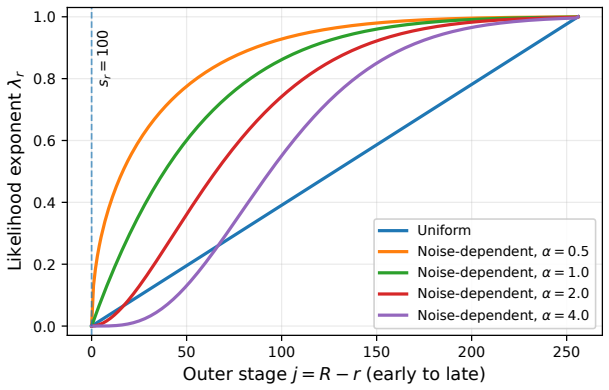
, R , 0< Z r <∞ , and the tempering schedule satisfies 0≤λ R ≤λ R−1 ≤ · · · ≤λ 0 = 1
Well-defined targets.For every r= 0, . . . , R , 0< Z r <∞ , and the tempering schedule satisfies 0≤λ R ≤λ R−1 ≤ · · · ≤λ 0 = 1. 2.Initialization.λ R = 0, and the initial particles are sampled i.i.d. from the noisy prior: z(i) R ∼p sR(zR), w (i) R = 1/N. Equivalently, the initial weighted empirical measure is consistent forη R
-
[62]
Exact reconstruction.For each r= 0, . . . , R , the stagewise reconstruction kernel used by ideal TGD is the exact conditional law Kr(dx0 |z r) :=p λr,sr(x0 |z r,y)dx 0 = πr(x0)psr(zr |x 0) ηr(zr) dx0.(23) Equivalently, pλr,sr(x0 |z r,y)∝p sr(x0 |z r)ℓ(x0)λr .(24) 4.Bounded incremental potentials.For eachr=R, . . . ,1, the incremental potential Gr(x0) :=ℓ...
-
[63]
Consistent resampling.At each outer stage, either resampling is omitted or the resampling scheme preserves consistency of weighted empirical measures: whenever the weighted particle system is consistent for a target distribution, the equally weighted resampled particles are also consistent for the same target. Standard SMC schemes [6, 33] such as multinom...
discussion (0)
Sign in with ORCID, Apple, or X to comment. Anyone can read and Pith papers without signing in.