Recognition: unknown
Learning Dominant States in Elementary Resource Constrained Shortest Path Problems
Pith reviewed 2026-05-07 15:21 UTC · model grok-4.3
The pith
Machine learning can identify dominating states from dynamic programming labels in elementary resource constrained shortest path problems.
A machine-rendered reading of the paper's core claim, the machinery that carries it, and where it could break.
Core claim
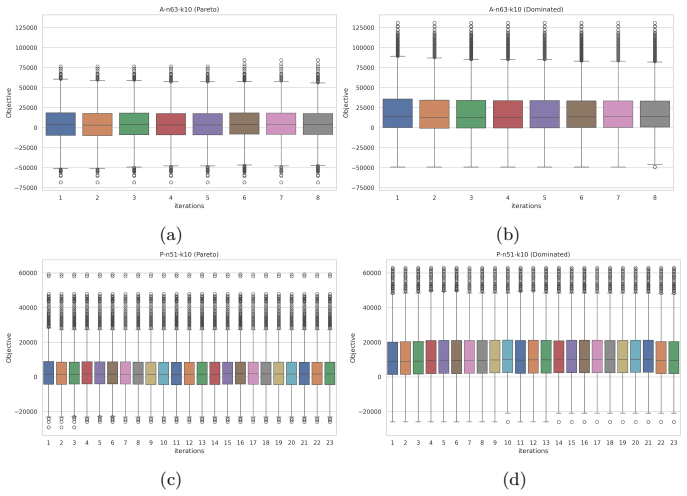
Solving 41 ERCSPP instances with iterative relaxation produced two large datasets of labels. After designing constant-time features and applying a normalization step, supervised learning techniques were used to classify states as dominating. The resulting models reliably separate dominating states within the same problem but show declining accuracy when tested on previously unseen instances.
What carries the argument
Supervised classifiers trained on constant-time ad-hoc features of labels to predict dominance after a normalization step.
If this is right
- Data-driven filtering of states can reduce the number of labels processed in dynamic programming for these problems.
- Normalization reveals consistent patterns across successive relaxations within a single instance.
- The same pipeline supports hybrid solvers that combine traditional relaxation with learned dominance checks.
- Performance is stronger when the model stays within the distribution of training instances.
Where Pith is reading between the lines
- If more diverse training instances are added, generalization to unseen problems may improve enough for routine use in solvers.
- Constant-time features alone may prove sufficient for dominance decisions in other combinatorial optimization settings that rely on label-based dynamic programming.
- Integrating the classifier directly into the relaxation loop could yield measurable speedups on large instances without changing the underlying algorithm.
Load-bearing premise
The constant-time ad-hoc features capture enough patterns to distinguish dominating states and those patterns generalize beyond the 41 training instances.
What would settle it
Apply the trained models to a fresh set of ERCSPP instances outside the original 41 and measure whether they still correctly flag dominating states at high accuracy.
Figures




read the original abstract
In this work, we investigate whether machine learning can be leveraged to identify promising states in dynamic programming algorithms, focusing on Elementary Resource Constrained Shortest Path Problems (ERCSPP). More in detail, we solved 41 single resource instances from SPPRCLIB using iterative relaxation techniques through the PathWyse library, systematically collecting all generated states (i.e. labels). We designed ad-hoc features computable in constant time and constructed two datasets: one containing all generated labels (G) and another with only those inserted into data pools (I), totaling several hundred million labels. Machine learning tools are then employed to explore these datasets, revealing significant patterns between successive relaxations. Leveraging these insights, we propose a normalization approach and apply supervised learning techniques to distinguish dominating states, both within subsequent relaxations of the same problem and in previously unseen instances. Our results demonstrate the effectiveness of this approach on Dataset G, while for Dataset I, performance varies, showing strong results within the same instance but declining for unseen ones. Overall, these findings open new perspectives for the development of data-driven dynamic programming algorithms.
Editorial analysis
A structured set of objections, weighed in public.
Referee Report
Summary. The paper investigates whether supervised machine learning can identify dominating states within dynamic programming for Elementary Resource Constrained Shortest Path Problems (ERCSPP). The authors solve 41 single-resource instances from SPPRCLIB via iterative relaxation in the PathWyse library, collect all generated labels into Dataset G and the subset inserted into pools into Dataset I (hundreds of millions of labels total), design ad-hoc constant-time features, and train classifiers to distinguish dominating states both within the same instance and on unseen instances. They report strong effectiveness on G and variable results on I (strong within-instance but declining on unseen instances), suggesting potential for data-driven DP enhancements.
Significance. If the central empirical claims hold after addressing generalization and reproducibility issues, the work would demonstrate a viable path toward hybrid ML-DP algorithms that prune non-dominating states in ERCSPP, potentially yielding faster exact solutions on large instances. The scale of the collected data and the focus on constant-time features are positive aspects, but the observed drop in performance on unseen instances limits the immediate practical significance for previously unseen problems.
major comments (3)
- [Abstract and results description] Abstract and results description: The claim of 'effectiveness' on Dataset G and 'strong results within the same instance' on Dataset I is not supported by any reported quantitative metrics (accuracy, precision, recall, F1, or AUC), baseline comparisons, or error analysis, making it impossible to assess whether the supervised learning actually outperforms simple dominance rules or random guessing.
- [Methodology and experimental setup] Methodology and experimental setup: The ad-hoc features are described only as 'computable in constant time' without explicit definitions, formulas, or justification for why they capture transferable dominance patterns rather than instance-specific correlations; combined with training on only 41 instances, this leaves the generalization claim (declining performance on unseen instances) without a concrete test or ablation.
- [Results on Dataset I] Results on Dataset I: The explicit note of 'declining for unseen ones' directly undermines the utility claim for data-driven DP on previously unseen ERCSPP instances; no analysis is provided of whether this stems from overfitting, feature insufficiency, or label noise, which is load-bearing for the paper's stated goal of opening perspectives for new algorithms.
minor comments (1)
- [Abstract] The abstract and text use 'Dataset G' and 'Dataset I' without clarifying the exact construction criteria for 'inserted into data pools' in the first mention.
Simulated Author's Rebuttal
We thank the referee for the constructive and detailed review of our manuscript on applying supervised learning to identify dominating states in ERCSPP. We address each major comment point by point below, indicating where revisions will be made to improve clarity, rigor, and completeness while preserving the exploratory nature of the work.
read point-by-point responses
-
Referee: [Abstract and results description] Abstract and results description: The claim of 'effectiveness' on Dataset G and 'strong results within the same instance' on Dataset I is not supported by any reported quantitative metrics (accuracy, precision, recall, F1, or AUC), baseline comparisons, or error analysis, making it impossible to assess whether the supervised learning actually outperforms simple dominance rules or random guessing.
Authors: We agree that the abstract and results description would be strengthened by explicit quantitative metrics. The current manuscript emphasizes the discovery of patterns and the feasibility of the approach rather than exhaustive benchmarking, but this omission makes evaluation difficult. In the revised version, we will update the abstract and expand the results section to report accuracy, precision, recall, F1-score, and AUC for the classifiers on both Dataset G and Dataset I. We will also add baseline comparisons against simple dominance rules and random guessing, together with a basic error analysis. These additions will be presented in new tables and will allow readers to directly assess performance relative to non-ML alternatives. revision: yes
-
Referee: [Methodology and experimental setup] Methodology and experimental setup: The ad-hoc features are described only as 'computable in constant time' without explicit definitions, formulas, or justification for why they capture transferable dominance patterns rather than instance-specific correlations; combined with training on only 41 instances, this leaves the generalization claim (declining performance on unseen instances) without a concrete test or ablation.
Authors: The features were intentionally designed to be lightweight and instance-independent so they could be used inside a DP loop without overhead. We acknowledge that the manuscript provides insufficient detail on their exact form and rationale. In the revision, we will add a dedicated subsection with explicit definitions, mathematical formulas, and justification for each feature, explaining why they are expected to reflect dominance properties that may generalize. We will also include an ablation study on feature importance and clarify the train/test protocol used for within-instance versus cross-instance evaluation, along with a discussion of the diversity present in the 41 SPPRCLIB instances. revision: yes
-
Referee: [Results on Dataset I] Results on Dataset I: The explicit note of 'declining for unseen ones' directly undermines the utility claim for data-driven DP on previously unseen ERCSPP instances; no analysis is provided of whether this stems from overfitting, feature insufficiency, or label noise, which is load-bearing for the paper's stated goal of opening perspectives for new algorithms.
Authors: We recognize that the performance drop on unseen instances is a central and potentially limiting observation. The manuscript presents it as an empirical finding that opens perspectives rather than as a solved capability. In the revision, we will expand the discussion of Dataset I results with an analysis of contributing factors, including possible overfitting to instance-specific patterns, limitations of the current constant-time feature set, and label noise arising from the iterative relaxation procedure. This will be supported by additional experiments such as grouped cross-validation and feature-sensitivity checks, thereby clarifying the boundaries of the method and strengthening the forward-looking claims. revision: yes
Circularity Check
No circularity: empirical ML results on collected DP states are self-contained
full rationale
The paper's chain is: solve 41 instances via PathWyse to generate and label states, extract ad-hoc constant-time features, train supervised classifiers on the resulting datasets G and I, then report direct test performance (strong on G; within-instance strong but cross-instance weak on I). Dominance labels originate from the external solver's actual relaxations, not from the ML model or any fitted quantity defined in terms of the target prediction. No equations redefine the output as the input, no self-citation chain bears the central claim, and the reported decline on unseen instances is an explicit empirical observation rather than a constructed result. The work is therefore a standard experimental study whose conclusions do not reduce to their own inputs by definition.
Axiom & Free-Parameter Ledger
axioms (2)
- domain assumption Ad-hoc features computable in constant time are sufficient to distinguish dominating states
- domain assumption Patterns learned from generated states in 41 instances generalize to dominance prediction
Reference graph
Works this paper leans on
-
[1]
2023 , eprint=
PathWise: a flexible, open-source library for the Resource Constrained Shortest Path , author=. 2023 , eprint=
2023
-
[2]
Optimization Methods and Software , volume =
Salani, Matteo and Basso, Saverio and Giuffrida, Vincenzo , title =. Optimization Methods and Software , volume =. 2024 , publisher =
2024
-
[3]
Enhanced bi-directional dynamic programming algorithm for the resource constrained shortest path problem , journal =
Matteo Salani and Saverio Basso and Giovanni Righini , keywords =. Enhanced bi-directional dynamic programming algorithm for the resource constrained shortest path problem , journal =. 2024 , issn =
2024
-
[4]
New benchmark instances for the Capacitated Vehicle Routing Problem , journal =
Eduardo Uchoa and Diego Pecin and Artur Pessoa and Marcus Poggi and Thibaut Vidal and Anand Subramanian , keywords =. New benchmark instances for the Capacitated Vehicle Routing Problem , journal =. 2017 , issn =
2017
-
[5]
Garey, M. R. and Johnson, David S. , journal =
-
[6]
2005 , publisher=
Column generation , author=. 2005 , publisher=
2005
-
[7]
Shortest Path Problems with Resource Constraints
Irnich, Stefan and Desaulniers, Guy. Shortest Path Problems with Resource Constraints. Column Generation. 2005
2005
-
[8]
A survey of resource constrained shortest path problems: Exact solution approaches , volume =
Luigi Di Puglia Pugliese and Francesca Guerriero , Journal =. A survey of resource constrained shortest path problems: Exact solution approaches , volume =
-
[9]
Aref and Faizan Ur Rehman and Mohamed Abdur Rahman and Saleh M
Amgad Madkour and Walid G. Aref and Faizan Ur Rehman and Mohamed Abdur Rahman and Saleh M. Basalamah , title =. CoRR , volume =. 2017 , opurl =. 1705.02044 , timestamp =
-
[10]
Beasley, J. E. and Christofides, N. , title =. Networks , volume =
-
[11]
Matthew and Royset, Johannes O
Carlyle, W. Matthew and Royset, Johannes O. and Kevin Wood, R. , title =. Networks , volume =
-
[12]
Resource Constrained Shortest Paths
Mehlhorn, Kurt and Ziegelmann, Mark. Resource Constrained Shortest Paths. Algorithms - ESA 2000. 2000
2000
-
[13]
and Boland, N
Dumitrescu, I. and Boland, N. , title =. Networks , volume =
-
[14]
INFOR: Information Systems and Operational Research , volume =
Martin Desrochers and Francois Soumis , title =. INFOR: Information Systems and Operational Research , volume =. 1988 , publisher =
1988
-
[15]
Wolsey , keywords =
François Vanderbeck and Laurence A. Wolsey , keywords =. An exact algorithm for IP column generation , journal =. 1996 , optissn =
1996
-
[16]
Column Generation
Desaulniers, Guy and Desrosiers, Jacques and Solomon, Marius M. Column Generation. 2005
2005
-
[17]
and Nemhauser, George L
Barnhart, Cynthia and Johnson, Ellis L. and Nemhauser, George L. and Savelsbergh, Martin W. P. and Vance, Pamela H. , title =. Operations Research , volume =. 1998 , optdoi =
1998
-
[18]
Transportation Science , volume =
Costa, Luciano and Contardo, Claudio and Desaulniers, Guy , title =. Transportation Science , volume =. 2019 , optdoi =
2019
-
[19]
Mathematical Programming , volume =
Fukasawa, Ricardo and Lysgaard, Jens and Poggi de Aragão, Marcus and Reis Marcelo and Uchoa, Eduardo and Renato F., Werneck , title =. Mathematical Programming , volume =
-
[20]
Operations Research , volume =
Jepsen, Mads and Petersen, Bjørn and Spoorendonk, Simon and Pisinger, David , title =. Operations Research , volume =. 2008 , optdoi =
2008
-
[21]
Networks , volume =
Feillet, Dominique and Dejax, Pierre and Gendreau, Michel and Gueguen, Cyrille , title =. Networks , volume =
-
[22]
Asymmetry matters: Dynamic Half-Way Points in Bidirectional Labeling for Solving Shortest Path Problems with Resource Constraints Faster , volume =
Tilk, Christian and Rothenb\:acher, Ann-Kathrin and Gschwind, Timo and Irnich, Stefan , year =. Asymmetry matters: Dynamic Half-Way Points in Bidirectional Labeling for Solving Shortest Path Problems with Resource Constraints Faster , volume =. European Journal of Operational Research , optdoi =
-
[23]
The orienteering problem: A survey , journal =
Pieter Vansteenwegen and Wouter Souffriau and Dirk Van Oudheusden , optkeywords =. The orienteering problem: A survey , journal =. 2011 , optissn =
2011
-
[24]
and Levy, Larry and Vohra, Rakesh , title =
Golden, Bruce L. and Levy, Larry and Vohra, Rakesh , title =. Naval Research Logistics (NRL) , volume =
-
[25]
Orienteering Problem: A survey of recent variants, solution approaches and applications , journal =
Aldy Gunawan and Hoong Chuin Lau and Pieter Vansteenwegen , optkeywords =. Orienteering Problem: A survey of recent variants, solution approaches and applications , journal =. 2016 , optissn =
2016
-
[26]
1990 , optissn =
The selective travelling salesman problem , journal =. 1990 , optissn =
1990
-
[27]
Transportation Science , volume =
Feillet, Dominique and Dejax, Pierre and Gendreau, Michel , title =. Transportation Science , volume =. 2005 , optdoi =
2005
-
[28]
Mathematical and Computer Modelling of Dynamical Systems , volume =
Tusan Derya and Esra Dinler and Barış Keçeci , title =. Mathematical and Computer Modelling of Dynamical Systems , volume =. 2020 , publisher =
2020
-
[29]
Operations Research , volume =
Baldacci, Roberto and Mingozzi, Aristide and Roberti, Roberto , title =. Operations Research , volume =. 2011 , optdoi =
2011
-
[30]
INFORMS Journal on Computing , volume =
Irnich, Stefan and Villeneuve, Daniel , title =. INFORMS Journal on Computing , volume =. 2006 , optdoi =
2006
-
[31]
Transportation Science , volume =
Desaulniers, Guy and Lessard, François and Hadjar, Ahmed , title =. Transportation Science , volume =. 2008 , optdoi =
2008
-
[32]
Efficient elementary and restricted non-elementary route pricing , volume =
Martinelli, Rafael and Pecin, Diego and Poggi, Marcus , year =. Efficient elementary and restricted non-elementary route pricing , volume =. European Journal of Operational Research , optdoi =
-
[33]
A two-phase hybrid metaheuristic for the vehicle routing problem with time windows , journal =
Jörg Homberger and Hermann Gehring , keywords =. A two-phase hybrid metaheuristic for the vehicle routing problem with time windows , journal =. 2005 , note =
2005
-
[34]
and Soumis, Fran c ois and Villeneuve, Daniel
Desaulniers, Guy and Desrosiers, Jacques and loachim, Irina and Solomon, Marius M. and Soumis, Fran c ois and Villeneuve, Daniel. A Unified Framework for Deterministic Time Constrained Vehicle Routing and Crew Scheduling Problems. Fleet Management and Logistics. 1998
1998
-
[35]
Transportation Science , volume =
Haase, Knut and Desaulniers, Guy and Desrosiers, Jacques , title =. Transportation Science , volume =. 2001 , optdoi =
2001
-
[36]
Operations Research , volume =
Gamache, Michel and Soumis, François and Marquis, Gérald and Desrosiers, Jacques , title =. Operations Research , volume =. 1999 , optdoi =
1999
-
[37]
Optimal Risk Path Algorithms , author=
-
[38]
Networks , year=
Shortest path with time constraints on movement and parking , author=. Networks , year=
-
[39]
The network design problem with relays , author=. Eur. J. Oper. Res. , year=
-
[40]
A Green Vehicle Routing Problem , journal =
Sevgi Erdoğan and Elise Miller-Hooks , keywords =. A Green Vehicle Routing Problem , journal =. 2012 , note =
2012
-
[41]
Medaglia , keywords =
Leonardo Lozano and Andrés L. Medaglia , keywords =. On an exact method for the constrained shortest path problem , journal =. 2013 , optissn =
2013
-
[42]
A Bucket Graph–Based Labeling Algorithm with Application to Vehicle Routing , volume =
Ruslan Sadykov and Eduardo Uchoa and Artur Pessoa , Journal =. A Bucket Graph–Based Labeling Algorithm with Application to Vehicle Routing , volume =
-
[43]
Improved branch-cut-and-price for capacitated vehicle routing , volume =
Diego Pecin and Artur Pessoa and Marcus Poggi and Eduardo Uchoa , Journal =. Improved branch-cut-and-price for capacitated vehicle routing , volume =
-
[44]
International Transactions in Operational Research , volume =
Costa, Luciano and Contardo, Claudio and Desaulniers, Guy and Pecin, Diego , title =. International Transactions in Operational Research , volume =
-
[45]
2018 , optissn =
A branch-and-price algorithm for the Minimum Latency Problem , journal =. 2018 , optissn =
2018
-
[46]
Proceedings of the AAAI Conference on Artificial Intelligence , author=
A Fast Exact Algorithm for the Resource Constrained Shortest Path Problem , volume=. Proceedings of the AAAI Conference on Artificial Intelligence , author=. 2021 , month=
2021
-
[47]
INFORMS Journal on Computing , volume =
Pecin, Diego and Contardo, Claudio and Desaulniers, Guy and Uchoa, Eduardo , title =. INFORMS Journal on Computing , volume =. 2017 , optdoi =
2017
-
[48]
2020 , issue_date =
Lu, Shengliang and He, Bingsheng and Li, Yuchen and Fu, Hao , title =. 2020 , issue_date =
2020
-
[49]
A generic exact solver for vehicle routing and related problems , journal =
Artur Alves Pessoa and Ruslan Sadykov and Eduardo Uchoa and Fran. A generic exact solver for vehicle routing and related problems , journal =. 2020 , opurl =
2020
-
[50]
2020 , publisher =
David Torres Sanchez , title =. 2020 , publisher =
2020
-
[51]
2020 , publisher =
Romain Montagné and David Torres Sanchez and Halvard Olsen Storbugt , title =. 2020 , publisher =
2020
-
[52]
2021 , opturl =
Ksenia Bestuzheva and Mathieu Besan. 2021 , opturl =
2021
-
[53]
Machine learning for combinatorial optimization: A methodological tour d’horizon , journal =
Yoshua Bengio and Andrea Lodi and Antoine Prouvost , keywords =. Machine learning for combinatorial optimization: A methodological tour d’horizon , journal =. 2021 , optissn =
2021
-
[54]
Transportation Science , volume =
Morabit, Mouad and Desaulniers, Guy and Lodi, Andrea , title =. Transportation Science , volume =. 2021 , optdoi =
2021
-
[55]
2024 , eprint=
Neural Combinatorial Optimization Algorithms for Solving Vehicle Routing Problems: A Comprehensive Survey with Perspectives , author=. 2024 , eprint=
2024
-
[56]
TOP , year=
Andrea Lodi and Giulia Zarpellon , title=. TOP , year=
-
[57]
IN ECML , year =
Alejandro Marcos Alvarez and Quentin Louveaux and Louis Wehenkel , title =. IN ECML , year =
-
[58]
European Journal of Operational Research , year=
Václavík, Roman and Novák, Antonín and Šůcha, Přemysl and Hanzálek, Zdeněk , title=. European Journal of Operational Research , year=
-
[59]
Learning to Configure Separators in Branch-and-Cut , volume =
Li, Sirui and Ouyang, Wenbin and Paulus, Max and Wu, Cathy , booktitle =. Learning to Configure Separators in Branch-and-Cut , volume =
-
[60]
Learning to Schedule Heuristics in Branch and Bound , volume =
Chmiela, Antonia and Khalil, Elias and Gleixner, Ambros and Lodi, Andrea and Pokutta, Sebastian , booktitle =. Learning to Schedule Heuristics in Branch and Bound , volume =
-
[61]
2022 , eprint=
Machine-learning-based arc selection for constrained shortest path problems in column generation , author=. 2022 , eprint=
2022
-
[62]
INFORMS Journal on Optimization , volume=
Machine-learning--based arc selection for constrained shortest path problems in column generation , author=. INFORMS Journal on Optimization , volume=. 2023 , publisher=
2023
-
[63]
Networks , volume=
Learning to repeatedly solve routing problems , author=. Networks , volume=. 2024 , publisher=
2024
-
[64]
Graphs and Combinatorial Optimization: From Theory to Applications: CTW 2023, Garmisch-Partenkirchen, Germany, June 20-22 , volume=
Data-Driven Feasibility for the Resource Constrained Shortest Path Problem Check for updates , author=. Graphs and Combinatorial Optimization: From Theory to Applications: CTW 2023, Garmisch-Partenkirchen, Germany, June 20-22 , volume=. 2024 , publisher=
2023
-
[65]
2025 , issn =
Enhancing column generation by reinforcement learning-based hyper-heuristic for vehicle routing and scheduling problems , journal =. 2025 , issn =
2025
-
[66]
Integrating Machine Learning Into Vehicle Routing Problem: Methods and Applications , year=
Shahbazian, Reza and Pugliese, Luigi Di Puglia and Guerriero, Francesca and Macrina, Giusy , journal=. Integrating Machine Learning Into Vehicle Routing Problem: Methods and Applications , year=
-
[67]
Pointer Networks , opturl =
Vinyals, Oriol and Fortunato, Meire and Jaitly, Navdeep , booktitle =. Pointer Networks , opturl =
-
[68]
Eric Larsen and S. Predicting Solution Summaries to Integer Linear Programs under Imperfect Information with Machine Learning , journal =. 2018 , opurl =. 1807.11876 , timestamp =
-
[69]
Kruber and M
M. Kruber and M. L\". Learning When to Use a Decomposition , booktitle =. 2017 , editor =
2017
-
[70]
Symmetry helps: Bounded bi-directional dynamic programming for the elementary shortest path problem with resource constraints , journal =
Giovanni Righini and Matteo Salani , keywords =. Symmetry helps: Bounded bi-directional dynamic programming for the elementary shortest path problem with resource constraints , journal =. 2006 , note =
2006
-
[71]
Networks , volume =
Righini, Giovanni and Salani, Matteo , title =. Networks , volume =
-
[72]
Robust Optimization with Recovery: Application to Shortest Paths and Airline Scheduling , Year =
Niklaus Eggenberg and Matteo Salani and Michel Bierlaire , Booktitle =. Robust Optimization with Recovery: Application to Shortest Paths and Airline Scheduling , Year =
-
[73]
Branch and Bound and Dynamic Programming Approaches for the Path Avoiding Forbidden Pairs Problem
Ferone, Daniele and Festa, Paola and Salani, Matteo. Branch and Bound and Dynamic Programming Approaches for the Path Avoiding Forbidden Pairs Problem. Optimization and Decision Science: ODS, Virtual Conference, November 19, 2020. 2021
2020
-
[74]
Electron
Giovanni Righini and Matteo Salani , title =. Electron. Notes Discret. Math. , volume =
-
[75]
A Pricing Algorithm for the Vehicle Routing Problem with Soft Time Windows
Liberatore, Federico and Righini, Giovanni and Salani, Matteo. A Pricing Algorithm for the Vehicle Routing Problem with Soft Time Windows. Innovations in Distribution Logistics. 2009
2009
-
[76]
Weyland and M
D. Weyland and M. Salani and R. Montemanni and L.M. Gambardella , Title =. Journal of Traffic and Logistics Engineering , Pages =
-
[77]
Righini and Matteo Salani , optdoi =
Federico Liberatore and G. Righini and Matteo Salani , optdoi =. A column generation algorithm for the vehicle routing problem with soft time windows , Year =. 4OR: A Quarterly Journal of Operations Research , Note =
-
[78]
Righini and Matteo Salani , optdoi =
Alberto Ceselli and G. Righini and Matteo Salani , optdoi =. A column generation algorithm for a vehicle routing problem with economies of scale and additional constraints , Volume =. Transportation Science , Number =. 2009 , Bdsk-Url-1 =
2009
-
[79]
Dell'Amico and G
M. Dell'Amico and G. Righini and Matteo Salani , optdoi =. A Branch-and-Price Approach to the Vehicle Routing Problem with Simultaneous Distribution and Collection , Volume =. Transportation Science , Number =. 2006 , Bdsk-Url-1 =
2006
-
[80]
The Vehicle Routing Problem with Discrete Split Delivery and Time Windows , Year =
Ilaria Vacca and Matteo Salani , Booktitle =. The Vehicle Routing Problem with Discrete Split Delivery and Time Windows , Year =
discussion (0)
Sign in with ORCID, Apple, or X to comment. Anyone can read and Pith papers without signing in.