Recognition: unknown
First-Order Transitions in Weak Ising Spin-Orbit-Coupled Superconductors
Pith reviewed 2026-05-07 12:51 UTC · model grok-4.3
The pith
Weak Ising spin-orbit coupling produces first-order superconducting transitions under large exchange fields.
A machine-rendered reading of the paper's core claim, the machinery that carries it, and where it could break.
Core claim
Using a free-energy approach, first-order transitions emerge in superconductors with weak ISOC under large exchange fields. In this regime, conventional gap-equation methods fail to determine the thermodynamic critical field and instead yield only the supercooling field. The quasiparticle spectra display two pronounced in-gap coherence peaks, which represent the weak-ISOC manifestation of the previously reported mirage-gap states.
What carries the argument
Free-energy functional that equates the energies of the superconducting and normal phases to locate the thermodynamic transition point.
If this is right
- The thermodynamic critical field lies below the supercooling field obtained from the gap equation.
- Quasiparticle spectra exhibit two distinct in-gap coherence peaks.
- First-order transitions occur specifically in the weak-ISOC regime at large fields despite spin-orbit protection.
- Mirage-gap states appear as in-gap peaks when ISOC is weak.
Where Pith is reading between the lines
- Field-sweep experiments on thin films may show hysteresis in magnetization or heat capacity near the transition.
- Scanning tunneling spectroscopy could detect the two in-gap peaks to identify the weak-ISOC regime.
- Free-energy methods may be needed in other spin-orbit-protected superconductors to avoid underestimating critical fields.
Load-bearing premise
The free-energy functional accurately captures the thermodynamics of the system in the weak-ISOC, large-exchange-field regime without important contributions from fluctuations, disorder, or higher-order effects that would alter the order of the transition.
What would settle it
An experiment that measures a continuous change in the order parameter or specific heat with no hysteresis at the critical exchange field would falsify the first-order transition; observing a discontinuous jump together with two in-gap peaks would support it.
Figures


read the original abstract
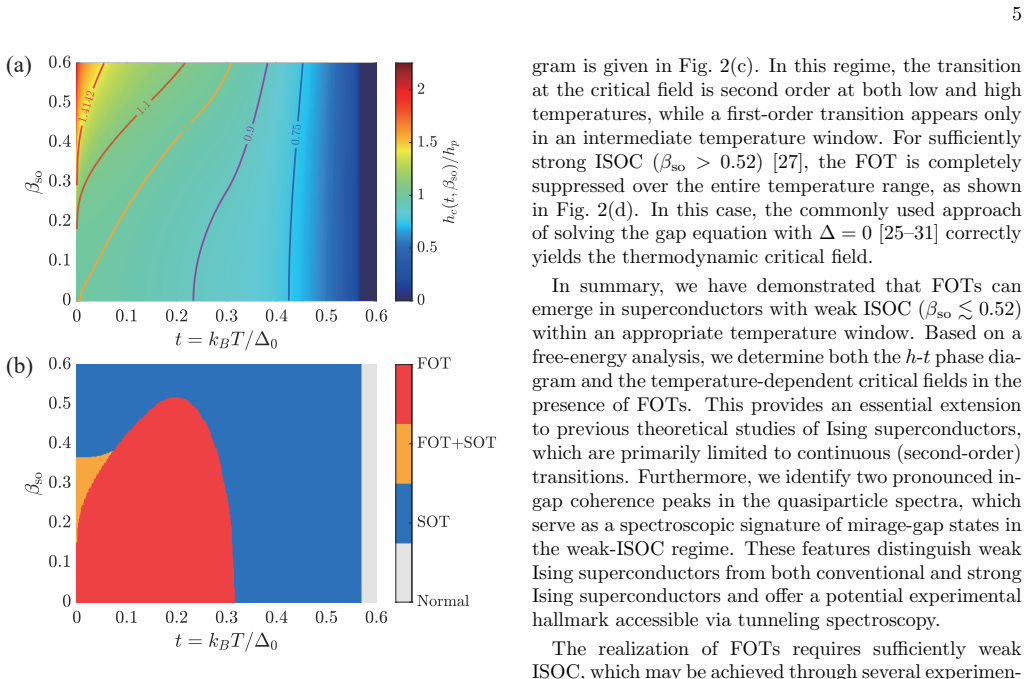
Ising spin-orbit coupling (ISOC) can strongly protect superconductivity against exchange-field-induced depairing, typically leading to critical fields far exceeding the Pauli limit and continuous (second-order) phase transitions. Here, using a free-energy approach, we demonstrate that first-order transitions can emerge in superconductors with weak ISOC under large exchange fields. In this regime, conventional theoretical approaches based on the gap equation fail to determine the thermodynamic critical field and instead yield only the supercooling field. Moreover, we identify two pronounced in-gap coherence peaks in the quasiparticle spectra, which represent the weak-ISOC manifestation of the previously reported mirage-gap states. Our results establish the importance of free-energy analysis in describing the first-order phase transitions in Ising superconductors and reveal distinct spectroscopic signatures of the weak-ISOC regime.
Editorial analysis
A structured set of objections, weighed in public.
Referee Report
Summary. The manuscript claims that in superconductors with weak Ising spin-orbit coupling (ISOC) under large exchange fields, a free-energy minimization approach reveals first-order phase transitions, while conventional gap-equation methods only yield the supercooling field rather than the thermodynamic critical field. It further identifies two pronounced in-gap coherence peaks in the quasiparticle spectra as the weak-ISOC manifestation of previously reported mirage-gap states.
Significance. If the free-energy analysis is accurate and the mean-field functional captures the thermodynamics, the result would be significant for theoretical modeling of Ising superconductors. It highlights limitations of gap-equation techniques in the weak-ISOC regime and provides distinct spectroscopic predictions that could be tested experimentally, advancing understanding of protected superconductivity and phase-transition order in spin-orbit-coupled systems.
major comments (2)
- [Free-energy approach and thermodynamic calculation] The central claim that first-order transitions emerge relies on the free-energy functional (derived in the methods/results section) being thermodynamically complete in the weak-ISOC, large-exchange-field regime. No explicit demonstration is given that fluctuation corrections, disorder, or higher-order ISOC terms beyond the leading weak-coupling expansion are negligible or do not restore a continuous transition, as raised by the stress-test concern; this is load-bearing for the reported order of the transition and the distinction from gap-equation results.
- [Comparison of free-energy and gap-equation methods] The assertion that gap-equation methods fail to determine the thermodynamic critical field (while free-energy succeeds) requires a direct, quantitative comparison of the two approaches, including explicit solutions or plots of the gap equation versus free-energy minimization for the same parameters; without this, the contrast remains qualitative and the supercooling-field interpretation is not fully substantiated.
minor comments (2)
- [Introduction and model] Define the quantitative range for 'weak ISOC' (e.g., relative to exchange field or pairing strength) more explicitly, perhaps with a parameter scan or inequality, to clarify the regime of validity.
- [Quasiparticle spectra] The quasiparticle spectra section would benefit from additional detail on how the two in-gap coherence peaks are computed (e.g., via specific Green's function or DOS formula) and a clearer link to prior mirage-gap literature, including any parameter mapping.
Simulated Author's Rebuttal
We thank the referee for their careful reading of our manuscript and for the constructive comments. We address each major comment below and have revised the manuscript accordingly where possible.
read point-by-point responses
-
Referee: [Free-energy approach and thermodynamic calculation] The central claim that first-order transitions emerge relies on the free-energy functional (derived in the methods/results section) being thermodynamically complete in the weak-ISOC, large-exchange-field regime. No explicit demonstration is given that fluctuation corrections, disorder, or higher-order ISOC terms beyond the leading weak-coupling expansion are negligible or do not restore a continuous transition, as raised by the stress-test concern; this is load-bearing for the reported order of the transition and the distinction from gap-equation results.
Authors: Our analysis is performed entirely within the mean-field approximation, which is the conventional framework used to study phase transitions and critical fields in Ising superconductors. We have added a clarifying paragraph in the revised discussion section that explicitly states the mean-field limitations and notes that fluctuation corrections, disorder, and higher-order ISOC terms lie outside the present scope. Within this controlled approximation the free-energy functional is thermodynamically complete and yields a first-order transition for the reported parameters; we do not claim robustness beyond mean-field theory. revision: partial
-
Referee: [Comparison of free-energy and gap-equation methods] The assertion that gap-equation methods fail to determine the thermodynamic critical field (while free-energy succeeds) requires a direct, quantitative comparison of the two approaches, including explicit solutions or plots of the gap equation versus free-energy minimization for the same parameters; without this, the contrast remains qualitative and the supercooling-field interpretation is not fully substantiated.
Authors: We agree that an explicit side-by-side comparison is necessary. In the revised manuscript we have added a new figure (and corresponding text in the results section) that plots both the gap-equation solutions and the free-energy minimization for identical parameter values. The figure shows that the gap equation produces only the supercooling field while the free-energy crossing defines the thermodynamic critical field, thereby providing the requested quantitative substantiation. revision: yes
- Explicit demonstration that fluctuation corrections, disorder, or higher-order ISOC terms beyond the leading weak-coupling expansion are negligible or do not restore a continuous transition
Circularity Check
No significant circularity; free-energy comparison is independent thermodynamic criterion
full rationale
The paper derives the first-order transition by direct minimization and comparison of a mean-field free-energy functional between normal and superconducting states, which is a standard, non-circular procedure in superconductivity theory. This is explicitly contrasted with the gap equation, which only locates the local stability limit (supercooling field). No equations reduce to fitted inputs renamed as predictions, no self-citation chain is load-bearing for the transition order, and the in-gap peaks are presented as a derived spectroscopic consequence rather than an ansatz or renaming. The derivation remains self-contained against external mean-field benchmarks.
Axiom & Free-Parameter Ledger
free parameters (2)
- ISOC strength
- exchange-field magnitude
axioms (2)
- domain assumption Mean-field BCS-like description of superconductivity remains valid
- domain assumption Ising-type spin-orbit coupling term dominates spin-momentum locking
Reference graph
Works this paper leans on
-
[1]
A. M. Clogston, Upper limit for the critical field in hard superconductors, Phys. Rev. Lett.9, 266 (1962)
1962
-
[2]
Chandrasekhar, A note on the maximum critical field of high-field superconductors, Appl
B. Chandrasekhar, A note on the maximum critical field of high-field superconductors, Appl. Phys. Lett.1, 7 (1962)
1962
-
[3]
Sarma, On the influence of a uniform exchange field acting on the spins of the conduction electrons in a su- perconductor, J
G. Sarma, On the influence of a uniform exchange field acting on the spins of the conduction electrons in a su- perconductor, J. Phys. Chem. Solids.24, 1029 (1963). 6
1963
-
[4]
Maki, Effect of pauli paramagnetism on magnetic properties of high-field superconductors, Phys
K. Maki, Effect of pauli paramagnetism on magnetic properties of high-field superconductors, Phys. Rev.148, 362 (1966)
1966
-
[5]
Fulde, High field superconductivity in thin films, Adv
P. Fulde, High field superconductivity in thin films, Adv. Phys.22, 667 (1973)
1973
-
[6]
Tedrow, R
P. Tedrow, R. Meservey, and B. Schwartz, Experimental evidence for a first-order magnetic transition in thin su- perconducting aluminum films, Phys. Rev. Lett24, 1004 (1970)
1970
-
[7]
Meservey, P
R. Meservey, P. Tedrow, and P. Fulde, Magnetic field splitting of the quasiparticle states in superconducting aluminum films, Phys. Rev. Lett25, 1270 (1970)
1970
-
[8]
Meservey, P
R. Meservey, P. Tedrow, and R. C. Bruno, Tunneling measurements on spin-paired superconductors with spin- orbit scattering, Phys. Rev. B11, 4224 (1975)
1975
-
[9]
Tedrow and R
P. Tedrow and R. Meservey, Supercooling magnetic field and thermodynamic fluctuations in very thin supercon- ducting aluminum films, Phys. Rev. B16, 4825 (1977)
1977
-
[10]
Tedrow and R
P. Tedrow and R. Meservey, Measurement of the super- cooling curve of a paramagnetically limited superconduc- tor, Phys. Lett. A63, 398 (1977)
1977
-
[11]
J. Lu, O. Zheliuk, I. Leermakers, N. F. Yuan, U. Zeitler, K. T. Law, and J. Ye, Evidence for two-dimensional Ising superconductivity in gated MoS2, Science350, 1353 (2015)
2015
-
[12]
Saito, Y
Y. Saito, Y. Nakamura, M. S. Bahramy, Y. Kohama, J. Ye, Y. Kasahara, Y. Nakagawa, M. Onga, M. Toku- naga, T. Nojima,et al., Superconductivity protected by spin–valley locking in ion-gated MoS2, Nat. Phys.12, 144 (2016)
2016
-
[13]
X. Xi, Z. Wang, W. Zhao, J.-H. Park, K. T. Law, H. Berger, L. Forr´ o, J. Shan, and K. F. Mak, Ising pair- ing in superconducting NbSe 2 atomic layers, Nat. Phys. 12, 139 (2016)
2016
-
[14]
E. Sohn, X. Xi, W.-Y. He, S. Jiang, Z. Wang, K. Kang, J.-H. Park, H. Berger, L. Forr´ o, K. T. Law,et al., An unusual continuous paramagnetic-limited superconduct- ing phase transition in 2D NbSe 2, Nat. Mater.17, 504 (2018)
2018
-
[15]
S. C. De la Barrera, M. R. Sinko, D. P. Gopalan, N. Sivadas, K. L. Seyler, K. Watanabe, T. Taniguchi, A. W. Tsen, X. Xu, D. Xiao,et al., Tuning Ising super- conductivity with layer and spin–orbit coupling in two- dimensional transition-metal dichalcogenides, Nat. Com- mun.9, 1427 (2018)
2018
-
[16]
C.-w. Cho, J. Lyu, L. An, T. Han, K. T. Lo, C. Y. Ng, J. Hu, Y. Gao, G. Li, M. Huang,et al., Nodal and ne- matic superconducting phases in NbSe2 monolayers from competing superconducting channels, Phys. Rev. Lett. 129, 087002 (2022)
2022
-
[17]
W. Li, J. Huang, X. Li, S. Zhao, J. Lu, Z. V. Han, and H. Wang, Recent progresses in two-dimensional Ising su- perconductivity, Mater. Today Phys.21, 100504 (2021)
2021
-
[18]
P. Wan, O. Zheliuk, N. F. Yuan, X. Peng, L. Zhang, M. Liang, U. Zeitler, S. Wiedmann, N. E. Hussey, T. T. Palstra,et al., Orbital Fulde-Ferrell-Larkin-ovchinnikov state in an Ising superconductor, Nature619, 46 (2023)
2023
-
[19]
J.-Y. Ji, Y. Hu, T. Bao, Y. Xu, M. Huang, J. Chen, Q.- K. Xue, and D. Zhang, Continuous tuning of spin-orbit coupled superconductivity in NbSe 2, Phys. Rev. B110, 104509 (2024)
2024
-
[20]
Volavka, J
D. Volavka, J. Kaˇ cmarˇ c´ ık, T. Moˇ sko, Z. Pribulov´ a, B. Stropkai, J. Bednarˇ c´ ık, Y. Gao, O. Moulding, M.-A. M´ easson, C. Marcenat,et al., Ising superconductivity in noncentrosymmetric bulk NbSe 2, Phys. Rev. Lett.136, 016002 (2026)
2026
-
[21]
Z. Y. Zhu, Y. C. Cheng, and U. Schwingenschl¨ ogl, Gi- ant spin-orbit-induced spin splitting in two-dimensional transition-metal dichalcogenide semiconductors, Phys. Rev. B84, 153402 (2011)
2011
-
[22]
Xiao, G.-B
D. Xiao, G.-B. Liu, W. Feng, X. Xu, and W. Yao, Cou- pled spin and valley physics in monolayers of MoS 2 and other group-VI dichalcogenides, Phys. Rev. Lett.108, 196802 (2012)
2012
-
[23]
N. F. Yuan, K. F. Mak, and K. Law, Possible topological superconducting phases of MoS 2, Phys. Rev. Lett113, 097001 (2014)
2014
-
[24]
B. T. Zhou, N. F. Yuan, H.-L. Jiang, and K. T. Law, Ising superconductivity and Majorana fermions in transition-metal dichalcogenides, Phys. Rev, B93, 180501 (2016)
2016
- [25]
-
[26]
Liu, Unconventional superconductivity in bilayer transition metal dichalcogenides, Phys
C.-X. Liu, Unconventional superconductivity in bilayer transition metal dichalcogenides, Phys. Rev. Lett.118, 087001 (2017)
2017
-
[27]
Ili´ c, J
S. Ili´ c, J. S. Meyer, and M. Houzet, Enhancement of the upper critical field in disordered transition metal dichalcogenide monolayers, Phys. Rev. Lett.119, 117001 (2017)
2017
-
[28]
H. Liu, H. Liu, D. Zhang, and X. Xie, Microscopic theory of in-plane critical field in two-dimensional Ising super- conducting systems, Phys. Rev. B102, 174510 (2020)
2020
-
[29]
M¨ ockli and M
D. M¨ ockli and M. Khodas, Ising superconductors: In- terplay of magnetic field, triplet channels, and disorder, Phys. Rev. B101, 014510 (2020)
2020
-
[30]
C. Wang, Y. Xu, and W. Duan, Ising superconductivity and its hidden variants, Acc. Mater. Res.2, 526 (2021)
2021
-
[31]
Ili´ c, J
S. Ili´ c, J. S. Meyer, and M. Houzet, Spectral properties of disordered Ising superconductors with singlet and triplet pairing in in-plane magnetic fields, Phys. Rev. B108, 214510 (2023)
2023
-
[32]
Maki and T
K. Maki and T. Tsuneto, Pauli paramagnetism and su- perconducting state, Prog. Theor. Phys.31, 945 (1964)
1964
-
[33]
Fulde and R
P. Fulde and R. A. Ferrell, Superconductivity in a strong spin-exchange field, Phys. Rev135, A550 (1964)
1964
-
[34]
Matsuda and H
Y. Matsuda and H. Shimahara, Fulde–Ferrell–Larkin– Ovchinnikov state in heavy fermion superconductors, Phys. Soc. Jpn76, 051005 (2007)
2007
-
[35]
Olde Olthof, J
L. Olde Olthof, J. Weggemans, G. Kimbell, J. Robinson, and X. Montiel, Tunable critical field in Rashba super- conductor thin films, Phys. Rev. B103, L020504 (2021)
2021
-
[36]
G. Tang, C. Bruder, and W. Belzig, Magnetic field- induced “mirage” gap in an Ising superconductor, Phys. Rev. Lett.126, 237001 (2021)
2021
-
[37]
Patil, G
S. Patil, G. Tang, and W. Belzig, Spectral properties of a mixed singlet-triplet Ising superconductor, Front. Elec- tron. Mater.3, 1254302 (2023)
2023
-
[38]
Altland and B
A. Altland and B. D. Simons,Condensed matter field theory(Cambridge university press, 2010)
2010
-
[39]
Y.-M. Xie, B. T. Zhou, and K. T. Law, Spin-orbit- parity-coupled superconductivity in topological mono- layer WTe2, Phys. Rev. Lett.125, 107001 (2020)
2020
- [40]
- [41]
-
[42]
R. C. Dynes, V. Narayanamurti, and J. P. Garno, Di- rect measurement of quasiparticle-lifetime broadening in a strong-coupled superconductor, Phys. Rev. Lett.41, 1509 (1978)
1978
-
[43]
Y. Wu, J. J. He, T. Han, S. Xu, Z. Wu, J. Lin, T. Zhang, Y. He, and N. Wang, Induced Ising spin-orbit interaction in metallic thin films on monolayer WSe 2, Phys. Rev. B 99, 121406 (2019)
2019
-
[44]
J. Harms, M. Hein, and W. Belzig, Collapse of the superconducting order parameter in Ising superconduc- tors with Rashba spin-orbit coupling, arXiv preprint arXiv:2512.01910 (2025). I. Free energy derivation and computational details for the Ising superconductor Considering ans-wave spin-singlet Ising superconductor, the mean-field Hamiltonian reads [27, ...
discussion (0)
Sign in with ORCID, Apple, or X to comment. Anyone can read and Pith papers without signing in.