Identity-Consistent Multi-Pose Generation of Contactless Fingerprints
Pith reviewed 2026-05-07 17:42 UTC · model grok-4.3
The pith
IMPOSE synthesizes identity-preserving multi-pose contactless fingerprints from rolled prints to close the cross-modal domain gap.
A machine-rendered reading of the paper's core claim, the machinery that carries it, and where it could break.
Core claim
The IMPOSE framework generates identity-consistent multi-pose contactless fingerprints through rolled-print synthesis via latent diffusion with discrete codebooks, cross-modal translation guided by Sauvola local adaptive binarization as an identity anchor, and physics-based simulation via 3D finger model texture mapping and projection. These samples maintain strict identity consistency at the ridge topology level and spatial alignment with standard fingerprint coordinate space. Fine-tuning fixed-length dense descriptors on the resulting data achieves state-of-the-art cross-modal matching, with equal error rates reduced to 8.74 percent on UWA and 2.26 percent on PolyU CL2CB, while also giving
What carries the argument
IMPOSE three-stage synthesis pipeline that uses Sauvola-based local adaptive binarization as an identity anchor during cross-modal translation and applies 3D finger model texture mapping and projection to produce realistic nonlinear distortions.
If this is right
- Fine-tuning fixed-length dense descriptors with IMPOSE-synthesized data achieves state-of-the-art cross-modal matching performance.
- Synthetic data produces consistent gains when applied to other mainstream representations including DeepPrint and AFRNet.
- The hybrid strategy of combining synthetic and real data for training yields the best overall matching results.
- The generated samples maintain strict identity consistency at the ridge topology level and spatial alignment with standard fingerprint coordinate space.
Where Pith is reading between the lines
- The synthesis approach could be extended to generate training data for other biometric tasks that suffer from pose or deformation variations.
- Unlimited synthetic samples may reduce dependence on large-scale collection of real contactless fingerprint datasets.
- Incorporating higher-fidelity 3D models or additional physical parameters could further narrow any remaining domain differences.
Load-bearing premise
The physics-based 3D finger model texture mapping and projection must accurately reproduce the nonlinear geometric distortions of real contactless captures while the generated samples preserve exact ridge topology identity and coordinate alignment.
What would settle it
Evaluating models fine-tuned solely on IMPOSE synthetic data against models trained only on real contactless data and finding equal or higher equal error rates on the UWA and PolyU CL2CB test sets would show that the synthesized samples fail to bridge the domain gap.
Figures


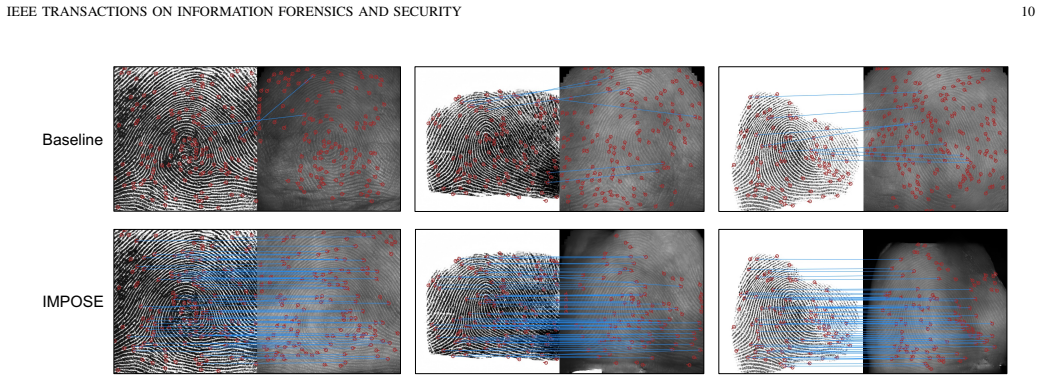




read the original abstract
Contactless fingerprint recognition has gained increasing attention due to its advantages in hygiene and acquisition flexibility. However, the absence of physical contact constraints introduces severe nonlinear geometric distortions caused by free finger poses in 3D space, resulting in a substantial cross-modal domain gap between contactless and conventional contact-based fingerprints. Existing solutions largely rely on explicit geometric correction or image enhancement, which are fragile under extreme pose variations. In this paper, we propose Identity-Consistent Multi-Pose Generation of Contactless Fingerprints (IMPOSE), a physics-inspired framework that synthesizes identity-preserving, multi-pose contactless fingerprint samples to empower recognition models. IMPOSE consists of three stages: (1) rolled fingerprint identity generation via latent diffusion with discrete codebook representations, (2) cross-modal translation from rolled to contactless modality guided by Sauvola-based local adaptive binarization as an identity anchor, and (3) physics-based multi-pose simulation through 3D finger model texture mapping and projection. The generated samples maintain strict identity consistency at the ridge topology level and spatial alignment with standard fingerprint coordinate space. Extensive experiments on the UWA and PolyU CL2CB databases demonstrate that fine-tuning fixed-length dense descriptors (FDD) with IMPOSE-synthesized data achieves state-of-the-art cross-modal matching, reducing EER to 8.74% on UWA and 2.26% on PolyU CL2CB. Synthetic data also yields consistent gains across mainstream representations including DeepPrint and AFRNet, and the hybrid strategy combining synthetic and real data achieves the best overall results. The code and generated samples are available at https://github.com/Yu-Yy/IMPOSE.
Editorial analysis
A structured set of objections, weighed in public.
Referee Report
Summary. The manuscript proposes IMPOSE, a three-stage physics-inspired framework for synthesizing identity-preserving multi-pose contactless fingerprints: (1) rolled fingerprint generation via latent diffusion with discrete codebook representations, (2) cross-modal translation from rolled to contactless modality using Sauvola-based local adaptive binarization as an identity anchor, and (3) physics-based multi-pose simulation via 3D finger model texture mapping and projection. The generated samples are claimed to maintain strict identity consistency at the ridge topology level and spatial alignment with standard fingerprint coordinate space. Experiments on the UWA and PolyU CL2CB databases show that fine-tuning fixed-length dense descriptors (FDD) with the synthetic data achieves state-of-the-art cross-modal matching (EER 8.74% on UWA, 2.26% on PolyU CL2CB), with consistent gains for DeepPrint and AFRNet representations; the hybrid real-plus-synthetic strategy performs best overall. Code and generated samples are released publicly.
Significance. If the synthetic samples faithfully reproduce the nonlinear geometric distortions of real free-pose contactless captures while preserving identity, the framework would provide a scalable augmentation strategy that narrows the contact-contactless domain gap without requiring large-scale real contactless data collection. The public release of code and generated samples is a clear strength supporting reproducibility.
major comments (2)
- [Experimental evaluation] The central performance claims (EER reductions to 8.74% on UWA and 2.26% on PolyU CL2CB) rest on the assertion that the physics-based 3D finger model in stage 3 accurately reproduces real nonlinear distortions (curvature, foreshortening, ridge compression). However, the experimental evaluation provides no quantitative validation metrics—such as pose-angle histograms, local affine distortion statistics, or minutiae displacement errors—comparing the synthetic multi-pose samples against real contactless captures from the same identities. Without these, it is unclear whether the observed gains arise from faithful cross-modal bridging or from generic data augmentation effects.
- [Method (stage 2)] The method description states that the generated samples 'maintain strict identity consistency at the ridge topology level,' yet the cross-modal translation stage relies on Sauvola binarization as an anchor without reporting an explicit identity-preservation metric (e.g., minutiae matching score or ridge pattern similarity) between input rolled prints and output synthetic contactless images across the generated pose variations.
minor comments (1)
- [Abstract and §3] The abstract and method sections would benefit from a brief table summarizing the key hyperparameters of the latent diffusion model and the 3D projection (e.g., camera angles, finger curvature parameters) to improve reproducibility.
Simulated Author's Rebuttal
We thank the referee for the constructive and detailed feedback on our manuscript. We have carefully reviewed the major comments and provide point-by-point responses below, including clarifications and commitments to revisions where appropriate.
read point-by-point responses
-
Referee: [Experimental evaluation] The central performance claims (EER reductions to 8.74% on UWA and 2.26% on PolyU CL2CB) rest on the assertion that the physics-based 3D finger model in stage 3 accurately reproduces real nonlinear distortions (curvature, foreshortening, ridge compression). However, the experimental evaluation provides no quantitative validation metrics—such as pose-angle histograms, local affine distortion statistics, or minutiae displacement errors—comparing the synthetic multi-pose samples against real contactless captures from the same identities. Without these, it is unclear whether the observed gains arise from faithful cross-modal bridging or from generic data augmentation effects.
Authors: We acknowledge the value of direct quantitative validation for the fidelity of the 3D projection stage. Our primary evidence for the utility of the generated samples remains the consistent EER reductions and gains across multiple representations (FDD, DeepPrint, AFRNet) when fine-tuning with synthetic data, which exceed those from generic augmentation baselines in our experiments. The physics-based 3D finger model follows established anatomical parameters for curvature and projection to simulate realistic distortions. To strengthen the manuscript, we will add in the revision pose-angle histograms derived from the synthetic samples and compare their distribution to real contactless images from the UWA and PolyU CL2CB datasets (via available pose estimation techniques). We will also include local affine distortion statistics computed on ridge patterns. Note that minutiae displacement errors cannot be directly computed without paired ground-truth correspondences, which are unavailable in the datasets. revision: partial
-
Referee: [Method (stage 2)] The method description states that the generated samples 'maintain strict identity consistency at the ridge topology level,' yet the cross-modal translation stage relies on Sauvola binarization as an anchor without reporting an explicit identity-preservation metric (e.g., minutiae matching score or ridge pattern similarity) between input rolled prints and output synthetic contactless images across the generated pose variations.
Authors: The Sauvola-based local adaptive binarization in stage 2 is explicitly designed to anchor and preserve the ridge topology and minutiae structure from the input rolled fingerprint during the latent diffusion translation, ensuring identity consistency before the pose simulation stage. While we did not include an explicit numerical metric (such as average minutiae matching scores) in the original submission, the downstream cross-modal matching results provide supporting evidence of preserved identity. In the revised version, we will add a dedicated analysis section reporting minutiae matching scores and ridge pattern similarity metrics between the input rolled prints and the generated contactless images (both pre- and post-pose simulation) to make the identity preservation explicit and quantifiable. revision: yes
Circularity Check
No circularity in derivation chain; claims rest on external empirical evaluation
full rationale
The paper describes a three-stage generative pipeline (latent diffusion for rolled prints, Sauvola-guided cross-modal translation, and 3D physics-based pose simulation) whose outputs are then used to fine-tune external recognition models. All reported performance numbers (EER reductions on UWA and PolyU CL2CB) are obtained by training and testing on independent public datasets, with no equations, fitted parameters, or self-citations that reduce the claimed gains to the method's own inputs by construction. The identity-consistency and distortion-modeling assertions are presented as design goals rather than derived predictions, and the evaluation protocol does not invoke any self-referential loop.
Axiom & Free-Parameter Ledger
Reference graph
Works this paper leans on
-
[1]
C2CL: Contact to contactless fingerprint matching,
S. A. Grosz, J. J. Engelsma, E. Liu, and A. K. Jain, “C2CL: Contact to contactless fingerprint matching,”IEEE Transactions on Information F orensics and Security, vol. 17, pp. 196–210, 2021
2021
-
[2]
Maltoni, D
D. Maltoni, D. Maio, A. K. Jain, and J. Feng,Handbook of Fingerprint Recognition. Springer Nature, 2022
2022
-
[3]
Synthesis of multi-view 3d fingerprints to advance contactless fingerprint identification,
C. Dong and A. Kumar, “Synthesis of multi-view 3d fingerprints to advance contactless fingerprint identification,”IEEE Transactions on Pattern Analysis and Machine Intelligence, vol. 45, no. 11, pp. 13 134– 13 151, 2023
2023
-
[4]
Bridging dimensions in fingerprints to advance distinctiveness: Recovering 3d minutiae from a single contactless 2d fingerprint image,
——, “Bridging dimensions in fingerprints to advance distinctiveness: Recovering 3d minutiae from a single contactless 2d fingerprint image,” IEEE Transactions on Pattern Analysis and Machine Intelligence, 2025
2025
-
[5]
Monocular 3d fingerprint reconstruction and unwarping,
Z. Cui, J. Feng, and J. Zhou, “Monocular 3d fingerprint reconstruction and unwarping,”IEEE Transactions on Pattern Analysis and Machine Intelligence, vol. 45, no. 7, pp. 8679–8695, 2023
2023
-
[6]
Fixed-length dense descriptor for efficient fingerprint matching,
Z. Pan, Y . Duan, J. Feng, and J. Zhou, “Fixed-length dense descriptor for efficient fingerprint matching,” in2024 IEEE International Workshop on Information F orensics and Security (WIFS). IEEE, 2024, pp. 1–6
2024
-
[7]
Fixed-length dense fingerprint representation with alignment and robust enhancement,
Z. Pan, X. Guan, Y . Duan, J. Feng, and J. Zhou, “Fixed-length dense fingerprint representation with alignment and robust enhancement,”IEEE Transactions on Information F orensics and Security, vol. 21, pp. 1751– 1765, 2026
2026
-
[8]
3D fingerprint reconstruction system using feature correspondences and prior estimated finger model,
F. Liu and D. Zhang, “3D fingerprint reconstruction system using feature correspondences and prior estimated finger model,”Pattern Recognition, vol. 47, no. 1, pp. 178–193, 2014
2014
-
[9]
SFinGe: An approach to synthetic fingerprint generation,
R. Cappelli, D. Maio, and D. Maltoni, “SFinGe: An approach to synthetic fingerprint generation,” inProceedings of the International Workshop on Biometric Technologies (BT), Vigevano, Italy, 2004, pp. 147–154
2004
-
[10]
Printsgan: Synthetic finger- print generator,
J. J. Engelsma, S. Grosz, and A. K. Jain, “Printsgan: Synthetic finger- print generator,”IEEE Transactions on Pattern Analysis and Machine Intelligence, vol. 45, no. 5, pp. 6111–6124, 2022
2022
-
[11]
Universal fingerprint generation: Controllable diffusion model with multimodal conditions,
S. A. Grosz and A. K. Jain, “Universal fingerprint generation: Controllable diffusion model with multimodal conditions,”IEEE Transactions on Pattern Analysis and Machine Intelligence, 2024
2024
-
[12]
Fpgan-control: A controllable fingerprint generator for training with synthetic data,
A. Shoshan, N. Bhonker, E. Ben Baruch, O. Nizan, I. Kviatkovsky, J. En- gelsma, M. Aggarwal, and G. Medioni, “Fpgan-control: A controllable fingerprint generator for training with synthetic data,” inProceedings of the IEEE/CVF winter conference on applications of computer vision, 2024, pp. 6067–6076
2024
-
[13]
Denoising diffusion probabilistic models,
J. Ho, A. Jain, and P. Abbeel, “Denoising diffusion probabilistic models,” Advances in neural information processing systems, vol. 33, pp. 6840– 6851, 2020
2020
-
[14]
SynCoLFinGer: Synthetic contactless fingerprint generator,
J. Priesnitz, C. Rathgeb, N. Buchmann, and C. Busch, “SynCoLFinGer: Synthetic contactless fingerprint generator,”Pattern Recognition Letters, vol. 157, pp. 127–134, 2022
2022
-
[15]
Adaptive document image binarization,
J. Sauvola and M. Pietik ¨ainen, “Adaptive document image binarization,” Pattern recognition, vol. 33, no. 2, pp. 225–236, 2000
2000
-
[16]
A benchmark 3d fingerprint database,
W. Zhou, J. Hu, I. Petersen, S. Wang, and M. Bennamoun, “A benchmark 3d fingerprint database,” in2014 11th international conference on fuzzy systems and knowledge discovery (fskd). IEEE, 2014, pp. 935–940
2014
-
[17]
Fingerprint image synthesis based on statistical feature models,
Q. Zhao, A. K. Jain, N. G. Paulter, and M. Taylor, “Fingerprint image synthesis based on statistical feature models,” in2012 IEEE Fifth International Conference on Biometrics: Theory, Applications and Systems (BTAS). IEEE, 2012, pp. 23–30
2012
-
[18]
Texture modeling for synthetic fingerprint generation,
P. Johnson, F. Hua, and S. Schuckers, “Texture modeling for synthetic fingerprint generation,” inProceedings of the IEEE Conference on Computer Vision and Pattern Recognition Workshops, 2013, pp. 154–159
2013
-
[19]
Generative adversarial networks,
I. Goodfellow, J. Pouget-Abadie, M. Mirza, B. Xu, D. Warde-Farley, S. Ozair, A. Courville, and Y . Bengio, “Generative adversarial networks,” Communications of the ACM, vol. 63, no. 11, pp. 139–144, 2020
2020
-
[20]
Fingerprint synthesis: Search with 100 million prints,
V . Mistry, J. J. Engelsma, and A. K. Jain, “Fingerprint synthesis: Search with 100 million prints,” in2020 IEEE international joint conference on biometrics (IJCB). IEEE, 2020, pp. 1–10
2020
-
[21]
Finger-gan: Generating realistic fingerprint images using connectivity imposed gan,
S. Minaee and A. Abdolrashidi, “Finger-gan: Generating realistic fingerprint images using connectivity imposed gan,”arXiv preprint arXiv:1812.10482, 2018
-
[22]
Synfi: Automatic synthetic fingerprint generation,
M. S. Riazi, S. M. Chavoshian, and F. Koushanfar, “Synfi: Automatic synthetic fingerprint generation,”arXiv preprint arXiv:2002.08900, 2020
-
[23]
High fidelity fingerprint generation: Quality, uniqueness, and privacy,
K. Bahmani, R. Plesh, P. Johnson, S. Schuckers, and T. Swyka, “High fidelity fingerprint generation: Quality, uniqueness, and privacy,” in2021 IEEE International Conference on Image Processing (ICIP). IEEE, 2021, pp. 3018–3022
2021
-
[24]
Fingerprint synthesis: Evaluating fingerprint search at scale,
K. Cao and A. Jain, “Fingerprint synthesis: Evaluating fingerprint search at scale,” in2018 International Conference on Biometrics (ICB). IEEE, 2018, pp. 31–38
2018
-
[25]
Towards contactless, low-cost and accurate 3d fingerprint identification,
A. Kumar and C. Kwong, “Towards contactless, low-cost and accurate 3d fingerprint identification,” inProceedings of the IEEE Conference on Computer Vision and Pattern Recognition, 2013, pp. 3438–3443. IEEE TRANSACTIONS ON INFORMATION FORENSICS AND SECURITY 13
2013
-
[26]
Towards more accurate contactless fingerprint minutiae extraction and pose-invariant matching,
H. Tan and A. Kumar, “Towards more accurate contactless fingerprint minutiae extraction and pose-invariant matching,”IEEE Transactions on Information F orensics and Security, vol. 15, pp. 3924–3937, 2020
2020
-
[27]
Towards more accurate matching of contactless fingerprints with a deep geometric graph convolutional network,
Y . Shi, Z. Zhang, S. Liu, and M. Liu, “Towards more accurate matching of contactless fingerprints with a deep geometric graph convolutional network,”IEEE Transactions on Biometrics, Behavior , and Identity Science, vol. 5, no. 1, pp. 29–38, 2022
2022
-
[28]
Improving contactless fingerprint recognition with robust 3d feature extraction and graph embedding,
Y . Jia, S. Zheng, F. Feng, Z. Cui, and F. Su, “Improving contactless fingerprint recognition with robust 3d feature extraction and graph embedding,”arXiv e-prints, pp. arXiv–2409, 2024
2024
-
[29]
High- resolution image synthesis with latent diffusion models,
R. Rombach, A. Blattmann, D. Lorenz, P. Esser, and B. Ommer, “High- resolution image synthesis with latent diffusion models,” inProceedings of the IEEE/CVF conference on computer vision and pattern recognition, 2022, pp. 10 684–10 695
2022
-
[30]
Denoising Diffusion Implicit Models
J. Song, C. Meng, and S. Ermon, “Denoising diffusion implicit models,” arXiv preprint arXiv:2010.02502, 2020
work page internal anchor Pith review arXiv 2010
-
[31]
Neural discrete representation learning,
A. Van Den Oord, O. Vinyals, and K. Kavukcuoglu, “Neural discrete representation learning,” inProceedings of the 31st International Conference on Neural Information Processing Systems, ser. NIPS’17. Red Hook, NY , USA: Curran Associates Inc., 2017, p. 6309–6318
2017
-
[32]
National institute of standards and technology special database 302: Nail to nail fingerprint challenge,
G. Fiumara, P. Flanagan, J. Grantham, K. Ko, K. Marshall, M. Schwarz, E. Tabassi, B. Woodgate, and C. Boehnen, “National institute of standards and technology special database 302: Nail to nail fingerprint challenge,” Technical Note 2007, National Institute of Standards and Technology, 2018
2007
-
[33]
Estimating fingerprint pose via dense voting,
Y . Duan, J. Feng, J. Lu, and J. Zhou, “Estimating fingerprint pose via dense voting,”IEEE Transactions on Information F orensics and Security, vol. 18, pp. 2493–2507, 2023
2023
-
[34]
VeriFinger SDK
Neurotechnology. VeriFinger SDK. Accessed: Apr. 18, 2025. [Online]. Available: https://www.neurotechnology.com/verifinger.html
2025
-
[35]
Adding conditional control to text-to-image diffusion models,
L. Zhang, A. Rao, and M. Agrawala, “Adding conditional control to text-to-image diffusion models,” inProceedings of the IEEE/CVF international conference on computer vision, 2023, pp. 3836–3847
2023
-
[36]
Pose-specific 3d fingerprint unfolding,
X. Guan, J. Feng, and J. Zhou, “Pose-specific 3d fingerprint unfolding,” inChinese Conference on Biometric Recognition. Springer, 2021, pp. 185–194
2021
-
[37]
NIST finger- print image quality 2 (NFIQ 2),
E. Tabassi, M. Olsen, O. Bausinger, C. Busch, A. Figlarz, G. Fiumara, O. Henniger, J. Merkle, T. Ruhland, C. Schielet al., “NIST finger- print image quality 2 (NFIQ 2),” National Institute of Standards and Technology, Gaithersburg, MD, Tech. Rep. NISTIR 8034, 2021
2021
-
[38]
Finger pose estimation for under- screen fingerprint sensor,
X. Guan, Z. Pan, J. Feng, and J. Zhou, “Finger pose estimation for under- screen fingerprint sensor,”IEEE Transactions on Information F orensics and Security, vol. 20, pp. 12 739–12 753, 2025
2025
-
[39]
Learning a fixed-length fingerprint representation,
J. J. Engelsma, K. Cao, and A. K. Jain, “Learning a fixed-length fingerprint representation,”IEEE Transactions on Pattern Analysis and Machine Intelligence, vol. 43, no. 6, pp. 1981–1997, 2021
1981
-
[40]
AFR-Net: Attention-driven fingerprint recognition network,
S. A. Grosz and A. K. Jain, “AFR-Net: Attention-driven fingerprint recognition network,”IEEE Transactions on Biometrics, Behavior , and Identity Science, pp. 1–1, 2023
2023
discussion (0)
Sign in with ORCID, Apple, or X to comment. Anyone can read and Pith papers without signing in.