Simultaneous CNN Approximation on Manifolds with Applications to Boundary Value Problems
Pith reviewed 2026-05-08 18:17 UTC · model grok-4.3
The pith
CNNs approximate manifold functions and their derivatives at rates set by intrinsic dimension alone.
A machine-rendered reading of the paper's core claim, the machinery that carries it, and where it could break.
Core claim
We prove simultaneous Sobolev approximation theorems for CNNs on compact Riemannian manifolds, with error rates controlled by intrinsic dimension and smoothness. We then introduce a physics-informed CNN framework whose boundary loss is expressed as weighted frequency energies via the boundary Laplace-Beltrami operator, yielding stable Sobolev-trace control without auxiliary extensions or singular integrals.
What carries the argument
Simultaneous Sobolev approximation for CNNs transferred to Riemannian manifolds, together with the spectral boundary loss based on the boundary Laplace-Beltrami operator.
If this is right
- High-dimensional manifold data can be processed by CNNs without exponential growth in network size.
- Simultaneous derivative approximation enables direct use inside differential operators for PDE solvers.
- The spectral boundary loss supports FFT-based or precomputed-basis implementations on structured boundaries.
- Numerical experiments show improved accuracy and stability compared with standard physics-informed networks.
Where Pith is reading between the lines
- The same rate statements may apply to other architectures once they are lifted to manifold-valued inputs.
- The spectral loss construction could be reused for time-dependent or nonlinear problems on manifolds.
- The approach suggests a route to parameter-free error bounds when the manifold is sampled rather than given explicitly.
Load-bearing premise
The CNN architecture can be adapted to the Riemannian manifold so that Euclidean approximation rates transfer without extra manifold-specific error terms that would dominate the claimed rates.
What would settle it
A concrete manifold and target function where measured Sobolev approximation error grows with ambient dimension or where the spectral boundary loss fails to produce the predicted trace-norm decay.
Figures


read the original abstract
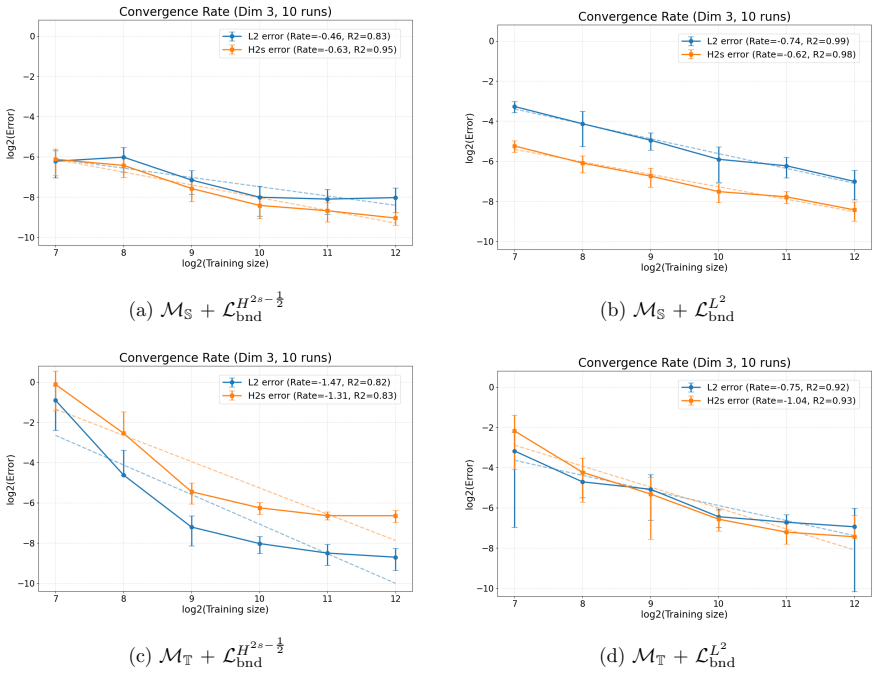
This paper develops convolutional neural network (CNN) methods for simultaneous approximation and elliptic boundary value problems on compact Riemannian manifolds. We establish simultaneous Sobolev approximation results for single- and multichannel CNNs, showing that manifold functions and their derivatives can be approximated with rates governed by the intrinsic dimension and the smoothness gap, rather than by the ambient dimension, thereby mitigating the curse of dimensionality. Building on this approximation theory, we propose a physics-informed CNN (PICNN) framework specially designed for boundary value problems. The main numerical issue is a boundary-norm mismatch: standard PINNs usually impose boundary data through low-order, often L2-type, penalties, whereas elliptic stability requires Sobolev trace control. We address this by introducing a spectral boundary loss based on the boundary Laplace-Beltrami operator, which represents trace errors as weighted frequency energies and relates truncation error to boundary eigenvalue decay. This avoids smooth auxiliary constructions required by exact boundary enforcement and singular double integrals arising in Sobolev-Slobodeckij penalties, while enabling implementations based on Fast Fourier Transforms (FFTs) or precomputed spectral bases on structured boundaries. Numerical experiments demonstrate improved accuracy, convergence, and stability over standard PINNs.
Editorial analysis
A structured set of objections, weighed in public.
Referee Report
Summary. The manuscript develops simultaneous Sobolev approximation results for single- and multichannel CNNs on compact Riemannian manifolds, showing that manifold functions and their derivatives can be approximated with rates governed by the intrinsic dimension and the smoothness gap rather than the ambient dimension. Building on this, it proposes a physics-informed CNN (PICNN) framework for elliptic boundary value problems that introduces a spectral boundary loss based on the boundary Laplace-Beltrami operator to enforce trace control and avoid issues with standard L2 penalties or Sobolev-Slobodeckij terms.
Significance. If the approximation rates hold as stated, the work would advance manifold learning and physics-informed neural networks by mitigating the curse of dimensionality in high-codimension embeddings and providing a stable, FFT-friendly boundary enforcement method that improves convergence over standard PINNs. The combination of theory and numerics on structured boundaries adds practical utility for PDEs on manifolds.
major comments (2)
- [Simultaneous Sobolev approximation results] The transfer of Euclidean CNN Sobolev rates to the manifold setting (via charts, exponential maps, or pullbacks) is load-bearing for the central claim that rates depend only on intrinsic dimension. Explicit bounds are needed on manifold-specific contributions such as metric distortion, Christoffel symbols in derivative approximations, and partition-of-unity overlap errors to confirm they are absorbed into the stated rates without introducing ambient-dimension or curvature-dependent factors that would dominate.
- [PICNN framework and spectral boundary loss] The spectral boundary loss is claimed to relate truncation error to boundary eigenvalue decay and to provide Sobolev trace control. A precise stability estimate or comparison theorem showing that this loss yields the required elliptic regularity without auxiliary smooth extensions would be necessary to support the improved accuracy and stability reported in the numerical experiments.
minor comments (2)
- [CNN architecture adaptation] Clarify the precise definition of multichannel CNNs in the approximation theorems and how the multichannel structure interacts with the manifold tangent bundle.
- [Numerical experiments] In the numerical section, report both intrinsic and embedding dimensions for each manifold example to allow direct assessment of the claimed dimension-independent rates.
Simulated Author's Rebuttal
We thank the referee for the careful reading and constructive comments. We address the two major points below by clarifying the proof structure and committing to added estimates and lemmas in the revision.
read point-by-point responses
-
Referee: [Simultaneous Sobolev approximation results] The transfer of Euclidean CNN Sobolev rates to the manifold setting (via charts, exponential maps, or pullbacks) is load-bearing for the central claim that rates depend only on intrinsic dimension. Explicit bounds are needed on manifold-specific contributions such as metric distortion, Christoffel symbols in derivative approximations, and partition-of-unity overlap errors to confirm they are absorbed into the stated rates without introducing ambient-dimension or curvature-dependent factors that would dominate.
Authors: We agree that explicit control of these terms strengthens the presentation. The proof localizes via a finite smooth atlas, applies the Euclidean CNN result in each chart (with rates depending only on intrinsic dimension), and controls transition errors by the C^infty regularity of the charts and metric. Metric distortion and Christoffel symbols are bounded by constants depending solely on intrinsic invariants (injectivity radius, sectional curvature bounds, atlas overlap multiplicity) and are absorbed into the overall constant prefactor; they introduce no ambient-dimension dependence. We will add a new lemma (Lemma 3.4) that states these bounds explicitly in terms of manifold geometry only. revision: yes
-
Referee: [PICNN framework and spectral boundary loss] The spectral boundary loss is claimed to relate truncation error to boundary eigenvalue decay and to provide Sobolev trace control. A precise stability estimate or comparison theorem showing that this loss yields the required elliptic regularity without auxiliary smooth extensions would be necessary to support the improved accuracy and stability reported in the numerical experiments.
Authors: The spectral loss is defined via the eigen-expansion of the boundary Laplace-Beltrami operator and is equivalent (up to constants) to the H^{1/2} trace norm by the spectral theorem; truncation after M modes is controlled by the eigenvalue decay rate. This directly supplies the Sobolev trace control needed for elliptic regularity without requiring smooth extensions or singular integrals. We will add an appendix proposition establishing the norm equivalence and a remark explaining how the combined loss (interior residual plus spectral boundary term) inherits the required stability. A complete a-priori optimizer error bound is beyond the present scope but is not needed for the stated claims. revision: yes
Circularity Check
No significant circularity; derivation is self-contained against external benchmarks
full rationale
The paper's central claims rest on establishing new simultaneous Sobolev approximation rates for CNNs on manifolds (governed by intrinsic dimension) and introducing a spectral boundary loss via the Laplace-Beltrami operator. No load-bearing step reduces by construction to a fitted parameter renamed as prediction, a self-citation chain, or an ansatz smuggled from prior work by the same authors. The approximation results are presented as extensions of Euclidean CNN theory with manifold adaptation, and the spectral loss is constructed explicitly to address boundary-norm mismatch without re-expressing existing quantities. The derivation chain is independent of the target results and externally falsifiable via numerical experiments on BVP accuracy.
Axiom & Free-Parameter Ledger
axioms (2)
- standard math Compact Riemannian manifolds admit well-defined Sobolev spaces and trace operators with standard embedding and stability properties.
- domain assumption Convolutional neural networks can be defined or pulled back onto the manifold while preserving their approximation capabilities from the ambient Euclidean setting.
Lean theorems connected to this paper
-
Foundation/AlexanderDuality.lean (D=3 forcing)alexander_duality_circle_linking unclear?
unclearRelation between the paper passage and the cited Recognition theorem.
We establish simultaneous Sobolev approximation results for single- and multichannel CNNs, showing that manifold functions and their derivatives can be approximated with rates governed by the intrinsic dimension and the smoothness gap, rather than by the ambient dimension
-
Cost.FunctionalEquation / Foundation.AlphaCoordinateFixation (J-cost uniqueness)washburn_uniqueness_aczel unclear?
unclearRelation between the paper passage and the cited Recognition theorem.
The CNN architectures (single-channel expanding-width and fixed-width multichannel) with ReLU/ReQU activations and complexity N ≲ ε^{-d/(k-s)}
What do these tags mean?
- matches
- The paper's claim is directly supported by a theorem in the formal canon.
- supports
- The theorem supports part of the paper's argument, but the paper may add assumptions or extra steps.
- extends
- The paper goes beyond the formal theorem; the theorem is a base layer rather than the whole result.
- uses
- The paper appears to rely on the theorem as machinery.
- contradicts
- The paper's claim conflicts with a theorem or certificate in the canon.
- unclear
- Pith found a possible connection, but the passage is too broad, indirect, or ambiguous to say the theorem truly supports the claim.
Reference graph
Works this paper leans on
-
[1]
Iskander Azangulov, George Deligiannidis, and Judith Rousseau. Convergence of diffusion models under the manifold hypothesis in high-dimensions.arXiv preprint arXiv:2409.18804, 2024
-
[2]
Yoshua Bengio, Aaron Courville, and Pascal Vincent. Representation learning: A review and new perspectives.IEEE transactions on pattern analysis and machine intelligence, 35(8):1798–1828, 2013
work page 2013
-
[3]
Stefano Berrone, Claudio Canuto, Moreno Pintore, and Natarajan Sukumar. Enforc- ing dirichlet boundary conditions in physics-informed neural networks and variational physics-informed neural networks.Heliyon, 9(8), 2023
work page 2023
-
[4]
Andrea Bonito, Ronald DeVore, Guergana Petrova, and Jonathan W Siegel. Convergence and error control of consistent PINNs for elliptic PDEs.IMA journal of numerical analysis, 46(1):90–148, 2026
work page 2026
-
[5]
Ernesto De Vito, Nicole M¨ ucke, and Lorenzo Rosasco. Reproducing kernel Hilbert spaces on manifolds: Sobolev and diffusion spaces.Analysis and Applications, 19(03):363–396, 2021
work page 2021
-
[6]
Nonlinear approximation.Acta Numerica, 7:51–150, 1998
Ronald A DeVore. Nonlinear approximation.Acta Numerica, 7:51–150, 1998
work page 1998
-
[7]
Zhiying Fang, Han Feng, Shuo Huang, and Ding-Xuan Zhou. Theory of deep convolu- tional neural networks II: Spherical analysis.Neural Networks, 131:154–162, 2020
work page 2020
-
[8]
Edward Fuselier and Grady B Wright. Scattered data interpolation on embedded sub- manifolds with restricted positive definite kernels: Sobolev error estimates.SIAM Journal on Numerical Analysis, 50(3):1753–1776, 2012
work page 2012
-
[9]
Evarist M. Gin´ e. The addition formula for the eigenfunctions of the Laplacian.Advances in Mathematics, 18(1):102–107, 1975
work page 1975
-
[10]
Gaussian Error Linear Units (GELUs)
D Hendrycks. Gaussian error linear units (GELUs).arXiv preprint arXiv:1606.08415, 2016
work page Pith review arXiv 2016
-
[11]
Trace regularity PINNs: EnforcingH 1/2(∂Ω) for bound- ary data.arXiv preprint arXiv:2510.16817, 2025
Doyoon Kim and Junbin Song. Trace regularity PINNs: EnforcingH 1/2(∂Ω) for bound- ary data.arXiv preprint arXiv:2510.16817, 2025
-
[12]
Alex Krizhevsky, Ilya Sutskever, and Geoffrey E Hinton. Imagenet classification with deep convolutional neural networks.Advances in neural information processing systems, 25, 2012
work page 2012
-
[13]
Guanhang Lei, Zhen Lei, Lei Shi, Chenyu Zeng, and Ding-Xuan Zhou. Solving PDEs on spheres with physics-informed convolutional neural networks.Applied and Computational Harmonic Analysis, 74:101714, 2025
work page 2025
-
[14]
St´ ephane Mallat. Understanding deep convolutional networks.Philosophical Trans- actions of the Royal Society A: Mathematical, Physical and Engineering Sciences, 374 (2065):20150203, 2016
work page 2065
-
[15]
Shiv Mishra and Arbaz Khan. Consistent PINNs for higher-order elliptic PDEs.Inter- national Journal for Numerical Methods in Engineering, 127(7):e70320, 2026. 23
work page 2026
-
[16]
Francis Narcowich, Stephen Rowe, and Joseph Ward. A novel Galerkin method for solving PDEs on the sphere using highly localized kernel bases.Mathematics of Computation, 86(303):197–231, 2017
work page 2017
-
[17]
Diffusion models are minimax opti- mal distribution estimators
Kazusato Oko, Shunta Akiyama, and Taiji Suzuki. Diffusion models are minimax opti- mal distribution estimators. InICLR 2023 Workshop on Mathematical and Empirical Understanding of Foundation Models, 2023
work page 2023
-
[18]
Springer Science & Business Media, 2012
Allan Pinkus.N-widths in Approximation Theory, volume 7. Springer Science & Business Media, 2012
work page 2012
-
[19]
Jonathan W Siegel. Sharp lower bounds on the manifold widths of Sobolev and Besov spaces.Journal of Complexity, 85:101884, 2024
work page 2024
-
[20]
Natarajan Sukumar and Ankit Srivastava. Exact imposition of boundary conditions with distance functions in physics-informed deep neural networks.Computer Methods in Applied Mechanics and Engineering, 389:114333, 2022
work page 2022
-
[21]
Two-point homogeneous spaces.Annals of Mathematics, 55(1): 177–191, 1952
Hsien-Chung Wang. Two-point homogeneous spaces.Annals of Mathematics, 55(1): 177–191, 1952
work page 1952
-
[22]
Cambridge University Press, 2004
Holger Wendland.Scattered Data Approximation, volume 17. Cambridge University Press, 2004
work page 2004
-
[23]
Yunfei Yang, Han Feng, and Ding-Xuan Zhou. On the rates of convergence for learning with convolutional neural networks.SIAM Journal on Mathematics of Data Science, 7 (4):1755–1772, 2025
work page 2025
-
[24]
Ding-Xuan Zhou. Deep distributed convolutional neural networks: Universality.Analysis and Applications, 16(06):895–919, 2018
work page 2018
-
[25]
Theory of deep convolutional neural networks: Downsampling.Neural Networks, 124:319–327, 2020
Ding-Xuan Zhou. Theory of deep convolutional neural networks: Downsampling.Neural Networks, 124:319–327, 2020
work page 2020
-
[26]
Ding-Xuan Zhou. Universality of deep convolutional neural networks.Applied and Com- putational Harmonic Analysis, 48(2):787–794, 2020
work page 2020
-
[27]
Hanfei Zhou and Lei Shi. Expressive power of deep networks on manifolds: Simultaneous approximation.arXiv preprint arXiv:2509.09362, 2025
-
[28]
Qixuan Zhou, Chuqi Chen, Tao Luo, and Yang Xiang. SSBE-PINN: A sobolev boundary scheme boosting stability and accuracy in elliptic/parabolic PDE learning.arXiv preprint arXiv:2508.10322, 2025. 24
discussion (0)
Sign in with ORCID, Apple, or X to comment. Anyone can read and Pith papers without signing in.