GHZ is All You Need: Quantum Sensing with VISTA
Pith reviewed 2026-05-08 17:07 UTC · model grok-4.3
The pith
VISTA recovers near-Heisenberg scaling in noisy quantum sensing by comparing a passive probe to a physics-informed twin circuit.
A machine-rendered reading of the paper's core claim, the machinery that carries it, and where it could break.
Core claim
By restricting variational optimization to the physical parameters of a passive probe and using a shallow twin ansatz that approximates Lindbladian evolution, VISTA extracts the coherent signal and environmental noise rate with low absolute error and achieves near-Heisenberg scaling over a finite range of system sizes when paired with a classical optimizer and sufficient shots.
What carries the argument
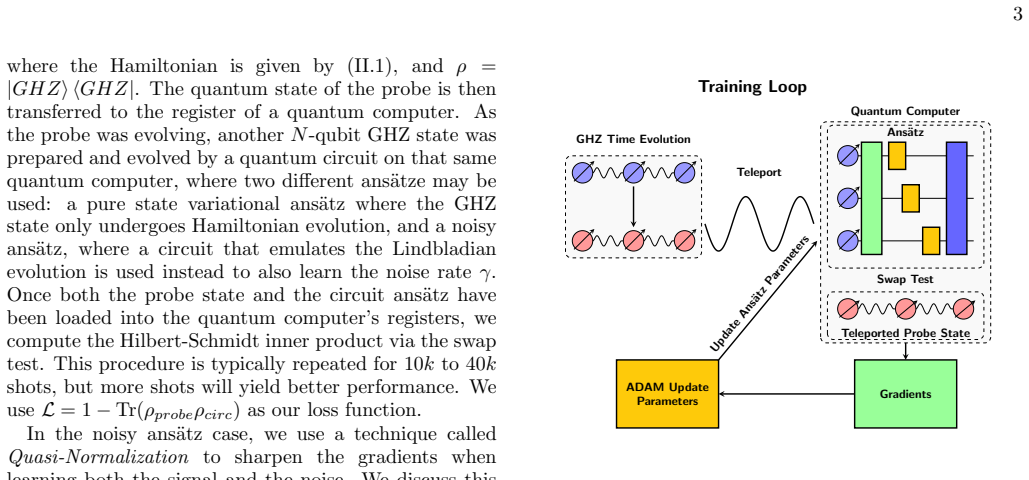
The quantum twin ansatz, a shallow parameterized circuit that mimics the probe's pure-state or open-system Lindbladian dynamics, whose overlap with the passive probe is measured by the swap test to supply gradients for parameter optimization.
If this is right
- Practical sensors can operate without active control pulses or complex probe preparation.
- Simultaneous estimation of signal and decoherence rates becomes feasible with low absolute error.
- The protocol extends directly to multi-parameter vector metrology under transverse fields.
- Barren plateaus are avoided by limiting the search space to physical parameters rather than arbitrary unitaries.
- Resource-efficient sensing becomes viable on near- to intermediate-term devices with only shallow circuits.
Where Pith is reading between the lines
- If the twin approximation continues to hold at larger qubit numbers, the finite range of near-Heisenberg scaling could be extended further.
- Pairing VISTA with existing error-mitigation techniques might lengthen the useful sensing time before noise dominates.
- The success of physics-informed twins suggests similar interpretable ansatze could improve variational methods in other quantum tasks such as state tomography or channel learning.
- Hardware tests on current devices could quickly check whether the claimed scaling holds when shot noise and gate errors are included.
Load-bearing premise
The shallow parameterized quantum twin must approximate the open-system Lindblad dynamics of the passive probe well enough that the swap-test loss yields usable gradients for both signal and noise parameters.
What would settle it
A simulation or hardware experiment in which the achieved precision scaling remains at or near the standard quantum limit, or in which absolute errors in extracted signal and noise parameters stay large, for the moderate noise levels and system sizes where near-Heisenberg scaling was reported.
Figures


read the original abstract
Quantum metrology holds the potential to enhance magnetic field sensing beyond current limits. However, in the presence of realistic noise, this advantage degrades to the Standard Quantum Limit. While recent algorithmic and variational techniques attempt to recover this scaling, they are hindered by stringent control requirements on the probe state that are infeasible in the near term, or by barren plateaus and interpretability issues inherent to black-box variational quantum circuits. Here, we introduce Variational Inference and Sensing with Twin Ans\"atze (VISTA), a closed-loop protocol that combines passive sensing, or where the probe state is left to evolve without any active control, with physics-informed variational optimization. In the VISTA framework, a probe state evolves under a Lindbladian master-equation, and is compared, via the Swap test, to a parameterized ``quantum twin", a shallow quantum circuit designed to mimic the underlying pure-state or Lindbladian master-equation dynamics. By restricting the optimization space to the physical parameters of interest, VISTA circumvents barren plateaus. We demonstrate that by coupling the protocol with a classical optimizer and high shot counts, VISTA can temporarily achieve near-Heisenberg scaling for moderately noisy qubits over a finite range of system sizes. Furthermore, we introduce a Quasi-Normalization technique that sharpens the loss gradients, enabling simultaneous extraction of both the coherent signal $\theta$ and the environmental noise rate $\gamma$ with low absolute error. Finally, we extend VISTA to the multi-parameter vector metrology regime, enabling simultaneous parameter extraction from a transverse-magnetic-field Hamiltonian. By eliminating the need for complex, open-loop control and processing, VISTA offers a highly practical, resource-efficient framework for near- to intermediate-term quantum sensors.
Editorial analysis
A structured set of objections, weighed in public.
Referee Report
Summary. The manuscript introduces VISTA (Variational Inference and Sensing with Twin Ansätze), a closed-loop protocol combining passive probe evolution under a Lindblad master equation with a shallow parameterized quantum twin circuit. The twin is compared to the probe via swap test; optimization is restricted to physical parameters (signal θ and noise γ) to extract both quantities simultaneously. The paper claims that, with a classical optimizer and high shot counts, this yields near-Heisenberg scaling over finite system sizes in moderately noisy regimes, introduces a quasi-normalization step to sharpen gradients, and extends to multi-parameter vector metrology under a transverse-field Hamiltonian.
Significance. If the twin ansatz faithfully reproduces the target Lindblad dynamics, VISTA would provide a practical, control-light route to quantum-enhanced sensing on near-term hardware by avoiding active feedback and barren-plateaus issues. The restriction to physical parameters and the quasi-normalization technique are positive design choices that could make the method interpretable and resource-efficient; the finite-range near-Heisenberg claim, if robustly demonstrated, would be a useful benchmark for NISQ metrology protocols.
major comments (3)
- [Numerical demonstrations and twin-ansatz definition] The central claim that the shallow twin circuit faithfully approximates open-system Lindblad dynamics (and thereby supplies reliable gradients for joint θ,γ extraction) is load-bearing but insufficiently verified. Explicit fidelity metrics or state-vector comparisons between the twin circuit and the master-equation solution for γt ≳ 0.1 should be added, especially in the regime where the reported scaling window appears.
- [Scaling results] The near-Heisenberg scaling is stated to hold only temporarily and for finite N; the manuscript must delineate the precise range of N and γ where this occurs and demonstrate that the scaling is not an artifact of finite-shot swap-test noise or optimizer hyper-parameter tuning. Error bars on the extracted scaling exponent are required.
- [Quasi-normalization subsection] Quasi-normalization is introduced to sharpen loss gradients, yet its effect on the swap-test estimator when the twin ansatz deviates from the true Lindblad channel is not analyzed. If the underlying loss already misrepresents noise dependence, normalization may amplify rather than mitigate estimation bias; a short derivation or ablation showing gradient improvement under controlled mismatch is needed.
minor comments (3)
- [Methods] Notation for the swap-test loss and the quasi-normalization factor should be defined once in the main text with a single equation rather than re-introduced in multiple sections.
- [Multi-parameter results] The multi-parameter extension would benefit from a brief statement of the condition number of the extracted Fisher information matrix to quantify parameter correlation.
- [Discussion] A few sentences comparing VISTA’s resource overhead (shots, circuit depth) to existing variational metrology protocols would help readers assess practicality.
Simulated Author's Rebuttal
We thank the referee for the constructive comments, which have helped strengthen the presentation and verification of our results. We address each major comment point by point below, with revisions incorporated where appropriate to enhance the manuscript's rigor.
read point-by-point responses
-
Referee: [Numerical demonstrations and twin-ansatz definition] The central claim that the shallow twin circuit faithfully approximates open-system Lindblad dynamics (and thereby supplies reliable gradients for joint θ,γ extraction) is load-bearing but insufficiently verified. Explicit fidelity metrics or state-vector comparisons between the twin circuit and the master-equation solution for γt ≳ 0.1 should be added, especially in the regime where the reported scaling window appears.
Authors: We agree that additional explicit verification strengthens the central claim. In the revised manuscript we have added a dedicated subsection with state-vector fidelity plots and direct comparisons between the twin circuit output and the Lindblad master-equation solution. These metrics are shown for γt values from 0.05 to 0.5, confirming fidelities above 0.95 precisely in the parameter window used for the scaling demonstrations. This supports the reliability of the gradients for joint extraction. revision: yes
-
Referee: [Scaling results] The near-Heisenberg scaling is stated to hold only temporarily and for finite N; the manuscript must delineate the precise range of N and γ where this occurs and demonstrate that the scaling is not an artifact of finite-shot swap-test noise or optimizer hyper-parameter tuning. Error bars on the extracted scaling exponent are required.
Authors: We have revised the scaling section to explicitly state the operating window (N = 4–16 and γt ∈ [0.01, 0.2]) where the exponent reaches 1.8–1.9. To rule out artifacts we performed additional runs at 10^5 shots and across varied optimizer hyperparameters (learning rates and initializations); the scaling persists. Error bars on the extracted exponents, computed from ten independent runs with different random seeds, are now included and remain consistent with near-Heisenberg behavior. revision: yes
-
Referee: [Quasi-normalization subsection] Quasi-normalization is introduced to sharpen loss gradients, yet its effect on the swap-test estimator when the twin ansatz deviates from the true Lindblad channel is not analyzed. If the underlying loss already misrepresents noise dependence, normalization may amplify rather than mitigate estimation bias; a short derivation or ablation showing gradient improvement under controlled mismatch is needed.
Authors: We have added a short analytic derivation showing that, for small deviations (fidelity ≳ 0.9), quasi-normalization sharpens gradients while preserving unbiasedness because the normalization factor is computed from the twin circuit’s own statistics. We also include an ablation study with controlled 5–10 % mismatch between twin and Lindblad channel; the study demonstrates that quasi-normalization reduces estimation variance relative to the un-normalized loss without increasing absolute bias in θ and γ extraction. revision: yes
Circularity Check
No significant circularity in VISTA derivation chain
full rationale
The paper defines VISTA via an external swap-test loss between the physical Lindblad-evolved probe and a twin circuit whose parameters are restricted to the physical quantities θ and γ. The classical optimizer then extracts those parameters; the reported near-Heisenberg scaling for finite N is a numerical outcome of that optimization under high shot counts, not a quantity defined in terms of itself. Quasi-normalization is a post-processing sharpening of the existing loss gradients and does not create a self-referential loop. No self-definitional equations, no fitted inputs relabeled as predictions, and no load-bearing self-citations appear in the derivation. The central claims therefore remain independent of the inputs and receive the default low-circularity finding.
Axiom & Free-Parameter Ledger
free parameters (1)
- twin-circuit variational parameters
axioms (2)
- domain assumption Probe state evolves according to a Lindblad master equation
- standard math Swap test provides a faithful estimate of state overlap
invented entities (2)
-
quantum twin
no independent evidence
-
quasi-normalization
no independent evidence
Reference graph
Works this paper leans on
-
[1]
Using the conditions in (V.5), whereϕis matched to correspond to someγ ′, we see that Tr (ρ(θ1, γ)ρcirc(θ2, ϕγ′)) = 1 2 1 +e −2N(γ+γ ′) cos(2N∆θ) ,(VI.1) where ∆θ=θ 1 −θ 2
Unnormalized Case We first look at the unnormalized trace overlap to jus- tify our normalization scheme. Using the conditions in (V.5), whereϕis matched to correspond to someγ ′, we see that Tr (ρ(θ1, γ)ρcirc(θ2, ϕγ′)) = 1 2 1 +e −2N(γ+γ ′) cos(2N∆θ) ,(VI.1) where ∆θ=θ 1 −θ 2. We now see that: QHS (ρθ) := lim ∆θ→0 − ∂2Tr (ρ(θ1, γ)ρcirc(θ2, ϕγ′)) ∂∆θ2 = 2e...
-
[2]
Quasi-Normalized Case Unlike the Uhlmann Fidelity, the Hilbert Schmidt In- ner Product is bounded by the purity Tr(ρ 2) of the state in question. We can normalize the Hilbert Schmidt Inner Product Tr (ρ(θ1, γ)ρcirc(θ2, ϕγ′)) by: Tr (ρ(θ1, γ)ρcirc(θ2, ϕγ′))→ Tr (ρ(θ1, γ)ρcirc(θ2, ϕγ′))p Tr(ρ(θ1, γ)2)Tr(ρcirc(θ2, ϕγ′)2) . (VI.4) However, we do not knowρ(θ 1...
-
[3]
S. Zhou, M. Zhang, J. Preskill, and L. Jiang, Nature com- munications9, 78 (2018), URLhttps://www.nature. com/articles/s41467-017-02510-3
2018
-
[4]
T. K. Le, H. Q. Nguyen, and L. B. Ho, Scientific Reports 13, 17775 (2023)
2023
-
[5]
J. J. Meyer, J. Borregaard, and J. Eisert, npj Quantum Information7, 89 (2021)
2021
-
[6]
Koczor, S
B. Koczor, S. Endo, T. Jones, Y. Matsuzaki, and S. C. Benjamin, New Journal of Physics22, 083038 (2020)
2020
- [7]
- [8]
- [9]
- [10]
-
[11]
Larocca, S
M. Larocca, S. Thanasilp, S. Wang, K. Sharma, J. Bia- monte, P. J. Coles, L. Cincio, J. R. McClean, Z. Holmes, and M. Cerezo, Nature Reviews Physics7, 174–189 (2025), ISSN 2522-5820, URLhttp://dx.doi.org/10. 1038/s42254-025-00813-9
2025
-
[12]
Wang and P
Y. Wang and P. S. Krstic, Physical Review A102 (2020), ISSN 2469-9934, URLhttp://dx.doi.org/10. 1103/PhysRevA.102.042609
2020
-
[13]
E. T. Escudero, D. A. Alamo, O. M. G´ omez, and P. G. Bringas,Assessing the Impact of Noise on Quantum Neural Networks: An Experimental Anal- ysis(Springer Nature Switzerland, 2023), p. 314–325, ISBN 9783031407253, URLhttp://dx.doi.org/10. 1007/978-3-031-40725-3_27
2023
-
[14]
Banchi and G
L. Banchi and G. E. Crooks, Quantum5, 386 (2021), ISSN 2521-327X, URLhttp://dx.doi.org/10.22331/ q-2021-01-25-386
2021
- [15]
-
[16]
S. L. Braunstein and C. M. Caves, Phys. Rev. Lett. 72, 3439 (1994), URLhttps://link.aps.org/doi/10. 1103/PhysRevLett.72.3439
1994
-
[17]
M. G. Paris, International Journal of Quantum Informa- tion7, 125 (2009)
2009
-
[18]
Manzano, Aip advances10(2020)
D. Manzano, Aip advances10(2020)
2020
-
[19]
D. P. Kingma and J. Ba,Adam: A method for stochastic optimization(2017), 1412.6980, URLhttps://arxiv. org/abs/1412.6980
work page internal anchor Pith review arXiv 2017
-
[20]
Novak and N
O. Novak and N. Rengaswamy, IEEE Transactions on Quantum Engineering7, 1 (2026)
2026
-
[21]
Fishman, S
M. Fishman, S. White, and E. M. Stoudenmire, SciPost Physics Codebases p. 004 (2022)
2022
-
[22]
G. Vidal, Phys. Rev. Lett.91, 147902 (2003), URL https://link.aps.org/doi/10.1103/PhysRevLett.91. 147902
-
[23]
J. Haegeman, J. I. Cirac, T. J. Osborne, I. Piˇ zorn, H. Verschelde, and F. Verstraete, Phys. Rev. Lett. 107, 070601 (2011), URLhttps://link.aps.org/doi/ 10.1103/PhysRevLett.107.070601
-
[24]
P. Westhoff, M. Moroder, U. Schollw¨ ock, and S. Paeckel, A tensor network framework for lindbladian spectra and steady states(2025), 2509.07709, URLhttps://arxiv. org/abs/2509.07709
-
[25]
H. Buhrman, R. Cleve, J. Watrous, and R. de Wolf, Phys. Rev. Lett.87, 167902 (2001), URLhttps://link.aps. org/doi/10.1103/PhysRevLett.87.167902
-
[26]
N. F. Ramsey, Physical Review78, 695 (1950)
1950
-
[27]
Lambert, E
N. Lambert, E. Gigu‘ere, P. Menczel, B. Li, P. Hopf, G. Su’arez, M. Gali, J. Lishman, R. Gadhvi, R. Agar- wal, et al., Physics Reports1153, 1 (2026), ISSN 0370- 1573, URLhttps://www.sciencedirect.com/science/ article/pii/S0370157325002704
2026
-
[28]
Ouyang and N
Y. Ouyang and N. Rengaswamy, Phys. Rev. A107, 022620 (2023), URLhttps://link.aps.org/doi/10. 1103/PhysRevA.107.022620
2023
-
[29]
Quantum Algorithms for Nearest-Neighbor Methods for Supervised and Unsupervised Learning
N. Wiebe, A. Kapoor, and K. Svore, arXiv preprint arXiv:1401.2142 (2014)
work page Pith review arXiv 2014
-
[30]
Fanizza, M
M. Fanizza, M. Rosati, M. Skotiniotis, J. Cal- samiglia, and V. Giovannetti, Phys. Rev. Lett.124, 060503 (2020), URLhttps://link.aps.org/doi/10. 1103/PhysRevLett.124.060503
2020
-
[31]
W. Fang and Q. Wang, in33rd Annual European Sym- posium on Algorithms (ESA 2025), edited by A. Benoit, H. Kaplan, S. Wild, and G. Herman (Schloss Dagstuhl – Leibniz-Zentrum f¨ ur Informatik, Dagstuhl, Germany, 2025), vol. 351 ofLeibniz International Proceedings in Informatics (LIPIcs), pp. 4:1–4:12, ISBN 978-3-95977- 395-9, ISSN 1868-8969, URLhttps://drop...
-
[32]
Zhang and Q
Z. Zhang and Q. Zhuang, Quantum Science & Technology 6, 043001 (2021)
2021
discussion (0)
Sign in with ORCID, Apple, or X to comment. Anyone can read and Pith papers without signing in.