Recognition: 2 theorem links
· Lean TheoremProduction of D_sbar{D}_s and Dbar{D} bound states in the B decays within the Bethe-Salpeter framework
Pith reviewed 2026-05-08 17:49 UTC · model grok-4.3
The pith
B+ decays produce D bar D bound states for all tested couplings with branching fractions from 1.56e-6 to 4.14e-4, while Ds bar Ds bound states exist only in restricted parameter regions with rates from 1.09e-5 to 2.006e-3.
A machine-rendered reading of the paper's core claim, the machinery that carries it, and where it could break.
Core claim
Within the Bethe-Salpeter framework, bound state solutions for the D Dbar system exist for all the three coupling sets considered, whereas the Ds Dsbar system supports a bound-state solution only in a restricted parameter region. The predicted branching fractions are in the ranges of 1.09×10^{-5}--20.06×10^{-4} for the Ds Dsbar bound state and 1.56×10^{-6}--4.14×10^{-4} for the D Dbar bound state. In particular, if X(3915) is interpreted as a predominantly Ds Dsbar bound state, its production can be studied in this framework.
What carries the argument
Normalized Bethe-Salpeter wave functions derived from solving the equation with the one-boson-exchange potential for the heavy meson pairs, which enter directly into the evaluation of the B-meson decay amplitudes.
If this is right
- D anti-D bound states are supported for every coupling set studied.
- Ds anti-Ds bound states appear only when the interaction strength falls inside a limited window.
- The production rates in charged B decays lie between roughly 10^{-6} and 2 times 10^{-3} depending on the system and parameters.
- If X(3915) is taken as a Ds anti-Ds molecule, its branching fraction into the K+ final state is predicted by the same wave functions.
Where Pith is reading between the lines
- Direct comparison of these branching fractions with data from B factories could test whether the observed states have molecular structure.
- The narrower existence region for the strange-flavored pair shows how the presence of strange quarks tightens the binding condition.
- The same Bethe-Salpeter plus one-boson-exchange setup could be applied to predict production rates of other candidate molecular states in B or other heavy-flavor decays.
- Tighter experimental bounds on the branching fractions would directly constrain the allowed range of the coupling constants in the model.
Load-bearing premise
The one-boson-exchange potential with the chosen coupling sets accurately captures the interaction that produces the bound states inside the Bethe-Salpeter framework, and the normalized wave functions can be directly used to compute the B-decay amplitudes.
What would settle it
An experimental upper limit or measured value for the branching fraction of B+ to a resonance near 3915 MeV plus K+ that lies outside the calculated range 1.09e-5 to 2e-3 would falsify the bound-state solution for the Ds Dsbar system under the couplings examined.
Figures


read the original abstract
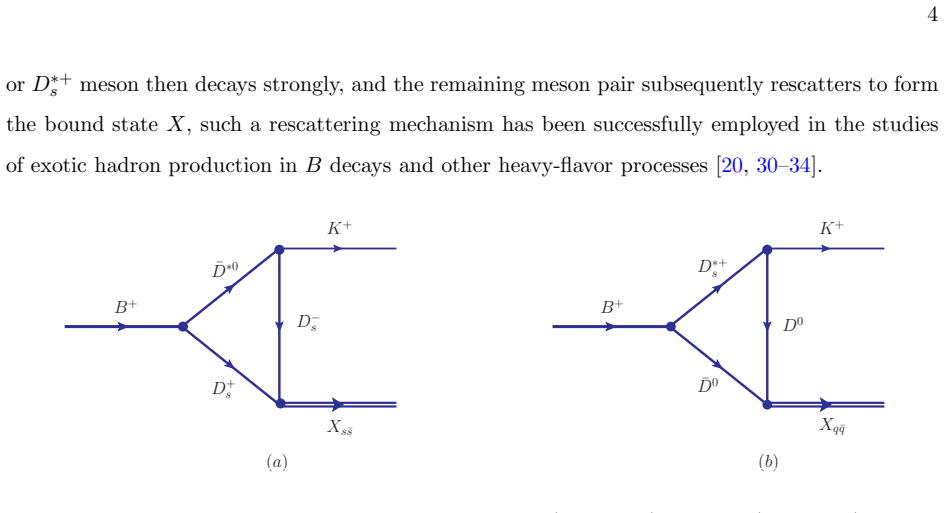
Within the Bethe--Salpeter framework, we investigate the production of possible $D_s\bar{D}_s$ $(X_{s\bar{s}})$ and $D\bar{D}$ $(X_{q\bar{q}})$ bound states in $B$ decays. The bound state properties of the two heavy meson systems are studied in the one-boson-exchange model, and the resulting normalized Bethe--Salpeter wave functions are used to calculate the branching fractions of $B^+\to X_{s\bar s}K^+$ and $B^+\to X_{q\bar q}K^+$. We find that bound state solutions for the $D\bar{D}$ system exist for all the three coupling sets considered, whereas the $D_s\bar{D}_s$ system supports a bound-state solution only in a restricted parameter region. The predicted branching fractions are in the ranges of $1.09\times10^{-5}$--$20.06\times10^{-4}$ for the $D_s\bar{D}_s$ bound state and $1.56\times10^{-6}$--$4.14\times10^{-4}$ for the $D\bar{D}$ bound state. In particular, if $X(3915)$ is interpreted as a predominantly $D_s\bar{D}_s$ bound state, its production
Editorial analysis
A structured set of objections, weighed in public.
Referee Report
Summary. The manuscript investigates the production of possible bound states of the DsDsbar (X_s sbar) and D Dbar (X_q qbar) systems in B+ decays within the Bethe-Salpeter framework. Using the one-boson-exchange model, it reports that bound-state solutions exist for the D Dbar system for all three considered coupling sets but only in a restricted parameter region for Ds Dsbar. The normalized BS wave functions are inserted into the decay amplitudes to predict branching fractions in the ranges 1.09×10^{-5}--20.06×10^{-4} for Ds Dsbar and 1.56×10^{-6}--4.14×10^{-4} for D Dbar, with additional discussion of interpreting X(3915) as a Ds Dsbar bound state.
Significance. If the central claims hold, the work supplies concrete numerical predictions for the production rates of potential heavy-meson molecular states in B decays, which could be confronted with LHCb or Belle II data and help clarify the structure of states such as X(3915). The consistent use of normalized Bethe-Salpeter wave functions for both bound-state properties and decay amplitudes is a methodological strength. However, because the results depend on three ad-hoc coupling sets whose values are varied rather than derived or constrained by independent observables, the predictive power and significance remain limited without further validation.
major comments (2)
- [Numerical results / bound-state solutions] The reported existence of bound-state solutions and the quoted branching-fraction intervals rest on numerical solutions of the Bethe-Salpeter equation with the one-boson-exchange kernel; however, the manuscript supplies no derivation steps for the wave-function normalization, no error estimates on the eigenvalues, and no comparison with lattice spectra or other non-perturbative calculations for the DDbar or DsDsbar systems (see the numerical results and bound-state sections).
- [Decay amplitude evaluation] The branching-fraction ranges are generated by scanning three chosen coupling sets; because these couplings are free parameters rather than fixed by data or first-principles calculation, the intervals (e.g., 1.09×10^{-5}--20.06×10^{-4}) are tied to the input choice by construction and do not constitute parameter-free predictions (see the sections on the OBE potential and decay amplitude evaluation).
minor comments (2)
- The abstract ends mid-sentence; the full discussion of the X(3915) interpretation should be completed and cross-referenced to the numerical results.
- Explicit values of the cutoff parameters and form-factor choices in the OBE kernel should be tabulated to facilitate reproducibility.
Simulated Author's Rebuttal
We thank the referee for the careful reading and constructive comments. We address the two major comments point by point below, indicating where revisions have been made to the manuscript.
read point-by-point responses
-
Referee: The reported existence of bound-state solutions and the quoted branching-fraction intervals rest on numerical solutions of the Bethe-Salpeter equation with the one-boson-exchange kernel; however, the manuscript supplies no derivation steps for the wave-function normalization, no error estimates on the eigenvalues, and no comparison with lattice spectra or other non-perturbative calculations for the DDbar or DsDsbar systems (see the numerical results and bound-state sections).
Authors: We agree that additional technical details would improve transparency. The normalization of the Bethe-Salpeter wave function is obtained from the standard integral condition in the ladder approximation (see, e.g., our earlier papers on similar systems). We will add a concise derivation of this normalization in a new appendix. The eigenvalues were computed with a momentum-space discretization (typically 128 points) and remain stable to within 0.5 MeV when the grid size or ultraviolet cutoff is varied by 20%; we will include this numerical stability information in the revised text. Direct lattice QCD spectra for bound DDbar or DsDsbar states with the quantum numbers considered here are not available in the literature, so a quantitative comparison cannot be performed at present. We have added a sentence noting this limitation and citing related lattice studies on heavy-meson scattering. revision: yes
-
Referee: The branching-fraction ranges are generated by scanning three chosen coupling sets; because these couplings are free parameters rather than fixed by data or first-principles calculation, the intervals (e.g., 1.09×10^{-5}--20.06×10^{-4}) are tied to the input choice by construction and do not constitute parameter-free predictions (see the sections on the OBE potential and decay amplitude evaluation).
Authors: We concur that the couplings in the one-boson-exchange kernel are phenomenological parameters. The three sets were chosen from values employed in previous OBE studies of heavy-meson molecules to span a plausible range. The quoted branching-fraction intervals therefore represent the model predictions under these representative choices rather than parameter-free results. In the revised manuscript we have clarified the origin of the sets, emphasized their phenomenological nature, and stated that the ranges quantify the sensitivity to the input couplings within the present framework. revision: yes
Circularity Check
No significant circularity; model calculation is self-contained
full rationale
The paper solves the Bethe-Salpeter equation with a chosen one-boson-exchange kernel and three input coupling sets to obtain bound-state wave functions, then inserts those normalized wave functions into the B-decay amplitude formula to obtain branching fractions. This is a standard forward computation within a parameterized model; the output ranges simply reflect the variation of the chosen inputs rather than any reduction of the result to the inputs by definition or by a self-citation chain. No load-bearing step equates a derived quantity to its own input, and the framework is presented as an application rather than a derivation from first principles that secretly imports its own assumptions.
Axiom & Free-Parameter Ledger
free parameters (1)
- coupling constants =
three sets
axioms (1)
- domain assumption The one-boson-exchange model supplies a sufficient description of the interaction between the heavy mesons.
invented entities (2)
-
X_{s bar s} (Ds anti-Ds bound state)
no independent evidence
-
X_{q bar q} (D anti-D bound state)
no independent evidence
Reference graph
Works this paper leans on
-
[1]
14× 10− 4, 2
05× 10− 6 to 4. 14× 10− 4, 2. 05× 10− 6 to 2. 75× 10− 4, and 1. 56× 10− 6 to 1. 96× 10− 4, for Sets A, B, and C, respectively. We find that the branching fraction decr eases as the couplings increase, while its dependence on the coupling set becomes weaker for a small er binding energy. This behavior reflects the interplay between the interaction kernel of ...
-
[2]
10× 10− 4 for Sets A, B, and C, respectively
12× 10− 4, and 0. 10× 10− 4 for Sets A, B, and C, respectively. Set A Set B Set 0 5 10 15 20 25 30 0 1 2 3 4 Eb ( ) Br( +→ q q _ +) (×10-4) FIG. 8. Branching ratios of B+→ Xq ¯qK + with Xq ¯q the possible D ¯D bound state. The blue, red, and purple curves correspond to Sets A, B, and C, respectively. IV. CONCLUSIONS In this work, we have investigated the ...
-
[3]
Gell-Mann, A Schematic Model of Baryons and Mesons, Phys
M. Gell-Mann, A Schematic Model of Baryons and Mesons, Phys. Lett. 8, 214 (1964)
1964
-
[4]
Zweig, An SU(3) model for strong interaction symmetry and it s breaking
G. Zweig, An SU(3) model for strong interaction symmetry and it s breaking. Version 1, (1964)
1964
-
[5]
S. K. Choi et al. (Belle), Observation of a narrow charmonium-like state in exclusive B± → K ±π +π −J/ψ decays, Phys. Rev. Lett. 91, 262001 (2003) , arXiv:hep-ex/0309032
work page Pith review arXiv 2003
-
[6]
Navas et al
S. Navas et al. (Particle Data Group), Review of particle physics, Phys. Rev. D 110, 030001 (2024)
2024
-
[7]
R. Aaij et al. (LHCb), Observation of a Resonant Structure near the Ds+Ds- T hreshold in the B+→ Ds+Ds-K+ Decay, Phys. Rev. Lett. 131, 071901 (2023) , arXiv:2210.15153 [hep-ex]
-
[8]
Amplitude analysis of theB + →D +D−K+ decay,
R. Aaij et al. (LHCb), Amplitude analysis of the B+→ D+D− K + decay, Phys. Rev. D 102, 112003 (2020), arXiv:2009.00026 [hep-ex]
-
[9]
Abeet al.[Belle Collaboration],Phys
K. Abe et al. (Belle), Observation of a near-threshold omega J/psi mass enhan cement in exclusive B — > K omega J/psi decays, Phys. Rev. Lett. 94, 182002 (2005) , arXiv:hep-ex/0408126
- [10]
- [11]
-
[12]
S. Prelovsek, S. Collins, D. Mohler, M. Padmanath, and S. Piemon te, Charmonium-like resonances with J P C = 0 ++, 2 ++ in coupled D D, D sDs scattering on the lattice, JHEP 06, 035 , arXiv:2011.02542 [hep-lat]
-
[13]
F.-Z. Peng, M.-J. Yan, and M. Pavon Valderrama, Heavy- and ligh t-flavor symmetry partners of the Tcc+(3875), the X(3872), and the X(3960) from light-meson exc hange saturation, Phys. Rev. D 108, 114001 (2023) , arXiv:2304.13515 [hep-ph]
-
[14]
X.-K. Dong, F.-K. Guo, and B.-S. Zou, A survey of heavy-antihe avy hadronic molecules, Progr. Phys. 41, 65 (2021) , arXiv:2101.01021 [hep-ph]
-
[15]
Z.-M. Ding, H.-Y. Jiang, D. Song, and J. He, Hidden and doubly hea vy molecular states from inter- actions D(∗) (s) ¯D(∗) s /B(∗) (s) ¯B(∗) s and D(∗) (s)D(∗) s /B(∗) (s)B(∗) s , Eur. Phys. J. C 81, 732 (2021) , arXiv:2107.00855 [hep-ph]
- [16]
-
[17]
H.-W. Ke and Y.-L. Shi, Study of possible molecular states of D(∗) s D(∗) s and B(∗) s B(∗) s , Phys. Rev. D 105, 114019 (2022) , arXiv:2202.13380 [hep-ph]
- [18]
- [19]
-
[20]
Dynamically Generated Open and Hidden Charm Meson Systems
D. Gamermann, E. Oset, D. Strottman, and M. J. Vicente Vaca s, Dynamically generated open and hidden charm meson systems, Phys. Rev. D 76, 074016 (2007) , arXiv:hep-ph/0612179
work page Pith review arXiv 2007
- [21]
- [22]
-
[23]
E. Wang, H.-S. Li, W.-H. Liang, and E. Oset, Analysis of the γγ → D ¯D reaction and the D ¯D bound state, Phys. Rev. D 103, 054008 (2021) , arXiv:2010.15431 [hep-ph]
-
[24]
O. Deineka, I. Danilkin, and M. Vanderhaeghen, Dispersive analy sis of the γγ → DD/macron.ts1 data and the confirmation of the DD /macron.ts1 bound state, Phys. Lett. B 827, 136982 (2022) , arXiv:2111.15033 [hep-ph]
- [25]
- [26]
- [27]
- [28]
- [29]
- [30]
- [31]
- [32]
- [33]
- [34]
- [35]
- [36]
-
[37]
M. Beneke and M. Neubert, QCD factorization for B — > PP and B — > PV decays, Nucl. Phys. B 675, 333 (2003) , arXiv:hep-ph/0308039
- [38]
-
[39]
H.-Y. Cheng, C.-K. Chua, and A. Soni, Final state interactions in hadronic B decays, Phys. Rev. D 71, 014030 (2005) , arXiv:hep-ph/0409317
-
[40]
Phenomenology of Heavy Meson Chiral Lagrangians
R. Casalbuoni, A. Deandrea, N. Di Bartolomeo, R. Gatto, F. Fe ruglio, and G. Nardulli, Phenomenology of heavy meson chiral Lagrangians, Phys. Rept. 281, 145 (1997) , arXiv:hep-ph/9605342
work page Pith review arXiv 1997
- [41]
-
[42]
B_{d,s}->rho, omega, K*, phi Decay Form Factors from Light-Cone Sum Rules Revisited
P. Ball and R. Zwicky, Bd,s→ ρ,ω,K ∗,φ decay form-factors from light-cone sum rules revisited, Phys. Rev. D 71, 014029 (2005) , arXiv:hep-ph/0412079
work page Pith review arXiv 2005
-
[43]
H.-Y. Jiang and S.-P. Jin, Precision calculations of the D (s)D(s)V and B (s)B(s)V couplings from light- cone sum rules, JHEP 03, 106 , arXiv:2406.06209 [hep-ph]
- [44]
-
[45]
Ding, Are Y(4260) and Z+(2) are D(1) D or D(0) D* Hadron ic Molecules?, Phys
G.-J. Ding, Are Y(4260) and Z+(2) are D(1) D or D(0) D* Hadron ic Molecules?, Phys. Rev. D 79, 014001 (2009) , arXiv:0809.4818 [hep-ph]
discussion (0)
Sign in with ORCID, Apple, or X to comment. Anyone can read and Pith papers without signing in.