A Biased Nonnegative Block Term Tensor Decomposition Model for Dynamic QoS Prediction
Pith reviewed 2026-05-08 17:44 UTC · model grok-4.3
The pith
Biased nonnegative block term tensor decomposition predicts dynamic QoS more accurately than CP or Tucker methods.
A machine-rendered reading of the paper's core claim, the machinery that carries it, and where it could break.
Core claim
The Biased Nonnegative Block Term Tensor Decomposition model decomposes a three-way QoS tensor into multiple nonnegative block terms while adding explicit linear bias terms for users, services, and time; this structure, together with the SLF-NMUT update rule, produces more accurate forecasts of future QoS values than CP or Tucker decompositions on the same data.
What carries the argument
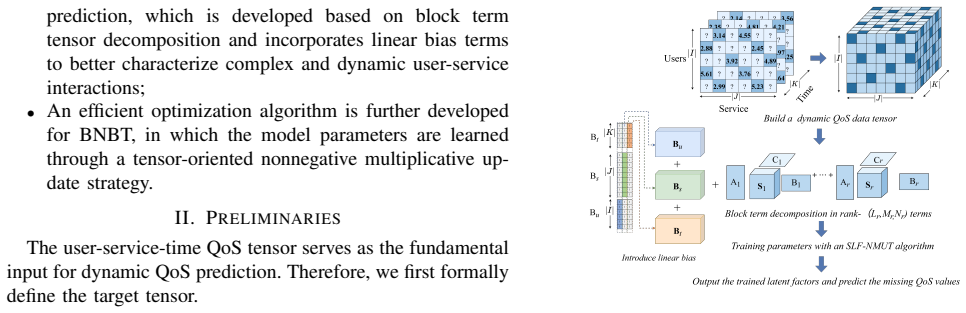
Biased Nonnegative Block Term Tensor Decomposition (BNBT), which represents the QoS tensor as a sum of low-rank nonnegative block terms augmented by additive bias vectors to model higher-order dynamic dependencies.
If this is right
- Service recommendation systems can select providers with higher reliability using the improved forecasts.
- The SLF-NMUT algorithm enables scalable parameter learning on large QoS tensors.
- Dynamic changes in service quality are tracked more closely because the block terms preserve multi-mode interactions.
- The same framework can be applied to other three-way recommendation tensors that exhibit similar dependency patterns.
Where Pith is reading between the lines
- The block-term-plus-bias design may reduce the need for manual feature engineering in other multi-dimensional service datasets.
- If the model remains efficient at larger scales, it could support online updates for real-time QoS monitoring.
- Similar bias-augmented block decompositions might improve accuracy in related tensor tasks such as traffic or sensor prediction.
Load-bearing premise
That block term decomposition plus linear biases can capture the complex dynamic dependencies in user-service QoS interactions where CP and Tucker decompositions cannot.
What would settle it
A new experiment on an independent QoS dataset in which BNBT fails to produce lower mean absolute error or root mean squared error than CP and Tucker baselines would falsify the accuracy claim.
Figures
read the original abstract
With the rapid development of cloud computing and Web services, Quality of Service (QoS) has become a key criterion for service selection and recommendation. Tensor latent feature analysis provides an effective way to model multidimensional QoS data, and most existing QoS prediction methods are mainly based on Canonical Polyadic (CP) decomposition or Tucker decomposition. However, constrained by their inherent structural properties, these methods cannot accurately capture the complex and dynamic dependencies in user-service interactions, which limits their prediction performance. To address this issue, this paper proposes a dynamic QoS prediction framework based on the Biased Nonnegative Block Term Tensor Decomposition Model, termed BNBT. Specifically, the proposed framework is developed from three aspects: (1) block term tensor decomposition is employed to enhance the representation capability of latent feature learning; (2) linear bias terms are incorporated to further improve prediction accuracy; and (3) a tensor-oriented single-element-dependent nonnegative multiplicative update algorithm, called SLF-NMUT, is designed for efficient parameter estimation. Extensive experiments on real-world QoS datasets demonstrate that the proposed BNBT framework consistently outperforms several state-of-the-art QoS prediction methods in terms of prediction accuracy.
Editorial analysis
A structured set of objections, weighed in public.
Referee Report
Summary. The paper proposes a Biased Nonnegative Block Term Tensor Decomposition (BNBT) model for dynamic QoS prediction. It employs block term decomposition to capture complex user-service dependencies beyond the capabilities of CP and Tucker decompositions, adds linear bias terms to enhance accuracy, and introduces the SLF-NMUT algorithm for efficient nonnegative parameter estimation via single-element-dependent multiplicative updates. The central claim is that extensive experiments on real-world QoS datasets show BNBT consistently outperforms state-of-the-art methods in prediction accuracy.
Significance. If the empirical results hold under proper validation, the work advances tensor latent feature analysis for QoS by offering a more flexible decomposition structure than standard CP or Tucker approaches. The SLF-NMUT solver is a concrete algorithmic contribution that may apply to other nonnegative tensor factorization settings.
major comments (2)
- [Experimental Section] The abstract and experimental section assert that BNBT 'consistently outperforms' SOTA methods, but supply no quantitative metrics (e.g., MAE/RMSE values), error bars, dataset sizes, number of runs, cross-validation scheme, baseline implementation details, or significance tests. This prevents verification of the central claim and isolation of gains due to the block-term-plus-bias structure versus solver or protocol differences.
- [Model Formulation] The model formulation does not specify how block term ranks are selected relative to the ranks used in CP/Tucker baselines, nor does it analyze the effect of the free bias coefficients on overfitting or identifiability. Without such controls, the reported accuracy improvements cannot be attributed specifically to the proposed decomposition.
minor comments (1)
- [Algorithm] The description of the SLF-NMUT update rules would benefit from an explicit complexity analysis or convergence sketch to support the efficiency claim.
Simulated Author's Rebuttal
We thank the referee for the constructive and detailed comments, which have helped us identify areas where the manuscript can be strengthened. We provide point-by-point responses to the major comments below and will incorporate the suggested changes in the revised version.
read point-by-point responses
-
Referee: [Experimental Section] The abstract and experimental section assert that BNBT 'consistently outperforms' SOTA methods, but supply no quantitative metrics (e.g., MAE/RMSE values), error bars, dataset sizes, number of runs, cross-validation scheme, baseline implementation details, or significance tests. This prevents verification of the central claim and isolation of gains due to the block-term-plus-bias structure versus solver or protocol differences.
Authors: We agree that the current presentation of results lacks sufficient detail for independent verification. In the revised manuscript, we will expand the experimental section to report specific MAE and RMSE values in tables for all compared methods, include error bars (standard deviations over repeated trials), specify dataset sizes and sparsity levels, state the number of independent runs (10), describe the cross-validation scheme (e.g., 5-fold temporal hold-out), provide implementation details for all baselines (including parameter settings and sources), and add statistical significance tests (paired t-tests or Wilcoxon tests) to substantiate the performance claims. These additions will also clarify the contributions attributable to the block-term structure and bias terms versus other factors. revision: yes
-
Referee: [Model Formulation] The model formulation does not specify how block term ranks are selected relative to the ranks used in CP/Tucker baselines, nor does it analyze the effect of the free bias coefficients on overfitting or identifiability. Without such controls, the reported accuracy improvements cannot be attributed specifically to the proposed decomposition.
Authors: We acknowledge the need for greater transparency on these aspects. In the revised model formulation and experimental sections, we will explicitly describe the block-term rank selection procedure (R and K values chosen via cross-validation to balance expressiveness and complexity) and how these are aligned with the effective ranks or parameter counts used in the CP and Tucker baselines for fair comparison. We will also add a dedicated discussion and ablation analysis of the linear bias terms, examining their influence on overfitting (via training/validation error curves) and identifiability (noting that the biases are directly interpretable and do not introduce additional ambiguity beyond the core decomposition). revision: yes
Circularity Check
No significant circularity in derivation or claims
full rationale
The paper defines a new model (BNBT) via block-term decomposition plus explicit bias terms and introduces a custom solver (SLF-NMUT). These components are stated as independent modeling choices rather than derived from the target QoS values. The outperformance claim rests on standard empirical evaluation against external real-world datasets and baselines; no equation or step reduces the reported accuracy to a fitted parameter renamed as a prediction, nor does any load-bearing premise collapse to a self-citation. The derivation chain is therefore self-contained against the benchmarks it uses.
Axiom & Free-Parameter Ledger
free parameters (2)
- block term ranks
- bias coefficients
axioms (2)
- domain assumption QoS data can be represented as a three-way tensor whose latent structure is captured by block-term decomposition
- domain assumption Nonnegativity constraint on latent factors is appropriate and does not harm predictive power
Lean theorems connected to this paper
-
IndisputableMonolith.Cost.FunctionalEquationwashburn_uniqueness_aczel unclear?
unclearRelation between the paper passage and the cited Recognition theorem.
objective function ε = Σ (y_ijk − ŷ_ijk)² + λ₁ Σ s² + λ₂(Σ a² + Σ b² + Σ c²) + λ₃(d² + e² + f²)
-
IndisputableMonolith.Foundation.AlphaCoordinateFixationalpha_pin_under_high_calibration unclear?
unclearRelation between the paper passage and the cited Recognition theorem.
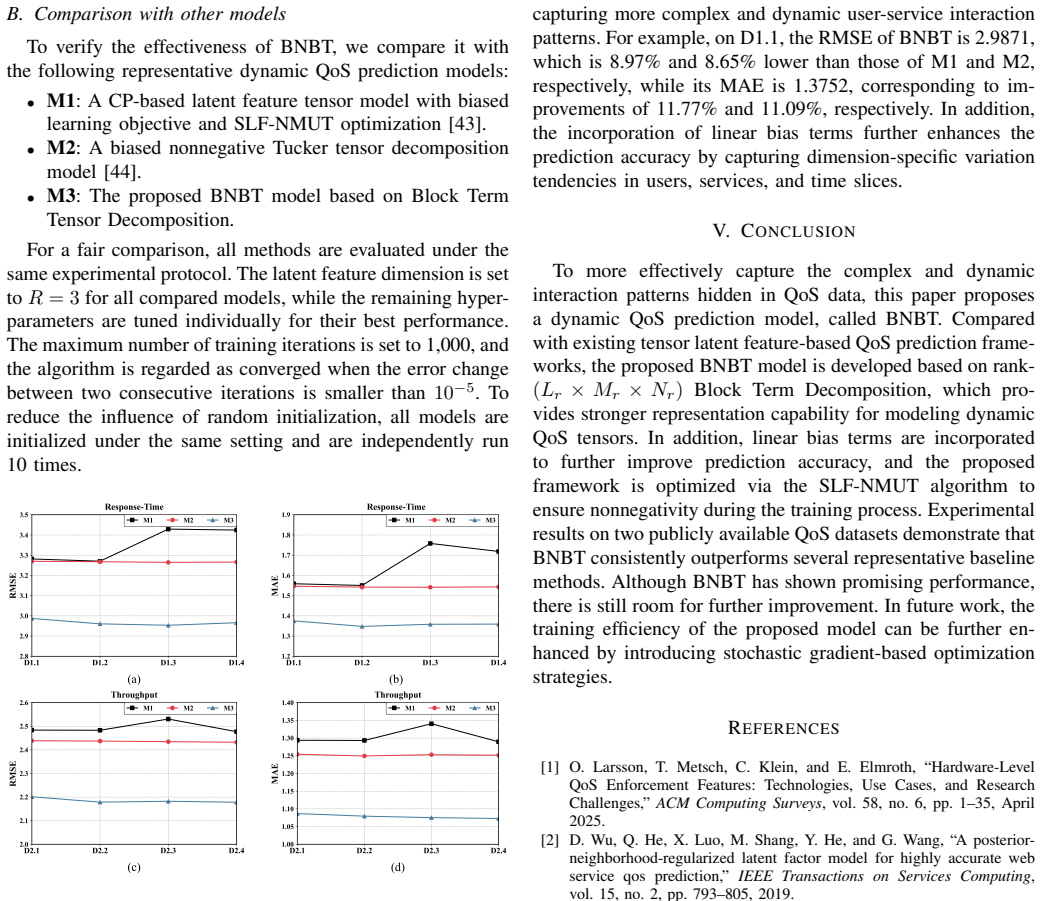
block term tensor decomposition with rank-(L_r × M_r × N_r); hyperparameters tuned individually for best performance
What do these tags mean?
- matches
- The paper's claim is directly supported by a theorem in the formal canon.
- supports
- The theorem supports part of the paper's argument, but the paper may add assumptions or extra steps.
- extends
- The paper goes beyond the formal theorem; the theorem is a base layer rather than the whole result.
- uses
- The paper appears to rely on the theorem as machinery.
- contradicts
- The paper's claim conflicts with a theorem or certificate in the canon.
- unclear
- Pith found a possible connection, but the passage is too broad, indirect, or ambiguous to say the theorem truly supports the claim.
Reference graph
Works this paper leans on
-
[1]
Hardware-Level QoS Enforcement Features: Technologies, Use Cases, and Research Challenges,
O. Larsson, T. Metsch, C. Klein, and E. Elmroth, “Hardware-Level QoS Enforcement Features: Technologies, Use Cases, and Research Challenges,”ACM Computing Surveys, vol. 58, no. 6, pp. 1–35, April 2025
work page 2025
-
[2]
D. Wu, Q. He, X. Luo, M. Shang, Y . He, and G. Wang, “A posterior- neighborhood-regularized latent factor model for highly accurate web service qos prediction,”IEEE Transactions on Services Computing, vol. 15, no. 2, pp. 793–805, 2019
work page 2019
-
[3]
Topology-aware neural model for highly accurate qos prediction,
J. Li, H. Wu, J. Chen, Q. He, and C. H. Hsu, “Topology-aware neural model for highly accurate qos prediction,”IEEE Transactions on Parallel and Distributed Systems, vol. 33, no. 7, pp. 1538–1552, 2022
work page 2022
-
[4]
Toward effec- tive personalized service qos prediction from the perspective of multi- task learning,
H. Lian, J. Li, H. Wu, Y . Zhao, L. Zhang, and X. Wang, “Toward effec- tive personalized service qos prediction from the perspective of multi- task learning,”IEEE Transactions on Network and Service Management, vol. 20, no. 3, pp. 2587–2597, 2023
work page 2023
-
[5]
Robust qos predic- tion based on reputation integrated graph convolution network,
Z. Wu, D. Ding, Y . Xiu, Y . Zhao, and J. Hong, “Robust qos predic- tion based on reputation integrated graph convolution network,”IEEE Transactions on Services Computing, vol. 17, no. 2, pp. 793–805, 2023
work page 2023
-
[6]
Outlier-resilient web service qos prediction,
F. Ye, Z. Lin, C. Chen, Z. Zheng, and H. Huang, “Outlier-resilient web service qos prediction,” inProceedings of the 30th International Conference on World Wide Web, 2021, pp. 3099–3110
work page 2021
-
[7]
H. Gao, W. Huang, and Y . Duan, “The cloud-edge-based dynamic recon- figuration to service workflow for mobile ecommerce environments: A qos prediction perspective,”ACM Transactions on Internet Technology, vol. 21, no. 6, pp. 1–23, 2021
work page 2021
-
[8]
A qos-aware clustering based multi-layer model for web service selection,
L. Purohit, S. S. Rathore, and S. Kumar, “A qos-aware clustering based multi-layer model for web service selection,”IEEE Transactions on Services Computing, vol. 16, no. 5, pp. 3141–3154, 2023
work page 2023
-
[9]
Wspred: A time-aware personalized qos prediction framework for web services,
Y . Zhang, Z. Zheng, and M. Lyu, “Wspred: A time-aware personalized qos prediction framework for web services,” in2011 IEEE 22nd In- ternational Symposium on Software Reliability Engineering, 2011, pp. 210–219
work page 2011
-
[10]
X. Luo, M. Chen, H. Wu, Z. Liu, H. Yuan, and M. Zhou, “Adjust- ing learning depth in nonnegative latent factorization of tensors for accurately modeling temporal patterns in dynamic QoS data,”IEEE Transactions on Automation Science and Engineering, vol. 18, no. 4, pp. 2142–2155, 2021
work page 2021
-
[11]
H. Wu and X. Luo, “Instance-frequency-weighted regularized, non- negative and adaptive latent factorization of tensors for dynamic QoS analysis,” in2021 IEEE International Conference on Web Services (ICWS), September 2021, pp. 560–568
work page 2021
-
[12]
D. Wu, X. Luo, Y . He, and M. Zhou, “A prediction-sampling-based multilayer-structured latent factor model for accurate representation to high-dimensional and sparse data,”IEEE Transactions on Neural Networks and Learning Systems, vol. 35, no. 3, pp. 3845–3858, 2024
work page 2024
-
[13]
Y . Yuan, J. Li, and X. Luo, “A fuzzy pid-incorporated stochastic gradient descent algorithm for fast and accurate latent factor analysis,”IEEE Transactions on Fuzzy Systems, vol. 32, no. 7, pp. 4049–4061, 2024
work page 2024
-
[14]
M. Shang, X. Luo, Z. Liu, J. Chen, Y . Yuan, and M. Zhou, “Randomized latent factor model for high-dimensional and sparse matrices from industrial applications,”IEEE/CAA Journal of Automatica Sinica, vol. 6, no. 1, pp. 131–141, 2019
work page 2019
-
[15]
X. Luo, M. Zhou, S. Li, and M. Shang, “An inherently nonnegative latent factor model for high-dimensional and sparse matrices from industrial applications,”IEEE Transactions on Industrial Informatics, vol. 14, no. 5, pp. 2011–2022, 2018
work page 2011
-
[16]
W. Qin and X. Luo, “Asynchronous parallel fuzzy stochastic gradient descent for high-dimensional incomplete data representation,”IEEE Transactions on Fuzzy Systems, vol. 32, no. 2, pp. 445–459, 2024
work page 2024
-
[17]
A graph-incorporated latent factor analysis model for high-dimensional and sparse data,
D. Wu, Y . He, and X. Luo, “A graph-incorporated latent factor analysis model for high-dimensional and sparse data,”IEEE Transactions on Emerging Topics in Computing, vol. 11, no. 4, pp. 907–917, 2023
work page 2023
-
[18]
F. Bi, X. Luo, B. Shen, H. Dong, and Z. Wang, “Proximal alternating- direction-method-of-multipliers-incorporated nonnegative latent factor analysis,”IEEE/CAA Journal of Automatica Sinica, vol. 10, no. 6, pp. 1388–1406, 2023
work page 2023
-
[19]
A differential evolution- enhanced position-transitional approach to latent factor analysis,
J. Chen, R. Wang, D. Wu, and X. Luo, “A differential evolution- enhanced position-transitional approach to latent factor analysis,”IEEE Transactions on Emerging Topics in Computational Intelligence, vol. 7, no. 2, pp. 389–401, 2023
work page 2023
-
[20]
A deep latent factor model for high-dimensional and sparse matrices in recom- mender systems,
D. Wu, X. Luo, M. Shang, Y . He, G. Wang, and M. Zhou, “A deep latent factor model for high-dimensional and sparse matrices in recom- mender systems,”IEEE Transactions on Systems, Man, and Cybernetics: Systems, vol. 51, no. 7, pp. 4285–4296, 2021
work page 2021
-
[21]
W. Qin, X. Luo, S. Li, and M. Zhou, “Parallel adaptive stochastic gradient descent algorithms for latent factor analysis of high-dimensional and incomplete industrial data,”IEEE Transactions on Automation Science and Engineering, vol. 21, no. 3, pp. 2716–2729, 2024
work page 2024
-
[22]
Momentum-incorporated symmetric non-negative latent factor models,
Y . Zhong, L. Jin, M. Shang, and X. Luo, “Momentum-incorporated symmetric non-negative latent factor models,”IEEE Transactions on Big Data, vol. 8, no. 4, pp. 1096–1106, 2022
work page 2022
-
[23]
A kalman-filter-incorporated latent factor analysis model for temporally dynamic sparse data,
Y . Yuan, X. Luo, M. Shang, and Z. Wang, “A kalman-filter-incorporated latent factor analysis model for temporally dynamic sparse data,”IEEE Transactions on Cybernetics, vol. 53, no. 9, pp. 5788–5801, 2023
work page 2023
-
[24]
A distributed adaptive second-order latent factor analysis model,
J. Wang, W. Li, and X. Luo, “A distributed adaptive second-order latent factor analysis model,”IEEE/CAA Journal of Automatica Sinica, vol. 11, no. 11, pp. 2343–2345, 2024
work page 2024
-
[25]
Q. Hu, H. Wu, and X. Luo, “A comprehensive review of parallel optimization algorithms for high-dimensional and incomplete matrix factorization,”IEEE/CAA Journal of Automatica Sinica, vol. 12, no. 12, pp. 2399–2426, December 2025
work page 2025
-
[26]
H. Wu, Y . Qiao, and X. Luo, “A fine-grained regularization scheme for non-negative latent factorization of high-dimensional and incomplete tensors,”IEEE Transactions on Services Computing, vol. 17, no. 6, pp. 3006–3021, 2024
work page 2024
-
[27]
X. Luo, H. Wu, and Z. Li, “NeuLFT: A novel approach to nonlinear canonical polyadic decomposition on high-dimensional incomplete ten- sors,”IEEE Transactions on Knowledge and Data Engineering, vol. 35, no. 6, pp. 6148–6166, 2022
work page 2022
-
[28]
Y . Song, M. Li, X. Luo, G. Yang, and C. Wang, “Improved symmetric and nonnegative matrix factorization models for undirected, sparse and large-scaled networks: A triple factorization-based approach,”IEEE Transactions on Industrial Informatics, vol. 16, no. 5, pp. 3006–3017, 2020
work page 2020
-
[29]
Advancing non-negative latent fac- torization of tensors with diversified regularization schemes,
H. Wu, X. Luo, and M. Zhou, “Advancing non-negative latent fac- torization of tensors with diversified regularization schemes,”IEEE Transactions on Services Computing, vol. 15, no. 3, pp. 1334–1344, May 2022
work page 2022
-
[30]
H. Wu, X. Luo, M. Zhou, M. J. Rawa, K. Sedraoui, and A. Albeshri, “A PID-incorporated latent factorization of tensors approach to dynamically weighted directed network analysis,”IEEE/CAA Journal of Automatica Sinica, vol. 9, no. 3, pp. 533–546, March 2022
work page 2022
-
[31]
X. Liao, H. Wu, and X. Luo, “A novel tensor causal convolution network model for highly-accurate representation to spatio-temporal data,”IEEE Transactions on Automation Science and Engineering, vol. 22, pp. 19 525–19 537, 2025
work page 2025
-
[32]
A tensor-based approach for the qos evaluation in service-oriented environments,
X. Su, M. Zhang, Y . Liang, Z. Cai, L. Guo, and Z. Ding, “A tensor-based approach for the qos evaluation in service-oriented environments,”IEEE Transactions on Network and Service Management, vol. 18, no. 3, pp. 3843–3857, 2021
work page 2021
-
[33]
X. Xu, M. Lin, X. Luo, and Z. Xu, “An adaptively bias-extended non- negative latent factorization of tensors model for accurately representing the dynamic qos data,”IEEE Transactions on Services Computing, vol. 18, no. 2, pp. 603–617, 2025
work page 2025
-
[34]
Z. Peng and H. Wu, “Non-negative latent factorization of tensors model based on divergence for time-aware qos prediction,” in2022 IEEE International Conference on Networking, Sensing and Control, 2022, pp. 1–6
work page 2022
-
[35]
J. Dong, Y . Song, M. Li, and H. Rao, “Biased collective latent factoriza- tion of tensors with transfer learning for dynamic qos data predicting,” Digital Signal Processing, vol. 146, p. 104360, 2024
work page 2024
-
[36]
A novel approach to large-scale dynamically weighted directed network representation,
X. Luo, H. Wu, Z. Wang, J. Wang, and D. Meng, “A novel approach to large-scale dynamically weighted directed network representation,” IEEE Transactions on Pattern Analysis and Machine Intelligence, vol. 44, no. 12, pp. 9756–9773, 2021
work page 2021
-
[37]
H. Wu, X. Wu, and X. Luo,Dynamic Network Representation Based on Latent Factorization of Tensors. Singapore: Springer Nature Singapore, 2023
work page 2023
-
[38]
An adaptive PID-guided tensor wheel decomposition model for dynamic weighted network representation,
J. Chen, Q. Wang, and H. Wu, “An adaptive PID-guided tensor wheel decomposition model for dynamic weighted network representation,” Neurocomputing, vol. 656, p. 131490, December 2025
work page 2025
-
[39]
Q. Wang, H. Wu, and X. Luo, “A convolution bias-incorporated non- negative latent factorization of tensors model for accurate representation learning to dynamic directed graphs,”IEEE Transactions on Systems, Man, and Cybernetics: Systems, vol. 55, no. 12, pp. 8902–8914, De- cember 2025
work page 2025
-
[40]
H. Wu and J. Mi, “A cauchy loss-incorporated nonnegative latent factorization of tensors model for spatiotemporal traffic data recovery,” Neurocomputing, vol. 626, p. 129575, 2025
work page 2025
-
[41]
H. Fang and H. Wu, “Modularity and temporal proximity enhanced nonnegative tensor latent factorization for accurate dynamic community detection,” inProceedings of the 28th European Conference on Artificial Intelligence (ECAI 2025), October 2025
work page 2025
-
[42]
X. Luo, Z. Liu, L. Jin, Y . Zhou, and M. Zhou, “Symmetric nonnega- tive matrix factorization-based community detection models and their convergence analysis,”IEEE Transactions on Neural Networks and Learning Systems, vol. 33, no. 3, pp. 1203–1215, 2022
work page 2022
-
[43]
Temporal Pattern-Aware QoS Prediction via Biased Non-Negative Latent Factorization of Tensors,
X. Luo, H. Wu, H. Yuan, and M. Zhou, “Temporal Pattern-Aware QoS Prediction via Biased Non-Negative Latent Factorization of Tensors,” IEEE Transactions on Cybernetics, vol. 50, no. 5, pp. 1798–1809, May 2020
work page 2020
-
[44]
Temporal pattern-aware QoS prediction by Biased Non-negative Tucker Factorization of tensors,
P. Tang, T. Ruan, H. Wu, and X. Luo, “Temporal pattern-aware QoS prediction by Biased Non-negative Tucker Factorization of tensors,” Neurocomputing, vol. 582, p. 127447, May 2024
work page 2024
-
[45]
Learning accurate represen- tation to nonstandard tensors via a mode-aware tucker network,
H. Wu, Q. Wang, X. Luo, and Z. Wang, “Learning accurate represen- tation to nonstandard tensors via a mode-aware tucker network,”IEEE Transactions on Knowledge and Data Engineering, vol. 37, no. 12, pp. 7272–7285, December 2025
work page 2025
-
[46]
X. Liao, H. Wu, T. He, and X. Luo, “A proximal-ADMM-incorporated nonnegative latent-factorization-of-tensors model for representing dy- namic cryptocurrency transaction network,”IEEE Transactions on Sys- tems, Man, and Cybernetics: Systems, vol. 55, no. 11, pp. 8387–8401, November 2025
work page 2025
-
[47]
Investigating QoS of Real-World Web Services,
Z. Zheng, Y . Zhang, and M. R. Lyu, “Investigating QoS of Real-World Web Services,”IEEE Transactions on Services Computing, vol. 7, no. 1, pp. 32–39, January 2014
work page 2014
discussion (0)
Sign in with ORCID, Apple, or X to comment. Anyone can read and Pith papers without signing in.