Recognition: unknown
Response tensor for the superconducting (Josephson) diode effect
Pith reviewed 2026-05-08 16:18 UTC · model grok-4.3
The pith
A response tensor characterizes the non-reciprocal critical current in the Josephson diode effect by coupling its angular dipole component to the applied magnetic field.
A machine-rendered reading of the paper's core claim, the machinery that carries it, and where it could break.
Core claim
We propose a response tensor χ̂ to characterize the non-reciprocal critical current response of the superconducting (Josephson) diode effect. It describes the coupling between the dipole component of the angular distribution of the critical current and the applied magnetic field, an analogue to the Hall response in the normal state. In quasi-2D systems with Rashba spin-orbit coupling and point group symmetries C3v, C4v or C6v, this tensor takes a fully antisymmetric form. When nematicity is present, a symmetric contribution emerges, providing an indicator of the nematic order in the superconducting state. In contrast, for systems exhibiting Dresselhaus spin-orbit coupling with the D2d point,
What carries the argument
The response tensor χ̂, which encodes the linear coupling between the magnetic field vector and the dipole part of the angular critical-current distribution.
If this is right
- In Rashba systems with C3v, C4v or C6v symmetry the tensor is fully antisymmetric, so the diode effect reverses sign under 180-degree rotation of the field.
- Nematic order adds a symmetric part to the tensor, turning it into a direct probe of nematicity inside the superconducting phase.
- For Dresselhaus D2d systems the tensor is diagonal and traceless, and nematicity introduces a nonzero trace.
- The tensor accounts for diode behavior both with external fields and with intrinsic effective fields generated by other orders.
- It gives explicit symmetry rules for when the diode effect survives when magnetic field is parallel to current.
Where Pith is reading between the lines
- Experiments could determine the tensor by measuring critical current at several field angles and inverting the resulting dipole amplitudes.
- The same tensor might distinguish Rashba from Dresselhaus spin-orbit coupling by the presence or absence of off-diagonal versus diagonal entries.
- Temperature sweeps of the tensor components could reveal whether nematic order onsets at the superconducting transition or at a lower temperature.
- The framework could be extended to three-dimensional or multi-band superconductors by adding higher-order angular harmonics to the current distribution.
Load-bearing premise
The tensor's calculated symmetry properties remain valid in real materials and are not overwhelmed by other scattering or disorder effects.
What would settle it
Map the full angular dependence of critical current at fixed field in a Rashba C4v superconductor and extract the tensor; if the measured tensor contains a symmetric component where only the antisymmetric part is predicted, the central claim is falsified.
Figures

read the original abstract
We propose a response tensor $\mathbf{\hat \chi}$ to characterize the non-reciprocal critical current response of the superconducting (Josephson) diode effect. It describes the coupling between the dipole component of the angular distribution of the critical current and the applied magnetic field -- an analogue to the Hall response in the normal state. In quasi-2D systems with Rashba spin-orbit coupling and point group symmetries $C_{3v}$, $C_{4v}$ or $C_{6v}$, this tensor takes a fully antisymmetric form. When nematicity is present, a symmetric contribution emerges, providing an indicator of the nematic order in the superconducting state. In contrast, for systems exhibiting Dresselhaus spin-orbit coupling with the $D_{2d}$ symmetry, the tensor becomes diagonal traceless, and nematicity brings in a trace part. Our analysis not only accounts for the superconducting diode effect under external applied or intrinsic effective magnetic fields, but also predicts the symmetry conditions for realizing the diode effect when the magnetic field is aligned with the current. Beyond this, the proposed tensor provides a promising tool for detecting nematicity and potential nematic transitions deep within the superconducting phase. It may also encode additional information about the underlying electronic structure and symmetry-breaking orders, warranting further experimental investigation.
Editorial analysis
A structured set of objections, weighed in public.
Referee Report
Summary. The manuscript proposes a response tensor χ̂ to characterize the non-reciprocal critical current response of the superconducting (Josephson) diode effect. It describes the coupling between the dipole component of the angular distribution of the critical current and the applied magnetic field, an analogue to the Hall response in the normal state. For quasi-2D systems with Rashba spin-orbit coupling and C3v/C4v/C6v symmetries the tensor is fully antisymmetric; nematicity adds a symmetric contribution. For Dresselhaus spin-orbit coupling with D2d symmetry the tensor is diagonal and traceless, with nematicity adding a trace part. The work claims this accounts for the diode effect under external or intrinsic fields, predicts symmetry conditions when magnetic field is aligned with current, and provides a tool to detect nematicity deep in the superconducting phase.
Significance. If the tensor is rigorously derived and its symmetry properties are shown to survive in the superconducting state, the proposal could supply a compact symmetry-based diagnostic for nematic order and non-reciprocal transport in Josephson systems, extending normal-state concepts and motivating targeted experiments.
major comments (2)
- [Abstract and symmetry discussion] The central symmetry claims (fully antisymmetric form for Rashba + C3v/C4v/C6v; diagonal traceless for Dresselhaus + D2d) are asserted via point-group analysis but are not derived from the Josephson current-phase relation or any microscopic superconducting model. This is load-bearing for the claim that the tensor encodes the dipole component of Ic and survives in real materials as an indicator of nematic order.
- [Abstract and main analysis] The manuscript does not demonstrate that normal-state symmetries carry over unchanged into the superconducting phase or that the linear response is exhausted by χ̂; higher-order terms in the current-phase relation or vortex pinning could contribute to the critical current and alter the tensor's form.
minor comments (1)
- [Abstract] The notation χ̂ (with hat) is introduced without immediate clarification of its relation to other response tensors or the precise definition of its components.
Simulated Author's Rebuttal
We thank the referee for their careful reading and constructive comments on our manuscript. We address each major comment point by point below and have revised the manuscript to incorporate clarifications and derivations where they strengthen the presentation without altering the core claims.
read point-by-point responses
-
Referee: [Abstract and symmetry discussion] The central symmetry claims (fully antisymmetric form for Rashba + C3v/C4v/C6v; diagonal traceless for Dresselhaus + D2d) are asserted via point-group analysis but are not derived from the Josephson current-phase relation or any microscopic superconducting model. This is load-bearing for the claim that the tensor encodes the dipole component of Ic and survives in real materials as an indicator of nematic order.
Authors: We appreciate the referee's emphasis on this foundational aspect. The response tensor χ̂ is introduced as a phenomenological object that linearly couples the dipole component of the critical-current angular distribution to the applied field, with its allowed form fixed by the system's point-group symmetries in the superconducting state. To address the concern directly, the revised manuscript now includes an explicit expansion of a general Josephson current-phase relation to first order in the magnetic field. This derivation confirms that the leading dipole response is captured by the stated antisymmetric (Rashba) or diagonal traceless (Dresselhaus) tensor when the point-group symmetries are respected. The symmetry constraints themselves follow from the lattice and pairing symmetries and do not require a specific microscopic Hamiltonian; they are analogous to the symmetry-allowed form of the conductivity tensor in normal-state transport. We have added this derivation as a new subsection while retaining the original symmetry tables for clarity. revision: yes
-
Referee: [Abstract and main analysis] The manuscript does not demonstrate that normal-state symmetries carry over unchanged into the superconducting phase or that the linear response is exhausted by χ̂; higher-order terms in the current-phase relation or vortex pinning could contribute to the critical current and alter the tensor's form.
Authors: We agree that an explicit discussion of symmetry persistence and the regime of validity is necessary. In the revised manuscript we have added a dedicated paragraph arguing that the relevant point-group symmetries are preserved by the crystal lattice and by conventional superconducting pairing (s-wave or similar), so the constraints on χ̂ remain applicable deep in the superconducting phase; nematicity is treated as an additional symmetry-breaking order that modifies the tensor in a controlled way. We also acknowledge that higher harmonics in the current-phase relation and vortex-pinning effects can contribute to the measured critical current. However, for weak fields the leading non-reciprocal term linear in B is still isolated by χ̂, while higher-order corrections appear as nonlinear field dependence. The revised text now states the linear-response assumption explicitly and outlines the field-strength regime in which the tensor description is expected to hold, together with possible experimental signatures of deviations. revision: yes
Circularity Check
No circularity: tensor proposed via symmetry classification independent of its own outputs
full rationale
The paper defines the response tensor χ̂ by its intended physical role (coupling dipole component of critical current angular distribution to magnetic field) and then assigns its explicit matrix forms using standard point-group symmetry analysis for Rashba/Dresselhaus SOC plus C3v/C4v/C6v or D2d. No equation in the abstract or described derivation reduces the tensor to a fit of its own predictions, nor does any load-bearing step rely on self-citation of an unverified uniqueness theorem. The symmetry assignments are presented as direct consequences of the listed point groups rather than being smuggled in via prior author work or renamed empirical patterns. The derivation chain therefore remains self-contained against external symmetry tables and does not collapse by construction.
Axiom & Free-Parameter Ledger
axioms (1)
- domain assumption Quasi-2D systems possess Rashba or Dresselhaus spin-orbit coupling together with the listed point-group symmetries (C3v, C4v, C6v, D2d).
invented entities (1)
-
Response tensor χ̂
no independent evidence
Reference graph
Works this paper leans on
-
[1]
The response tensor can then be decom- posed as ˆχ =χ nmI +χ S4τ3 withχ nm = π 4B (c′ 1 − s′
-
[2]
Here, χ nm serves as a direct indica- tor of the strength of nematicity in the superconducting state
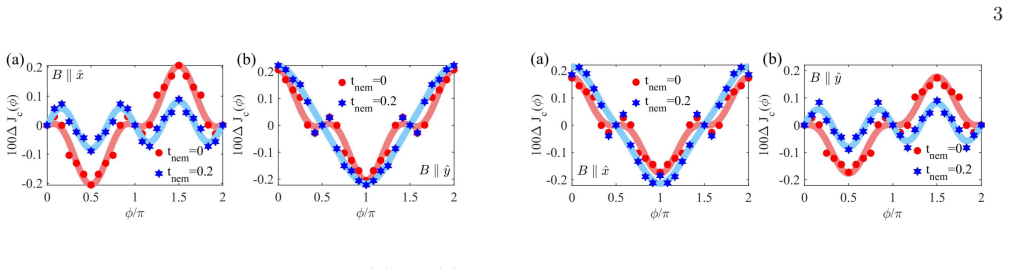
and χ S4 = π 4B (c′ 1 +s′ 1). Here, χ nm serves as a direct indica- tor of the strength of nematicity in the superconducting state. The χ nm components in both cases of Rashba and Dresselhaus SO couplings are indicators of asymmetry, i.e., the breakings of C4z and the S4 symmetries, re- spectively. Since they originate from symmetry break- ings, their app...
-
[3]
The red and blue lines are for the in-plane B-field along the x- and y-axis, respectively
2, respectively. The red and blue lines are for the in-plane B-field along the x- and y-axis, respectively. (e) The χ C4 component and χ nm component with the nematic strength η for the Rashba case. (f) The maximum of superconduct- ing diode efficicency ∆ Jc/ 2 ¯Jc for the Rashba cases, where ¯Jc = 1 2 (Jc(φ )+Jc(φ +π )), as functions of the nematic strength...
-
[4]
J. Hu, C. Wu, and X. Dai, Proposed design of a Joseph- son diode, Phys. Rev. Lett. 99, 067004 (2007)
2007
-
[5]
Wakatsuki and N
R. Wakatsuki and N. Nagaosa, Nonreciprocal current in noncentrosymmetric Rashba superconductors, Phys. Rev. Lett. 121, 26601 (2018)
2018
-
[6]
Jiang and J
K. Jiang and J. Hu, Superconducting diode effects, Nat. Phys. 18, 1145 (2022)
2022
-
[7]
Ando et al., Observation of superconducting diode ef- fect, Nature 584, 373 (2020)
F. Ando et al., Observation of superconducting diode ef- fect, Nature 584, 373 (2020)
2020
-
[8]
Narita et al., Field-free superconducting diode effec t in noncentrosymmetric superconductor/ferromagnet multi- layers, Nat
H. Narita et al., Field-free superconducting diode effec t in noncentrosymmetric superconductor/ferromagnet multi- layers, Nat. Nanotechnol. 17, 823 (2022)
2022
-
[9]
Lin et al., Zero-field superconducting diode effect in small-twist-angle trilayer graphene, Nat
J.-X. Lin et al., Zero-field superconducting diode effect in small-twist-angle trilayer graphene, Nat. Phys. 18, 1221 (2022)
2022
-
[10]
Pal et al., Josephson diode effect from Cooper pair momentum in a topological semimetal, Nat
B. Pal et al., Josephson diode effect from Cooper pair momentum in a topological semimetal, Nat. Phys. 18, 1228 (2022)
2022
-
[11]
Nagata et al., Field-free superconducting diode effec t in layered superconductor FeSe, Phys
U. Nagata et al., Field-free superconducting diode effec t in layered superconductor FeSe, Phys. Rev. Lett. 134, 236703 (2025)
2025
-
[12]
Hou et al., Ubiquitous superconducting diode effect in superconductor thin films, Phys
Y. Hou et al., Ubiquitous superconducting diode effect in superconductor thin films, Phys. Rev. Lett. 131, 027001 (2023)
2023
-
[13]
Le et al., Superconducting diode effect and inter- ference patterns in Kagome CsV 3Sb5, Nature 630, 64 (2024)
T. Le et al., Superconducting diode effect and inter- ference patterns in Kagome CsV 3Sb5, Nature 630, 64 (2024)
2024
-
[14]
Qi et al., High-temperature field-free superconduct ing diode effect in high- Tc cuprates, Nat
S. Qi et al., High-temperature field-free superconduct ing diode effect in high- Tc cuprates, Nat. Commun. 16, 531 (2025)
2025
-
[15]
L. D. Anh et al., Large superconducting diode ef- fect in ion-beam patterned Sn-based superconduc- tor nanowire/topological Dirac semimetal planar het- erostructures, Nat. Commun. 15, 8014 (2024)
2024
-
[16]
Valentini et al., Parity-conserving Cooper-pair tr ans- port and ideal superconducting diode in planar germa- nium, Nat
M. Valentini et al., Parity-conserving Cooper-pair tr ans- port and ideal superconducting diode in planar germa- nium, Nat. Commun. 15, 169 (2024)
2024
-
[17]
H. Wang, Y. Zhu, Z. Bai, Z. Lyu, J. Yang, L. Zhao, X. J. Zhou, Q.-K. Xue, and D. Zhang, Quantum supercon- ducting diode effect with perfect efficiency above liquid- nitrogen temperature, Nat. Phys. 22, 47 (2026)
2026
-
[18]
Nadeem, M
M. Nadeem, M. S. Fuhrer, and X. Wang, The supercon- ducting diode effect, Nat. Rev. Phys. 5, 558 (2023)
2023
-
[19]
Wang, Q.-H
D. Wang, Q.-H. Wang, and C. Wu, Current-reversion symmetry breaking and the DC Josephson diode effect, Sci. Bull. 70, 4181 (2025)
2025
-
[20]
Daido, Y
A. Daido, Y. Ikeda, and Y. Yanase, Intrinsic supercon- ducting diode effect, Phys. Rev. Lett. 128, 37001 (2022)
2022
-
[21]
N. F. Q. Yuan and L. Fu, Supercurrent diode effect and finite-momentum superconductors, Proc. Natl. Acad. Sci. 119, e2119548119 (2022)
2022
-
[22]
J. J. He, Y. Tanaka, and N. Nagaosa, A phenomenolog- ical theory of superconductor diodes, New J. Phys. 24, 53014 (2022)
2022
-
[23]
H. D. Scammell, J. I. A. Li, and M. S. Scheurer, Theory of zero-field superconducting diode effect in twisted trilayer graphene, 2D Mater. 9, 25027 (2022)
2022
-
[24]
Ili´ c and F
S. Ili´ c and F. S. Bergeret, Theory of the supercurrent diode effect in Rashba superconductors with arbitrary disorder, Phys. Rev. Lett. 128, 177001 (2022)
2022
-
[25]
Y. Mao, Q. Yan, Y.-C. Zhuang, and Q.-F. Sun, Uni- versal spin superconducting diode effect from spin-Orbit coupling, Phys. Rev. Lett. 132, 216001 (2024)
2024
-
[26]
Banerjee and M
S. Banerjee and M. S. Scheurer, Enhanced superconduct- 6 ing diode effect due to coexisting phases, Phys. Rev. Lett. 132, 046003 (2024)
2024
-
[27]
B. Lu, S. Ikegaya, P. Burset, Y. Tanaka, and N. Nagaosa, Tunable Josephson diode effect on the surface of topolog- ical insulators, Phys. Rev. Lett. 131, 096001 (2023)
2023
-
[28]
Hu, Z.-T
J.-X. Hu, Z.-T. Sun, Y.-M. Xie, and K. T. Law, Joseph- son diode effect induced by valley polarization in twisted bilayer graphene, Phys. Rev. Lett. 130, 266003 (2023)
2023
-
[29]
Zhang, Y
Y. Zhang, Y. Gu, P. Li, J. Hu, and K. Jiang, General theory of Josephson diodes, Phys. Rev. X 12, 041013 (2022)
2022
-
[30]
Daido and Y
A. Daido and Y. Yanase, Superconducting diode effect and nonreciprocal transition lines, Phys. Rev. B 106, 205206 (2022)
2022
-
[31]
C. M. Varma, Antisymmetric chiral currents at zero magnetic field in some two-dimensional superconductors, Phys. Rev. B 112, 024513 (2025)
2025
-
[32]
D. Wang, Q.-H. Wang, and C. Wu, Josephson diode ef- fect: a phenomenological perspective, arXiv:2506.23200
-
[33]
Universal Criterion and Graph-Theoretic Construction of Intrinsic Superconducting Diode Effect
R. Wang and N. Hao, Universal criterion and graph- theoretic construction of intrinsic superconducting diod e effect, arXiv:2507.04876
work page internal anchor Pith review Pith/arXiv arXiv
-
[34]
Y. A. Bychkov and E. I. Rashba, Properties of a 2D elec- tron gas with lifted spectral degeneracy, Pis’ma Zh. Eksp. Teor. Fiz. 39, 66 (1984) [JETP Lett. 39, 78 (1984)]
1984
-
[35]
Manchon, H
A. Manchon, H. C. Koo, J. Nitta, S. M. Frolov, and R. A. Duine, New Perspectives for Rashba spin-orbit coupling, Nat. Mater. 14, 871 (2015)
2015
-
[36]
Dresselhaus, Spin-orbit coupling effects in zinc ble nde structures, Phys
G. Dresselhaus, Spin-orbit coupling effects in zinc ble nde structures, Phys. Rev. 100, 580 (1955)
1955
-
[37]
Hamill et al., Two-fold symmetric superconductivit y in few-layer NbSe 2, Nat
A. Hamill et al., Two-fold symmetric superconductivit y in few-layer NbSe 2, Nat. Phys. 17, 949 (2021)
2021
-
[38]
Xiang et al., Twofold symmetry of c-axis resistivity in topological Kagome superconductor CsV 3Sb5 with in- plane rotating magnetic field, Nat
Y. Xiang et al., Twofold symmetry of c-axis resistivity in topological Kagome superconductor CsV 3Sb5 with in- plane rotating magnetic field, Nat. Commun. 12, 6727 (2021)
2021
-
[39]
Sigrist, Introduction to unconventional supercond uc- tivity, AIP Conf
M. Sigrist, Introduction to unconventional supercond uc- tivity, AIP Conf. Proc. 789, 165 (2005)
2005
-
[40]
Lederer, Y
S. Lederer, Y. Schattner, E. Berg, and S. A. Kivelson, Enhancement of superconductivity near a nematic quan- tum critical point, Phys. Rev. Lett. 114, 097001 (2015)
2015
-
[41]
N. E. Bonesteel, T. M. Rice, and F. C. Zhang, Spin-orbit coupling and spirals in doped La 2CuO4, Phys. Rev. Lett. 68, 2684 (1992)
1992
-
[42]
Zhang, Dynamic generation of spin-orbit coupling, Phys
Wu and S.-C. Zhang, Dynamic generation of spin-orbit coupling, Phys. Rev. Lett. 93, 036403 (2004)
2004
-
[43]
Zhang, D
X. Zhang, D. Wang, and C. Wu, Spontaneous spin-orbit coupling induced by quantum phonon dynamics, Phys. Rev. Lett. 135, 026505 (2025)
2025
discussion (0)
Sign in with ORCID, Apple, or X to comment. Anyone can read and Pith papers without signing in.