Uncovering hidden bias in neutron diffraction residual strain measurements
Pith reviewed 2026-05-08 16:26 UTC · model grok-4.3
The pith
Propagated uncertainties in neutron diffraction strain measurements underestimate true scatter when microstructure gradients are present.
A machine-rendered reading of the paper's core claim, the machinery that carries it, and where it could break.
Core claim
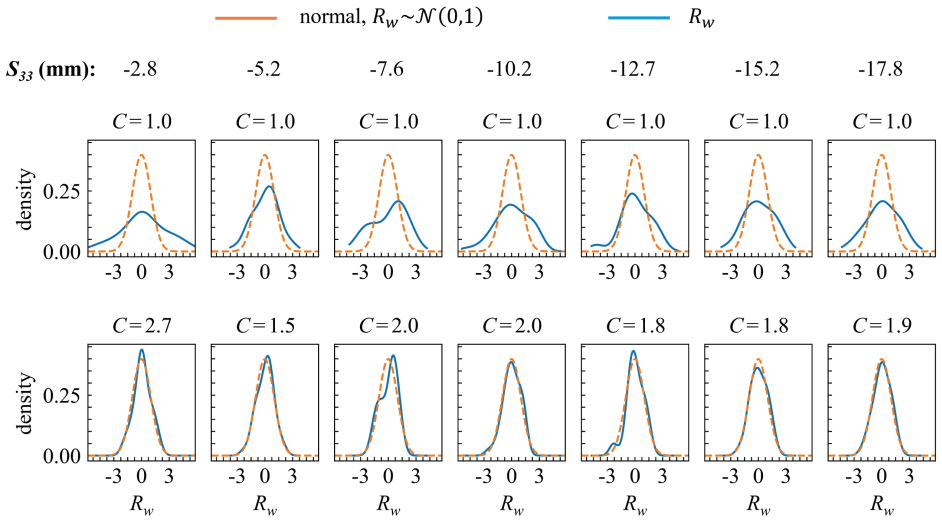
For the tested sample, direct inversion of any six unique orientation measurements into the full strain tensor retains a conservative estimate of uncertainty that matches the true experimental scatter under the strain transformation law, whereas uncertainties propagated through the thirty-six-measurement least-squares solution greatly underestimate that scatter. The authors therefore propose a straightforward statistical pathway to derive appropriate uncertainty intervals that incorporate the sample-dependent effects arising from sub-sampling of gradients in plastic strain, texture, and residual elastic strain.
What carries the argument
The physical constraint that all orientation-dependent strain measurements must agree under the strain transformation law when a single macroscopic strain state is assumed, used to test whether propagated uncertainties correctly describe the observed scatter across different tensor calculation pathways.
If this is right
- Uncertainties derived solely from peak fitting are inadequate when diffraction selectively samples microstructure and strain gradients.
- Direct inversion of six orientations supplies a conservative and statistically defensible uncertainty for the strain tensor.
- Least-squares solutions on many orientations require an additional statistical correction to avoid unrealistically narrow intervals.
- Oversampling many orientations and checking consistency against the strain transformation law yields both more accurate strain values and realistic uncertainties.
- Residual strain interpretation must account for intrinsic, sample-specific effects rather than treating propagated uncertainties as universally sufficient.
Where Pith is reading between the lines
- The same oversampling and consistency-check procedure could be applied to X-ray diffraction strain measurements on similar gradient-rich materials.
- Designers of additively manufactured components could adopt the suggested uncertainty pathway to set more appropriate safety margins against residual-stress-driven failure.
- Repeated application across many locations might allow mapping of the spatial scale of gradients directly from the degree of inconsistency among orientations.
Load-bearing premise
A single macroscopic strain state exists such that measurements from every orientation must agree under the strain transformation law, even though the sample contains fine-scale gradients of plastic strain, texture, and residual elastic strain.
What would settle it
In a uniform sample without gradients, repeated measurements at the same location would show that least-squares propagated uncertainties accurately bound the actual scatter, whereas the same procedure applied to the gradient-containing sample would continue to show underestimation.
Figures
read the original abstract
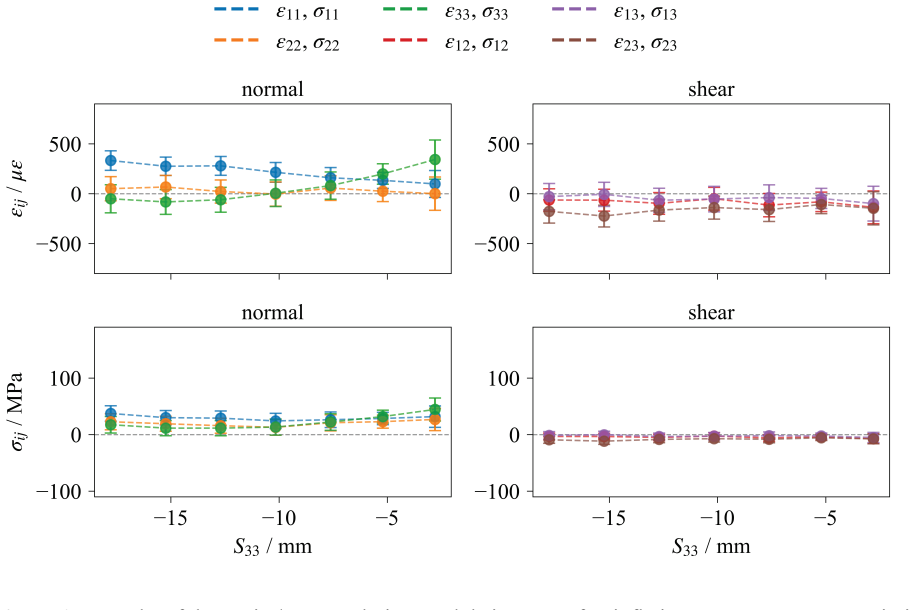
When calculating residual strain via neutron or X-ray diffraction, uncertainties propagated from the peak fit are often inadequate to describe the true scatter of measurements about a singular strain state, such as one that should describe a macroscopic continuum. Because diffraction is inherently a selective process, orientation dependent scatter arises from the sub-sampling of strong microstructure and strain gradients. This paper investigates the appropriateness of propagated uncertainties with reference to their original intention, i.e., noise about a mean value. Thirty-six unique orientations of strain measurements are taken at multiple locations within an additive friction-stir deposition component with fine-scale gradients (~200 um) of plastic strain, texture, and residual elastic strain. Multiple strain and stress calculation pathways are compared: direct substitution of three measurements into Hooke's law, direct inversion of any six unique orientations into the strain state tensor, and thirty-six measurement least-squares estimation. For the latter two cases, the appropriateness of the uncertainty interval is statistically evaluated based on a physical constraint: common agreement under the strain transformation law. For this sample, the direct inversion of six measurements retains a conservative estimate of the uncertainty. However, propagated uncertainties in the least-squares solution greatly underestimate the true experimental scatter. A simple pathway to estimate appropriate uncertainty intervals is suggested. These results demonstrate that interpretation of uncertainty in residual strain is strongly dependent on intrinsic, sample-dependent effects, and that oversampling orientations and statistical analysis can give more accurate results with realistic uncertainties.
Editorial analysis
A structured set of objections, weighed in public.
Referee Report
Summary. The manuscript compares three pathways for computing residual strain and stress from neutron diffraction data on an additive friction-stir deposition sample: direct substitution of three measurements into Hooke's law, direct inversion of any six orientations into the strain tensor, and least-squares fitting to all 36 orientations. Using a physical consistency test (agreement of all measurements under the strain transformation law), it concludes that propagated uncertainties from the least-squares fit greatly underestimate the observed experimental scatter while direct inversion of six measurements remains conservative, and proposes a simple correction for realistic uncertainty intervals. The work emphasizes that uncertainty interpretation depends on sample-specific microstructure and gradient effects.
Significance. If the central findings hold after addressing the experimental design, the paper would usefully demonstrate that standard peak-fit uncertainty propagation can be inadequate for diffraction-based residual strain work in heterogeneous materials. The use of an independent physical constraint (strain transformation law) for validating uncertainty intervals is a clear strength, as it supplies a falsifiable check that is not circular with the fitting procedure itself. This could inform better practice in additive-manufacturing and welding residual-stress studies.
major comments (2)
- [abstract and results section on statistical evaluation] The statistical evaluation of uncertainty appropriateness (abstract and the results section describing the physical consistency test) rests on the premise that all 36 orientation measurements must be consistent with one common strain tensor under the transformation law. However, the experiment acquires these measurements at multiple locations inside a sample that the abstract itself states contains fine-scale (~200 μm) gradients of plastic strain, texture, and residual elastic strain. Consequently, the residuals that are used to judge whether least-squares propagated uncertainties 'greatly underestimate the true experimental scatter' necessarily incorporate both measurement noise and real spatial variation. This conflates two distinct sources of scatter and weakens the claim that the underestimation is a general property of the least-squares pathway rather than an artifact of sampling a
- [abstract and results section comparing calculation pathways] The assertion that 'direct inversion of six measurements retains a conservative estimate of the uncertainty' (abstract) is sensitive to the choice of which six orientations are selected and to the local strain state at each measurement location. Because the sample is heterogeneous, different subsets of six orientations will correspond to different local tensors; without an explicit demonstration that the conservatism holds across multiple location-specific subsets or an accounting for the gradient length scale relative to the gauge volume, the comparative claim between pathways remains incompletely supported.
minor comments (2)
- [abstract] The abstract states that 'a simple pathway to estimate appropriate uncertainty intervals is suggested' but does not indicate the section or equation where the explicit procedure appears; adding a forward reference would improve readability.
- [methods] Notation for the strain tensor components and the transformation law should be defined once at first use and used consistently; occasional shifts between engineering and tensor notation are present in the methods description.
Simulated Author's Rebuttal
We thank the referee for their careful reading and constructive comments on our manuscript. We address each major comment point by point below, indicating planned revisions where appropriate.
read point-by-point responses
-
Referee: [abstract and results section on statistical evaluation] The statistical evaluation of uncertainty appropriateness (abstract and the results section describing the physical consistency test) rests on the premise that all 36 orientation measurements must be consistent with one common strain tensor under the transformation law. However, the experiment acquires these measurements at multiple locations inside a sample that the abstract itself states contains fine-scale (~200 μm) gradients of plastic strain, texture, and residual elastic strain. Consequently, the residuals that are used to judge whether least-squares propagated uncertainties 'greatly underestimate the true experimental scatter' necessarily incorporate both measurement noise and real spatial variation. This conflates two distinct sources of scatter and weakens the claim that the underestimation is a general property of the lsq
Authors: We agree that the observed scatter necessarily includes both peak-fit noise and real spatial variations arising from the fine-scale gradients. The manuscript's central point, however, is that in heterogeneous samples such as this additive friction-stir deposition component, a single-strain-tensor assumption underlying the least-squares fit is violated by microstructure and gradient effects; the physical-consistency test then shows that propagated uncertainties fail to describe the total observed scatter. We do not present the underestimation as a universal property of least-squares fitting independent of sample characteristics; the abstract and conclusions already stress sample-dependent interpretation. We will revise the abstract and results sections to state this context more explicitly, to note the gauge-volume interaction with the ~200 μm gradient length scale, and to clarify that the test evaluates practical adequacy for such materials rather than isolating pure measurement noise. revision: partial
-
Referee: [abstract and results section comparing calculation pathways] The assertion that 'direct inversion of six measurements retains a conservative estimate of the uncertainty' (abstract) is sensitive to the choice of which six orientations are selected and to the local strain state at each measurement location. Because the sample is heterogeneous, different subsets of six orientations will correspond to different local tensors; without an explicit demonstration that the conservatism holds across multiple location-specific subsets or an accounting for the gradient length scale relative to the gauge volume, the comparative claim between pathways remains incompletely supported.
Authors: We acknowledge that the degree of conservatism can depend on the particular choice of six orientations and on local strain state within a heterogeneous sample. Our analysis examined multiple combinations of six orientations drawn from different measurement locations and found the direct-inversion uncertainties to remain conservative relative to the observed scatter in each case. To strengthen the support for this claim, we will add explicit results for several randomly selected subsets at representative locations and will include a brief discussion of gauge volume relative to the ~200 μm gradient length scale when comparing the pathways. revision: partial
Circularity Check
No significant circularity; uncertainty evaluation is independent of fitting procedure
full rationale
The paper's central analysis compares direct inversion, least-squares fitting, and propagated uncertainties from peak fits against observed scatter in 36 orientation measurements, using the independent physical constraint that a single strain tensor must satisfy the strain transformation law across all orientations. No equation or result reduces by construction to a fitted parameter or self-defined quantity; the observed scatter is measured directly from the data, and the claim that least-squares propagated uncertainties underestimate it follows from comparing two distinct quantities (formal propagation vs. empirical residuals). The acknowledged presence of ~200 μm gradients is treated as a sample-specific effect rather than a definitional assumption that forces the outcome. No self-citation chains or ansatzes are load-bearing in the provided derivation.
Axiom & Free-Parameter Ledger
axioms (1)
- domain assumption A single macroscopic strain state exists that all orientation measurements must satisfy under the strain transformation law
Reference graph
Works this paper leans on
-
[1]
C., Hofmann, M., Stewart, B., Muránsky, O., Smith, M
Akrivos, V ., Wimpory, R. C., Hofmann, M., Stewart, B., Muránsky, O., Smith, M. C. & Bouchard, J. (2020). J. Appl. Crystallogr. 53, 1181–1194. Anderson, K., Weritz, J. & Kaufman, J. G. (2019). 6061 and Alclad 6061 Materials Park: ASM International. Andrae, R. (2010). Andrae, R., Schulze-Hartung, T. & Melchior, P. (2010). Bachmann, F., Hielscher, R. & Scha...
-
[2]
Fancher, C. M., Bunn, J. R., Bilheux, J., Zhou, W., Whitfield, R. E., Borreguero, J. & Peterson, P. F. (2021). J. Appl. Crystallogr. 54, 1886–1893. Hielscher, R. & Schaeben, H. (2008). J. Appl. Crystallogr. 41, 1024–1037. Holden, T. M., Traore, Y ., James, J., Kelleher, J. & Bouchard, P. J. (2015). J. Appl. Crystallogr. 48, 582–
work page 2021
-
[3]
Hutchings, M. T., Withers, P., Holden, T. M. & Lorentzen, T. (2005). Taylor & Francis 149–202. JCGM GUM-6:2020 Guide to the expression of uncertainty in measurement-Part 6: Developing and using measurement models Guide pour l’expression de l’incertitude de mesure -Partie 6: Élaboration et utilisation des modèles de mesure (2020). Metz, P. C., Arwood, Z., ...
work page 2005
-
[4]
Noyan, I. C. & Cohen, J. B. (1987). Residual stress : measurement by diffraction and interpretation New York: Springer-Verlag New York. Prime, M. B., DeWald, A. T., Hill, M. R., Clausen, B. & Tran, M. (2014). Eng. Fract. Mech. 116, 158–171. 42 Prime, M. B. & Hill, M. R. (2005). J. Eng. Mater. Technol. 128, 175–185. Rutherford, B. A., Avery, D. Z., Phillip...
work page 1987
discussion (0)
Sign in with ORCID, Apple, or X to comment. Anyone can read and Pith papers without signing in.