Phase Transitions and Gravitational Waves
Pith reviewed 2026-05-08 15:51 UTC · model grok-4.3
The pith
Fisher analysis forecasts DECIGO can determine phase transition strength and duration with logarithmic uncertainties of 0.12 and 0.145.
A machine-rendered reading of the paper's core claim, the machinery that carries it, and where it could break.
Core claim
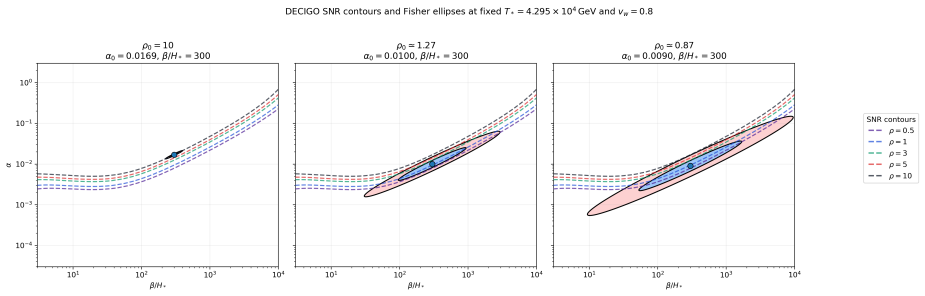
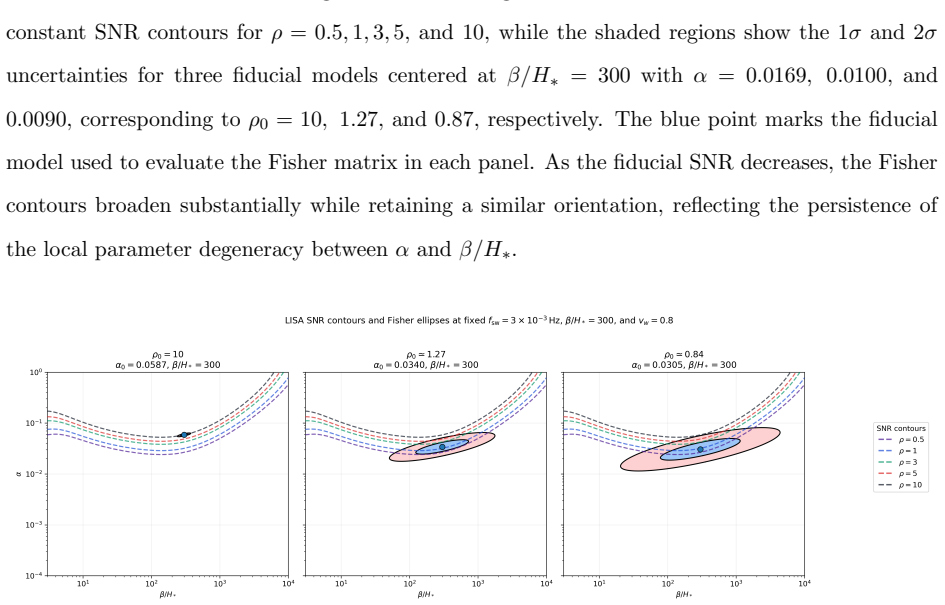
A two-parameter Fisher analysis in {ln alpha, ln(beta/H*)}, with fixed values of T* and v_w, yields marginalized 1 sigma uncertainties sigma(ln alpha) simeq 0.12 and sigma[ln(beta/H*)] simeq 0.145 for DECIGO, with correlation coefficient corr simeq 0.98. For LISA the corresponding values are Delta alpha/alpha simeq +0.044/-0.042 and Delta(beta/H*)/(beta/H*) simeq +0.119/-0.107, with corr simeq 0.78.
What carries the argument
The Fisher information matrix for the two free parameters ln alpha and ln(beta/H*) derived from the frequency-dependent gravitational wave energy density spectrum modeled as sound-wave plus turbulence terms.
If this is right
- DECIGO achieves marginalized uncertainties of approximately 0.12 on ln alpha and 0.145 on ln(beta/H*) with a correlation of 0.98.
- LISA achieves asymmetric uncertainties of about +0.044/-0.042 on alpha/alpha and +0.119/-0.107 on beta/H* over beta/H* with correlation 0.78.
- The strong correlations mean the parameters are not independently constrained by the signal shape.
- These results assume the signal peaks within each detector's sensitivity band and that T* and v_w are known from other inputs.
Where Pith is reading between the lines
- The high correlation between the two parameters indicates the spectrum supplies mostly one independent piece of information about the transition.
- The forecasts leave open how to obtain independent constraints on the fixed parameters T* and v_w from complementary data.
- If the model assumptions hold, the reported precisions set a benchmark for what real detections would imply about early-universe dynamics.
Load-bearing premise
The gravitational wave spectrum is exactly the sum of sound-wave and turbulence contributions parameterized only by alpha, beta/H*, T*, and v_w, and that fixing T* and v_w does not introduce bias or miss important degeneracies when constraining the other two parameters.
What would settle it
An observation of a stochastic gravitational wave background by DECIGO or LISA whose frequency spectrum deviates from the sum of sound-wave and turbulence contributions with only those four parameters.
Figures
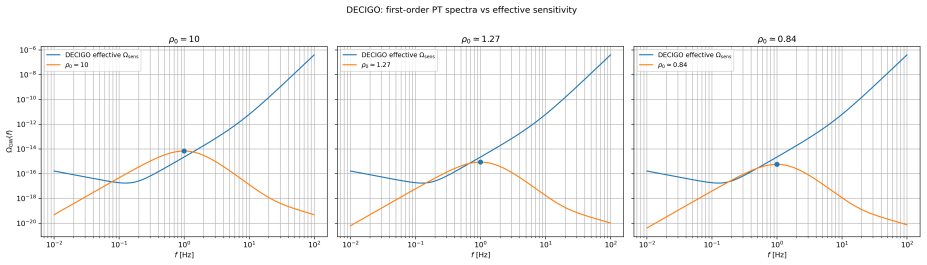
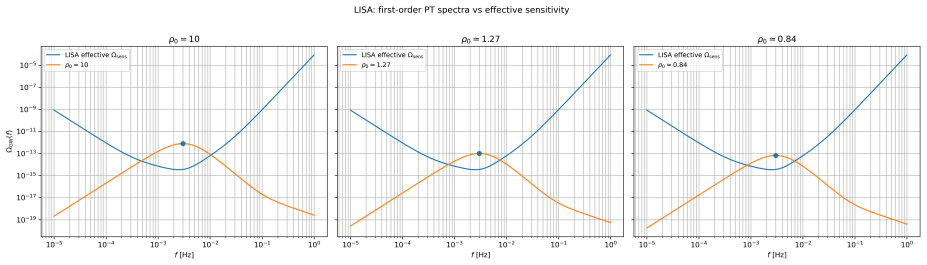
read the original abstract
We present a Fisher-matrix forecast for the detectability of a stochastic gravitational wave background generated by a first-order phase transition in the early universe. We use the DECIGO and LISA missions as reference cases. The source gravitational wave spectrum $\Omega_{\rm GW}(f)$ is modeled as the sum of sound wave and turbulence contributions and is parameterized by the transition strength $\alpha$, its inverse duration $\beta/H_*$, its transition temperature $T_{*}$, and the bubble wall velocity $v_{w}$. For each detector, we construct fiducial models with signal peaking in the sensitivity band of the detector, fixing $T_{*}$ and $v_{w}$, and perform a Fisher analysis on the remaining parameters $\ln\alpha$ and $\ln(\beta/H_{*})$. A two-parameter Fisher analysis in $\{\ln\alpha,\ln(\beta/H_{*})\}$, with fixed values of $T_{*}$ and $v_{w}$, yields marginalized $1\sigma $ uncertainties $\sigma(\ln\alpha)\simeq 0.12$ and $\sigma[\ln(\beta/H_{*})]\simeq 0.145$. The parameters are strongly correlated, with correlation coefficient $\mathrm{corr}\simeq 0.98$. We perform a corresponding analysis for LISA and report marginalized $1\sigma$ uncertainties $\Delta\alpha/\alpha \simeq {}^{+0.044}_{-0.042}$ and $\Delta(\beta/H_{*})/(\beta/H_{*}) \simeq {}^{+0.119}_{-0.107}$, with correlation coefficient $\mathrm{corr}\simeq 0.78$.
Editorial analysis
A structured set of objections, weighed in public.
Referee Report
Summary. The paper presents a Fisher-matrix forecast for the detectability of a stochastic gravitational wave background from a first-order phase transition, using DECIGO and LISA as reference detectors. The GW spectrum is modeled as the sum of sound-wave and turbulence contributions, parameterized by transition strength α, inverse duration β/H*, temperature T*, and wall velocity v_w. With T* and v_w fixed at fiducial values chosen so the signal peaks in each detector's band, a two-parameter Fisher analysis is performed on ln α and ln(β/H*), yielding specific marginalized uncertainties and correlation coefficients for each mission.
Significance. If the spectrum model and Fisher implementation are correct, the quoted constraints would supply concrete, quantitative benchmarks for how well future space-based GW observatories could measure early-universe phase-transition parameters. The calculation is a standard forward forecast with no circularity or self-referential definitions, and the explicit statement that T* and v_w are held fixed makes the scope of the claim transparent.
major comments (1)
- [Results and Methods sections (around the Fisher analysis description)] The abstract reports precise numerical results (e.g., σ(ln α) ≃ 0.12 and σ[ln(β/H*)] ≃ 0.145 with corr ≃ 0.98 for DECIGO; asymmetric Δα/α and Δ(β/H*)/(β/H*) for LISA), yet the manuscript provides neither the explicit functional form of Ω_GW(f) (sound-wave plus turbulence terms), the chosen fiducial values of T* and v_w, the definition of the Fisher matrix elements, nor any validation against mock data. Without these, the quoted uncertainties cannot be reproduced or assessed for accuracy.
minor comments (1)
- [Abstract] Notation for uncertainties is inconsistent between the two detectors (symmetric errors on logarithms for DECIGO versus asymmetric fractional errors for LISA); a brief explanation of why the two presentations are used would improve clarity.
Simulated Author's Rebuttal
We thank the referee for their careful reading of our manuscript and for identifying areas where additional detail is needed to ensure reproducibility of the Fisher forecasts. We address the major comment below and will revise the manuscript accordingly.
read point-by-point responses
-
Referee: [Results and Methods sections (around the Fisher analysis description)] The abstract reports precise numerical results (e.g., σ(ln α) ≃ 0.12 and σ[ln(β/H*)] ≃ 0.145 with corr ≃ 0.98 for DECIGO; asymmetric Δα/α and Δ(β/H*)/(β/H*) for LISA), yet the manuscript provides neither the explicit functional form of Ω_GW(f) (sound-wave plus turbulence terms), the chosen fiducial values of T* and v_w, the definition of the Fisher matrix elements, nor any validation against mock data. Without these, the quoted uncertainties cannot be reproduced or assessed for accuracy.
Authors: We agree with the referee that these elements are required for full reproducibility and assessment of the reported uncertainties. The current manuscript summarizes the modeling approach at a high level in the abstract and main text but does not provide the explicit functional forms of the sound-wave and turbulence contributions to Ω_GW(f), the specific fiducial values of T* and v_w, the mathematical definition of the Fisher matrix elements (including the frequency integral with detector noise curves), or any mock-data validation. In the revised manuscript we will add: (i) the standard analytic expressions for both contributions to Ω_GW(f) with references to the literature from which they are taken; (ii) the numerical fiducial values of T* and v_w chosen so the peak lies in each detector band; (iii) the explicit definition of the two-parameter Fisher matrix and its evaluation; and (iv) a new subsection validating the Fisher results against Monte-Carlo realizations of mock signals. These additions will be placed in the Methods and Results sections. revision: yes
Circularity Check
No significant circularity: standard forward Fisher forecast
full rationale
The paper performs a standard Fisher-matrix forecast for GW detector sensitivities. It adopts an explicit parametric model for the stochastic background (sum of sound-wave and turbulence terms), selects fiducial values for T* and v_w, and computes the expected marginalized uncertainties on ln α and ln(β/H*) from the detector noise curves. This is a forward mapping from assumed signal parameters and instrument response to predicted error ellipses; none of the reported quantities (σ(ln α), correlation coefficients, etc.) are obtained by fitting the same data or by re-expressing the inputs. No self-citation chain, uniqueness theorem, or ansatz smuggling is invoked in the derivation. The calculation is therefore self-contained against external benchmarks (detector sensitivity curves and the standard GW spectrum templates).
Axiom & Free-Parameter Ledger
axioms (2)
- domain assumption The stochastic gravitational wave spectrum is the sum of sound-wave and turbulence contributions parameterized by alpha, beta/H*, T*, and v_w
- domain assumption Fixing T* and v_w does not bias the two-parameter constraints on ln alpha and ln(beta/H*)
Reference graph
Works this paper leans on
-
[1]
specifies the relevant TDI noise spectra which combine withR(f) to determine Σ I(f) and hence Σ Ω(f). In this work we adopt a forecast-level effective strain noise model for LISA as in reference [14], which allows us to preserve the same Fisher matrix workflow used for DECIGO while capturing the dominant frequency dependence of LISA sensitivity. A full mu...
- [2]
-
[3]
Gravitational waves from first-order phase transitions assisted by temperature-enhanced scatterings
Arnab Chaudhuri. Gravitational waves from first-order phase transitions assisted by temperature-enhanced scatterings. Nucl. Phys. B, 1024:117357, 2026
work page 2026
-
[4]
Michele Vallisneri. Use and abuse of the Fisher information matrix in the assessment of gravitational-wave parameter-estimation prospects. Phys. Rev. D, 77:042001, 2008
work page 2008
-
[5]
Measuring cosmological parameters with galaxy surveys
Max Tegmark. Measuring cosmological parameters with galaxy surveys. Phys. Rev. Lett., 79:3806–3809, 1997
work page 1997
-
[6]
David J. Weir. Gravitational waves from a first order electroweak phase transition: a brief review. Phil. Trans. Roy. Soc. Lond. A, 376(2114):20170126, 2018. [Erratum: Phil.Trans.Roy.Soc.Lond.A 381, 20230212 (2023)]. 15
work page 2018
-
[7]
Huber, Kari Rummukainen, and David J
Mark Hindmarsh, Stephan J. Huber, Kari Rummukainen, and David J. Weir. Numerical simulations of acoustically generated gravitational waves at a first order phase transition. Phys. Rev. D, 92(12):123009, 2015
work page 2015
-
[8]
Signatures of the speed of sound on the gravitational wave power spectrum from sound waves
Lorenzo Giombi, Jani Dahl, and Mark Hindmarsh. Signatures of the speed of sound on the gravitational wave power spectrum from sound waves. JCAP, 01:100, 2025
work page 2025
-
[9]
General backreaction force of cosmological bubble expansion
Jun-Chen Wang, Zi-Yan Yuwen, Yu-Shi Hao, and Shao-Jiang Wang. General backreaction force of cosmological bubble expansion. Phys. Rev. D, 110(1):016031, 2024
work page 2024
-
[10]
Gravitational waves from scale-invariant vector dark matter model: Probing below the neutrino-floor
Ahmad Mohamadnejad. Gravitational waves from scale-invariant vector dark matter model: Probing below the neutrino-floor. Eur. Phys. J. C, 80(3):197, 2020
work page 2020
-
[11]
Meyers, Katarina Martinovic, Nelson Christensen, and Mairi Sakellariadou
Patrick M. Meyers, Katarina Martinovic, Nelson Christensen, and Mairi Sakellariadou. De- tecting a stochastic gravitational-wave background in the presence of correlated magnetic noise. Phys. Rev. D, 102(10):102005, 2020
work page 2020
-
[12]
Detector configuration of DECIGO/BBO and identification of cosmological neutron-star binaries
Kent Yagi and Naoki Seto. Detector configuration of DECIGO/BBO and identification of cosmological neutron-star binaries. Phys. Rev. D, 83:044011, 2011. [Erratum: Phys.Rev.D 95, 109901 (2017)]
work page 2011
-
[13]
Bruce Allen and Joseph D. Romano. Detecting a stochastic background of gravitational radiation: Signal processing strategies and sensitivities. Phys. Rev. D, 59:102001, 1999
work page 1999
-
[14]
Lee Samuel Finn, Shane L. Larson, and Joseph D. Romano. Detecting a Stochastic Gravitational-Wave Background: The Overlap Reduction Function. Phys. Rev. D, 79:062003, 2009
work page 2009
-
[15]
Travis Robson, Neil J. Cornish, and Chang Liu. The construction and use of LISA sensitivity curves. Class. Quant. Grav., 36(10):105011, 2019
work page 2019
-
[16]
Tristan L. Smith, Tristan L. Smith, Robert R. Caldwell, and Robert Caldwell. LISA for Cosmologists: Calculating the Signal-to-Noise Ratio for Stochastic and Deterministic Sources. Phys. Rev. D, 100(10):104055, 2019. [Erratum: Phys.Rev.D 105, 029902 (2022)]
work page 2019
-
[17]
Probing Trans-electroweak First Order Phase Transitions from Gravitational Waves
Andrea Addazi, Antonino Marcian` o, and Roman Pasechnik. Probing Trans-electroweak First Order Phase Transitions from Gravitational Waves. MDPI Physics, 1(1):92–102, 2019
work page 2019
-
[18]
LISA/DECIGO Fisher Analysis Source Code, 2026
Diego Rios and William Kinney. LISA/DECIGO Fisher Analysis Source Code, 2026. Python notebooks archived on Zenodo. DOI: 10.5281/zenodo.20013135. 16
discussion (0)
Sign in with ORCID, Apple, or X to comment. Anyone can read and Pith papers without signing in.